
PET-260 · Lesson 3 of 12 · 19 min
Multicomponent phase envelopes and reservoir fluid types
Prairie Crest has interests in more than oil. Across the Williston Basin, its acreage includes Bakken oil, deeper and more mature oil with high gas-oil ratios, and gas-condensate and dry-gas prospects. Nadia Petrov, who builds the reservoir models, asks Ethan to sort five wells by fluid type before she sets up their simulations. 'Get this wrong,' she warns, 'and we model a gas condensate as a dry gas and miss half the value, or call a volatile oil a black oil and overpredict recovery.' The tool for the job is the multicomponent phase envelope and a set of field rules of thumb that tell, from production data, which kind of fluid a well has found.
The multicomponent phase envelope
A reservoir fluid with many components has a pressure-temperature phase envelope that looks much like the binary envelopes of lesson 2. Outside the envelope the fluid is a single phase. Above the bubble point curve, on the left, it is a liquid; to the right of the dew point curve, it is a gas. The two curves meet at the critical point. Inside the envelope, quality lines show the volume percent of liquid at each pressure and temperature: 100 percent along the bubble point curve, 0 percent along the dew point curve, and intermediate values in between, converging at the critical point.
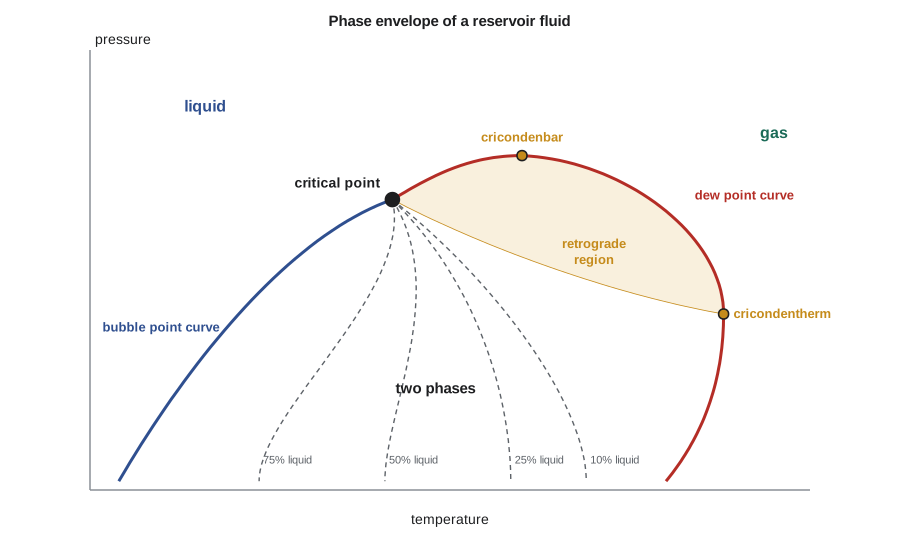
The shape and position of the envelope depend on composition. Fluids rich in heavy components have envelopes that extend to high temperatures, with critical points far to the right; light gases have small envelopes at low temperatures. The single most useful idea in reservoir fluid classification is to compare the reservoir temperature with the critical temperature and the cricondentherm of the fluid. Where the reservoir temperature falls on the envelope decides what happens as pressure declines during production.
Following pressure decline in the reservoir
In the reservoir, temperature stays nearly constant while pressure falls with production, so the reservoir path is a vertical line downward on the diagram. The surface path is different: fluid flows up the wellbore and through the separators, cooling and losing pressure together, ending at the separator and stock-tank conditions in the lower left. Both paths matter. The reservoir path tells what happens underground; the surface path tells how much liquid and gas are sold.
If the reservoir temperature is to the left of the critical point, the reservoir fluid is an oil. As pressure falls it first reaches the bubble point, after which gas comes out of solution in the reservoir. If the reservoir temperature lies between the critical point and the cricondentherm, the fluid is a gas at initial conditions, but as pressure falls it crosses the dew point curve and liquid condenses in the reservoir. That is retrograde condensation: liquid forms on depressurization, the opposite of ordinary behavior, which is why the fluid is called a retrograde gas or gas condensate. If the reservoir temperature is beyond the cricondentherm, the fluid stays a gas in the reservoir all the way to abandonment; whether liquid appears at the surface depends on whether the separator conditions lie inside the envelope.
The five reservoir fluid types
Petroleum engineers commonly recognize five reservoir fluid types, a scheme popularized by William McCain: black oil, volatile oil, gas condensate (retrograde gas), wet gas and dry gas. The boundaries are not sharp, because compositions vary continuously, but the classification is useful because each type needs a different kind of fluid model, laboratory study and depletion strategy.
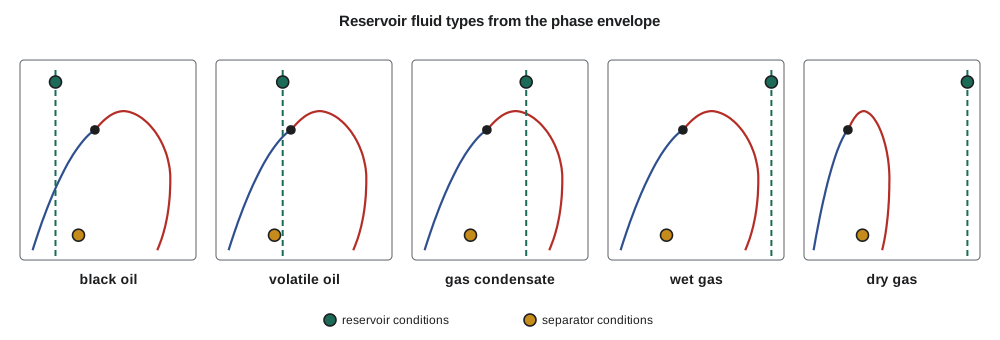
Black oils have reservoir temperatures well below the critical temperature. They contain many heavy molecules: typically more than 20 mole percent C7+ in the reservoir fluid. Initial producing gas-oil ratios are below about 1,750 scf/STB (about 310 m³/m³), stock-tank gravities are usually below about 45 API, and the stock-tank oil is dark. Formation volume factors are below about 2.0. Quality lines inside the envelope are widely spaced near the bubble point, so the oil releases gas gradually as pressure falls. Most Bakken oil is a black oil by these rules.
Volatile oils have reservoir temperatures closer to the critical temperature, with fewer heavy molecules, roughly 12.5 to 20 mole percent C7+. Initial gas-oil ratios run from about 1,750 to 3,200 scf/STB (310 to 570 m³/m³), stock-tank gravities are usually above 40 API, and formation volume factors above 2.0. Quality lines bunch up just below the bubble point, so a small pressure drop releases a large amount of gas. A volatile oil can shrink by half when it reaches the stock tank, and much of the stock-tank liquid comes out of the produced gas rather than the reservoir liquid. Black-oil models handle volatile oils poorly; compositional models are usually needed.
Gas condensates have reservoir temperatures between the critical point and the cricondentherm. Initial gas-oil ratios are above about 3,200 scf/STB and can exceed 15,000 scf/STB for lean condensates; the C7+ content is below about 12.5 mole percent. The stock-tank liquid is light, often 45 to 60 API, and pale or straw-colored. Below the dew point, liquid drops out in the reservoir, most of it never to be produced, and the produced gas becomes leaner as its heavy components are left behind. Near the wellbore, condensate banking can choke well productivity, a key concern in tight condensate reservoirs.
Wet gases have reservoir temperatures above the cricondentherm, so no liquid forms in the reservoir, but the separator conditions fall inside the envelope and liquid condenses at the surface. Gas-oil ratios are very high, typically above 15,000 scf/STB, with light, water-white condensate. Dry gases are almost pure methane with some ethane; the separator lies outside the envelope and no hydrocarbon liquid forms anywhere in the production system. In everyday speech, 'dry' and 'wet' sometimes refer to whether natural gas liquids can be extracted economically in a gas plant; in phase behavior the terms have the precise meaning given here.
| Fluid type | Initial GOR, scf/STB | Initial GOR, m³/m³ | C7+ in reservoir fluid, mole % | Stock-tank liquid |
|---|---|---|---|---|
| Black oil | below about 1,750 | below about 310 | above about 20 | dark, usually below 45 API |
| Volatile oil | about 1,750 to 3,200 | about 310 to 570 | about 12.5 to 20 | brown to orange, above 40 API |
| Gas condensate | above about 3,200 | above about 570 | below about 12.5 | light, often 45 to 60 API |
| Wet gas | above about 15,000 | above about 2,700 | very small | water-white condensate |
| Dry gas | no liquid | no liquid | essentially none | none |
# Classify reservoir fluids with McCain-style rules of thumb (approximate boundaries)
SI = False
wells = [  # name, initial producing GOR (scf/STB), stock-tank API gravity, C7+ mole % in reservoir fluid
    ('A-04 oil well', 650, 38.0, 34.5),
    ('B-11 oil well', 2400, 45.0, 17.0),
    ('C-07 gas well', 9000, 52.0, 6.0),
    ('D-02 gas well', 40000, 58.0, 1.2),
    ('E-09 gas well', 250000, 0.0, 0.1),
]

def classify(gor, api, c7):
    if gor < 1750 and c7 > 20: return 'black oil'
    if gor < 3200 and c7 > 12.5: return 'volatile oil'
    if gor < 15000 and c7 >= 4: return 'gas condensate (retrograde gas)'
    if gor < 100000: return 'wet gas'
    return 'dry gas'

for name, gor, api, c7 in wells:
    kind = classify(gor, api, c7)
    g = f"{gor:>7,} scf/STB" + (f" ({gor * 0.178:>7,.0f} m3/m3)" if SI else "")
    a = f"{api:4.0f} API" if api else "no liquid"
print(f"{name:14} {g} {a:>9} C7+ {c7:4.1f}% -> {kind}")A-04 oil well 650 scf/STB 38 API C7+ 34.5% -> black oil B-11 oil well 2,400 scf/STB 45 API C7+ 17.0% -> volatile oil C-07 gas well 9,000 scf/STB 52 API C7+ 6.0% -> gas condensate (retrograde gas) D-02 gas well 40,000 scf/STB 58 API C7+ 1.2% -> wet gas E-09 gas well 250,000 scf/STB no liquid C7+ 0.1% -> dry gas
The program applies the rule-of-thumb boundaries in order. The first well is clearly a black oil and the last a dry gas. The second, with a gas-oil ratio of 2,400 scf/STB and 17 percent C7+, is a volatile oil, and Nadia will need a compositional model for it. The third is a gas condensate, and the fourth a wet gas. Real wells sometimes sit near a boundary; then the only reliable answer is a laboratory test showing whether the reservoir fluid has a bubble point or a dew point at reservoir temperature.
Production signatures over time
Field data over time add another check. A black oil's producing gas-oil ratio stays roughly constant until reservoir pressure falls below the bubble point, then rises as free gas becomes mobile, and finally falls late in life as the gas is depleted. Stock-tank gravity changes little. A volatile oil shows a much faster rise in gas-oil ratio below the bubble point. A gas condensate's producing gas-oil ratio rises once pressure falls below the dew point, because liquid stays behind in the reservoir, and the stock-tank liquid gravity increases as the produced stream leans out. A wet gas or dry gas keeps a nearly constant gas-oil ratio throughout its life, because nothing changes phase in the reservoir.
Worked problem
Reading the reservoir path
A deep gas well has a reservoir temperature of 220 °F. The laboratory reports a critical temperature of 140 °F and a cricondentherm of 285 °F for the reservoir fluid, with a dew point pressure of 5,000 psia. Initial reservoir pressure is 5,500 psia. Classify the fluid and describe what will happen as pressure is drawn down.
Show solution
- Reservoir temperature (220 °F) is above the critical temperature (140 °F) and below the cricondentherm (285 °F): the fluid is a gas condensate.
- At 5,500 psia, above the dew point, the reservoir contains single-phase gas.
- When pressure falls below 5,000 psia, liquid condenses in the reservoir and the produced gas becomes leaner.
- Most condensed liquid is immobile and lost unless pressure is maintained, for example by cycling dry gas back into the reservoir.
Answer: Where the reservoir temperature sits between the critical point and the cricondentherm is the whole story: it predicts retrograde condensation before a single well is produced.
Undersaturated and saturated reservoirs
An oil reservoir whose initial pressure is above the bubble point is undersaturated: the oil could dissolve more gas. Early production comes from expansion of the oil, water and rock until pressure falls to the bubble point. An oil reservoir at its bubble point at discovery is saturated, and often has a gas cap above the oil leg. The gas in the cap is in equilibrium with the oil at the gas-oil contact, so the oil's bubble point equals the reservoir pressure at the contact, and the gas cap fluid is at its dew point. Gas caps over oil and oil rims under gas are common, and the two fluids must be described consistently in a fluid model.
Composition grading with depth, mentioned in lesson 1, can make the transition between oil and gas gradual. In some thick, hot reservoirs, the fluid changes from a gas condensate at the top to a volatile oil at the base with no visible contact, passing through a critical composition at some depth. Recognizing such systems early, from samples at several depths and from pressure gradients, avoids serious errors in volumes in place.
Common mistakes
MistakeClassifying a fluid from gas-oil ratio alone.
InsteadUse GOR, C7+ content, stock-tank gravity and, best, a laboratory bubble point or dew point at reservoir temperature.
MistakeAssuming liquid only forms at the surface in a gas reservoir.
InsteadBetween the critical point and the cricondentherm, liquid condenses in the reservoir as pressure falls.
MistakeModeling a volatile oil with black-oil correlations.
InsteadVolatile oils release large amounts of gas just below the bubble point and usually need compositional models.
MistakeTreating 'wet gas' in the phase behavior sense as the same as 'rich gas' in gas processing.
InsteadIn phase behavior, wet gas means no reservoir liquid but liquid at the separator.
Summary and key terms
- Multicomponent envelopes have bubble point and dew point curves meeting at a critical point, with quality lines inside.
- The reservoir temperature relative to the critical point and cricondentherm defines oils, retrograde gases and single-phase gases.
- Five fluid types are recognized: black oil, volatile oil, gas condensate, wet gas and dry gas.
- Field rules of thumb use initial GOR, C7+ content and stock-tank gravity; laboratory tests confirm the type.
- Undersaturated oils are above the bubble point; saturated oils are at it and may have a gas cap.
- Phase envelope
- The closed boundary of the two-phase region on a pressure-temperature diagram.
- Quality line
- A line inside the envelope joining points with the same liquid volume percent.
- Retrograde condensation
- Formation of liquid as pressure falls at constant temperature between the critical point and the cricondentherm.
- Black oil
- An oil whose reservoir temperature is well below its critical temperature, with modest gas content.
- Volatile oil
- An oil whose reservoir temperature is close to its critical temperature, releasing much gas just below the bubble point.
- Gas condensate
- A gas at reservoir conditions that condenses liquid in the reservoir below its dew point.
- Undersaturated
- An oil above its bubble point pressure.
Practice problems
Work each problem on paper first, then reveal the answer to check.
A reservoir fluid has a bubble point of 3,100 psia at reservoir temperature and initial pressure of 3,900 psia. Is it an oil or a gas, and is the reservoir saturated?
Show answer
A bubble point means an oil; initial pressure above it means undersaturated.
Why does a gas condensate's producing GOR increase below the dew point?
Show answer
Heavy components condense and stay in the reservoir, so the produced stream is leaner in liquid.
A well tests at 22,000 scf/STB with 55 API water-white liquid that has not changed with time. What fluid type is likely?
Show answer
Wet gas.
Give two reasons why classifying the fluid correctly matters for development planning.
Show answer
It decides the fluid model (black oil or compositional), the laboratory study and the depletion strategy, such as pressure maintenance for condensates.
Lesson quiz · 5 questions
Score 60% or more to complete this lesson.
Create a free account to save your progress, take quizzes and earn a certificate.