
PET-260 · Lesson 1 of 12 · 19 min
Hydrocarbon chemistry for reservoir engineers
Three weeks after the core study closed, Lena Haugen drops a thick PVT report on Ethan Cardinal's desk. It comes from a commercial core laboratory in Denver, and it describes the oil from the Haugen 14-6H well in the Tamarack Lake field. 'The rock tells us where the oil is,' she says. 'This tells us what the oil is, and what it will do when we take the pressure off it. Every reserves number, every simulation and every facility design at Prairie Crest starts here.' Ethan flips to the first table: a list of components from nitrogen to something called C7+, with mole fractions and molar masses. Before he can read the rest of the report, he needs to understand that table.
This course is about phase behavior: how reservoir fluids split into oil and gas as pressure and temperature change between the reservoir and the stock tank. PET-250 Rock & Fluid Properties introduced formation volume factors, solution gas and gas compressibility as numbers to plug into calculations. Here we look underneath those numbers, starting with the molecules themselves. A reservoir engineer does not need to be an organic chemist, but a working knowledge of hydrocarbon families, carbon numbers and molar mass is essential for reading PVT reports and building fluid models.
What petroleum is made of
Crude oil and natural gas are mixtures of thousands of compounds, almost all of them hydrocarbons: molecules made of carbon and hydrogen. Smaller amounts of non-hydrocarbons are also present: nitrogen, carbon dioxide and hydrogen sulfide in the gas, and compounds containing sulfur, nitrogen, oxygen and metals such as nickel and vanadium in the heavier oil. These minor components matter far beyond their amounts. Hydrogen sulfide is lethal at low concentrations and corrodes steel; carbon dioxide forms carbonic acid with water; nitrogen dilutes the heating value of sales gas; and the heavy polar compounds control wettability, emulsions and the deposition of asphaltenes.
Hydrocarbons are grouped into families according to how their carbon atoms are bonded. Each family behaves differently in the reservoir and in the refinery, and each has a characteristic range of densities and boiling points.
Paraffins, naphthenes and aromatics
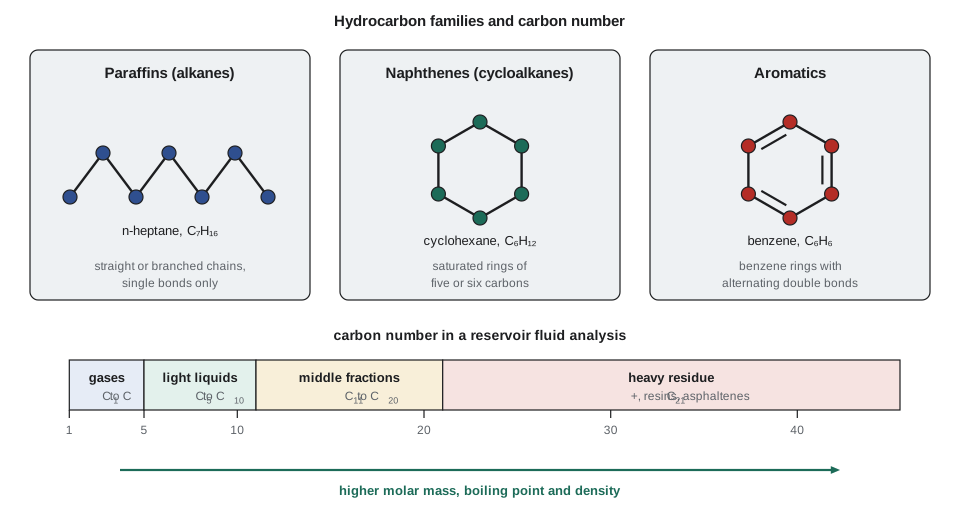
Paraffins, also called alkanes, have carbon atoms joined by single bonds in chains, with the general formula CnH2n+2. Methane (CH4), ethane (C2H6), propane (C3H8) and the butanes (C4H10) are gases at surface conditions. Pentanes through about C16 are liquids, and longer chains are waxy solids. Paraffins can be straight chains, called normal paraffins and written nC4, nC5 and so on, or branched, called isoparaffins and written iC4, iC5. Isomers have the same formula but different structures and slightly different properties: isobutane boils at about −12 °C and normal butane at about −0.5 °C. Long normal paraffins crystallize as wax when oil cools, a problem in pipelines and in wellbores where flowing temperature falls below the wax appearance temperature.
Naphthenes, also called cycloalkanes, have carbon atoms joined in rings, typically of five or six carbons, with the formula CnH2n for a single ring. Cyclohexane and methylcyclopentane are examples. Naphthenes are denser than paraffins with the same number of carbons and are abundant in many crude oils.
Aromatics contain one or more benzene rings, in which six carbon atoms share electrons in a ring with alternating bond character. Benzene, toluene and xylenes are the simplest. Aromatics are the densest of the three families for a given carbon number. Benzene is a known human carcinogen, which is why exposure limits apply in oil field facilities and why the benzene content of produced water and gas streams is monitored.
The heaviest part of crude oil contains resins and asphaltenes: large, polar, multi-ring molecules containing heteroatoms. Asphaltenes are defined by solubility rather than structure: they are the fraction that precipitates when the oil is mixed with an excess of a light paraffin such as n-heptane. In the reservoir they stay in solution, held by resins, but a drop in pressure or the injection of light gas can make them precipitate and plug wellbores and pore throats.
Carbon numbers and single carbon number fractions
A laboratory cannot identify every one of the thousands of molecules in an oil. Instead, gas chromatography separates the light components individually, from nitrogen through the hexanes, and groups the heavier part into single carbon number fractions: C7, C8, C9 and so on. Each fraction contains all the molecules that boil between the boiling points of adjacent normal paraffins. C7, for instance, contains n-heptane plus the many isomers, naphthenes and aromatics that boil in the same range. Beyond some carbon number, often C10, C20 or C36 depending on the analysis, everything heavier is reported as a single plus fraction, such as C7+ or C20+, with a measured molar mass and specific gravity.
The plus fraction is the most uncertain part of a fluid description, yet it often makes up most of the mass of an oil. Lesson 12 shows how engineers split it into pseudo-components for equation-of-state models. For now, the key point is that its molar mass and density are measured, not calculated, and small errors in them change predicted bubble points, densities and formation volume factors.
Moles, molar mass and mixtures
Phase behavior calculations work in moles, not in mass or volume, because the laws that describe gases and equilibrium count molecules. A mole of any substance contains the same number of molecules, and its mass in grams equals the molar mass: 16.04 g for methane, 44.10 g for propane. In field units, a pound-mole has a mass in pounds equal to the molar mass. A PVT report lists the composition as mole fractions, zi, which sum to one.
The apparent molar mass of a mixture is the mole-fraction-weighted average of the component molar masses. For a gas it gives the specific gravity relative to air, whose molar mass is 28.97. Converting mole fractions to mass fractions shows how misleading mole fractions can be: in a typical oil, methane is a third of the moles but only a few percent of the mass, while the C7+ fraction is a third of the moles and three-quarters of the mass.
# Molar mass, gas gravity and mass fractions of a separator gas and a reservoir oil
SI = False                                     # True prints SI units alongside field units
M = {'N2': 28.01, 'CO2': 44.01, 'C1': 16.04, 'C2': 30.07, 'C3': 44.10,
     'iC4': 58.12, 'nC4': 58.12, 'iC5': 72.15, 'nC5': 72.15, 'C6': 86.18}

gas = {'N2': 0.012, 'CO2': 0.018, 'C1': 0.712, 'C2': 0.142, 'C3': 0.071,
       'iC4': 0.011, 'nC4': 0.019, 'iC5': 0.005, 'nC5': 0.005, 'C6': 0.005}
Mg = sum(z * M[c] for c, z in gas.items())
print(f"separator gas: mole fractions sum to {sum(gas.values()):.3f}")
print(f"  apparent molar mass {Mg:.2f} g/mol, gas specific gravity {Mg / 28.97:.3f}")

# reservoir oil: same light components plus a C7+ fraction with its own molar mass
oil = {'N2': 0.002, 'CO2': 0.008, 'C1': 0.362, 'C2': 0.098, 'C3': 0.071,
       'iC4': 0.014, 'nC4': 0.035, 'iC5': 0.016, 'nC5': 0.019, 'C6': 0.030, 'C7+': 0.345}
M['C7+'] = 205.0
Mo = sum(z * M[c] for c, z in oil.items())
print(f"reservoir oil: apparent molar mass {Mo:.1f} g/mol")
print("component  mole %   mass %")
for c, z in oil.items():
    print(f"{c:>6} {100 * z:8.1f} {100 * z * M[c] / Mo:8.1f}")
light = oil['N2'] + oil['CO2'] + oil['C1'] + oil['C2']
print(f"C1 + C2 + N2 + CO2: {100 * light:.1f} mole % but {100 * sum(oil[c] * M[c] for c in ('N2', 'CO2', 'C1', 'C2')) / Mo:.1f} mass %")
if SI:
    print(f"gas density at standard conditions (15 C, 101.325 kPa): {101.325 * Mg / (8.314 * 288.15):.3f} kg/m3")
else:
print(f"gas density at standard conditions (60 F, 14.696 psia): {14.696 * Mg / (10.7316 * 519.67):.4f} lb/ft3")separator gas: mole fractions sum to 1.000
apparent molar mass 22.85 g/mol, gas specific gravity 0.789
reservoir oil: apparent molar mass 91.0 g/mol
component mole % mass %
N2 0.2 0.1
CO2 0.8 0.4
C1 36.2 6.4
C2 9.8 3.2
C3 7.1 3.4
iC4 1.4 0.9
nC4 3.5 2.2
iC5 1.6 1.3
nC5 1.9 1.5
C6 3.0 2.8
C7+ 34.5 77.7
C1 + C2 + N2 + CO2: 47.0 mole % but 10.1 mass %
gas density at standard conditions (60 F, 14.696 psia): 0.0602 lb/ft3The separator gas has a specific gravity of about 0.79, typical of gas released from a light oil: richer in ethane and propane than pipeline gas. The reservoir oil has an apparent molar mass of about 91 g/mol, because the many light molecules dissolved in it pull the average down. Look at the last line: nitrogen, carbon dioxide, methane and ethane are nearly half the moles but only a tenth of the mass. When the oil reaches the stock tank, those light components have left as gas, and the remaining dead oil has a molar mass of about 200 g/mol.
Standard conditions and units
Gas volumes only make sense at a stated pressure and temperature. US practice, followed by the Industrial Commission and most operators, uses standard conditions of 60 °F and 14.696 psia, and volumes are reported in standard cubic feet. At these conditions an ideal gas occupies 379.5 standard cubic feet per pound-mole, a number worth memorizing because it converts gas volumes to moles in almost every calculation in this course. Oil volumes are reported in stock-tank barrels at 60 °F, and gas-oil ratios in standard cubic feet per stock-tank barrel.
Worked problem
Moles of gas in a day of production
A Bakken well produces 400 STB/d of oil with a producing gas-oil ratio of 790 scf/STB. The separator gas has a molar mass of 22.85 lb/lbmol. How many pound-moles and how many pounds of gas does the well produce per day?
Show solution
- Gas volume = 400 × 790 = 316,000 scf/d.
- Moles = 316,000/379.5 = 833 lbmol/d.
- Mass = 833 × 22.85 = 19,000 lb/d, about 9.5 tons a day.
Answer: Moles connect volumes to masses. Mass balance on a facility, flaring calculations and the composition of sales gas all start from this conversion.
Why composition controls phase behavior
Every property in this course depends on composition. A fluid rich in methane stays mostly gas at surface conditions; a fluid rich in heavy components stays mostly liquid. In between, a reservoir fluid's tendency to release gas, shrink, condense liquid or deposit wax depends on the balance of light, intermediate and heavy molecules. Intermediate components, ethane through hexane, are especially important: they make gas condensates rich in liquid and they make injected gas miscible with oil, the subject of lesson 12. Engineers often group components as light (N2, C1), intermediate (CO2, C2 to C6) and heavy (C7+) when plotting compositions on triangular diagrams.
Composition also varies across a field and with depth. In thick reservoirs, gravity concentrates heavier components lower down, so the bubble point and gas-oil ratio can change with depth. Different pools in the same basin, such as Bakken pools of different thermal maturity, can contain quite different oils. A single sample rarely describes a whole field, which is why lesson 7 stresses sampling plans as much as sampling methods.
Non-hydrocarbon components in practice
Nitrogen, carbon dioxide and hydrogen sulfide need special attention. Hydrogen sulfide is present in some Williston Basin oils, and operators must design for it with sour service materials, monitoring and emergency planning. Ethan is told to check every new analysis for H2S, because injected water can feed sulfate-reducing bacteria that sour a reservoir over time. Carbon dioxide content matters for corrosion and for the heating value of sales gas, and nitrogen can reach several percent in some gases, lowering their value.
Because these gases have critical properties quite different from hydrocarbons, they also shift phase behavior. Carbon dioxide dissolves readily in oil and swells it, which is why it is used for enhanced recovery. Nitrogen is much less soluble and raises the bubble point of an oil sharply even in small amounts. Hydrogen sulfide behaves somewhat like propane in its solubility. Correlations developed for sweet hydrocarbon gases need corrections when these gases exceed a few percent, as lesson 4 shows.
Common mistakes
MistakeAveraging molar masses by mass fraction.
InsteadApparent molar mass is the mole-fraction-weighted average: Ma = Σ zi Mi.
MistakeAssuming the plus fraction is a single compound with known properties.
InsteadThe plus fraction is a mixture; its molar mass and density must be measured and are the most uncertain data in the report.
MistakeMixing standard conditions from different systems.
InsteadState the standard conditions; use 23.64 m³/kmol at 15 °C and 101.325 kPa, or 379.5 scf/lbmol at 60 °F and 14.696 psia.
MistakeIgnoring minor non-hydrocarbons.
InsteadH2S, CO2 and N2 change safety, corrosion, sales gas value and phase behavior even at a few percent.
Summary and key terms
- Reservoir fluids are mixtures of paraffins, naphthenes, aromatics, resins and asphaltenes, plus N2, CO2 and H2S.
- Laboratories identify light components individually and lump heavier ones into single carbon number fractions and a plus fraction.
- Phase behavior works in moles; apparent molar mass is the mole-weighted average of component molar masses.
- Gas specific gravity is apparent molar mass divided by 28.97.
- Standard conditions define gas volumes; one mole of ideal gas occupies 23.64 m³/kmol or 379.5 scf/lbmol at the respective standards.
- Paraffin
- A saturated chain hydrocarbon, CnH2n+2; methane through the waxes.
- Naphthene
- A saturated ring hydrocarbon, also called a cycloalkane.
- Aromatic
- A hydrocarbon containing one or more benzene rings.
- Asphaltene
- The heavy, polar oil fraction insoluble in excess light paraffin.
- Plus fraction
- All components heavier than a stated carbon number, reported as one lump with measured molar mass and density.
- Apparent molar mass
- The mole-fraction-weighted average molar mass of a mixture.
- Gas specific gravity
- The ratio of a gas molar mass to that of air, 28.97.
Practice problems
Work each problem on paper first, then reveal the answer to check.
A gas is 90% methane and 10% ethane by moles. Find its apparent molar mass and specific gravity.
Show answer
Ma = 0.9 × 16.04 + 0.1 × 30.07 = 17.44; γg = 17.44/28.97 = 0.602.
Why can isobutane and normal butane be reported separately but C9 isomers are lumped?
Show answer
Light isomers are few and separate cleanly by chromatography; heavier fractions contain many isomers with overlapping boiling points.
An oil is 40 mole % methane and 60 mole % of a fraction with M = 180. What is the mass fraction of methane?
Show answer
Mass: 0.4 × 16.04 = 6.42; 0.6 × 180 = 108; methane = 6.42/114.4 = 5.6%.
Give two reasons H2S content must be known before a well is produced.
Show answer
Toxicity and safety planning; corrosion and material selection (also sales gas specifications).
Lesson quiz · 5 questions
Score 60% or more to complete this lesson.
Create a free account to save your progress, take quizzes and earn a certificate.