
NUC-499 · Lesson 7 of 12 · 24 min
Shielding and radiation protection
Sofia's second task is to show that people on campus, and the staff who operate Kestrel-10, will receive radiation doses far below the limits and as low as reasonably achievable. She has four weeks and a clear set of targets from the requirements: 0.5 µSv per hour in any area the public can enter, 10 µSv per hour in routinely occupied controlled areas, a public dose from normal operation below 0.05 mSv per year at the campus boundary, and an emergency planning zone that stays within the campus. Kofi gives her the core source terms; Mira gives her the flows and transit times in the pool.
This lesson identifies the radiation sources in a pool-type reactor, reviews the dose quantities and limits used in design, applies the point-kernel method with buildup to size the water and concrete shields, examines nitrogen-16 and other activation products in the pool water, and sets out the radiation protection program: zoning, monitoring, effluents, occupational dose planning and the basis for a small emergency planning zone.
Radiation sources in a pool reactor
During operation, the core is an intense source of neutrons and gamma rays. Each fission releases about 2.5 neutrons and about 7 MeV of prompt gamma rays, and the fission products already in the fuel emit a similar amount of delayed gamma energy. At 10 MWt, the core produces about 3 × 10¹⁷ fissions per second. Most of the neutrons are absorbed or moderated within the core and the water close to it, but neutron capture in water, structures and concrete produces further gamma rays, some of high energy.
The pool water itself becomes a source. Fast neutrons react with oxygen-16 in the water to produce nitrogen-16, which decays with a half-life of 7.1 s and emits gamma rays of 6.1 and 7.1 MeV, energetic enough to penetrate several meters of water. Argon-40 dissolved in the water and in the air above the pool captures neutrons to form argon-41, with a half-life of 1.8 hours, which is released to the ventilation system. Deuterium in ordinary water produces small amounts of tritium. Corrosion products from the stainless steel liner and cladding, such as cobalt-60 and manganese-54, become activated in the core and are carried around the pool and purification system, where they build up in filters and ion exchange resins.
After shutdown, the core continues to emit gamma rays from fission product decay, which governs the shielding of fuel during refueling and storage. Spent fuel assemblies will be stored under water in a rack at the side of the pool for several years before transfer to dry storage, and the water above them must be deep enough to shield workers at the pool edge.
Dose quantities and design targets
Radiation protection uses the effective dose, in sieverts, which weights the absorbed dose in each organ by the type of radiation and the sensitivity of the organ, to express the risk to a person. For design and monitoring, the related operational quantity ambient dose equivalent is used, because it can be measured with instruments. Shielding calculations convert a particle fluence rate at a point into a dose rate using fluence-to-dose conversion coefficients, which depend strongly on particle type and energy: for 2 MeV photons, about 9 picosieverts for each photon per square centimeter, and for fast neutrons near 1 MeV, about forty times more.
The regulatory limits are the ceiling, not the target. Good design keeps doses as low as reasonably achievable, which in practice means setting design targets for each area according to its use and occupancy. The team's targets put public areas at 0.5 µSv per hour, which would give less than 1 mSv in a full working year of continuous presence, and controlled areas such as the reactor hall at 10 µSv per hour, with higher dose rates allowed only in areas that are entered rarely and under work control, such as the purification system room.
The point-kernel method
The point-kernel method estimates the dose from a gamma source by treating it as a point, or as a sum of points, and attenuating the uncollided photons exponentially through each shield layer. Scattered photons that still reach the detector are accounted for by a buildup factor B, which increases with the number of mean free paths of shielding:
where S is the source strength in photons per second, μ the linear attenuation coefficient, x the shield thickness and r the distance from source to detector. For several layers, the exponent becomes the sum of μx over the layers. Buildup factors are tabulated for each material and energy; for a quick estimate in water-like materials near 2 MeV, a linear approximation B = 1 + μx is often used, and it is reasonably accurate up to about ten mean free paths and conservative in some ranges but not all. For a concept study, the method is adequate if its assumptions are stated and the results are compared with a more detailed calculation later.
Sofia represents the core by an equivalent point source of 2 MeV photons, with a self-shielding factor of 0.1 for the fraction of gamma energy that escapes the core. Fast neutrons through the side wall are estimated with removal cross-sections, which describe the attenuation of fast neutrons in hydrogenous shields: about 0.10 per centimeter for water and 0.09 per centimeter for ordinary concrete. Both are screening methods, chosen because they can be checked by hand.
# Shielding for Kestrel-10: point-kernel gamma dose through water and concrete with linear buildup,
# fast-neutron removal through the side wall, and N-16 decay in the chimney flow. Illustrative screening model.
import math
P = 10.0e6
fissions = P / (200 * 1.602e-13)          # fissions per second
S_g = fissions * 7.0 / 2.0 * 0.1          # 2 MeV photon equivalents escaping the core (7 MeV of gammas per fission, 10 % escape)
G_CONV = 9.4e-6 * 3600                    # uSv/h per photon/(cm^2 s), 2 MeV ambient dose equivalent
N_CONV = 4.2e-4 * 3600                    # uSv/h per neutron/(cm^2 s), about 1 MeV
def gamma_dose(layers, r_cm):
    mux = sum(mu * t for mu, t in layers)  # layers: [(attenuation coefficient per cm, thickness cm)]
    return S_g * (1 + mux) * math.exp(-mux) / (4 * math.pi * r_cm ** 2) * G_CONV   # linear buildup 1 + mu x
def neutron_dose(layers, r_cm):
    sx = sum(s * t for s, t in layers)     # removal cross-sections per cm
    return fissions * 2.5 * 0.2 * math.exp(-sx) / (4 * math.pi * r_cm ** 2) * N_CONV
mu_w, mu_c, sr_w, sr_c = 0.0485, 0.106, 0.103, 0.089
print(f"fission rate {fissions:.2e} /s; escaping photon source {S_g:.2e} /s (2 MeV equivalent)")
print("core gamma dose at the pool surface, by depth of water above the top of the core:")
for d in (300, 450, 600, 900):
    print(f"  {d / 100:4.1f} m of water: {gamma_dose([(mu_w, d)], d + 60):10.3g} uSv/h")
print("outside the pool side wall (2.4 m of water from the core edge, then concrete):")
for t_c in (60, 90, 120, 150):
    r = 60 + 240 + t_c
    g = gamma_dose([(mu_w, 240), (mu_c, t_c)], r)
    n = neutron_dose([(sr_w, 240), (sr_c, t_c)], r)
    print(f"  concrete {t_c:3d} cm: gamma {g:9.3g} uSv/h, fast neutrons {n:9.3g} uSv/h, total {g + n:9.3g} uSv/h")
# N-16 (half-life 7.13 s) is made from oxygen in the core water and rises with the chimney flow (0.27 m/s in the core)
for label, t in (("leaving the core", 1), ("top of the 6 m chimney", 25), ("pool surface without a hot layer", 45), ("after a 60 s delay tank", 85)):
print(f"N-16 remaining {label:34s}: {0.5 ** (t / 7.13) * 100:8.3f} %")fission rate 3.12e+17 /s; escaping photon source 1.09e+17 /s (2 MeV equivalent) core gamma dose at the pool surface, by depth of water above the top of the core: 3.0 m of water: 1.69e+04 uSv/h 4.5 m of water: 8.58 uSv/h 6.0 m of water: 0.00468 uSv/h 9.0 m of water: 1.57e-09 uSv/h outside the pool side wall (2.4 m of water from the core edge, then concrete): concrete 60 cm: gamma 657 uSv/h, fast neutrons 0.0128 uSv/h, total 657 uSv/h concrete 90 cm: gamma 27.2 uSv/h, fast neutrons 0.000753 uSv/h, total 27.2 uSv/h concrete 120 cm: gamma 1.11 uSv/h, fast neutrons 4.5e-05 uSv/h, total 1.11 uSv/h concrete 150 cm: gamma 0.0454 uSv/h, fast neutrons 2.71e-06 uSv/h, total 0.0454 uSv/h N-16 remaining leaving the core : 90.736 % N-16 remaining top of the 6 m chimney : 8.800 % N-16 remaining pool surface without a hot layer : 1.259 % N-16 remaining after a 60 s delay tank : 0.026 %
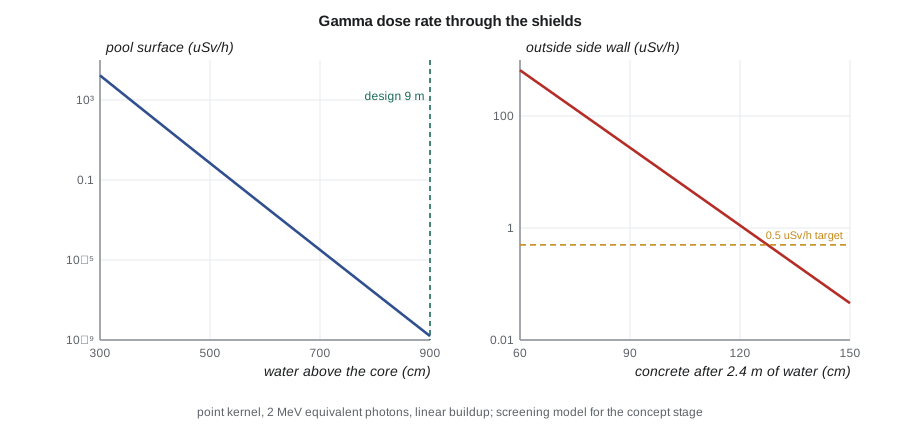
Water above the core and the side wall
The water above the core is far more than enough shielding for core gammas. With 4.5 m of water the dose rate at the surface would be a few microsieverts per hour; with the 9 m chosen for thermal hydraulic reasons, it is negligible. The pool depth is therefore set by boiling margin, not by shielding, and the shielding question at the surface becomes one of activation products rather than core radiation.
The side wall is different. Below grade, the pool wall is surrounded by soil, but part of the reactor building's lower level, where the purification equipment is located, is next to the pool. With 2.4 m of water between the edge of the core and the liner, 120 cm of ordinary concrete gives about 1.1 µSv per hour outside the wall, twice the target for a public area. The team has two choices: thicken the wall or restrict access to the space outside it. Sofia recommends 135 cm, which brings the estimate to about 0.2 µSv per hour, and also designates the adjacent room as a controlled area, so that the target is met with margin even if the screening method is optimistic. Fast neutron dose rates outside the wall are several orders of magnitude lower than the gamma dose rates. Sofia notes, however, that her model does not include capture gamma rays produced inside the concrete by thermal neutrons, which can dominate the dose outside thick concrete shields. That gap becomes an open item for the detailed design, to be closed with a Monte Carlo transport calculation.
Nitrogen-16 and the warm surface layer
Nitrogen-16 is the dominant source of radiation at the top of an operating pool reactor. Water leaving the core carries nitrogen-16 at nearly its production rate; if it rose straight to the surface, staff on the pool bridge would receive significant dose rates from 6 MeV gamma rays. The half-life of 7.1 s is the key to controlling it: every additional 7 s of transit halves the activity. Water rising through the 6 m chimney takes about 25 s to reach its top, by which time about 9 percent of the nitrogen-16 remains. If that water then rose straight to the surface it would arrive with about 1 percent remaining, still enough to dominate the dose rate at the pool bridge.
Pool reactors control this in two ways, and Kestrel-10 uses both. The first is the warm surface layer described in the thermal hydraulic design: a layer of water a few kelvin warmer than the water below, maintained by a small heated flow, is less dense and floats on top, so the chimney flow turns toward the heat exchanger well below the surface instead of rising through the layer. The second is a delay: the pool heat exchanger is placed so that water reaches it only after a transit of a minute or more, which reduces nitrogen-16 to a fraction of a percent of its initial activity before the water passes near any accessible area. The intermediate loop, which is not activated, carries no nitrogen-16 at all.
| Nuclide | Half-life | Origin | Concern | Control |
|---|---|---|---|---|
| N-16 | 7.1 s | oxygen in pool water | high-energy gammas at pool top | warm surface layer, transit delay |
| Ar-41 | 1.8 h | argon in water and air | airborne release | pool cover, ventilation hold-up, stack monitoring |
| H-3 | 12.3 y | deuterium in water | slow buildup in pool water | monitoring, water management |
| Co-60, Mn-54 | 5.3 y, 312 d | activated corrosion products | dose from filters and resins | water chemistry, shielded purification room |
| Fission products | various | fuel defects | pool water activity | clean fuel, purification, failed-fuel detection |
Zoning, monitoring and effluents
The building is divided into radiation zones by expected dose rate and contamination risk, with access controlled at each boundary. The reactor hall and the purification room are controlled areas; the control room, offices and visitor gallery are supervised or public areas with shielding and layout chosen so that their dose rates stay below the public target. Fixed area monitors in the reactor hall, at the pool bridge and in the purification room alarm locally and in the control room. The intermediate loop has a radiation monitor that would detect any leak from the pool heat exchanger, and the campus side of the second heat exchanger has a monitor that would detect any leak through both barriers, which should never happen given the pressure arrangement.
Airborne effluents are dominated by argon-41 and small amounts of tritium and noble gases. They are exhausted through filtered ventilation and a monitored stack. Liquid effluents are minimized by recycling pool water through the purification system, with any discharges batched, sampled and released only within authorized limits. Sofia estimates the public dose from normal effluents at the campus boundary to be a few microsieverts per year, well below the 0.05 mSv target, but she flags that her argon-41 estimate depends on the pool cover design, which has not yet been developed.
Occupational dose and ALARA
Most of the dose that operating staff receive in a reactor comes not from normal operation but from maintenance: changing filters and resins, inspecting the pool liner and heat exchanger, and handling fuel. Sofia estimates the annual collective dose for a staff of sixteen by listing the main tasks, their duration, the number of people involved and the expected dose rate. The largest single contribution is the annual changeout of the purification filters and resin, which she reduces by specifying remote handling tools and a shielded transfer cask. Her estimate is a few person-millisieverts per year, low compared with power reactors, and she records the assumptions so that the estimate can be refined.
Emergency planning
The size of the emergency planning zone depends on the source term, the amount of radioactive material that could be released in a severe accident, and on how quickly it could be released. Kestrel-10's inventory is small compared with a power reactor's, its fuel runs cold, and the pool keeps the fuel covered for weeks after any credible event. Sofia's bounding estimate, for a beyond-design-basis release from several damaged assemblies with partial credit for pool retention, gives doses at the campus boundary below the levels at which protective actions such as sheltering would be recommended. On that basis, the team argues that the emergency planning zone can be confined to the site, as R-12 requires. The NRC's 2023 rule on emergency preparedness for small modular reactors and other new technologies allows a plume exposure pathway zone sized to the facility's consequences, and the team notes that the argument would have to be made with a detailed source term analysis in the license application.
Worked problem
Concrete thickness for the public target
With 2.4 m of water from the core edge, the screening model gives 1.11 µSv/h outside 120 cm of concrete and 0.0454 µSv/h outside 150 cm. Estimate the thickness that meets 0.5 µSv/h, assuming the dose rate falls exponentially between these points.
Show solution
- The ratio over 30 cm is 1.11 ÷ 0.0454 = 24.4, so the dose falls by a factor of e^(ln 24.4 ÷ 30) per centimeter, a relaxation length of 30 ÷ ln 24.4 = 9.4 cm.
- To fall from 1.11 to 0.5 needs ln(1.11 ÷ 0.5) = 0.80 relaxation lengths, or 0.80 × 9.4 = 7.5 cm.
- Thickness = 120 + 7.5 ≈ 128 cm.
Answer: About 128 cm meets the target in the screening model. The team specifies 135 cm, a margin of about two relaxation lengths, because the model omits capture gammas in the concrete.
Common mistakes
MistakeThe deepest water gives the most important shielding.
InsteadAbove the core, water depth is set by boiling margin; the surface dose is governed by nitrogen-16.
MistakeBuildup factors can be ignored for thick shields.
InsteadScattered photons can exceed uncollided photons by a large factor; buildup must be included.
MistakeMeeting the regulatory limit is the design goal.
InsteadDesign to targets well below the limits, as low as reasonably achievable.
MistakeA point-kernel result is final.
InsteadIt is a screening estimate; capture gammas and streaming need a transport calculation.
Summary and key terms
- Sources include core neutrons and gammas, nitrogen-16 and argon-41 from the water and air, activated corrosion products and spent fuel.
- Design targets are set well below regulatory limits according to area use and occupancy.
- The point-kernel method with buildup sizes gamma shields; removal cross-sections screen fast neutrons.
- The 9 m of water above the core makes core gamma dose negligible; 135 cm of concrete meets the side-wall target with margin.
- A warm surface layer and a transit delay control nitrogen-16 at the pool top.
- Effluents and occupational doses are small, and the small source term supports an emergency planning zone within the campus.
- Effective dose
- A risk-weighted dose to the whole body, in sieverts.
- Ambient dose equivalent
- A measurable operational quantity used for area monitoring and design.
- Point kernel
- A method that sums attenuated contributions from point sources to estimate dose.
- Buildup factor
- The ratio of total to uncollided flux, accounting for scattered photons.
- Removal cross-section
- An effective attenuation coefficient for fast neutrons in hydrogenous shields.
- Nitrogen-16
- A 7.1 s activation product of oxygen that emits 6 to 7 MeV gamma rays.
- ALARA
- As low as reasonably achievable, the principle of optimizing radiation protection.
Practice problems
Work each problem on paper first, then reveal the answer to check.
Why is nitrogen-16 the main dose concern at the top of an operating pool?
Show answer
It is made in the core water and emits 6 to 7 MeV gammas; without a delay or surface layer it reaches the surface.
What does the buildup factor account for?
Show answer
Photons that scatter in the shield but still reach the detector.
Why did the team specify 135 cm rather than 128 cm of concrete?
Show answer
For margin, because the screening model omits capture gammas in the concrete.
Where does most occupational dose come from?
Show answer
Maintenance tasks such as filter and resin changeout, inspections and fuel handling.
What argument supports an emergency planning zone within the campus?
Show answer
The small, cold inventory and long grace period give boundary doses below protective action levels even in a bounding accident.
Lesson quiz · 5 questions
Score 60% or more to complete this lesson.
Create a free account to save your progress, take quizzes and earn a certificate.