
MSBA-291 · Lesson 10 of 12 · 25 min
Data residency
▶ Video coming soon A video version of this lesson is on the way.
In MSBA-290, Skerry decided not to use GitHub Enterprise Cloud with data residency. The decision took ten minutes at the time, because no region matched the company's needs and nothing in its contracts required code to stay in one country. In this session the question came back from a different direction. Skerry was negotiating to supply store software to a European franchise partner, and the partner's lawyers had asked where the code and its metadata would be stored. Marisol asked the team to understand the option properly, so that the answer to the partner would be an informed one rather than the earlier quick no.
What data residency means on GitHub
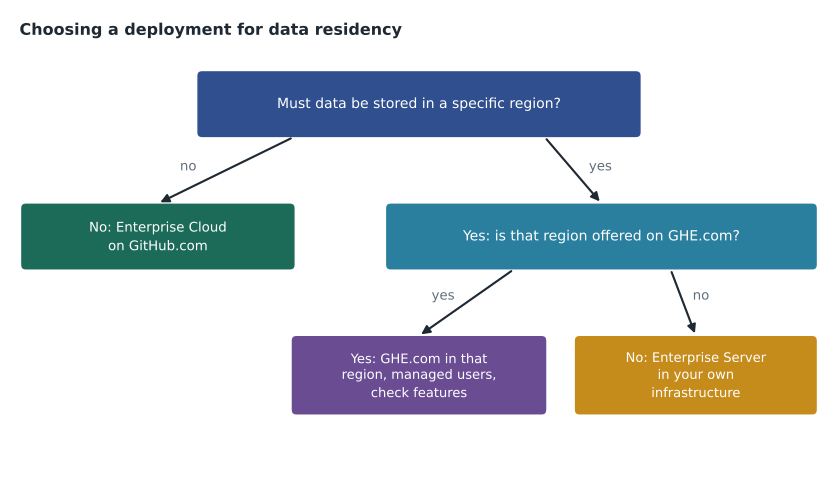
GitHub Enterprise Cloud with data residency runs an enterprise on a dedicated subdomain of GHE.com, such as skerry.ghe.com, in a chosen geographic region. Repository data and the main customer content for the enterprise are stored in that region, rather than in the GitHub.com infrastructure. It is the same Enterprise Cloud product, licensed the same way, but deployed separately from GitHub.com.
As of November 2026, GitHub's documentation listed these regions:
| Region | Notes |
|---|---|
| European Union | Also suitable for customers in Norway and Switzerland, according to GitHub |
| Australia | Data stored in Australia |
| United States | For customers who need data kept in the United States specifically |
| Japan | Data stored in Japan |
There was no Canadian region. For Skerry, which operates in the United States, a US region existed, but nothing in its contracts required it, so GitHub.com met its needs.
What comes with it
Choosing data residency brings several requirements and differences that administrators must plan for.
| Area | On GHE.com with data residency |
|---|---|
| Identity | Enterprise Managed Users is required; there are no personal accounts |
| Addresses | The enterprise has its own subdomain, and the API is at api.SUBDOMAIN.ghe.com rather than api.github.com |
| Usernames | Managed usernames use a random, hidden shortcode suffix rather than one the customer chooses |
| Networking | Firewalls and proxies must allow the GHE.com addresses and IP ranges, which differ from GitHub.com's |
| Features | Most Enterprise Cloud features are available, but some arrive later or are unavailable; check the feature documentation |
| Integrations | Third-party tools must support a custom GitHub host; some Marketplace apps do not |
| Migrations | Specific tools are supported for moving data in; some GitHub.com tools, such as the GitHub Importer, are not available |
The integrations row is often the deciding one. A tool that hard-codes github.com as its address will not work with a GHE.com enterprise until its vendor adds support for a custom host. Skerry's review in lesson 3 had left 61 GitHub Apps and 12 OAuth apps, and the team checked each one: 49 supported a custom host, 15 had it on their roadmap and 9 had no plans. For the franchise partner's small team that was manageable; for the whole company it would not have been.
Feature availability
GHE.com is a separate deployment, so features reach it on their own schedule. GitHub publishes a page listing which features are available on GHE.com and which are not. Some arrive at the same time as GitHub.com, some later, and some depend on underlying services that are not yet offered in every region. As an example of the pattern, GitHub Codespaces became generally available for data residency enterprises in April 2026, some time after it had been available on GitHub.com. Administrators should check the current list for anything their teams rely on, especially newer AI and Copilot features, rather than assume parity.
Worked problem
Checking a requirement against features
The franchise partner needs repositories, pull requests, Actions with GitHub-hosted runners, code scanning and Copilot code completion, all with data in the European Union. What should Skerry check before proposing GHE.com?
Show solution
- Confirm that the EU region is available: it is.
- Check each required feature against GitHub's GHE.com feature availability page, including whether Copilot features process data in the region.
- Check each integration the partner will use for custom host support.
- Confirm the identity provider supports the managed users setup on GHE.com.
Answer: Check the region, the feature availability list for each required feature including Copilot processing, the integrations and the identity setup, and record the results in the proposal.
What residency does and does not cover
Data residency answers the question of where customer data is stored. It does not answer every compliance question. Some processing may involve other locations, for example support access, certain security services or AI features, and GitHub documents those cases. Contracts, data protection agreements and the customer's own controls still matter. A franchise partner who wants assurance needs both the residency commitment and the evidence described in lesson 9.
Residency also does not make an enterprise more secure by itself. The controls in lessons 1 to 8, rulesets, token policies, security configurations, Actions policies, apply on GHE.com in the same way as on GitHub.com. A badly governed enterprise in a chosen region is still badly governed.
Enterprise Server as the alternative
When a required region is not offered, or when data must stay on the customer's own infrastructure, GitHub Enterprise Server remains the option. The customer installs the appliance in its own data center or its own cloud account in the region it chooses. The trade-off is the operational burden: upgrades, backups, high availability, patching and capacity, all the work Roderick's team had struggled with on the store-systems appliance. Enterprise Server releases arrive roughly every quarter, each supported for a limited period, so an appliance falls out of support quickly if nobody keeps it upgraded. GHES 3.22 became generally available in September 2026, and a 3.23 release candidate was available in November.
| Need | GitHub.com | GHE.com with data residency | Enterprise Server |
|---|---|---|---|
| Data in a specific offered region | No | Yes | Yes, wherever the customer runs it |
| Data in a region GHE.com does not offer | No | No | Yes |
| No infrastructure to run | Yes | Yes | No |
| Personal accounts and public open source | Yes | No | Limited to the appliance |
| Newest features first | Yes | Usually, with some delays | Later, with each release |
| Air-gapped or offline operation | No | No | Yes |
Moving into GHE.com
An enterprise that chooses data residency later, or a team moving from Enterprise Server, needs to move data in. Lesson 11 covers migrations in detail. Two points are specific to GHE.com. First, GitHub Enterprise Importer supports moving repositories into GHE.com from GitHub.com, from Enterprise Server 3.4.1 and later, from Azure DevOps Services, from Bitbucket Server and Data Center, from GitLab, and between GHE.com enterprises, with some size limits for GHE.com sources. Second, Enterprise Live Migrations, generally available since September 1, 2026, moves repositories from Enterprise Server to GHE.com while developers keep working, by continuously syncing data until a short cutover. It requires recent Enterprise Server patch releases, from 3.17 onward, and is driven by a GitHub CLI extension.
Worked problem
Choosing a migration tool for residency
A company runs Enterprise Server 3.20 with a 90-gigabyte monorepo under heavy daily use and wants to move it to an EU GHE.com enterprise with minimal downtime. Which tool fits, and what should it check first?
Show solution
- The destination is GHE.com and the source is Enterprise Server, so both GitHub Enterprise Importer and Enterprise Live Migrations are candidates.
- A large, busy repository suits Enterprise Live Migrations, which syncs continuously and needs only a short cutover.
- Live migrations require a recent patch release of the source version; check that the appliance runs at least the required 3.20 patch, and upgrade if not.
Answer: Use Enterprise Live Migrations after confirming the appliance is on a supported patch release; it keeps developers working until a short cutover.
Skerry's answer
The team's recommendation to Marisol had three parts. The main Skerry enterprise would stay on GitHub.com, because nothing required otherwise and the integrations depended on it. The European franchise partner's store customizations would live in a small separate enterprise on GHE.com in the EU region, with managed users from the partner's identity provider, and Skerry's shared store code would be mirrored into it by a release workflow rather than shared directly. And the governance standard, rulesets and security configurations would be applied to that enterprise from the same governance repository, so it would not become a second, weaker estate.
Lorcan asked about cost. The answer was that GHE.com is licensed like Enterprise Cloud, per user, so the partner's 35 developers would need 35 licenses whichever deployment they used. The additional cost was the work of running a second enterprise, which the platform team estimated at a few days a quarter once it was set up.
Worked problem
Counting licenses across two enterprises
Five Skerry platform engineers will be members of both the main enterprise on GitHub.com and the partner enterprise on GHE.com, alongside the partner's 35 developers. Will the five engineers need extra licenses?
Show solution
- GHE.com uses managed users, so the five engineers will have separate managed accounts in the partner enterprise.
- Licenses are counted per enterprise account unless GitHub links the accounts for billing, which administrators should confirm with their account team.
- Plan for 40 licenses in the partner enterprise unless GitHub confirms that the five will be deduplicated.
Answer: Plan for 40 licenses in the partner enterprise, and ask GitHub whether the five shared engineers can be counted once.
Network and integration planning for GHE.com
A GHE.com enterprise lives at different addresses from GitHub.com, and almost every client and integration needs to know that. Developers clone from the enterprise subdomain. The GitHub CLI and Git Credential Manager must be pointed at the GHE.com host. Actions runners, if self-hosted, must reach the GHE.com service addresses and the region's storage endpoints. And corporate firewalls and proxies must allow the GHE.com address ranges GitHub publishes for the region, which are separate from those for GitHub.com. The partner's IT team found that its proxy allowed github.com by name but not ghe.com, which would have broken every clone on the first day.
| Client or service | Change for GHE.com |
|---|---|
| Git and Git Credential Manager | Use the enterprise subdomain URL |
| GitHub CLI | Authenticate against the GHE.com host name |
| API scripts | Call api.SUBDOMAIN.ghe.com instead of api.github.com |
| Self-hosted runners | Register against the GHE.com enterprise or organization; allow its service and storage addresses |
| Firewalls and proxies | Allow the region's published GHE.com address ranges |
| Third-party tools | Configure a custom GitHub host, if the tool supports it |
Copilot and AI features with residency
AI features raise their own residency questions, because a prompt and its response may be processed by models hosted somewhere other than the region where code is stored. GitHub documents, feature by feature, where Copilot data is processed for GHE.com enterprises and which features are available. Skerry's proposal to the partner listed the Copilot features it intended to enable, linked GitHub's statement for each, and left the decision about whether to enable them with the partner's own privacy officer. That respected the reason the partner had asked about residency in the first place.
Residency and the governance model
The partner enterprise would be small, but small estates are where governance most often slips, because nobody watches them closely. Skerry's governance repository was extended with environment-specific files, so that the same rulesets, security configurations and Actions policies were applied to the GHE.com enterprise by the same reviewed process, through a second installation of the governance app on the partner enterprise. The drift check from lesson 12 ran against both enterprises every night.
Worked problem
Adapting a script for GHE.com
A reporting script calls https://api.github.com/orgs/skerry/repos. What must change for it to list repositories in the partner enterprise's organization, skerry-partner-eu, on skerry-eu.ghe.com?
Show solution
- The API host for a GHE.com enterprise is api followed by the enterprise subdomain.
- Replace api.github.com with api.skerry-eu.ghe.com.
- Replace the organization name with skerry-partner-eu.
- Authenticate with a credential issued in the GHE.com enterprise, because GitHub.com credentials do not work there.
Answer: Call https://api.skerry-eu.ghe.com/orgs/skerry-partner-eu/repos with a credential from the GHE.com enterprise.
Common mistakes
MistakeAssuming data residency is available in every country.
InsteadCheck the regions GitHub currently offers; Canada, for example, is not one of them.
MistakeAssuming every GitHub.com feature and integration works on GHE.com.
InsteadCheck the feature availability page and each integration's custom host support.
MistakeTreating residency as a complete compliance answer.
InsteadCombine it with contracts, data protection terms and the customer's own controls.
MistakeChoosing Enterprise Server for residency without planning its operation.
InsteadBudget for upgrades, backups, availability and support windows.
Summary and key terms
- Enterprise Cloud with data residency runs an enterprise on a GHE.com subdomain in a chosen region.
- Regions documented in November 2026 were the European Union, Australia, the United States and Japan.
- GHE.com requires managed users and uses its own addresses and API host; some features and integrations differ.
- Residency covers where data is stored, not every compliance question.
- Enterprise Server is the alternative when a region is not offered or data must stay on the customer's infrastructure.
- GitHub Enterprise Importer and Enterprise Live Migrations move data into GHE.com.
- Data residency
- Storing an enterprise's data in a chosen geographic region.
- GHE.com
- The domain that hosts Enterprise Cloud enterprises with data residency, each on its own subdomain.
- Feature availability
- GitHub's published list of which features work on GHE.com.
- Custom host support
- The ability of a tool to connect to a GitHub address other than github.com.
- Enterprise Live Migrations
- A tool that moves repositories from Enterprise Server to GHE.com with continuous sync and a short cutover.
- Support window
- The period during which an Enterprise Server release receives updates.
Practice problems
Work each problem on paper first, then reveal the answer to check.
Which identity model does GHE.com require?
Show answer
Enterprise Managed Users.
Why might a Marketplace app fail on a GHE.com enterprise?
Show answer
It may not support a custom GitHub host address.
What is the alternative when data must stay in a region GHE.com does not offer?
Show answer
GitHub Enterprise Server run in that region.
Lesson quiz · 5 questions
Score 60% or more to complete this lesson.
Create a free account to save your progress, take quizzes and earn a certificate.