
MSBA-130 · Lesson 1 of 12 · 19 min
Low-code and the business case
▶ Video coming soon A video version of this lesson is on the way.
On the first Tuesday of September 2026, Rupert Ellingsworth opened a meeting room at the downtown campus of Lumenvale Community Colleges in Boise and wrote one number on the whiteboard: 214. That was how many spreadsheets the colleges' internal audit had found holding student or staff records on shared drives, in email attachments and on personal OneDrive accounts. Some were tidy and well kept. Others had names such as Transcript_Requests_MASTER_v7_DO_NOT_TOUCH.xlsx, three people editing them at once and no record of who had changed what. The audit had found a graduation audit sheet with formulas silently broken for two terms and a parking-permit list that had been emailed, in full, to the wrong distribution group.
Lumenvale is a three-campus college system with about 11,000 students and 900 staff. Its downtown campus holds the registrar's office and central IT; the Lakeshore campus runs trades and health programs; the Ridgeview campus runs business and community programs. Rupert leads IT governance, and the colleges' leadership had asked him a direct question after the audit: could the colleges replace the riskiest spreadsheets with proper applications without hiring a team of developers or buying a dozen new systems? He had answered that Microsoft Power Platform was already partly licensed through the colleges' Microsoft 365 subscription, and that a small group of staff could learn to build on it safely. This course follows that group.
Around the table were the people who would carry the work. Maribeth Ferreira-Quon coordinates transcripts and records in the registrar's office and owns the spreadsheet that most worried the auditors. Kwabena Asante-Lowe is a data analyst in institutional research who builds the colleges' enrollment reports. Signe Tavernier-Mbeki is one of only two professional developers in central IT. Rupert himself would act as the Power Platform administrator. Maribeth had also decided to sit the Microsoft Power Platform Fundamentals exam, PL-900, in the new year, and Rupert promised that every session would line up with what that exam expects.
What low-code means
Traditional software development means writing an application in a programming language such as C# or JavaScript, designing a database, building the screens, testing and deploying the result. It is powerful and flexible, and it needs skilled developers and time. Low-code development keeps most of that power but replaces much of the hand-written code with visual designers, ready-made components and short formulas. A person drags a form onto a screen, connects it to a table, sets a few properties and writes a one-line formula to decide what happens when a button is pressed. The platform takes care of hosting, sign-in, security plumbing and updates.
No-code is sometimes used for the simplest end of the range, where a person builds something without writing even a formula: describing an app to Copilot, filling in a template or answering a few questions in a wizard. In practice the line between no-code and low-code is blurry, and Microsoft describes Power Platform as a low-code platform that also offers no-code starting points and full pro-code extension when it is needed.
| Approach | Who usually builds | Typical speed | Typical use |
|---|---|---|---|
| Spreadsheet and email | Anyone | Hours | Personal tracking, quick analysis, one-off lists |
| No-code (templates, Copilot prompts) | Business users | Minutes to hours | Simple forms, personal automations, first drafts |
| Low-code (Power Platform) | Business makers with IT support | Days to weeks | Departmental apps, approvals, process automation, agents |
| Pro-code (custom development) | Professional developers | Weeks to months | Complex systems, unusual integrations, large public products |
None of these approaches is better in every case. A spreadsheet is still the right tool for a quick calculation or a list one person keeps for a week. Custom development is still right for systems with very unusual requirements or huge scale. Low-code fills the large middle: processes that matter to a team or a department, that involve several people, that need proper data and permissions, and that change often enough that waiting months for a development project is not realistic.
Why organizations adopt low-code
Rupert had prepared a short case for the colleges' leadership. It rested on five benefits that Microsoft and most analysts describe in similar terms, and on one warning.
The first benefit is speed. A department can go from an idea to a working app in days because so much is prebuilt. Maribeth's transcript tracker did not need a database designed from scratch, a login system or a hosting plan. It needed a table, a form and a few rules.
The second is closeness to the problem. The people who understand a process best are usually the people who do it. When they can build, or at least shape, the solution, fewer requirements are lost in translation. Maribeth knows which fields an official transcript request really needs and which exceptions happen every week. A developer would have to spend days learning that.
The third is reduced backlog. Central IT at Lumenvale had a list of more than 60 requests for small systems that had waited for years because each was too small to justify a project. Low-code lets some of that work move to trained makers in the departments, with IT setting the rules and supporting them.
The fourth is better data and control than the spreadsheets being replaced. A Power Platform app stores data in a proper database with security roles, an audit trail and backups. People see only the records they are allowed to see. That is a step up in governance, not a step down, provided the platform itself is governed.
The fifth is integration. Power Platform connects to Microsoft 365, Dynamics 365, Azure and hundreds of other services through connectors. A process that today involves copying data between email, a spreadsheet and a student system can be joined up.
The warning is that low-code without governance can recreate the spreadsheet problem in a new form: hundreds of apps and flows with unclear owners, data copied to places it should not go and nobody able to say what exists. Much of this course is about the administration and governance that prevent that. Rupert put it plainly to leadership: "We are not buying a tool. We are setting up a way of working."
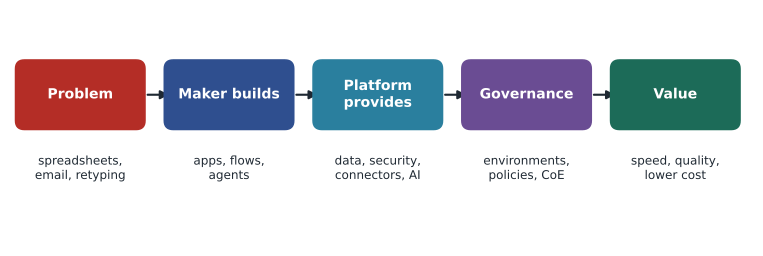
Measuring the business case
Leadership wanted numbers, not slogans. A business case for a low-code solution compares the cost and effort of the current way of working with the cost and effort of the new one, and adds the value of risks avoided. The pieces are the same whether the solution is one app or a hundred.
| Element | Questions to answer | Lumenvale example |
|---|---|---|
| Time saved | How many hours a week does the current process take, and how many will the new one take? | Transcript requests: about 14 hours a week of copying, checking and chasing |
| Error reduction | How often do mistakes happen, and what does each cost? | Two misdirected transcripts a term, each needing a formal privacy incident report |
| Risk avoided | What could go wrong with the current data, and how likely is it? | Student records in unprotected spreadsheets flagged by audit |
| License and platform cost | Which licenses, capacity or pay-as-you-go charges are needed? | Mostly covered by Microsoft 365; a few premium licenses for advanced makers |
| Build and support effort | Who builds, who supports, who trains? | Maribeth builds with Signe reviewing; Rupert administers |
| Adoption | Will people actually use it? | Six registrar staff and about 40 advisers |
Worked problem
Estimating the value of one app
The registrar's office spends about 14 hours a week on manual work around transcript requests. Rupert estimates a new app and a flow will cut that to 4 hours. Staff time costs the colleges about 45 dollars an hour once benefits are included. The office works 46 weeks a year. What is the yearly value of the time saved, before any license costs?
Show solution
- Hours saved each week: 14 minus 4 equals 10 hours.
- Hours saved each year: 10 hours times 46 weeks equals 460 hours.
- Value of that time: 460 hours times 45 dollars equals 20,700 dollars.
- Add the risk side separately rather than inventing a number: fewer misdirected transcripts means fewer privacy incidents, which the colleges' privacy officer values highly.
Answer: About 20,700 dollars a year of staff time, plus a reduction in privacy risk that is harder to price but matters more to leadership.
Time saved is the easiest number to estimate and the easiest to exaggerate. Rupert insisted that each estimate be checked with the people who do the work, and that "time saved" be described honestly: staff do not disappear, they spend the time on work that needs judgment, such as helping students with complicated cases. A good business case says what the freed time will be used for.
Typical low-code solutions
Most first Power Platform projects fall into a small number of patterns. Recognizing them helps a team pick good first projects and avoid poor ones.
| Pattern | Description | Example at Lumenvale |
|---|---|---|
| Replace a spreadsheet | Move shared data from a file into a proper table with a form | Transcript request log |
| Request and approval | Collect a request, route it for approval, notify people | Room bookings that need a dean's approval |
| Inspection or checklist | A mobile app filled in on site, often with photos | Lab safety checks at the Lakeshore campus |
| Notification and reminder | Watch for an event and tell someone | Remind advisers of students at academic risk |
| Repetitive desktop task | Automate clicks and typing in an older system | Copying exam results from a legacy grading tool |
| Question and answer | An agent that answers common questions from approved sources | An agent answering staff questions about records policy |
Good first projects share a few traits: a clear owner, a process that is painful today, a modest number of users, data that is not the most sensitive the organization holds, and a measurable result. Poor first projects are the opposite: a vague goal, many departments that disagree about the process, the colleges' most sensitive data, or an attempt to replace a core system such as the student information system itself. Rupert steered the group away from rebuilding the student system and toward the work that surrounds it.
The Microsoft view of business value
The PL-900 exam opens with a short domain on the business value of Power Platform. In the version of the skills measured dated July 24, 2026, it weighs 5 to 10 percent of the exam and asks candidates to describe the value of each part of the platform: Power Apps for building applications, Power Automate for automating processes, Dataverse for organizing business data, connectors for integrating services and data, Power Pages for building websites, generative AI features across the platform, and Copilot Studio for creating agents. The next lesson tours each of those parts. For the exam, the key skill is matching a business need to the component that meets it.
Microsoft also describes the platform as working with the rest of the Microsoft cloud. Power Platform apps run inside Microsoft Teams and SharePoint, Power Automate flows react to Outlook and Forms, Copilot Studio agents can appear in Microsoft 365 Copilot, and the same Dataverse database underpins Dynamics 365 business applications. For an organization that already uses Microsoft 365, that integration is a large part of the value: people sign in with the identities they already have, and administrators use the same Microsoft Entra ID security.
Who pays and who benefits
One more question shaped Lumenvale's business case: who pays for the platform, and who benefits? Licenses are often bought centrally, while savings appear in departments. Rupert proposed that central IT fund the platform's base licenses and administration for the first year, while departments that wanted premium apps would fund their own premium licenses after a pilot proved the value. That arrangement kept the first projects moving without arguments about budgets and gave departments a reason to measure their results.
Common mistakes
MistakeTreating low-code as a way to avoid IT altogether.
InsteadLow-code moves some building to the business, but IT still sets environments, policies and support. The best results come from a partnership.
MistakeChoosing the hardest, most political process as the first project.
InsteadStart with a contained, painful process that has a clear owner and a measurable result.
MistakeQuoting time saved without checking it with the people who do the work.
InsteadEstimate with the process owners and say what the freed time will be used for.
MistakeAssuming an app is safer than a spreadsheet automatically.
InsteadIt is safer only when the platform is governed: environments, security roles and data policies are in place.
By the end of the first session the group had a shortlist of three projects: Maribeth's transcript request log, the Lakeshore lab safety checklist and a reminder flow for academic advisers. Rupert wrote "governance first" next to the list. Before anyone built anything, he would set up the environments and policies that later lessons describe.
Summary and key terms
- Low-code development uses visual designers, prebuilt components and short formulas so that people closer to a problem can build solutions faster.
- Benefits include speed, closeness to the problem, a smaller IT backlog, better-governed data than spreadsheets, and integration across services.
- Without governance, low-code can multiply unmanaged apps and data, so administration is part of the business case.
- A business case weighs time saved, errors and risk avoided against license, build and support effort, and checks estimates with the people who do the work.
- Good first projects are contained, painful today, clearly owned and measurable.
- Low-code
- Building software mainly with visual designers, prebuilt components and short formulas instead of hand-written code.
- No-code
- Building a simple solution without writing formulas or code, for example from a template or a Copilot prompt.
- Pro-code
- Traditional software development in a programming language by professional developers.
- Maker
- A person who builds apps, flows or agents on Power Platform, often from a business team.
- Business case
- A comparison of the costs, benefits and risks of a proposed solution with the current way of working.
Practice problems
Work each problem on paper first, then reveal the answer to check.
Name three benefits of low-code development for an organization.
Show answer
Any three of: speed, closeness of builders to the problem, a smaller IT backlog, better-governed data than spreadsheets, integration with other services.
A process saves 6 hours a week for 46 weeks at 45 dollars an hour. What is the yearly value of the time?
Show answer
6 x 46 = 276 hours; 276 x 45 = 12,420 dollars.
Why is replacing the student information system a poor first low-code project?
Show answer
It is a core, complex system with the most sensitive data and many stakeholders; first projects should be contained and clearly owned.
Lesson quiz · 5 questions
Score 60% or more to complete this lesson.
Create a free account to save your progress, take quizzes and earn a certificate.