
MSAZ-349 · Lesson 2 of 12 · 21 min
Question types and labs
▶ Video coming soon A video version of this lesson is on the way.
On the morning of Sunday, November 15, 2026, the day after her diagnostic, Ama opened the exam sandbox at home and clicked through every screen. The sandbox is a short demonstration that Microsoft publishes so candidates can see the exam interface before the day: the welcome screens, the item types, the review page and the way case studies open. It uses sample questions about nothing in particular, so it teaches nothing about security. What it teaches is how the exam behaves, and Nadia believes that matters more than most candidates expect. 'You do not want to spend the first ten minutes of a 100-minute exam working out where the Next button is,' she said.
This lesson describes the kinds of items that Microsoft role-based exams use, what each one asks of the candidate, and how Ama will practice each kind. Microsoft does not say which item types a particular exam contains, and the mix can change between versions, so the lesson covers the full set Microsoft documents and notes which ones SC-200 candidates most often describe.
What Microsoft says about the exam experience
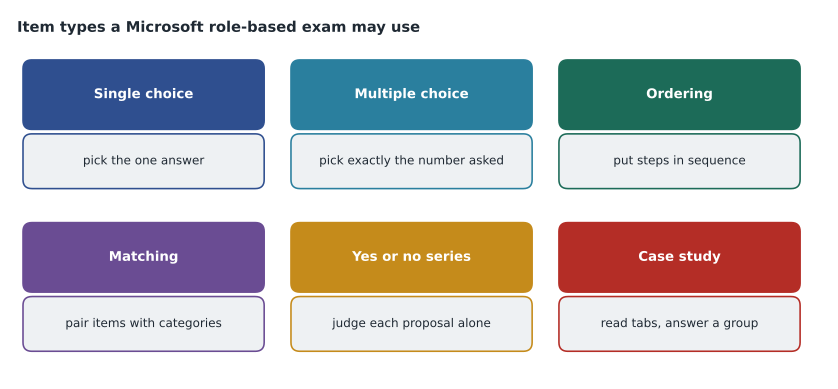
Microsoft's guidance on the exam experience describes the formats a role-based exam may use. Most items are some form of multiple choice: choose one answer, choose several, put steps in order, or match items to categories. Some items are grouped into case studies, where a long scenario is followed by several questions about it. Some exams have sections that cannot be revisited once they are finished. And some exams may include interactive components, in which the candidate works in a simulated portal or command window. The SC-200 certification page says the exam is proctored and may have interactive components to complete. It does not promise a lab, and candidates in 2025 and 2026 have mostly described multiple-choice, drag-and-drop and case-study items. Ama will prepare for all of them.
Single-answer and multiple-answer items
A single-answer item gives a scenario and four or more options, one of which is correct. A multiple-answer item says how many answers to choose, such as 'Each correct answer presents part of the solution. Choose two.' The exam may give partial credit on some multiple-answer items and none on others, and Microsoft does not say which. The practical rule is to read the instruction line carefully: if it says choose two, choosing one or three is wrong.
Single-answer items in SC-200 usually turn on one detail. A question may describe a Defender for Endpoint device that must be isolated while still letting the analyst collect an investigation package, and ask which action to take. Two options may sound right, but only one keeps the connection to the Defender service that the investigation needs. Ama practices these by writing down, before looking at the options, what the answer should do. Then she reads the options and picks the one that matches her description, instead of letting the options suggest an answer.
Ordering and matching items
Ordering items list steps and ask the candidate to put them in sequence. SC-200 questions of this kind often cover setup tasks, such as configuring Windows Security events collection with the Azure Monitor Agent: install or enable the agent, create a data collection rule, choose the event set, and confirm data in the SecurityEvent table. They also cover response sequences, such as the order in which an analyst contains an identity compromise. Some ordering items include extra steps that do not belong, and the candidate must leave those out.
Matching items give a list of things on one side and categories on the other, such as matching log sources to the tables they populate, or matching analytics rule types to their behavior. They test whether the candidate knows the boundaries between similar concepts. Ama's weak point here, from the diagnostic, was matching sources to tables: she knew SigninLogs and SecurityEvent from the Sentinel sprint but hesitated over IdentityDirectoryEvents and CloudAppEvents in advanced hunting.
| Item type | What it tests | Ama's practice method |
|---|---|---|
| Single answer | One deciding detail in a scenario | Describe the answer before reading the options |
| Multiple answer | Knowing every part of a solution | Count the parts the instruction asks for |
| Ordering | The sequence of setup or response steps | Write the steps from memory, then compare |
| Matching | Boundaries between similar concepts | Flashcards pairing sources, tables and rule types |
| Yes or no series | Whether each proposed solution meets a goal | Judge each solution on its own, never as a set |
| Case study | Reading a long scenario for requirements | Mark requirements and constraints before the questions |
Yes or no series
Some Microsoft exams include a series of items that share a scenario and a goal. Each item proposes a solution, and the candidate answers yes if the solution meets the goal or no if it does not. Once an item in the series is answered, the candidate usually cannot go back to it. The series may have one correct solution, several or none. That last possibility catches people: candidates often assume that one of the proposals must work and answer yes to the least bad one.
A typical SC-200 series might describe a requirement that Sentinel create an incident whenever a sign-in from a particular list of addresses occurs, with as little delay as possible. One proposal is a scheduled analytics rule that runs every five minutes, another is a near-real-time rule, and a third is an automation rule. Each has to be judged on its own. A near-real-time rule runs every minute and meets the 'as little delay as possible' wording; a scheduled rule every five minutes creates incidents but with more delay, so whether it meets the goal depends on the exact wording; an automation rule cannot create an incident from raw data at all, because it acts on incidents and alerts that already exist.
Case studies
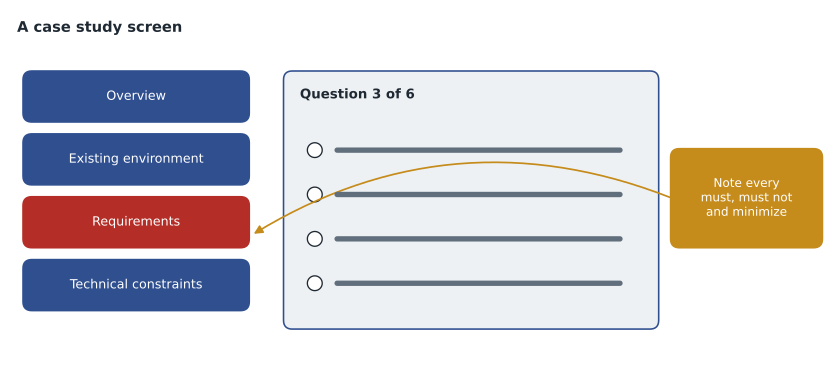
A case study presents a fictional organization in several tabs: an overview, the existing environment, requirements, and sometimes technical constraints or problem statements. A set of questions follows, often five to seven. The candidate can switch between the tabs and the questions while working on that case study, but once the case study section is finished it usually cannot be reopened. Case studies reward careful reading more than speed. Requirements often contain small qualifiers, such as 'without changing existing workbooks' or 'minimizing administrative effort', that decide between two otherwise correct answers.
Ama's practice method is the one Nadia uses when she reads a new customer's security requirements: before reading any question, scan the requirements tab and write down every 'must', 'must not', 'minimize' and 'as soon as possible'. Then, for each question, check the chosen answer against the list. Lesson 10 works through a full practice case study in this way.
Interactive components
The SC-200 certification page says the exam may have interactive components. Microsoft uses that phrase for items in which the candidate works in a simulation, for example selecting settings in a portal page or completing a query. Microsoft has used live labs on some exams in the past and has said little about how often they appear now. For SC-200, the safest preparation is the work Ama already does: knowing where settings live in the Defender portal, what the options are called and what each one changes. Reading about a setting is not the same as having clicked it.
In practice, Ama's portal knowledge is strongest in Sentinel and weakest in Defender for Endpoint settings, which Sunil administers. Nadia arranged for Ama to shadow Sunil once a month from March, with read-only access to the advanced features page, device groups, automation levels and attack surface reduction policies, so that she sees each page and its options at least twice before the exam.
How the clock works
The 100 minutes include everything on the exam itself: reading, answering, case studies and reviewing. Before the exam starts, the candidate reads and accepts the non-disclosure agreement and the instructions; on most exams that time does not come out of the exam's own clock, but the full appointment is longer than 100 minutes, so Ama will plan for about two hours at the desk. The candidate can mark items for review and return to them from the review page, except in sections that cannot be revisited, such as yes or no series and finished case studies. Leaving an item unanswered earns nothing, and there is no extra penalty for a wrong answer compared with a blank one, so every item should get an answer, even a careful guess.
Microsoft also lets candidates request extra time in two situations. A candidate whose first language is not offered for the exam can ask for 30 more minutes. A candidate who needs an accommodation, such as extra time because of a disability or the use of assistive technology, can request it through Microsoft's accommodations process before booking. Ama is taking the exam in English, her first language, so neither applies to her, but she noted both for colleagues.
Using Microsoft Learn during the exam
For some role-based exams Microsoft has allowed candidates to open a restricted view of Microsoft Learn documentation during the exam, without extra time. When this is available, the clock keeps running while the candidate reads. Nadia's advice is to treat it as a last resort for a single fact, such as a table name, not as a way to answer whole questions. Microsoft's rules on this can change, so Ama will check the exam experience page before her exam and will not plan to rely on it.
Turning item types into practice habits
Knowing the item types is only useful if practice copies them. Most practice material is single-answer multiple choice, because it is the easiest kind to write. That leaves candidates underprepared for ordering, matching and series items, which reward precise recall. Ama's plan corrects for this in three ways. First, every week from March she writes three of her own ordering items from real work, such as the steps Sunil follows to onboard a new server to Defender for Endpoint, and swaps them with Renata, who writes her own for SC-300. Second, she keeps a deck of matching cards with a source on one side and the table it fills on the other, which she reviews for five minutes at the start of each shift. Third, when she reviews a practice question she got wrong, she rewrites it as a yes or no series: three proposed solutions, each judged on its own against the same goal.
Nadia added one more habit from her years at a managed detection and response provider. After each practice set, Ama spends ten minutes on the questions she got right but was unsure about. Those are the items most likely to go wrong on the day, because the knowledge behind them is shaky. A correct guess teaches nothing unless the candidate goes back and finds out why it was correct. Ama marks these in her error log with a question mark, separate from the outright misses, and lesson 11 uses both kinds of entries to decide what to review each week.
The last habit is about wording. Microsoft writes items in a consistent style: a scenario, a goal, and a question that often contains a qualifier such as 'first', 'next', 'minimize' or 'without'. Ama practices underlining the qualifier before reading the options. On the diagnostic, four of her 21 misses came from answering a different question than the one asked, such as choosing the best long-term fix when the item asked what to do first.
Worked problem
Budgeting time for a case study
Suppose Ama's exam has 50 items in 100 minutes, and one case study contains 6 of them. She wants to spend 3 extra minutes reading the case study's requirements before answering. How long can she spend on each case-study item if she wants the case study as a whole to take no more than its share of the time plus those 3 minutes?
Show solution
- Average time per item: 100 ÷ 50 = 2 minutes.
- The case study's share: 6 × 2 = 12 minutes.
- Allowed total for the case study: 12 + 3 = 15 minutes.
- Reading the requirements uses 3 of those minutes, leaving 15 − 3 = 12 minutes for 6 items.
- \[12 \div 6 = 2\]
- So she still has 2 minutes per case-study item, the same as the exam average, because the extra 3 minutes went to reading.
Answer: She can spend 2 minutes on each case-study item after 3 minutes of reading, for 15 minutes in all.
Common mistakes
MistakeEvery SC-200 exam has a hands-on lab.
InsteadThe certification page says the exam may have interactive components; it does not promise a lab.
MistakeIn a yes or no series, at least one proposed solution must work.
InsteadA series may have one correct solution, several or none; judge each proposal on its own.
MistakeA blank answer is safer than a wrong guess.
InsteadA blank earns nothing and a wrong answer costs nothing extra, so every item should get an answer.
MistakeCase-study questions can be revisited at the end of the exam.
InsteadOnce a case study section is finished it usually cannot be reopened.
MistakeThe 100 minutes include signing the non-disclosure agreement.
InsteadThe exam clock covers the exam itself; plan for a longer appointment than 100 minutes.
Summary and key terms
- The exam sandbox shows the interface and item types; use it before the exam so nothing on screen is new.
- Microsoft exams may use single-answer, multiple-answer, ordering, matching, yes or no series and case-study items.
- Read instruction lines carefully: 'choose two' means exactly two.
- Yes or no series and finished case studies usually cannot be revisited.
- The SC-200 exam may include interactive components, so portal familiarity matters.
- Candidates can request 30 extra minutes if the exam is not in their language, or an accommodation through Microsoft's process.
- Case study
- A long scenario in several tabs followed by a group of related questions.
- Yes or no series
- A group of items sharing a goal, each proposing one solution to judge.
- Interactive component
- An exam item in which the candidate works in a simulated interface.
- Review page
- The screen listing every item, its status and any marks for review.
- Accommodation
- An approved change to exam conditions, such as extra time or assistive technology.
Practice problems
Work each problem on paper first, then reveal the answer to check.
What should a candidate do in a yes or no series if no proposed solution seems to work?
Show answer
Answer no to each one; a series can have no correct solution.
What does Ama write down before answering case-study questions?
Show answer
Every must, must not, minimize and as-soon-as-possible statement in the requirements.
Why should every item get an answer?
Show answer
A blank earns nothing, and a wrong answer costs nothing more than a blank.
Who can request an extra 30 minutes?
Show answer
A candidate whose preferred language is not offered for the exam.
How will Ama build portal familiarity for Defender for Endpoint?
Show answer
By shadowing Sunil monthly from March with read-only access to the settings pages.
Lesson quiz · 5 questions
Score 60% or more to complete this lesson.
Create a free account to save your progress, take quizzes and earn a certificate.