
MSAZ-349 · Lesson 1 of 12 · 21 min
The Security Operations Analyst certification
▶ Video coming soon A video version of this lesson is on the way.
On Friday, November 13, 2026, after the notebooks session that closed the KQL clinic, Nadia Okonjo asked Ama Boateng to stay for ten minutes. Incident 4196 was contained, the post-incident review was booked for the following Friday, and the new session-reuse rule had gone live that morning. Nadia took a marker and wrote on the whiteboard in the corner of the security operations center at Harrow & Finch Home Supply in Des Moines: 'SC-200, Friday, September 24, 2027.' Ama had joined the security team in the summer as a junior analyst, had shadowed the Defender and Sentinel work for a month, and had just helped investigate her first real account compromise. The date gave the next ten months a shape.
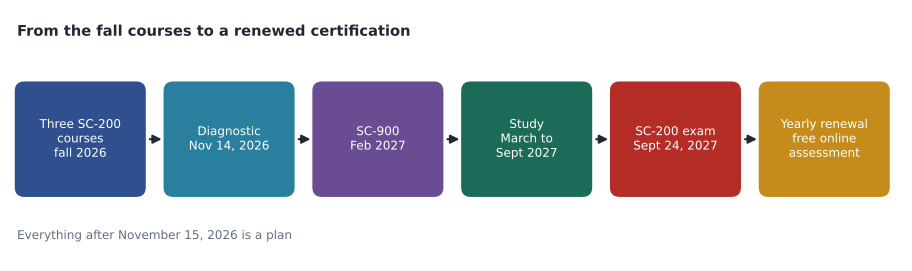
The plan Nadia sketched has two steps. In February 2027 Ama sits the fundamentals exam, SC-900, which covers security, compliance and identity concepts across Microsoft's products. From March to September she prepares for SC-200, the Security Operations Analyst exam, using the work she already does as her main study material. On Saturday, November 14, 2026, Ama worked through a 60-question diagnostic set that Nadia had built from the quizzes in the three SC-200 courses: Defender XDR, Sentinel, and threat hunting with KQL. This course is the plan the two of them made from that result. Everything after November 15, 2026 in it is a plan, not something that has already happened.
What the certification is
Exam SC-200, Microsoft Security Operations Analyst, leads to the Microsoft Certified: Security Operations Analyst Associate certification. It is a role-based certification at the associate level, the middle of Microsoft's three levels, above fundamentals certifications such as SC-900 and below expert certifications such as SC-100, Cybersecurity Architect. There are no formal prerequisites, and SC-900 is not required. Nadia recommends it to new analysts because it gives them the vocabulary of identity, compliance and Zero Trust before they meet the detail.
Microsoft describes the candidate as someone who works with the organization's stakeholders to secure its information technology systems. In practice the role investigates, responds to and hunts for threats using Microsoft Sentinel, Microsoft Defender XDR and the products that feed them, such as Defender for Endpoint, Defender for Office 365, Defender for Identity, Defender for Cloud Apps, Defender for Cloud and Microsoft Purview. The analyst uses Kusto Query Language (KQL) to search data, builds detections and automation so that the team spends its time on real threats, and works incidents through to closure. That description matches what Ama did in October and November: triaging the queue, tuning rules, joining sign-in tables, and following incident 4196 from the first alert to the review.
The description also says what the exam is not. It is not an exam about designing a security strategy; that is the job of SC-100. It is not an exam about administering Microsoft Entra ID in depth; that is SC-300, which Ama's colleague Renata is considering. And it is not an exam about attacking systems. SC-200 is a defender's exam. It asks what an analyst sees, what the evidence means and what to do next. Attacker techniques appear in questions the way they appear in this course: by their MITRE ATT&CK names and the traces they leave in logs.
The exam at a glance
Microsoft's certification page lists the basic facts. The exam lasts 100 minutes. It is offered in ten languages: English, Japanese, Chinese (Simplified), Chinese (Traditional), Korean, French, German, Spanish, Portuguese (Brazil) and Italian. It is proctored and scheduled through Pearson VUE, either at a test center or online. The page says the exam may have interactive components to complete, which means some items may ask the candidate to work in a simulated interface instead of choosing from a list. Microsoft does not publish a price for all countries; the price depends on the country or region where the exam is proctored, so Ama will see the price in US dollars when she books.
The passing score is 700 on a scale of 1 to 1,000. That is a scaled score, not a percentage of correct answers. Microsoft adjusts scores for the difficulty of each candidate's questions, so 700 does not mean that a fixed share of answers must be right. Some items may carry more than one point, and a small number of unscored items may be included while Microsoft tries out new material. A candidate cannot tell which items those are, so every item deserves full effort. Microsoft does not publish the number of questions either. Candidates commonly report somewhere around 40 to 60 items, but the count varies, and Ama's practice plan does not depend on an exact number.
| Item | SC-200 fact | Where it comes from |
|---|---|---|
| Certification | Microsoft Certified: Security Operations Analyst Associate | Certification page |
| Exam length | 100 minutes | Certification page |
| Languages | Ten, including English, French and Spanish | Certification page |
| Passing score | 700 on a scaled score | Study guide |
| Skill groups | Three: 40 to 45, 35 to 40 and 20 to 25 parts in 100 | Study guide |
| Skills measured as of | October 21, 2026 | Study guide |
| Delivery | Pearson VUE, proctored, with possible interactive components | Certification page |
| Renewal | Every 12 months, free online assessment on Microsoft Learn | Certification page |
| Retake after a first failure | 24 hours | Retake policy |
The study guide and its updates
The most important document is the study guide. It lists every skill the exam can test, grouped into three skill groups and nine areas, with a weight range for each group. In November 2026 the guide said the skills were measured as of October 21, 2026. Managing a security operations environment carries 40 to 45 parts in 100 of the exam, responding to security incidents 35 to 40, and performing threat hunting 20 to 25. Nadia printed the skills list and pinned it beside Ama's second monitor. 'If it is on this page, it can be asked,' she said. 'If it is not, spend your time elsewhere.'
Microsoft revises its exams to keep up with its products, and Defender and Sentinel change quickly. When an outline changes, the English exam changes first, and the study guide includes a change log that compares the skills before and after the update. Localized versions usually follow about eight weeks later, although Microsoft notes that this schedule is not always met. The October 21, 2026 change log showed no change to the audience profile or to managing a security operations environment as a group, and a minor change to the area on ingesting data into Sentinel. Ama will read the study guide again in March, when her study starts, and once more in late August. If the outline has changed by then, she will study from the new version.
The current outline reflects how Microsoft's security products have moved in 2025 and 2026. Several skills name the Sentinel data lake, KQL jobs and summary rules, the Sentinel graph and the Sentinel MCP server, and investigation with agentic AI, including Security Copilot embedded in Defender. Ama met all of these in the three courses, but some were in preview when she used them. The study guide says most questions cover features that are generally available, and that preview features may appear if they are commonly used. The safe approach is to know what each feature is for, where it lives and what it needs, without relying on preview details that may change.
The practice assessment and the exam sandbox
Microsoft offers a free practice assessment for SC-200. In 2026 it moved to a new experience on AI Skills Navigator, which the study guide says matches the exam more closely, and the older practice assessment on Microsoft Learn is no longer updated. Ama will take the new one twice: once in early June, after the first round of review, and once in late August, before the full timed sets. A practice assessment uses the same outline and similar question formats, but its score is not a prediction of the scaled score. Its real value is in the explanations, especially the ones that surprise you.
Microsoft also offers an exam sandbox, a short demonstration that lets a candidate try the question types and the exam interface before the real thing. Lesson 2 walks through it. Nadia's advice is to use it once in the spring and once in the week before the exam, so that nothing about the screen, the navigation or the review page is new on the day.
Renewal and retakes
Associate certifications expire every 12 months unless they are renewed. Renewal is free: the candidate passes a short, unproctored online assessment on Microsoft Learn that focuses on recent changes to the technology. Microsoft opens the renewal window in the months before expiry and sends reminders. If Ama passes on September 24, 2027, her certification will need renewing by September 2028, and lesson 12 covers how she plans for it.
If a candidate fails, the retake policy applies. After a first failed attempt, the candidate waits 24 hours before trying again. After each later failure the wait is 14 days, and no more than five attempts are allowed in the 12 months after the first attempt. A candidate cannot retake an exam already passed unless the certification has expired. Each retake is paid for, unless an offer or voucher covers it. A waiting period can be waived only when a technical problem, such as a lost connection or equipment failure, interrupted the exam and a Pearson VUE case was opened. Ama and Nadia agreed not to plan around a retake, but to book early enough that a second attempt could fit before the end of October if it were ever needed.
Ama also asked a practical question: which account should she register with? The certification page recommends a personal Microsoft account rather than a work or school account, because exam records tied to an organization's account can be lost if the person leaves. Ama will register with her own account and add her work email as a contact address.
Ama's diagnostic
Nadia built the diagnostic set so that its 60 questions followed the exam's weights: 25 on managing a security operations environment, 21 on responding to incidents and 14 on threat hunting. Ama answered 17 of 25, 15 of 21 and 7 of 14, for a total of 39 of 60, or 65 in 100. A set this small is noisy; on another day the same knowledge could have produced 35 or 43. What it shows is a pattern, and the pattern surprised Ama.
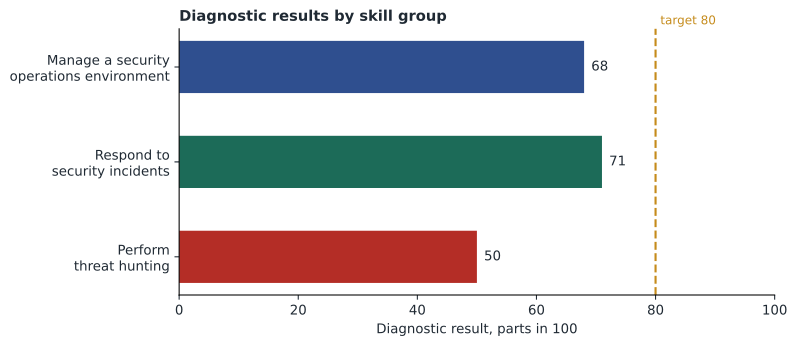
She had expected threat hunting to be her strongest area, because the KQL clinic was the most recent and most intense part of her fall. Instead it was her weakest, at 50 in 100. Looking at the wrong answers, Nadia saw why. Ama could write the queries she had practiced, but several questions asked which table to use for a source she had not queried, such as identity directory events or cloud app events, and two asked about KQL jobs and summary rules in the data lake, which she had read about but never run. Her strongest area was incident response, where the incident 4196 work had given her a feel for the order of steps. Managing the environment sat in between: she knew the Sentinel connectors and rules well but missed questions on Defender for Endpoint settings, device groups and automation levels.
Nadia set a target of 80 in 100 in every group on practice sets by September. A high average is not enough on its own, because the exam is long enough to expose a weak area and the weights are uneven: a weak first group costs more than a weak third group, but a very weak third group can still pull a total below the line. Lesson 3 turns the diagnostic and the weights into a study budget, and lesson 11 turns the budget into dates.
Worked problem
Reading a diagnostic result
Ama scored 17 of 25, 15 of 21 and 7 of 14 in the three skill groups. Her target is 80 in 100 in each group. How many more correct answers does she need in each group, rounding up to whole questions, and in total?
Show solution
- Target in group 1: 0.80 × 25 = 20, so she needs 20 − 17 = 3 more.
- Target in group 2: 0.80 × 21 = 16.8, which rounds up to 17, so she needs 17 − 15 = 2 more.
- Target in group 3: 0.80 × 14 = 11.2, which rounds up to 12, so she needs 12 − 7 = 5 more.
- \[3 + 2 + 5 = 10\]
- Her total would rise from 39 to 49 of 60, about 82 in 100, because rounding up in two groups puts the target slightly above 80.
Answer: She needs 3, 2 and 5 more correct answers, 10 in all, and half of the gap is in threat hunting.
Common mistakes
MistakeA scaled score of 700 means 70 in 100 answers were correct.
InsteadScores are scaled for the difficulty of each candidate's questions; 700 is the pass mark, not a fixed share.
MistakeSC-900 is a prerequisite for SC-200.
InsteadSC-200 has no prerequisites; SC-900 is useful preparation but optional.
MistakeSC-200 is about designing a security strategy.
InsteadStrategy and architecture belong to SC-100; SC-200 is about detecting, investigating, responding and hunting.
MistakeThe legacy practice assessment on Microsoft Learn is the best one to use.
InsteadMicrosoft recommends the newer practice assessment on AI Skills Navigator; the legacy one is no longer updated.
MistakeA failed attempt can be retaken whenever the candidate likes.
InsteadThe wait is 24 hours after a first failure and 14 days after each later one, with at most five attempts in 12 months.
Summary and key terms
- Exam SC-200 leads to the Microsoft Certified: Security Operations Analyst Associate certification.
- It lasts 100 minutes, is offered in ten languages, is proctored through Pearson VUE and may include interactive components.
- The pass mark is a scaled score of 700; the price depends on the country and Microsoft does not publish a question count.
- The study guide, with skills measured as of October 21, 2026, weights the three groups 40 to 45, 35 to 40 and 20 to 25 parts in 100.
- Renewal is a free yearly online assessment; retakes wait 24 hours, then 14 days, with at most five attempts in 12 months.
- Ama scored 39 of 60 on her diagnostic, with threat hunting weakest, and aims for 80 in 100 in every group.
- Role-based certification
- A Microsoft certification aimed at a job role, at the associate or expert level.
- Scaled score
- A score adjusted for the difficulty of a candidate's questions, reported on a scale of 1 to 1,000.
- Study guide
- The published list of skills measured on an exam, with weights and a change log.
- Exam sandbox
- A short demonstration of the exam interface and question types.
- Renewal assessment
- A free, unproctored online test that keeps a certification current for another year.
Practice problems
Work each problem on paper first, then reveal the answer to check.
How long is the SC-200 exam?
Show answer
100 minutes.
Which skill group carries the most weight?
Show answer
Managing a security operations environment, at 40 to 45 parts in 100.
What date were the current SC-200 skills measured as of, in November 2026?
Show answer
October 21, 2026.
Which account type does Microsoft recommend for registering?
Show answer
A personal Microsoft account, so the exam record is not lost if the candidate changes employer.
Why is a 60-question diagnostic not a prediction of the exam score?
Show answer
It is small and noisy; it shows strengths and weaknesses rather than a scaled score.
Lesson quiz · 5 questions
Score 60% or more to complete this lesson.
Create a free account to save your progress, take quizzes and earn a certificate.