
MSAZ-329 · Lesson 3 of 12 · 20 min
Domain weights
▶ Video coming soon A video version of this lesson is on the way.
Nikolai plans with numbers. After the diagnostic review he opened a spreadsheet and asked Ines a practical question: if she has about 100 hours for exam preparation between February 1 and her exam on Friday, May 28, 2027, how should she spend them? 'You can't study everything equally,' he said, 'and you shouldn't study what you're best at just because it feels good.' The answer depends on two things: how much of the exam each part of the outline is worth, and how well Ines already knows each part.
This lesson explains what the DP-700 weights mean and what they do not, counts the skills in each group, turns the weights and the diagnostic into a study budget, and pushes the budget down to the twelve areas of the outline. It ends with the limits of any such plan.
The three skill groups
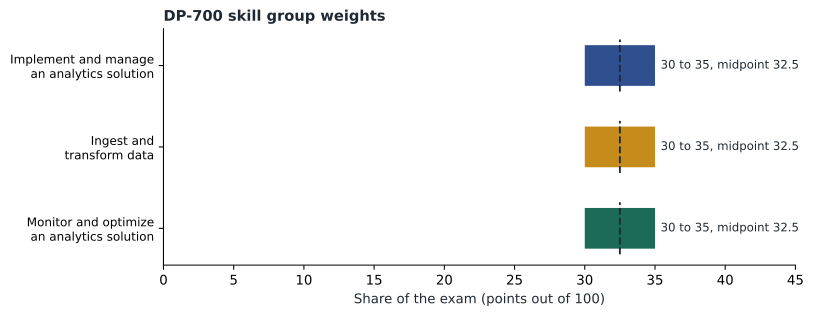
The DP-700 study guide divides the exam into three skill groups. Implement and manage an analytics solution covers workspace settings, lifecycle management, security and governance, and orchestration. Ingest and transform data covers loading patterns, batch ingestion and transformation, and streaming. Monitor and optimize an analytics solution covers monitoring, finding and fixing errors, and performance. Each group has a weight range of 30 to 35 parts in 100.
Equal weights are unusual. Many Microsoft exams have one large group and several small ones, which makes it tempting to put most of the effort into the large one. On DP-700 no group can be safely set aside. A candidate who is excellent at ingestion but weak at monitoring is weak on roughly a third of the exam.
What a weight range means
A weight range describes roughly what share of the exam's points comes from a group. It is a range, not a single number, because each candidate gets a different set of questions and the share varies from set to set. The DP-700 ranges add to between 90 and 105, which shows that they are approximate. A weight is about points rather than questions: if some questions are worth more than one point, a group could have fewer questions and still carry its share. And a weight says nothing about difficulty. A group with tricky questions can cost more marks than a group of the same weight that a candidate knows well.
How the skills are spread
Weights become more useful when they are compared with the number of skills listed. The study guide lists twelve areas and 49 skills. Counting them shows how thinly each group's weight is spread.
| Skill group | Areas | Skills listed | Midpoint weight | Weight per skill |
|---|---|---|---|---|
| Implement and manage an analytics solution | Workspace settings; lifecycle management; security and governance; orchestration | 16 | 32.5 | about 2.0 |
| Ingest and transform data | Loading patterns; batch data; streaming data | 17 | 32.5 | about 1.9 |
| Monitor and optimize an analytics solution | Monitoring; errors; performance | 16 | 32.5 | about 2.0 |
The skills are spread almost evenly, at about 2 points of weight per skill. Two conclusions follow. First, every listed skill matters; no single skill dominates the exam. Second, the areas inside a group are uneven in size. The batch-data area under ingest and transform has nine skills, from choosing a data store to handling late-arriving data, while the loading-patterns area has three. A candidate who studies area by area should give the batch-data area about three times the attention of loading patterns, not the same amount.
Counts are only a guide. Some skills, such as 'Transform data by using PySpark, SQL and KQL', are broad and could produce many questions. Others, such as 'Endorse items', are narrow. But the exercise makes Nikolai's point: the outline is a checklist, and Ines should be able to say something specific about every line on it.
Turning results into a budget
A diagnostic set is too small to measure knowledge precisely, but it is good enough to set priorities. Nikolai's method gives each group a need score: its midpoint weight multiplied by the share of diagnostic questions Ines got wrong. A heavy group where she does poorly gets the most need; a group she knows well gets the least. Hours are then shared in proportion to need.
weights = {"Implement and manage": 32.5, "Ingest and transform": 32.5, "Monitor and optimize": 32.5}
correct = {"Implement and manage": (14, 20), "Ingest and transform": (13, 20), "Monitor and optimize": (10, 20)}
hours_available = 100

need = {}
for group, weight in weights.items():
    right, asked = correct[group]
    need[group] = weight * (1 - right / asked)

total_need = sum(need.values())
for group in weights:
    share = need[group] / total_need
print(f"{group:22} need {need[group]:6.3f} hours {hours_available * share:5.1f}")Implement and manage need 9.750 hours 26.1 Ingest and transform need 11.375 hours 30.4 Monitor and optimize need 16.250 hours 43.5
What this code does
The program starts with the midpoint weight of each skill group and how many diagnostic questions Ines answered correctly in it. For each group it multiplies the weight by the share she got wrong, giving a need score that is large when a group is both heavy and weak. It then divides the 100 hours in proportion to those scores, so the printout shows how many hours each group should get.
Because the weights are equal, the result simply follows her mistakes: about 44 hours for monitoring and optimizing, 30 for ingesting and transforming, and 26 for implementing and managing. Ines was relieved that the plan matched her instinct, but Nikolai pointed out that this only happens because the weights are equal. On an exam with uneven weights, a heavy group with a moderate result can outrank a light group with a poor one.
Nikolai then adjusts by judgment. The pilot will run on the F16 capacity from January 4, so by February Ines will have weeks of real monitoring experience she does not have today. He keeps the monitoring hours anyway, because the exam asks about items the pilot will not use, such as semantic model refreshes and eventstream errors, and because her diagnostic mistakes there were about recognizing problems she had never seen. He moves three hours from implementing and managing into orchestration patterns with parameters and dynamic expressions, which she found slow on the diagnostic even when she got the answer right.
Budgeting by area
The same thinking works one level down. Inside each group, Ines puts more time into large areas and areas where her diagnostic answers were weak. The result is written as a table with one row per area, the planned hours, the main source and a practice method. It is a budget, not a calendar; lesson 11 turns it into dates.
| Area | Planned hours | Main source | Practice method |
|---|---|---|---|
| Workspace settings | 4 | MSAZ-310 | Name each setting and what changes when it is turned on |
| Lifecycle management | 7 | MSAZ-310 lesson 10, MSAZ-320 lesson 12 | Branch out, commit, deploy through three stages twice |
| Security and governance | 8 | MSAZ-310 lessons 7 to 9 | Pick the control for each of 20 short access requirements |
| Orchestration | 7 | MSAZ-320 lesson 2 | Write pipeline expressions and parameter passing from memory |
| Loading patterns | 5 | MSAZ-320 lessons 1, 3, 8, 9 | Design full, incremental and streaming loads for three sources |
| Batch ingestion and transformation | 16 | MSAZ-320 | Choose a store and a tool for 15 scenarios; write the transform |
| Streaming | 9 | MSAZ-320 lesson 11, MSAZ-321 lessons 1 to 6 | Choose an engine and write a window for six sensor cases |
| Monitoring and alerts | 12 | MSAZ-321 lessons 7, 8 | Find the right monitoring tool for each of 12 symptoms |
| Errors | 14 | MSAZ-321 lesson 11, MSAZ-320 lesson 12 | Read error messages for six item types and name the fix |
| Performance | 15 | MSAZ-321 lessons 9, 10 | Tune a slow table, pipeline, warehouse query and Spark job |
| Reserve | 3 | Kept for weak spots found in April |
What weights cannot tell you
Weights describe the exam as a whole. They do not say which questions Ines will get, how hard they will be or how many points each one carries. A candidate can study exactly by the weights and still meet a set of questions that leans toward the area they know least. That is why the target is a margin above the pass mark in every group rather than a high overall average.
Weights also hide the way groups overlap. A question about a failed nightly load is in the errors area, but the fix may need knowledge of watermarks from loading patterns and of retry settings from orchestration. A question about giving a store team access to curated tables is in security, but it may turn on knowing the difference between a lakehouse and its SQL analytics endpoint. Studying by group is a convenient way to organize time; the exam tests a working engineer.
Finally, a 60-question diagnostic is noisy. Ten correct answers out of twenty in monitoring could easily have been eight or twelve on another day. Ines will measure again with larger practice sets in April and May and move hours if the pattern changes. The plan is a starting point, not a forecast.
Checking the outline against experience
Before setting hours, Nikolai and Ines went through all 49 skills and marked each one in three ways: done on the hub this fall, seen in a course but not done, or not met at all. The result was useful in a way the diagnostic alone was not. Of the 49 skills, Ines had done 21 on the hub, seen 22 in the three Fabric courses, and not met 6. The six she had not met were configuring data workflow workspace settings, implementing database projects, monitoring semantic model refresh, resolving dataflow errors other than credentials, optimizing eventstreams, and processing data with Spark structured streaming at production scale rather than as a prototype.
| Status | Skills | Example | Study approach |
|---|---|---|---|
| Done on the hub | 21 | Incremental loads with a watermark | Short review; practice exam wording |
| Seen in a course only | 22 | Hopping and session windows | Hands-on lab, then practice questions |
| Not met | 6 | Database projects for a warehouse | Read the documentation, build a small example, then practice |
The table changes how the hours are used inside each area more than it changes the totals. An hour on a skill Ines has already done is mostly practice with exam-style questions. An hour on a skill she has only read about is mostly a lab. An hour on a skill she has never met starts with documentation and a small build. Nikolai's rule of thumb is that a skill moves up one level for each focused hour: from not met to seen, from seen to done, from done to confident. That rule is rough, but it makes the budget easy to check: the 6 unmet skills need at least 18 hours between them, and the 22 seen-only skills need about 44, which leaves enough of the 100 for review and practice sets.
Worked problem
Need scores with equal weights
Every DP-700 group has a midpoint weight of 32.5. Ines missed 6, 7 and 10 of 20 questions in the three groups. Find each need score and the share of 100 hours each group receives.
Show solution
- \[32.5 \times 6 \div 20 = 9.75\]
- \[32.5 \times 7 \div 20 = 11.375\]
- \[32.5 \times 10 \div 20 = 16.25\]
- \[9.75 + 11.375 + 16.25 = 37.375\]
- \[100 \times 16.25 \div 37.375 \approx 43.5\]
- Implement and manage gets about 26.1 hours and ingest and transform about 30.4.
Answer: About 26, 30 and 44 hours. With equal weights the hours are simply in proportion to the questions missed: 6, 7 and 10 out of 23.
Common mistakes
MistakeThe weight ranges add to exactly 100.
InsteadOn DP-700 they add to between 90 and 105; each range is an approximate share of the points.
MistakeEqual weights mean equal study time.
InsteadTime should follow weakness too; Ines's monitoring group gets the most hours because she missed the most there.
MistakeWeights say how many questions each group will have.
InsteadWeights describe points, and some questions may be worth more than one point.
MistakeEvery area in a group deserves the same time.
InsteadAreas differ in size: batch ingestion has nine skills, loading patterns three.
MistakeA diagnostic score is a reliable measure of readiness.
InsteadA small set is noisy; use it to set priorities and measure again with larger sets.
Summary and key terms
- DP-700 has three skill groups, each weighted 30 to 35 parts in 100.
- The study guide lists 12 areas and 49 skills, about 2 points of weight per skill.
- A need score multiplies a group's midpoint weight by the share of practice questions missed; hours follow need.
- Ines's 100 hours split about 26, 30 and 44 across the three groups, with monitoring and optimizing largest.
- Budget by area too, giving the most time to large, weak areas such as batch ingestion, errors and performance.
- Weights cannot predict a particular exam; aim for a margin in every group and re-measure.
- Skill group
- One of the three top-level parts of the DP-700 outline, each with a weight range.
- Weight range
- The approximate share of an exam's points that comes from one skill group.
- Midpoint weight
- The middle of a weight range, used as a single planning number.
- Need score
- A planning figure equal to a group's weight multiplied by the share of practice questions missed.
- Study budget
- A table of planned hours by area, with a source and practice method for each.
Practice problems
Work each problem on paper first, then reveal the answer to check.
What is the weight range of each DP-700 skill group?
Show answer
30 to 35 parts in 100.
How many skills does the study guide list in total?
Show answer
49, across 12 areas.
Why does the monitoring group get the most hours in Ines's plan?
Show answer
The weights are equal, so hours follow her mistakes, and she missed the most questions there.
Which area of ingest and transform has the most listed skills?
Show answer
Ingest and transform batch data, with nine skills.
Why is a diagnostic set a poor predictor of a scaled score?
Show answer
It is small and noisy; it shows priorities rather than a likely result.
Lesson quiz · 5 questions
Score 60% or more to complete this lesson.
Create a free account to save your progress, take quizzes and earn a certificate.