
MSAZ-329 · Lesson 2 of 12 · 21 min
Question types and case studies
▶ Video coming soon A video version of this lesson is on the way.
When Ines and Nikolai went through the wrong answers on her diagnostic, about a third of her mistakes had nothing to do with Fabric. In one question she chose two options when the question said 'Each correct answer presents a complete solution', and picked a pair that only worked together. In another she spent four minutes on a long scenario before realizing the question underneath it was about one setting. In a third, a list of five steps, she put the right steps in the wrong order because she had never done that task in that sequence. 'These are format mistakes,' Nikolai said. 'They are the cheapest marks to win back.'
This lesson goes through the question formats Microsoft uses on role-based exams, the layout of a case study, the possibility of interactive components on DP-700, and the rules about reviewing answers. It ends with a reading method that works across all of them.
Why formats matter
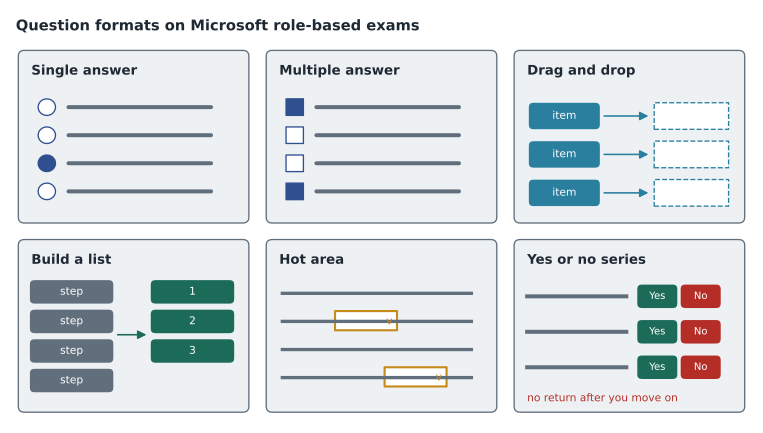
Each format asks for a different kind of thinking. A single-answer question wants the best option among several that may look reasonable. A multiple-answer question gives credit only for the right combination. A build-a-list question tests whether the candidate knows the order of a task, not only its parts. A case study tests whether the candidate can hold a whole business situation in mind and apply it to several questions. Recognizing the format in the first few seconds tells a candidate how to read the rest of the question.
Microsoft's exam sandbox shows each format with sample content and the same navigation buttons as the real exam. Ines will click through it once in February and once in May, so that the interface is familiar and none of her 100 minutes go on learning where the review button is.
Single answer
The most common format gives a short scenario, a requirement and four or more options, one of which is correct. DP-700 scenarios usually describe a workspace, a source system, a schedule or a problem, then ask what to do: 'You need to load only the rows that changed since the last run, with the least development effort. What should you use?' The trap is that several options would work. A notebook with custom watermark logic would load changed rows, but a copy job with incremental copy does it with less effort. The words 'least effort', 'minimize cost' or 'without writing code' are the part of the requirement that decides between options that all work.
Nikolai's method is to read the last sentence first, the one that asks the question, and list the constraints in it. Then read the scenario for facts that bear on those constraints. Then test each option against each constraint. Usually two options fail at once, and the remaining two differ in one detail that the scenario has already settled, such as the size of the data, whether the source supports change data capture, or whether the team writes Python.
Multiple answer
Multiple-answer questions say how many options to choose. The wording matters. 'Each correct answer presents part of the solution' means the chosen options work together, such as the two permissions an engineer needs to run a pipeline that writes to a lakehouse. 'Each correct answer presents a complete solution' means each chosen option works on its own, such as two different ways to stop analysts from seeing the full value of a column. The interface does not let a candidate choose more than the stated number. Whether partial credit is given is shown in the instructions for that question.
Ines's diagnostic mistake was exactly this. The question asked for two complete solutions to hide email addresses from analysts in a warehouse, and she chose dynamic data masking and a security role, which together would work but which she had pictured as one solution. Each of those is a complete solution for a different version of the requirement: masking when analysts should still see a partly hidden value, column-level security when they should not be able to query the column at all.
Drag and drop and build a list
Drag-and-drop questions give a set of items and a set of targets. A candidate might drag the names of Fabric items into the boxes of an architecture diagram, or drag KQL operators into the blanks of a query. Some items are not used, and some may be used more than once; the instructions say which. Build-a-list questions ask the candidate to move steps into an answer area in the right order, for example the steps to promote a change from a development workspace to production through a deployment pipeline: commit the change to Git from the development workspace, deploy to the test stage, validate, then deploy to production with deployment rules that change the connections.
When Ines cannot recall an order, she asks what each step depends on. A deployment rule cannot be set until the pipeline has a stage to set it on. A shortcut cannot point to a folder until the connection exists. A watermark cannot be read before the control table has a row. Dependencies usually reveal the sequence, and they are also how a real engineer would plan the task.
Hot area
A hot area question shows a diagram, a screen, a code listing or a table and asks the candidate to select part of it, or to choose values from drop-down lists placed inside it. On DP-700 a common version shows a PySpark, SQL or KQL statement with two or three drop-down boxes in place of a function, a keyword or a number: a choice between append and overwrite, between summarize and extend, or between a tumbling and a hopping window. Each drop-down is often scored separately, so a candidate who knows two of three can still earn credit.
The key habit is to read the whole statement before choosing anything. The right value in an early box often depends on a clause near the end. A choice between merge and append for a write, for example, depends on whether the statement later names a key column to match on. Lesson 7 practices this in detail.
Yes or no series
A yes or no series gives one scenario and then a sequence of proposed solutions, usually three, each on its own screen. The candidate says whether each solution meets the goal. These questions often cannot be revisited once answered, because seeing the later solutions could give away the earlier answers; the exam says so at the start of the series. Each solution must be judged against the goal exactly as stated. A solution that would work but costs more, takes longer or needs more privileges than the goal allows is a 'no'.
Ines found these the most stressful format on the diagnostic, because she second-guessed the first answer after reading the second. Nikolai's advice is to treat each solution as a separate question and to decide it fully before moving on, using only the scenario and the goal, not what the other solutions might reveal.
Case studies
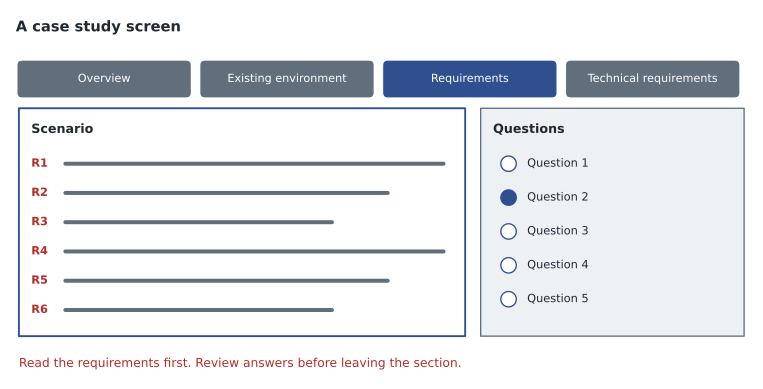
A case study presents a longer scenario about a fictional organization, split into tabs such as Overview, Existing environment, Requirements and Technical requirements, followed by several questions that all refer to it. The scenario may describe the company's sources, its current Fabric workspaces, its security rules and its plans. Questions might ask which item to use for a new load, how to give a team access, or how to fix a slow query, all within the constraints stated in the case.
Case studies are usually presented as a separate section. The exam warns when a case study begins, and once the candidate leaves the section, its questions cannot be reviewed. Inside the section, the candidate can move between the scenario tabs and the questions freely. Ines's habit will be to skim the tabs once, noting the requirements in her head, and then read each question and go back to the one tab that matters for it, rather than trying to memorize everything first. Lesson 9 practices a full case.
Interactive components
The DP-700 certification page says the exam may include interactive components. On some Microsoft exams this has meant tasks in a simulated or live environment, where the candidate performs steps rather than choosing an answer. Microsoft does not publish exactly how many such items appear, and the mix can change. The safest preparation is the same as for every other format: practice the tasks themselves in a real workspace. Lesson 10 sets out a hands-on practice plan for exactly that reason. If an interactive item appears, the candidate should read the task, do only what it asks, and check that each requirement is met before moving on.
Reviewing answers
For most sections, the candidate can mark a question for review and return to it before finishing the section. The review screen lists answered, unanswered and marked questions. Unanswered questions score nothing, so every question should get an answer, even a guess, before time runs out; there is no extra penalty for a wrong answer compared with a blank one. Questions that cannot be revisited, such as the yes or no series and case study sections, are announced in advance.
Ines will use marking sparingly. A question gets marked only if she has a specific reason to revisit it, such as a later question that might jog her memory. Marking a third of the exam and then rushing through the review in the last ten minutes is worse than committing to a best answer on the first pass.
How long each format takes
Formats also differ in how long they take. A short single-answer question can take under a minute. A listing with three drop-downs, or a case study question that sends the candidate back to a requirements tab, can take three or four. On the diagnostic Ines averaged about a minute and a half per question, but her times ranged from 20 seconds to over five minutes, and the long ones were nearly all questions where she had not recognized the format at first. Lesson 11 turns this into a pacing plan with checkpoints. The point for now is that a candidate who knows the formats spends their time on Fabric, not on working out what the screen wants.
Nikolai also asked Ines to note, during practice, which formats she gets wrong most often. If the pattern is a format rather than a topic, the fix is a reading habit, which takes days to build, not a study area, which takes weeks.
Worked problem
Complete solution or part of one
A question says: 'Analysts must not see customers' email addresses in the warehouse table dbo.customers, but must still see the email column in their query results, with the values hidden. Each correct answer presents a complete solution. Which two actions should you take?' The options are: (A) apply dynamic data masking to the email column; (B) deny SELECT on the email column with column-level security; (C) move the email column to a separate table the analysts cannot read; (D) replace each email with a masked copy in a view and grant analysts access only to the view.
Show solution
- The requirement has two parts: the analysts must not see the values, and the column must still appear in their results.
- Option A: masking hides the values while leaving the column visible. It meets both parts on its own.
- Option B: column-level security makes any query that selects the column fail, so it never appears in their results. It fails the second part.
- Option C: removing the column from the table fails the second part.
- Option D: a view that shows a masked copy of the column keeps the column visible and hides the values. It also meets both parts on its own.
Answer: A and D. Each is a complete solution by itself, which is what the instruction asks for.
Common mistakes
Mistake'Each correct answer presents a complete solution' means the options work together.
InsteadIt means each chosen option works on its own; 'part of the solution' means they work together.
MistakeRead the scenario carefully first, then the question.
InsteadRead the question sentence first to find the constraints, then read the scenario for the facts that matter.
MistakeQuestions in a yes or no series can always be revisited.
InsteadThey are often not reviewable; the exam says so at the start of the series.
MistakeLeave hard questions blank and come back if there is time.
InsteadUnanswered questions score nothing; give a best answer, and mark it only if there is a reason to return.
MistakeInteractive items need special tricks.
InsteadThey need hands-on familiarity with the tasks, which comes from practice in a real workspace.
Summary and key terms
- Microsoft role-based exams use single-answer, multiple-answer, drag-and-drop, build-a-list, hot area and yes or no formats, plus case studies.
- Read the question sentence first, list its constraints, and test each option against each constraint.
- Watch the difference between 'part of the solution' and 'a complete solution' in multiple-answer questions.
- Case studies are separate sections with tabs; once you leave a section, you cannot review it.
- DP-700 may include interactive components, so practice the tasks themselves.
- Answer every question; mark for review only with a specific reason.
- Case study
- A long scenario about a fictional organization, followed by several questions that refer to it.
- Hot area
- A question format where the candidate selects part of a diagram or code, or picks values from drop-down lists placed in it.
- Yes or no series
- A set of proposed solutions to one scenario, each judged separately against the goal.
- Build a list
- A question format where the candidate moves steps into an answer area in the right order.
- Exam sandbox
- A Microsoft demonstration of the exam interface and question formats.
Practice problems
Work each problem on paper first, then reveal the answer to check.
What does 'Each correct answer presents part of the solution' mean?
Show answer
The chosen options must work together to meet the goal.
Why can yes or no series questions often not be revisited?
Show answer
Seeing later proposed solutions could reveal the answers to earlier ones.
What is Nikolai's first step when reading a single-answer question?
Show answer
Read the question sentence first and list its constraints.
Is there a penalty for a wrong answer compared with leaving a question blank?
Show answer
No; a blank scores nothing, so every question should get an answer.
How should a candidate prepare for interactive components?
Show answer
By practicing the tasks in a real workspace, so the steps are familiar.
Lesson quiz · 5 questions
Score 60% or more to complete this lesson.
Create a free account to save your progress, take quizzes and earn a certificate.