
MSAZ-329 · Lesson 11 of 12 · 20 min
Timed practice plan
▶ Video coming soon A video version of this lesson is on the way.
Knowing the material and finishing the exam in time are two separate problems. Ines's diagnostic in November was untimed, and she took nearly two and a half hours over it. On the real exam she will have 100 minutes. 'Speed isn't something you add at the end,' Nikolai said. 'You build it the same way as knowledge: in small amounts, often, and by measuring it.' This lesson turns the plan from lesson 3 into a dated calendar from February 1 to May 28, 2027, with timed practice built in, a pacing method for exam day, and rules for adjusting the plan when results come in.
The plan is Ines's, but its shape fits most candidates with a full-time job: about six hours a week, a review phase, a timed phase, and a light final week. The dates and hours can be changed; the order matters more than the numbers.
The shape of the plan
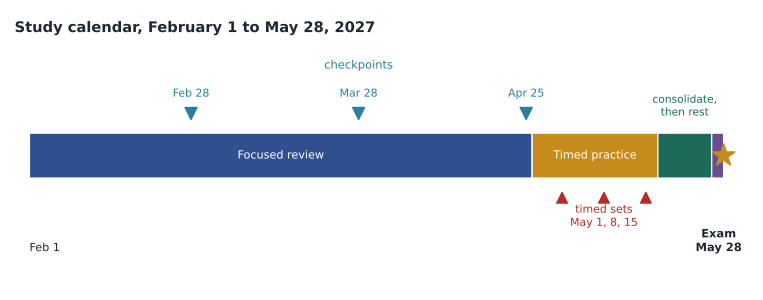
The plan has four phases. Phase 1, from Monday, February 1 to Sunday, April 25, is the focused review: twelve weeks covering the three skill groups in the order and with the hours set by the need scores in lesson 3, with one lab a week from lesson 10 and a short daily reading drill from lesson 7. Phase 2, from April 26 to May 16, is timed practice: three weeks of full-length and half-length timed sets, with review of every miss. Phase 3, from May 17 to May 25, is consolidation: no new material, only weak spots from the practice log and the trap card. Phase 4, May 26 to May 28, is rest and logistics: a short review, a check of the exam booking and identification, and an early night before the exam on Friday.
| Phase | Dates (2027) | Hours | Main activity |
|---|---|---|---|
| 1. Focused review | Feb 1 to Apr 25 | About 72 | Review lessons, labs, daily reading drill |
| 2. Timed practice | Apr 26 to May 16 | About 20 | Timed sets and review of every miss |
| 3. Consolidation | May 17 to May 25 | About 6 | Practice log, trap card, weak spots |
| 4. Rest and logistics | May 26 to May 28 | About 2 | Light review, booking and ID check, sleep |
The total is about 100 hours, matching the budget in lesson 3. The review phase gets most of the time because it is where gaps are filled. The timed phase is shorter but more intense; each hour includes a timed set and its review.
Phase 1 in detail
Within the review phase the order of skill groups follows the need scores. Monitor and optimize had the largest need, so it comes first, from February 1 to March 14, six weeks with about 31 hours including labs 8 to 11. Ingest and transform comes next, from March 15 to April 4, three weeks with about 22 hours and labs 4 to 7. Implement and manage, her strongest group, comes last, from April 5 to April 25, three weeks with about 19 hours and labs 1 to 3. Putting the strongest group last has a useful side effect: it is fresh in her mind going into the timed phase, while the weakest group has had the longest time to settle and has been revisited by the drills and checkpoints in between.
Each week has the same rhythm, which makes it easy to keep going on tired evenings. Monday and Tuesday are reading: one review lesson section and its notes. Wednesday is the lab. Thursday is practice questions on the week's skills, about 20 questions, with the practice log updated. Friday is off. Saturday morning is a longer session: finishing the lab, writing the lab note and doing any catch-up. Sunday is off. The ten-minute reading drill runs every weekday morning before work.
Checkpoints
The plan has three checkpoints in phase 1, at the end of February, March and April: on Sunday, February 28, Sunday, March 28 and Sunday, April 25. At each one, Ines takes the free practice assessment in practice mode or a set of 30 questions across all skills, records the score by skill group, and compares it with the last checkpoint. The checkpoint is not a test she can pass or fail; it is a measurement that decides whether the next month's hours stay as planned or move.
The adjustment rule is simple. If a group's score at a checkpoint has risen to at least 80 out of 100 on questions in that group, it gets no extra hours and can lose up to two hours to the weakest group. If a group's score has not risen since the previous checkpoint, the next month adds a lab and two hours for it, taken from the strongest group. If every group is above 80, she adds timed sets earlier. Nikolai's view is that a rule written down in advance prevents the common mistake of spending extra time on whatever feels most pleasant to study.
Phase 2: timed practice
Timed practice starts on Monday, April 26. The phase has three full-length timed sets, on Saturday mornings, May 1, May 8 and May 15, each 100 minutes, as close to exam conditions as possible: one sitting, no notes, phone in another room, the same time of day as the exam booking. Between them, on weekday evenings, she does half-length sets of 50 minutes on mixed skills. Every set is followed by a review session of at least the same length, in which every miss and every guess is logged with its pattern from lesson 8.
Microsoft does not publish a fixed number of questions for DP-700, and the number can vary between sittings. For practice, Ines uses sets of about 50 questions for a full-length sitting, including one case study of about 8 questions, because that is a reasonable size for 100 minutes and pacing with a larger set is the safer habit. If the real exam has fewer questions, she will have spare time; if it has a similar number, she will be ready for it.
Pacing checkpoints
A pacing plan answers one question during the exam: am I on time? Rather than calculating under pressure, Ines will set three checkpoints before she starts, based on the number of questions shown at the beginning. She budgets time for the case study separately because its questions take longer, and keeps a reserve at the end for reviewing marked questions. The Python below works out the checkpoints for a practice sitting.
total_minutes = 100
reserve = 10
questions = 50
case_study_questions = 8
case_study_minutes = 20

single = questions - case_study_questions
single_minutes = total_minutes - reserve - case_study_minutes
per_question = single_minutes / single
print(f"single questions: {single}, about {per_question:.2f} minutes each")

for done in (14, 28, single):
    minute = done * per_question
    print(f"after question {done:2}: aim to be at about minute {round(minute)}")

print(f"case study: minutes {round(single_minutes)} to {round(single_minutes + case_study_minutes)}")
print(f"reserve for marked questions: last {reserve} minutes")single questions: 42, about 1.67 minutes each after question 14: aim to be at about minute 23 after question 28: aim to be at about minute 47 after question 42: aim to be at about minute 70 case study: minutes 70 to 90 reserve for marked questions: last 10 minutes
What this code does
The program starts with the 100 minutes of the sitting and keeps 10 of them back as a reserve. It sets aside 20 minutes for a case study of 8 questions, so the remaining 42 single questions share the other 70 minutes, which comes to about one and two thirds of a minute each. It then prints the minute by which she should have finished question 14, question 28 and the last single question, and finally prints when the case study should start and end and how long is left for reviewing marked questions.
The output gives Ines three times to remember: question 14 by about minute 23, question 28 by about minute 47 and the last single question by minute 70. If she is ahead at a checkpoint, she carries on at the same pace. If she is more than five minutes behind, she uses the rule from lesson 2: make the best choice, mark the question for review and move on. On exam day she will rerun the same arithmetic in her head with the real question count, which takes less than a minute once practiced.
One point matters for case studies. On many Microsoft exams, once a candidate leaves a case study section they cannot return to it, and questions in some sections cannot be reviewed after moving on. The exam tells the candidate when this is the case, at the start of the section. Ines's pacing plan therefore treats the case study as its own block with its own reserve: she reviews her case study answers before leaving it, not at the end of the exam.
Reviewing timed sets
A timed set without a review is mostly wasted. The review has a fixed form. For each question she got wrong or guessed, she writes the skill, the pattern from lesson 8 if one applies, the deciding detail she missed, and what she will do differently. She also writes the time she spent on any question that took more than three minutes, because slow questions are a pacing problem even when they are right. After three timed sets, the log usually shows two or three repeated causes. On her November diagnostic, the most common causes were reading the requirement too fast and not knowing which engine a feature belongs to; she expects them to be different by May, and the log will show whether they are.
Keeping the plan alive
Plans fail more often from interruptions than from difficulty. Work deadlines, illness and holidays will take some weeks away. The plan has two buffers. The first is that Fridays and Sundays are free, so a missed evening can move to Friday without disturbing anything else. The second is that the consolidation phase is flexible: if April runs late, phase 3 shrinks before phase 2 does, because timed practice is harder to replace. If more than two weeks are lost, Ines will move the exam rather than cut timed practice; the retake policy makes a failed attempt costly in time, and rescheduling a booking well before the date is usually simple.
Nikolai will check in every second Thursday at a short meeting already in both calendars. He looks at the practice log, not at her mood about the plan, and the only question he asks is whether the next two weeks still match the plan or need the adjustment rule.
Simulating exam conditions
A timed set only builds exam readiness if it feels like the exam. Ines will sit each full set at 9 a.m. on a Saturday, the same time as her booking, at a desk with nothing on it but a blank sheet and a pen to stand in for the note board. She will use the practice assessment's exam mode where it offers one, or a mixed set of questions she has not seen, so that she cannot recognize answers from memory. A set made of questions she has already reviewed measures recall, not readiness, and Nikolai warned that this is the most common way timed practice gives a falsely high score.
Worked problem
Applying the adjustment rule at a checkpoint
At the February 28 checkpoint, Ines scores 74 on ingest and transform (up from 65 in November), 70 on monitor and optimize (up from 50) and 82 on implement and manage (up from 70). What should change for March?
Show solution
- Implement and manage is at least 80, so it gets no extra hours and can give up to two hours.
- Ingest and transform and monitor and optimize have both risen, so neither triggers the extra-lab rule.
- Monitor and optimize is still the weakest group, at 70, so the two hours from implement and manage go there.
- Monitor and optimize is being reviewed until March 14, so the two hours are added to the first two weeks of March.
Answer: Move two hours from implement and manage to monitor and optimize in early March; no other change.
Common mistakes
MistakeTimed practice can wait until the last week.
InsteadPacing is a skill built over several weeks; start full timed sets at least three weeks before the exam.
MistakeA timed set is finished when the time runs out.
InsteadEach set needs a review of at least the same length, logging every miss and guess.
MistakeSpend extra time on whatever feels weakest today.
InsteadUse a written adjustment rule at fixed checkpoints, based on measured scores.
MistakeThe exam always has the same number of questions.
InsteadThe number can vary; work out pacing checkpoints from the count shown at the start.
MistakeCase study answers can be reviewed at the end of the exam.
InsteadSome sections cannot be revisited; review case study answers before leaving the section.
Summary and key terms
- Split about 100 hours into focused review, timed practice, consolidation and rest.
- Order the review by need score, and keep a steady weekly rhythm with free evenings as buffers.
- Measure at monthly checkpoints and adjust hours with a rule written in advance.
- Do three full timed sets in exam conditions, with half sets between them, and review every one.
- Set pacing checkpoints from the question count, budget the case study separately, and keep a reserve.
- If time is lost, shrink consolidation first; move the exam rather than skip timed practice.
- Checkpoint
- A fixed date on which progress is measured and the plan is adjusted.
- Adjustment rule
- A rule, written in advance, for moving hours between skill groups based on checkpoint scores.
- Timed set
- A practice sitting under exam conditions with a strict time limit.
- Pacing checkpoint
- A question number and target minute used to check progress during an exam.
- Reserve
- Minutes kept at the end of an exam for reviewing marked questions.
Practice problems
Work each problem on paper first, then reveal the answer to check.
What are the four phases of Ines's plan?
Show answer
Focused review, timed practice, consolidation, and rest and logistics.
On which dates are the three full timed sets?
Show answer
Saturdays May 1, May 8 and May 15, 2027.
If a group scores at least 80 at a checkpoint, what happens to its hours?
Show answer
It gets no extra hours and can give up to two hours to the weakest group.
In the pacing example, by about which minute should question 28 be done?
Show answer
About minute 47.
What gives way first if April runs late?
Show answer
The consolidation phase shrinks before timed practice does.
Lesson quiz · 5 questions
Score 60% or more to complete this lesson.
Create a free account to save your progress, take quizzes and earn a certificate.