
MEC-280 · Lesson 8 of 12 · 23 min
Welding processes and weld metallurgy
The KG-40 gearbox hangs from the tractor frame on a welded steel cradle: two 10 mm plates of ASTM A572 Grade 50 structural steel joined by fillet welds to a length of rectangular tube, with a forged 4140 lifting eye welded on top. Welding makes permanent joints by fusing the parts together, usually with added filler metal. It builds bridges, ships, pipelines, pressure vessels, truck frames and farm equipment, and it repairs worn and broken parts. It is also the joining process most likely to cause trouble if it is not specified and controlled carefully. This lesson covers the main welding processes, how heat input and cooling shape the weld's structure, the defects and distortion welding causes, and how welds are qualified and inspected.
Welding of structures in the United States is governed largely by AWS D1.1, the Structural Welding Code for steel, and by codes such as the ASME Boiler and Pressure Vessel Code for pressure equipment. Kestrel Drive Systems's cradle is not a building structure, but the company follows D1.1 practice for procedures and welder qualification because customers ask for it.
Fusion welding: the common arc processes
Most production welding melts the joint edges with an electric arc. The arc, a current flowing through ionized gas between an electrode and the work at around 20 to 35 volts and tens to hundreds of amperes, reaches temperatures of several thousand degrees and melts a small weld pool that travels along the joint. The molten metal must be protected from oxygen and nitrogen in the air, which would make the weld porous and brittle, by a shielding gas, a flux or both.
Shielded metal arc welding (SMAW), or stick welding, uses a consumable electrode coated with flux. The flux burns to form shielding gas and a slag that covers the cooling weld. Equipment is simple and portable, ideal for field work and repairs, but deposition rates are low and the welder must stop to change electrodes and chip slag. Gas metal arc welding (GMAW), often called MIG welding, feeds a continuous solid wire through a gun with shielding gas, usually argon-carbon dioxide mixtures for steel. It is fast, easy to automate and robotize, and is the workhorse of factory welding; the cradle will be GMAW welded by a robot. Flux-cored arc welding (FCAW) uses a tubular wire filled with flux, with or without external gas, giving high deposition and good tolerance of mill scale.
Gas tungsten arc welding (GTAW), or TIG, uses a non-consumable tungsten electrode with inert gas shielding, adding filler rod separately if needed. It gives very clean, precise welds on thin material, stainless steel, aluminum and titanium, and is used for root passes on pipe, but it is slow. Submerged arc welding (SAW) buries the arc under granular flux; it is very fast and deep penetrating, used for thick plate, beams, pipe and pressure vessels in flat or horizontal positions.
| Process | Shielding | Typical deposition (kg/h) | Strengths | Limitations |
|---|---|---|---|---|
| SMAW (stick) | Flux coating | 1 to 3 | Portable, all positions, simple equipment | Slow, slag removal, skill dependent |
| GMAW (MIG) | Gas | 2 to 8 | Fast, easy to automate, little cleanup | Wind disturbs gas; less portable |
| FCAW | Flux core, with or without gas | 3 to 10 | High deposition, tolerant of scale | Slag, fumes |
| GTAW (TIG) | Inert gas | 0.5 to 1.5 | Clean, precise, any metal | Slow, high skill |
| SAW | Granular flux | 5 to 20+ | Very fast, deep penetration | Flat or horizontal only, thick work |
Other welding processes
Resistance welding passes a large current through overlapping sheets clamped between copper electrodes; the contact resistance heats a small nugget that fuses in a fraction of a second. Resistance spot welding joins car bodies, with several thousand spot welds per vehicle. Laser and electron beam welding focus energy into a very small spot, producing deep, narrow welds with little heat input and distortion; they join transmission gears, battery tabs and precision assemblies. Friction welding spins one part against another until the interface is hot and plastic, then forges them together without melting; it joins dissimilar metals such as aluminum to steel and is used for axle shafts and drill pipe. Friction stir welding traverses a rotating pin along a joint in aluminum plate, stirring the softened metal together below its melting point.
Heat input
The amount of heat put into the joint per unit length governs much of what follows: penetration, the size of the heat-affected zone, the cooling rate and distortion. Arc heat input is calculated from the arc voltage \(V\), current \(I\) and travel speed \(v\), multiplied by a thermal efficiency \(\eta\) that accounts for heat lost from the arc before it reaches the work, about 0.8 for GMAW and SMAW, 0.6 to 0.7 for GTAW and 0.95 or more for SAW.
Typical arc welds have heat inputs of 0.5 to 3 kJ/mm. Higher heat input means slower cooling, a wider heat-affected zone and more distortion; lower heat input means faster cooling, which can produce hard, crack-prone structures in steels with high carbon or alloy content. Procedures therefore specify a range of heat input, not just a current.
Weld metallurgy: the zones of a weld
A fusion weld has three regions. The fusion zone is metal that melted and resolidified, a mixture of filler and base metal with a cast structure of columnar grains growing inward from the fusion boundary. Next to it is the heat-affected zone, base metal that did not melt but was heated enough to change its microstructure. Beyond lies unaffected base metal. In steels the heat-affected zone itself has sub-zones: a coarse-grained region next to the fusion line, heated well into the austenite range where grains grow large; a fine-grained region heated just above the transformation temperature, which is often tough; and an intercritical region partly transformed.
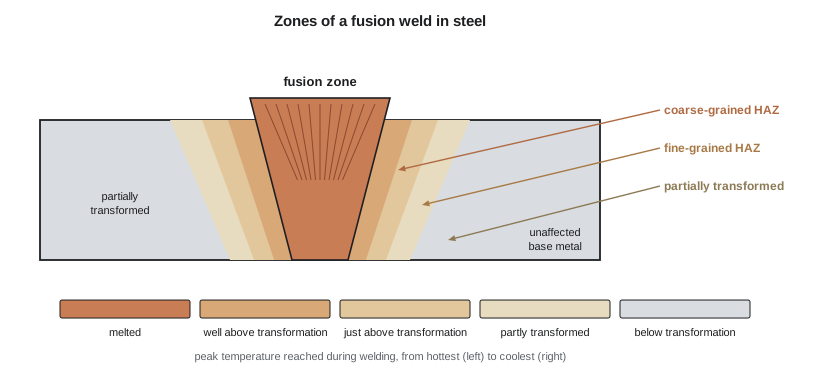
What the coarse-grained region becomes depends on how fast it cools through the transformation range, usually characterized by the time to cool from 800 to 500 °C. Fast cooling in a hardenable steel forms martensite, hard and brittle, especially combined with hydrogen. Slow cooling forms softer ferrite and pearlite or bainite. Cooling is faster for thicker plates, which conduct heat away in three dimensions, for lower heat input and for lower preheat.
Hydrogen cracking, carbon equivalent and preheat
The most notorious weld defect in steels is hydrogen-induced cold cracking, also called delayed cracking because it can appear hours or days after welding. It needs three things together: a hard, susceptible microstructure in the heat-affected zone, hydrogen dissolved in the weld from moisture in fluxes, damp joints or contaminants, and tensile stress from restraint. Remove any one and cracking is prevented. Low-hydrogen consumables stored dry, clean joints and controlled preheat are the usual defenses.
A steel's susceptibility is summarized by its carbon equivalent, which weights alloying elements by their effect on hardenability compared with carbon. The International Institute of Welding formula is widely used.
Steels with CE below about 0.40 are generally easily weldable without preheat in moderate thicknesses. Between about 0.40 and 0.60, preheat and low-hydrogen practice are needed, increasing with thickness. Above 0.60, as for 4140 with CE near 0.8, welding requires substantial preheat, often 200 to 300 °C, controlled interpass temperatures and post-weld heat treatment to temper the martensite. That is exactly the situation for the forged 4140 lifting eye on the cradle.
Worked problem
Heat input and preheat for the cradle welds
The robot welds the 10 mm (3/8 in) A572 Grade 50-equivalent plates to the tube with GMAW at 28 V, 260 A and 7.0 mm/s (16.5 in/min). The plate's mill certificate gives C 0.16, Mn 1.25, Cr 0.05, Mo 0.02, V 0.04, Ni 0.08, Cu 0.15. The 4140 lifting eye has C 0.40, Mn 0.85, Cr 0.95, Mo 0.20, Ni 0.10, Cu 0.10. Find the heat input and both carbon equivalents, and judge the preheat needed.
Show solution
- Heat input: \(H = 0.8(28)(260)/7.0 = 832\ \text{J/mm} = 0.83\ \text{kJ/mm}\).
- Plate: \(CE = 0.16 + 1.25/6 + (0.05 + 0.02 + 0.04)/5 + (0.08 + 0.15)/15 = 0.16 + 0.208 + 0.022 + 0.015 = 0.41\).
- Eye: \(CE = 0.40 + 0.85/6 + (0.95 + 0.20)/5 + (0.10 + 0.10)/15 = 0.40 + 0.142 + 0.230 + 0.013 = 0.79\).
- Plate welds: CE about 0.41 and 10 mm thick with low-hydrogen wire: little or no preheat, perhaps 20 to 50 °C in cold conditions. Eye weld: CE 0.79 needs about 250 °C preheat, interpass control and a post-weld temper.
Answer: The plate welds are routine. The lifting eye is the problem; Jonah recommends changing it to a forged low-carbon steel eye, removing the need for preheat entirely. It is cheaper to change the material than to control a demanding procedure on every cradle.
# Heat input and carbon equivalent for the KG-40 cradle welds

def heat_input(V, I, v_mm_s, eta):
    return eta * V * I / v_mm_s          # J/mm

procedures = [
    ("GMAW robot, plate to tube", 28, 260, 7.0, 0.80),
    ("GMAW manual tack", 22, 160, 4.0, 0.80),
    ("SMAW repair, low-hydrogen", 24, 140, 2.5, 0.80),
    ("SAW, thick plate", 32, 600, 8.0, 0.95),
]
print("Procedure                     heat input (kJ/mm)")
for name, V, I, v, eta in procedures:
    print(f"{name:29s} {heat_input(V, I, v, eta) / 1000:8.2f}")

def ce_iiw(c):
    g = lambda k: c.get(k, 0.0)
    return g("C") + g("Mn") / 6 + (g("Cr") + g("Mo") + g("V")) / 5 + (g("Ni") + g("Cu")) / 15

def preheat_guide(ce, t_mm):
    # A simple rule-of-thumb guide for low-hydrogen practice; codes give the governing values
    if ce < 0.40: base = 0
    elif ce < 0.45: base = 25
    elif ce < 0.55: base = 100
    elif ce < 0.65: base = 175
    else: base = 250
    if t_mm > 25 and base > 0: base += 50
    return base

steels = {
    "plate (mill certificate)": {"C": 0.16, "Mn": 1.25, "Cr": 0.05, "Mo": 0.02, "V": 0.04, "Ni": 0.08, "Cu": 0.15},
    "4140 lifting eye": {"C": 0.40, "Mn": 0.85, "Cr": 0.95, "Mo": 0.20, "Ni": 0.10, "Cu": 0.10},
    "low-carbon forged eye": {"C": 0.18, "Mn": 0.80},
}
print("\nSteel                       CE     suggested preheat at 10 mm (C)")
for name, chem in steels.items():
    ce = ce_iiw(chem)
    ph = preheat_guide(ce, 10)
print(f"{name:26s} {ce:5.2f} {ph if ph else 'none or warm to 20'}")Procedure heat input (kJ/mm) GMAW robot, plate to tube 0.83 GMAW manual tack 0.70 SMAW repair, low-hydrogen 1.08 SAW, thick plate 2.28 Steel CE suggested preheat at 10 mm (C) plate (mill certificate) 0.41 25 4140 lifting eye 0.79 250 low-carbon forged eye 0.31 none or warm to 20
Defects, residual stress and distortion
Besides hydrogen cracking, common weld defects include porosity from contamination or lost shielding gas; slag inclusions trapped between passes; lack of fusion where weld metal did not bond to the joint face; incomplete penetration at the root; undercut, a groove melted into the base metal at the weld toe; and solidification cracking down the weld centerline when shrinkage stresses pull apart the last liquid. Each has known causes in technique, joint design or materials, and procedure qualification tests are designed to show a procedure avoids them.
As a weld cools and shrinks, the surrounding cold metal restrains it, leaving residual tensile stress in the weld, often near the yield stress, balanced by compression farther away. The same shrinkage distorts the part: fillet welds pull plates into angular distortion, long welds bow beams, and butt welds shorten the assembly. Engineers limit distortion by using the minimum weld size, balancing welds on both sides of a neutral axis, welding in a planned sequence, presetting parts so they shrink into position, and clamping in fixtures. Post-weld heat treatment, holding the welded part near 600 °C for steel, relieves residual stress where codes or service demand it.
Welds are often the critical location for fatigue, because the weld toe concentrates stress, residual stress is tensile, and small defects act as starter cracks. Fatigue design codes classify welded details by category and give much lower allowable stress ranges than for plain plate. Grinding or hammer peening the weld toe improves fatigue strength where needed, as the cradle analysis found for its lower toe welds.
Procedures, qualification and inspection
Welding quality is managed through written procedures and qualified people. A welding procedure specification lists the process, base metals, filler, joint design, position, preheat and interpass temperatures, electrical parameters and travel speed. It is qualified by welding test coupons that are then cut, bent, tensile tested and examined, and the results recorded. Welders are qualified separately by welding test plates in the positions they will work in. Codes such as CSA W59 and AWS D1.1 list prequalified joints and procedures that need less testing.
Inspection starts with visual examination of every weld for size, profile, undercut and surface cracks. Surface methods, magnetic particle testing for steels and dye penetrant for any material, reveal fine surface cracks. Volumetric methods, ultrasonic testing and radiography, find internal defects such as lack of fusion and porosity. The cradle's lifting eye welds get magnetic particle inspection on every part, and the plate-to-tube welds get visual inspection with periodic macro-etch sections cut from production samples.
Welding safety
Welding hazards include electric shock, especially in damp conditions; arc radiation, which burns skin and causes arc eye, requiring filter shades and screens to protect bystanders; fumes containing metal oxides, manganese and, for stainless steel, hexavalent chromium, which must be captured by local exhaust; fire from sparks and spatter, which calls for hot work permits and fire watches; and burns. Robotic cells like Kestrel Drive Systems's add the hazard of moving robot arms, managed with fencing and interlocked gates.
Common mistakes
MistakeSpecifying a welding current without a travel speed.
InsteadHeat input depends on V, I and travel speed; specify a heat-input range.
MistakeWelding high-carbon-equivalent steels like ordinary structural steel.
InsteadAbove CE about 0.4 to 0.45, plan preheat, low-hydrogen consumables and possibly post-weld heat treatment.
MistakeAssuming hydrogen cracks will appear right after welding.
InsteadHydrogen cracking can be delayed by hours or days; inspect after a waiting period on critical welds.
MistakeOversizing fillet welds for safety.
InsteadLarger welds add heat, distortion and residual stress; specify the size the design needs.
MistakeIgnoring the weld toe in fatigue design.
InsteadWelded details have much lower fatigue strength; use code detail categories and toe treatments where needed.
Summary and key terms
- Arc processes include SMAW, GMAW, FCAW, GTAW and SAW, differing in shielding, speed and suitability.
- Resistance, laser, electron beam, friction and friction stir welding serve special needs.
- Heat input H = ηVI/v controls penetration, HAZ width, cooling rate and distortion.
- A weld has a fusion zone, a heat-affected zone and unaffected base metal; the coarse-grained HAZ is the most susceptible.
- Hydrogen cracking needs a hard microstructure, hydrogen and stress; carbon equivalent guides preheat.
- Welds leave residual stress and distortion; procedures, qualified welders and inspection control quality.
- Fusion zone
- The part of a weld that melted and resolidified.
- Heat-affected zone
- Base metal whose microstructure was changed by welding heat without melting.
- Heat input
- Arc energy delivered per unit length of weld, ηVI/v.
- Shielding gas
- Gas that protects the weld pool from the atmosphere.
- GMAW
- Gas metal arc welding: continuous wire electrode with gas shielding.
- GTAW
- Gas tungsten arc welding: non-consumable tungsten electrode with inert gas.
- Carbon equivalent
- A weighted sum of alloy content indicating hardenability and cracking risk.
- Preheat
- Heating the joint before welding to slow cooling and drive off hydrogen.
- Hydrogen cracking
- Delayed cracking caused by hydrogen, a hard microstructure and tensile stress.
- Undercut
- A groove melted into the base metal along the weld toe.
- Welding procedure specification
- A written, qualified set of instructions for making a weld.
Practice problems
Work each problem on paper first, then reveal the answer to check.
Find the heat input for 24 V, 180 A, 5 mm/s and η = 0.8.
Show answer
H = 0.8(24)(180)/5 = 691 J/mm.
If travel speed doubles at the same voltage and current, what happens to heat input?
Show answer
It halves.
Find the CE of a steel with C 0.20, Mn 1.0 and no other alloying.
Show answer
CE = 0.20 + 0.167 = 0.37.
Name the three conditions needed for hydrogen cracking.
Show answer
A susceptible hard microstructure, diffusible hydrogen and tensile stress.
Which inspection method finds lack of fusion inside a thick butt weld?
Show answer
Ultrasonic testing (or radiography).
In the program, change the eye to a low-carbon steel with C 0.18, Mn 0.80 and no other alloying. What is its CE?
Show answer
CE = 0.18 + 0.133 = 0.31: no preheat needed.
Lesson quiz · 5 questions
Score 60% or more to complete this lesson.
Create a free account to save your progress, take quizzes and earn a certificate.