
MEC-280 · Lesson 1 of 12 · 22 min
Manufacturing systems and process selection
Kestrel Drive Systems builds gearboxes, shafts and hydraulic cylinders for farm and forestry machines at its plant in Peoria, Illinois. In MEC-250 we followed the company's materials work: co-op student Amira Haddad, materials and process engineer Jonah Mercer and lab technician Rosa Delgado traced a broken power take-off shaft to a fillet machined too small. This course moves from what parts are made of to how they are made. The same team, joined by manufacturing engineer Dev Patel and lead machinist Carla Brandt, is launching a new product, the KG-40 right-angle gearbox for a compact tractor. Every part of that gearbox, from the cast housing and forged gears to the machined shafts, welded mounting frame, molded seals and printed fixtures, needs a process chosen, planned and controlled.
Manufacturing is the conversion of materials into products of greater value through a sequence of processes. The word once meant making by hand; today it covers everything from a blacksmith's forge to a fully automated machining cell. For a mechanical engineer, the subject matters because design and manufacturing cannot be separated. A shaft drawn with a tight tolerance, a sharp internal corner or a hard-to-machine alloy may cost several times more than one designed with the process in mind, and the process chosen also sets the part's strength, surface, residual stress and reliability. The PTO shaft failure in MEC-250 was a manufacturing failure as much as a design one.
The families of manufacturing processes
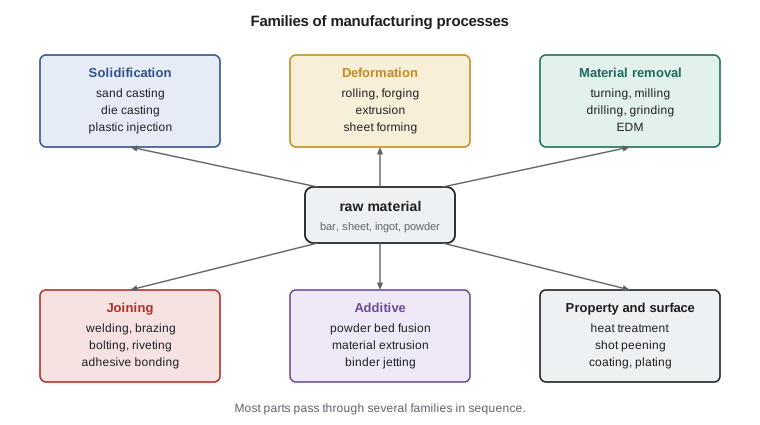
Engineers group shaping processes by what they do to the material. Solidification processes start with a liquid and let it freeze in a cavity of the desired shape: metal casting, and for polymers, injection molding. Deformation processes push solid metal into shape without removing material: rolling, forging, extrusion, drawing and sheet metal forming. Material removal processes cut away unwanted material: turning, milling, drilling, grinding and nontraditional methods such as electrical discharge machining. Joining processes connect parts: welding, brazing, soldering, mechanical fastening and adhesive bonding. Additive processes build a part layer by layer from powder, wire, resin or filament. A family of property-enhancing and surface processes rounds out the list: heat treatment, shot peening, coating and plating.
Most real parts pass through several families. The KG-40 output shaft starts as hot-rolled bar, is forged to a rough shape, turned, heat treated, ground on its bearing journals, and finally shot peened at the fillet to improve fatigue life. The housing is sand cast in gray iron, then machined on its bores and faces. Choosing a sequence, not just a single process, is the real job of process planning.
Production volume and the shape of a factory
How many parts are needed changes almost every decision. Engineers speak of job shop, batch and mass production. A job shop makes one or a few of many different parts, using general-purpose machines and skilled operators; repair work and prototypes live here. Batch production makes medium quantities, perhaps tens to thousands, in runs separated by changeovers; most of Kestrel Drive Systems's plant works this way. Mass production makes hundreds of thousands or millions of the same part on dedicated equipment, such as a transfer line machining engine blocks or a progressive die stamping brackets at 60 strokes a minute.
Volume also determines how the factory is laid out. A process layout groups similar machines together, all lathes in one area and all mills in another, and parts travel between departments; it is flexible but slow and full of waiting. A product layout lines machines up in the sequence a single product needs. Cellular manufacturing sits between: a cell groups the machines needed for a family of similar parts, so a shaft cell might hold a saw, a CNC lathe, a spline mill and a washer. Dev's plan for the KG-40 puts all four of its shafts through one cell, because their sizes and operations are similar.
Cost: fixed, variable and breakeven
Every process has fixed costs, which do not depend on quantity, and variable costs, which are paid for every part. Fixed costs include tooling (patterns, dies, molds, fixtures), programming and setup. Variable costs include material, machine time, labor, energy and consumables. The cost per part is the fixed cost spread over the quantity, plus the variable cost.
Processes with expensive tooling, such as die casting, forging and injection molding, have high fixed costs and low variable costs; they win at high volume. Processes with cheap or no tooling, such as machining from bar or additive manufacturing, have low fixed costs and higher variable costs; they win at low volume. The breakeven quantity, where two processes cost the same, follows from setting their cost equations equal.
Worked problem
Machine from bar or forge the KG-40 input gear blank?
The gear blank can be machined from 3.5 in bar, with fixed costs of 1800 dollars for programming and fixtures and a variable cost of 41.50 dollars per part (mostly material and lathe time). Alternatively it can be forged near net shape, with forging dies and trim tools costing 26 000 dollars and a variable cost of 19.20 dollars per part. Find the breakeven quantity and the cost per part at the planned 3000 per year.
Show solution
- Breakeven: \(Q^{*} = (26\,000 - 1800)/(41.50 - 19.20) = 24\,200/22.30 = 1085\) parts.
- At 3000 parts, machining from bar: \(1800/3000 + 41.50 = 42.10\) dollars per part.
- At 3000 parts, forging: \(26\,000/3000 + 19.20 = 27.87\) dollars per part.
- Annual saving from forging: \((42.10 - 27.87)(3000) \approx 42\,700\) dollars.
Answer: Forging pays for itself after about 1100 parts, well under one year's demand. It also gives better grain flow in the gear teeth, a quality benefit we return to in Lesson 3.
# Cost per part for three ways of making the KG-40 input gear blank
options = {
    "machine from bar": (1800, 41.50),     # fixed cost (dollars), variable cost per part
    "closed-die forging": (26000, 19.20),
    "powder metal": (60000, 12.80),
}

def cost_per_part(fixed, variable, q):
    return fixed / q + variable

print("Quantity  " + "  ".join(f"{name:>20s}" for name in options))
for q in (100, 500, 1000, 3000, 10000, 30000):
    row = "  ".join(f"{cost_per_part(f, v, q):20.2f}" for f, v in options.values())
    print(f"{q:8d}  {row}")

names = list(options)
print()
for i in range(len(names)):
    for j in range(i + 1, len(names)):
        f1, v1 = options[names[i]]
        f2, v2 = options[names[j]]
        q_star = (f2 - f1) / (v1 - v2)
        print(f"Breakeven, {names[i]} vs {names[j]}: {q_star:,.0f} parts")

# Cheapest option at the planned volume
q = 3000
best = min(options, key=lambda n: cost_per_part(*options[n], q))
print(f"\nCheapest at {q} parts per year: {best}")Quantity machine from bar closed-die forging powder metal
100 59.50 279.20 612.80
500 45.10 71.20 132.80
1000 43.30 45.20 72.80
3000 42.10 27.87 32.80
10000 41.68 21.80 18.80
30000 41.56 20.07 14.80
Breakeven, machine from bar vs closed-die forging: 1,085 parts
Breakeven, machine from bar vs powder metal: 2,028 parts
Breakeven, closed-die forging vs powder metal: 5,313 parts
Cheapest at 3000 parts per year: closed-die forging| Process | Typical tooling cost | Economic quantity | Typical tolerance | Typical roughness Ra (µm) |
|---|---|---|---|---|
| Sand casting | Low (patterns) | 1 to thousands | ±0.8 to ±2 mm | 6 to 25 |
| Investment casting | Medium | 100 to 100 000 | ±0.1 to ±0.3 mm | 1.6 to 3.2 |
| Pressure die casting | High (steel dies) | 10 000 and up | ±0.05 to ±0.2 mm | 0.8 to 3.2 |
| Closed-die forging | High | 1000 and up | ±0.3 to ±1 mm | 3.2 to 12.5 |
| Turning and milling | Low | 1 and up | ±0.01 to ±0.05 mm | 0.8 to 6.3 |
| Grinding | Low | 1 and up | ±0.002 to ±0.01 mm | 0.1 to 0.8 |
| Injection molding | High (steel molds) | 10 000 and up | ±0.05 to ±0.2 mm | 0.2 to 1.6 |
| Powder bed fusion (metal) | None | 1 to hundreds | ±0.1 to ±0.2 mm | 6 to 20 as built |
Matching process to part
Process selection starts from the part's requirements and screens out processes that cannot meet them. Five questions do most of the work. What material is it, and can the process handle that material? Some alloys cast well but forge poorly; titanium machines slowly; many polymers cannot be welded. What shape is it: round, prismatic, thin-walled, hollow, with undercuts? How big is it, and how many are needed? What tolerance and surface finish does it need, and on which features? And what properties must the process deliver, such as grain flow, freedom from porosity, or residual compressive stress at a fillet?
Michael Ashby's approach from MEC-250 extends naturally to processes. Process attribute charts plot each process's achievable range of size, minimum section thickness, tolerance and roughness, and economic batch size. Drawing the part's requirements on these charts leaves a short list of candidates, which a cost model then ranks. The approach does not replace experience, but it stops a designer from choosing a familiar process out of habit.
The KG-40 housing shows the reasoning. It is a hollow, complex shape about 280 mm across with walls 8 mm thick, made of gray cast iron for its damping and machinability, needed at 3000 a year. Machining it from solid would waste 85 percent of the material and take hours. Forging cannot make the internal cavity. Sand casting handles the shape, the material and the size, with modest tooling cost; investment casting would be more precise but costs more and gains nothing, because the bearing bores will be machined anyway. Sand casting followed by machining of the functional surfaces is the answer.
Design for manufacture and assembly
Design for manufacture and assembly, often shortened to DFMA, is the discipline of shaping a design so that it is easy to make and put together. Its guidelines sound simple but save real money. Reduce the number of parts, because every part needs drawings, tooling, inventory and assembly time. Use standard parts, materials and features. Specify the loosest tolerance that works, because cost rises steeply as tolerances tighten. Design parts to be self-locating and to assemble from one direction. Avoid features the chosen process makes badly: sharp internal corners in castings, deep narrow pockets in machined parts, undercuts in molded parts.
Tolerance deserves particular attention. Halving a tolerance can double the machining cost once the feature moves from a routine turning operation to one needing finish passes, in-process gauging or grinding. On the KG-40 drawings, Dev asked the design team to justify every tolerance tighter than ±0.05 mm. Only the bearing seats, the gear bores and the seal surfaces kept their tight limits; twenty other dimensions were opened up, and the estimated machining time for the housing fell by 18 percent.
Sustainability and the life of a process
Manufacturing uses about a fifth of all energy in industrial countries, and processes differ widely in material and energy efficiency. Near-net-shape processes such as precision forging, die casting and additive manufacturing reduce the material removed later. Machining chips are usually recycled, but the energy that went into making the bar is partly lost. Coolants must be filtered, maintained and eventually treated. When Kestrel Drive Systems compares processes, it now adds the energy per part and the scrap rate to the cost model, and it tracks the carbon content of purchased bar and castings. A process choice that saves 10 percent of material on a high-volume part often matters more environmentally than any change to the product's operating efficiency.
Process choice also affects quality and safety on the shop floor. Foundries and forges involve molten metal, heat, noise and silica dust; machine shops involve rotating spindles, flying chips and coolant mist; welding involves fumes and arc radiation. A good process plan includes the guarding, ventilation and procedures each step needs. We note the main hazards of each process as we meet it.
How this course is organized
The lessons follow the families. Lesson 2 covers metal casting and solidification. Lessons 3 and 4 cover deformation processes, first bulk forming and then sheet metal. Lessons 5 to 7 cover material removal: cutting mechanics, the main machining operations with CNC, and grinding and finishing. Lessons 8 and 9 cover joining. Lesson 10 covers polymer and composite processing, Lesson 11 additive manufacturing, and Lesson 12 brings the course together with metrology, quality control, cost estimating and lean production, ending with the KG-40 launch plan.
Common mistakes
MistakeChoosing a process for one requirement, such as tolerance, and ignoring the others.
InsteadScreen on material, shape, size, quantity, tolerance and finish together, then rank the survivors on cost.
MistakeComparing processes on variable cost alone.
InsteadInclude tooling and setup: the cost per part is C_F/Q + c_V, and the best choice depends on quantity.
MistakeApplying tight tolerances everywhere on a drawing.
InsteadTighten only functional features; every unnecessary tight tolerance adds cost.
MistakeThinking of manufacturing as a single process.
InsteadMost parts need a sequence: for example forge, turn, heat treat, grind and peen.
MistakeTreating process choice as separate from part performance.
InsteadThe process sets grain flow, porosity, residual stress and surface finish, all of which affect strength and fatigue life.
Summary and key terms
- Processes fall into families: solidification, deformation, material removal, joining, additive and property-enhancing.
- Production volume ranges from job shop to batch to mass production and shapes the layout of a plant.
- Cost per part is C_F/Q + c_V; tooling-heavy processes win at high volume and the breakeven quantity is ΔC_F/Δc_V.
- Selection screens processes on material, shape, size, quantity, tolerance, finish and required properties.
- Design for manufacture and assembly reduces part count, uses standard features and keeps tolerances as loose as function allows.
- Energy, scrap and workplace hazards belong in a process comparison alongside cost.
- Manufacturing
- Converting materials into products of greater value through a sequence of processes.
- Job shop
- Production of small quantities of many different parts on general-purpose equipment.
- Batch production
- Production of medium quantities in runs separated by changeovers.
- Mass production
- Continuous production of very large quantities on dedicated equipment.
- Cellular manufacturing
- A layout grouping the machines needed for a family of similar parts.
- Fixed cost
- A cost that does not depend on quantity, such as tooling and setup.
- Variable cost
- A cost paid for every part made, such as material and machine time.
- Breakeven quantity
- The quantity at which two processes have the same total cost.
- Near net shape
- A process result close to final dimensions, leaving little material to remove.
- DFMA
- Design for manufacture and assembly: shaping a design so it is easy to make and assemble.
Practice problems
Work each problem on paper first, then reveal the answer to check.
A part costs 8 dollars each by machining with 500 dollars of fixtures, or 3 dollars each by die casting with 40 000 dollars of tooling. Find the breakeven quantity.
Show answer
Q* = (40 000 − 500)/(8 − 3) = 7900 parts.
At 20 000 parts, what is the cost per part for each option in the previous question?
Show answer
Machining 8.03 dollars; die casting 5.00 dollars.
Name the process family for each: extrusion, investment casting, brazing, electrical discharge machining, shot peening.
Show answer
Deformation; solidification; joining; material removal; property and surface processes.
Why is sand casting chosen for the KG-40 housing rather than forging?
Show answer
Forging cannot form the hollow internal cavity; sand casting handles the complex shape and gray iron at modest tooling cost.
List three DFMA guidelines.
Show answer
Reduce part count; use standard parts and features; specify the loosest tolerance that works (also: self-locating parts, one assembly direction).
In the program, raise the forging die cost to 40 000 dollars. What is the new breakeven with machining from bar?
Show answer
About 1710 parts.
Lesson quiz · 5 questions
Score 60% or more to complete this lesson.
Create a free account to save your progress, take quizzes and earn a certificate.