
MEC-230 · Lesson 1 of 12 · 29 min
Systems, properties, states and units
Northgate District Energy runs a central plant on the edge of downtown Minneapolis that heats about forty buildings: a hospital, two university residence halls, a courthouse, offices and apartment towers. Three natural-gas boilers raise steam at 4 MPa (about 580 psia) and 400 °C (752 °F). A small back-pressure steam turbine takes that steam, turns a generator, and releases it at a lower pressure into the district steam main, which runs under the streets at about 1 MPa (145 psia). Heat exchangers in each building turn the steam into hot water for radiators, and the condensate flows back to the plant, where a deaerator, feedwater pumps and the boilers start the loop again. A heat pump recovers warmth from treated sewage, a cooling tower rejects heat in summer, and an air compressor supplies the pneumatic valve actuators. Plant engineer Elena Varga, chief operator Graham Okoro and co-op student Tomás Reyes will follow us through this course, because every one of these machines is a lesson in thermodynamics.
Thermodynamics is the science of energy and its transformations: how heat becomes work in the turbine, how work becomes a temperature rise in the feedwater pump, how energy moves from hot steam to cold water in a heat exchanger, and why some of these conversions can never be complete. It rests on a few laws, each stated once and then applied everywhere. The first law says energy is conserved. The second law says energy has quality as well as quantity, and that real processes always degrade it. Before we can use either law, we need a precise vocabulary for what we are analyzing, what condition it is in, and how we measure that condition. That vocabulary is the subject of this lesson.
Systems, boundaries and surroundings
A thermodynamic system is whatever we choose to study: a quantity of matter or a region in space. Everything outside it is the surroundings, and the surface that separates the two is the boundary. The boundary can be real, like the inside wall of a tank, or imaginary, like the plane across a pipe where steam enters a turbine. It can be fixed, or it can move, like the face of a piston. The first and most important decision in any analysis is where to draw it, because the laws are written for the system, and everything that crosses the boundary must be accounted for.
A closed system, also called a control mass, contains a fixed quantity of matter. No mass crosses its boundary, although energy can, as heat or work. The gas trapped in a cylinder behind a piston is a closed system; so is the air sealed in a rigid tank. An open system, or control volume, is a region in space through which mass flows. Its boundary is called the control surface. The turbine, the feedwater pump, a heat exchanger and a nozzle are all analyzed as control volumes: steam flows in and out, and we keep track of the energy it carries. An isolated system is a special closed system across whose boundary neither heat nor work passes. Nothing in the plant is truly isolated, but a system drawn large enough to include everything that interacts, the plant plus its surroundings, behaves like one, and that idea will matter when we reach the second law.
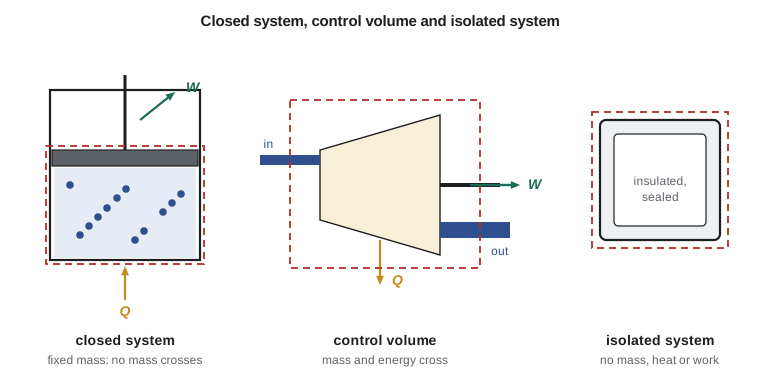
The choice of system is not always obvious, and different choices can make the same problem easy or hard. Suppose Tomás is asked how much energy the boiler adds to the water. He can draw the boundary around the water inside the boiler drum at an instant (a closed system that changes with time), or around the whole boiler with feedwater entering and steam leaving (a control volume in steady operation). The second choice is simpler, because the boiler runs steadily for hours, and steady-flow analysis, which we develop in Lessons 7 and 8, turns the problem into one line of algebra.
Properties and state
A property is any measurable characteristic of a system: pressure \(P\), temperature \(T\), volume \(V\), mass \(m\), and less familiar ones such as internal energy \(U\), enthalpy \(H\) and entropy \(S\), which we meet in later lessons. Properties are either intensive, independent of the size of the system (pressure, temperature, density), or extensive, proportional to its size (mass, volume, total energy). A quick test: cut the system in half with an imaginary partition. Intensive properties keep their values in each half; extensive properties are halved.
Dividing an extensive property by the mass gives a specific property, which is intensive. Specific volume \(v = V/m\) is the reciprocal of density \(\rho\); specific internal energy is \(u = U/m\). Thermodynamic tables are written in specific properties, because one table then serves any amount of substance. By convention, lower-case letters denote specific properties and capitals denote totals, a habit worth adopting from the first day.
The state of a system is its condition as described by its properties. When the properties have definite values everywhere in the system and do not change unless something from outside acts, the system is in thermodynamic equilibrium: thermal equilibrium (uniform temperature), mechanical equilibrium (no unbalanced pressure differences), phase equilibrium and chemical equilibrium. Classical thermodynamics deals with equilibrium states, which is why we can describe steam in the main by a handful of numbers.
How many properties do we need to fix a state? The state postulate answers this for the systems we study: the state of a simple compressible system, one where electrical, magnetic, gravitational and surface-tension effects are unimportant, is completely specified by two independent intensive properties. For superheated steam, pressure and temperature are independent, so knowing that the steam is at 4 MPa and 400 °C fixes every other property: its specific volume, its enthalpy, its entropy. During boiling, however, pressure and temperature are tied together, and we will need a different second property. This subtlety drives much of Lesson 3.
Processes and cycles
Any change from one equilibrium state to another is a process, and the series of states passed through is the path. Strictly, a system passing through states quickly is not in equilibrium along the way; there may be pressure waves or temperature gradients inside it. A process carried out slowly enough that the system stays infinitesimally close to equilibrium at every instant is a quasi-equilibrium, or quasi-static, process. Real compressors and engines are not quasi-static, but the idealization is surprisingly good for many devices and gives the limiting performance that real machines are measured against.
Processes are often named for the property held constant. An isothermal process keeps temperature constant, an isobaric process keeps pressure constant, and an isochoric (isometric) process keeps volume constant. An adiabatic process has no heat transfer. A system that passes through a series of processes and returns to its initial state has executed a cycle; the water in the Northgate loop follows a cycle through the boilers, turbine, district main, building heat exchangers, condensate return, deaerator and pumps, and its properties at the end of each lap equal those at the start.
A steady-flow process is one in which nothing at any fixed point inside a control volume changes with time, although properties may differ from point to point. The turbine at full load is in steady flow: steam at the inlet is always at 4 MPa and 400 °C, steam at the outlet is always at the same exhaust condition, and the shaft delivers the same power minute after minute. Most of the plant spends most of its life in steady flow, and the analysis of steady-flow devices is one of the most useful skills in the course.
Units and dimensions
Thermodynamics uses the International System of Units (SI) in most of the world's engineering literature, and increasingly in US industry. The base units we need are the kilogram (kg) for mass, meter (m) for length, second (s) for time and kelvin (K) for temperature. The newton is the force that accelerates 1 kg at 1 m/s², the joule is the work done by 1 N acting through 1 m, and the watt is 1 J/s. Pressure is force per unit area: 1 pascal = 1 N/m², which is tiny, so engineers work in kilopascals (kPa) and megapascals (MPa). One bar is 100 kPa, and standard atmospheric pressure is 101.325 kPa.
The last identity, 1 kPa·m³ = 1 kJ, is used constantly: a pressure in kilopascals times a volume in cubic meters gives an energy in kilojoules. Specific energies are in kJ/kg, specific volumes in m³/kg, and rates of energy transfer in kW. Keeping units attached to every number in a calculation, and canceling them as you go, is the single most effective way to catch errors.
Much of the equipment literature in the United States, and many nameplates in the plant, use United States customary units: pound-mass (lbm), pound-force (lbf), foot, second, degree Rankine (R) and the British thermal unit (Btu). One pound-force accelerates one pound-mass at 32.174 ft/s², so a constant \(g_c = 32.174\ \text{lbm·ft/(lbf·s}^2)\) appears in Newton's law in that system. Other useful facts: 1 Btu = 778.17 ft·lbf = 1.055 kJ, 1 psi = 6.895 kPa, 1 Btu/lbm = 2.326 kJ/kg, and 1 psia·ft³ = 0.18505 Btu. This course works mainly in SI, with US customary examples alongside, because practicing engineers in the United States read both systems every day.
Worked problem
Mass, weight and energy in US customary units
A feedwater tank holds 2,000 lbm of water, raised 40 ft above the pump inlet. Find the weight of the water and the increase in its potential energy, in ft·lbf and Btu, at standard gravity.
Show solution
- Weight: \(W = mg/g_c = 2000(32.174)/32.174 = 2000\ \text{lbf}\). At standard gravity the numbers match, though the units differ.
- Potential energy: \(\Delta PE = mg\Delta z/g_c = 2000(32.174)(40)/32.174 = 80{,}000\ \text{ft·lbf}\).
- \[\Delta PE = \frac{80{,}000\ \text{ft·lbf}}{778.17\ \text{ft·lbf/Btu}} = 102.8\ \text{Btu} \approx 108\ \text{kJ}\]
Answer: About 103 Btu: lifting a metric ton of water through 12 m stores only about as much energy as raising 0.26 kg of water from 0 °C to 100 °C. Potential energy is usually small next to thermal energy, a fact we will lean on repeatedly.
Density, specific gravity and pressure
Density varies little for liquids and strongly for gases. Liquid water is about 1000 kg/m³ at room temperature and 958 kg/m³ at 100 °C; steam at 1 MPa and 300 °C is only about 3.9 kg/m³. Specific gravity is the ratio of a substance's density to that of water at 4 °C, and specific weight \(\gamma = \rho g\) is weight per unit volume.
Pressure is the normal force a fluid exerts per unit area. It is the same in all directions at a point in a fluid at rest, and it increases with depth: in a fluid of constant density, \(P_{\text{bottom}} = P_{\text{top}} + \rho g h\). The boiler drum level gauge, a manometer on a duct and the static head in a tall building's hot-water riser all follow this relation. In a 30-story residence connected to the hot-water loop, the pressure at the bottom of the riser is nearly 300 kPa higher than at the top, which is why tall buildings are often hydraulically separated from the district loop by heat exchangers.
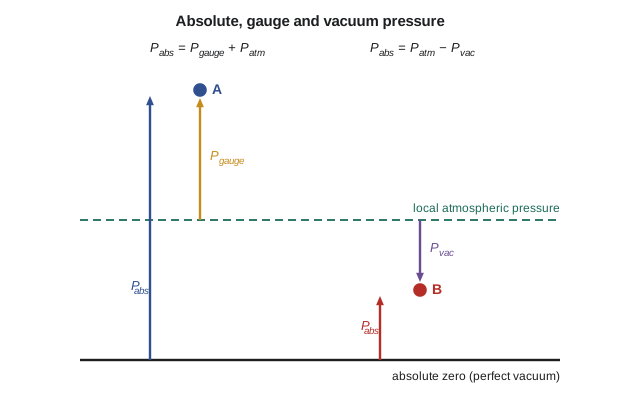
Most gauges read gauge pressure, the difference between the actual (absolute) pressure and the local atmospheric pressure. Thermodynamic relations and property tables always use absolute pressure. A vacuum gauge reads how far below atmospheric the pressure is. Forgetting to add atmospheric pressure to a gauge reading is one of the most common errors in the subject, and its size depends on the pressure: on a 4 MPa boiler it is a 2.5 percent error, but on a deaerator at 20 kPa gauge it is an 80 percent error.
Worked problem
Absolute pressure in the steam main
A Bourdon gauge on the district steam main reads 900 kPa (130.5 psig). The barometer in the control room reads 99.0 kPa (14.36 psia). What absolute pressure should Tomás use to look up the steam properties? A compound gauge on the condensate return line reads 35 kPa (5.1 psi) of vacuum; what is the absolute pressure there?
Show solution
- Steam main: \(P_{\text{abs}} = P_{\text{gauge}} + P_{\text{atm}} = 900 + 99.0 = 999\ \text{kPa}\), essentially 1 MPa, or \(130.5 + 14.36 = 144.9\ \text{psia}\).
- Condensate return: \(P_{\text{abs}} = P_{\text{atm}} - P_{\text{vac}} = 99.0 - 35 = 64.0\ \text{kPa} = 9.28\ \text{psia}\).
Answer: The steam main is at 1 MPa absolute and the return line at 64 kPa absolute. Using 900 kPa in the steam tables would give a saturation temperature about 4 °C too low; using 35 kPa for the return would be badly wrong.
The program below converts the plant's typical gauge readings to absolute pressure in both unit systems, checks a hydrostatic head, and converts temperatures between the four scales. Change the barometric pressure to see how much a weather system moves the absolute pressures: a deep low can drop the barometer by 3 or 4 kPa.
# Gauge and absolute pressure, and unit conversions, for readings around the plant
p_atm = 99.0                      # kPa, local barometric pressure on the day of the readings

readings = [                      # (location, gauge reading in kPa; negative means vacuum)
    ("boiler steam header",      3900.0),
    ("district steam main",       900.0),
    ("deaerator",                  20.0),
    ("hot-water loop supply",     450.0),
    ("condensate return vacuum",  -35.0),
]

KPA_PER_PSI = 6.894757
print(f"{'location':26s} {'gauge kPa':>10s} {'abs kPa':>9s} {'abs psia':>9s} {'gauge psig':>11s}")
for name, pg in readings:
    pabs = pg + p_atm
    print(f"{name:26s} {pg:10.1f} {pabs:9.1f} {pabs / KPA_PER_PSI:9.2f} {pg / KPA_PER_PSI:11.2f}")

# Hydrostatic pressure difference across a column of water: dP = rho g h
rho, g = 998.0, 9.81              # kg/m3, m/s2
for h in (1.0, 10.0, 30.0):
    print(f"{h:5.1f} m of water -> {rho * g * h / 1000:6.2f} kPa")

# Temperatures on four scales
for tc in (-40.0, 0.0, 100.0, 400.0):
    tk, tf = tc + 273.15, tc * 1.8 + 32
print(f"{tc:7.1f} C = {tk:7.2f} K = {tf:7.1f} F = {tf + 459.67:7.2f} R")location gauge kPa abs kPa abs psia gauge psig
boiler steam header 3900.0 3999.0 580.01 565.65
district steam main 900.0 999.0 144.89 130.53
deaerator 20.0 119.0 17.26 2.90
hot-water loop supply 450.0 549.0 79.63 65.27
condensate return vacuum -35.0 64.0 9.28 -5.08
1.0 m of water -> 9.79 kPa
10.0 m of water -> 97.90 kPa
30.0 m of water -> 293.71 kPa
-40.0 C = 233.15 K = -40.0 F = 419.67 R
0.0 C = 273.15 K = 32.0 F = 491.67 R
100.0 C = 373.15 K = 212.0 F = 671.67 R
400.0 C = 673.15 K = 752.0 F = 1211.67 RTemperature and the zeroth law
Temperature is familiar but surprisingly hard to define. Thermodynamics defines it through equilibrium. When a hot body touches a cold one, energy flows until both reach the same temperature and the flow stops; they are then in thermal equilibrium. The zeroth law of thermodynamics states that if two bodies are each in thermal equilibrium with a third body, they are in thermal equilibrium with each other. This sounds obvious, but it is what makes thermometers work: the thermometer is the third body, and two systems that give the same reading will not exchange heat when brought together.
Temperature scales assign numbers to these equilibrium states. The Celsius scale puts 0 °C at the ice point and 100 °C at the steam point of water at one standard atmosphere; the Fahrenheit scale puts them at 32 °F and 212 °F. Thermodynamics also needs absolute scales, which start at absolute zero and do not depend on the properties of any one substance. The kelvin scale is the SI absolute scale, with \(T(\text{K}) = T(°\text{C}) + 273.15\). The Rankine scale is its customary counterpart, with \(T(\text{R}) = T(°\text{F}) + 459.67\). A temperature difference of 1 K equals 1 °C, and 1 R equals 1 °F; one kelvin is 1.8 rankines.
Use absolute temperature in every thermodynamic relation that involves a ratio or a product with temperature: the ideal-gas law, efficiencies of heat engines, entropy changes. Celsius is fine for temperature differences, such as the rise of water through a heat exchanger. In Lesson 10 we will see that the second law itself defines a thermodynamic temperature scale that is identical to the kelvin scale, which is why the kelvin is truly absolute.
In the plant, temperatures are measured by resistance temperature detectors (RTDs), whose electrical resistance rises with temperature, and by thermocouples, which produce a small voltage that depends on the temperature difference between two junctions of dissimilar metals. Both are calibrated against fixed points defined by the International Temperature Scale. Each measurement is only as good as the thermal contact between the sensor and the fluid; a sensor in a poorly filled thermowell can read many degrees low on a fast-changing steam line.
Energy balances start with the right system
Before any numbers, Elena teaches every new engineer at Northgate to sketch the system, mark the boundary, and list what crosses it: mass flows, heat transfers, work transfers. She calls it the thirty-second sketch, and it prevents most of the errors that cost hours later. In this course every worked example starts the same way. Ask what the system is, whether it is closed or open, whether it is steady, which properties are known, and what crosses the boundary. The laws themselves are short; the skill lies in applying them to the right system.
Common mistakes
MistakeUsing gauge pressure in property tables or the ideal-gas law.
InsteadAdd local atmospheric pressure; tables use absolute pressure.
MistakeUsing degrees Celsius in a ratio such as \(T_2/T_1\) or in \(PV = mRT\).
InsteadConvert to kelvins (or rankines) for any product or ratio with temperature.
MistakeTreating specific properties and total properties as interchangeable.
InsteadMultiply specific values (lower case) by mass to get totals (capitals).
MistakeAssuming two properties always fix the state.
InsteadThey must be independent; during phase change, pressure and temperature are not.
MistakeConfusing pound-mass and pound-force.
InsteadUse \(g_c\): 1 lbf accelerates 1 lbm at 32.174 ft/s².
Summary and key terms
- A system is the matter or region chosen for study; the boundary separates it from its surroundings.
- Closed systems (control masses) exchange energy but not mass; open systems (control volumes) also exchange mass.
- Intensive properties do not depend on size; dividing an extensive property by mass gives an intensive specific property.
- Two independent intensive properties fix the state of a simple compressible system.
- A quasi-equilibrium process passes through equilibrium states; steady flow means no change with time at any point.
- Absolute pressure = gauge pressure + atmospheric pressure; property tables use absolute pressure.
- Use kelvins or rankines whenever temperature appears in a ratio or product.
- 1 kPa·m³ = 1 kJ; 1 Btu = 778.17 ft·lbf = 1.055 kJ.
- System
- The quantity of matter or region in space chosen for analysis.
- Boundary
- The real or imaginary surface separating a system from its surroundings.
- Closed system
- A system of fixed mass; energy but not mass may cross its boundary.
- Control volume
- A region in space through which mass flows; an open system.
- Isolated system
- A system across whose boundary neither mass nor energy passes.
- Intensive property
- A property independent of the size of the system, such as pressure or temperature.
- Extensive property
- A property proportional to the size of the system, such as mass or volume.
- Specific property
- An extensive property divided by mass, such as specific volume v = V/m.
- State postulate
- Two independent intensive properties fix the state of a simple compressible system.
- Quasi-equilibrium process
- A process slow enough that the system remains infinitesimally close to equilibrium.
- Steady flow
- Flow in which properties at each point in a control volume do not change with time.
- Gauge pressure
- Pressure measured relative to local atmospheric pressure.
- Zeroth law
- Two bodies each in thermal equilibrium with a third are in thermal equilibrium with each other.
Practice problems
Work each problem on paper first, then reveal the answer to check.
A gauge on a compressed-air receiver reads 750 kPa when the barometer reads 101 kPa. What is the absolute pressure?
Show answer
851 kPa.
A tank holds 0.40 m³ of air with a mass of 1.9 kg. Find its specific volume and density.
Show answer
v = 0.211 m³/kg; ρ = 4.75 kg/m³.
Classify as intensive or extensive: temperature, total enthalpy, density, specific internal energy, volume.
Show answer
Intensive: temperature, density, specific internal energy. Extensive: total enthalpy, volume.
Convert 180 °C to K, °F and R.
Show answer
453.15 K, 356 °F, 815.67 R.
What pressure difference, in kPa, does a 45 m column of water at 998 kg/m³ produce?
Show answer
About 441 kPa.
In the program, set the barometer to 95 kPa. Which absolute pressure changes by the largest percentage?
Show answer
The condensate return vacuum, which falls from 64 to 60 kPa absolute, about 6 percent.
Lesson quiz · 5 questions
Score 60% or more to complete this lesson.
Create a free account to save your progress, take quizzes and earn a certificate.