
MCAT-111 · Lesson 4 of 12 · 22 min
Gene regulation and chromosome organization
▶ Video coming soon A video version of this lesson is on the way.
Thandiwe began with a riddle. 'A neuron and a liver cell from the same person have the same genome, give or take a few mutations. One fires action potentials and the other makes albumin. How?' Devika answered first: 'They express different genes.' 'Right. And this lesson is about the switches.' She added that operon questions were among the most reliably tested passage topics she had seen in nine years of coaching, 'because they are a perfect little logic puzzle'.
This lesson covers control of gene expression in bacteria, especially the lac and trp operons, and in eukaryotes, from chromatin and DNA methylation to transcription factors, enhancers and regulatory RNAs. It also covers eukaryotic chromosome organization and the link between gene control and cancer. All of these appear in content category 1B on the AAMC outline. Passages often present a set of mutants and ask which combinations express a gene under which conditions.
Why regulate genes?
Making RNA and protein costs energy and materials. A bacterium that made the enzymes for digesting lactose all the time would waste resources whenever lactose was absent. A multicellular organism must also give different cells different identities. Gene expression can be controlled at many steps: chromatin access, transcription initiation, RNA processing, mRNA export and stability, translation, and protein activity and degradation. Transcription initiation is the most common control point because it stops the process before resources are spent.
The operon concept
In 1961 François Jacob and Jacques Monod proposed the operon model, based on genetic studies of lactose use in E. coli. An operon is a cluster of genes transcribed together from one promoter as a single polycistronic mRNA, plus the regulatory sequences that control them. The key regulatory sequence is the operator, a stretch of DNA, usually overlapping or next to the promoter, where a repressor protein can bind and block RNA polymerase.
Operons fall into two broad types. In an inducible operon, the genes are normally off and are switched on when an inducer is present; the lac operon is the classic example. In a repressible operon, the genes are normally on and are switched off when a corepressor is present; the trp operon is the classic example. Inducible operons usually encode catabolic enzymes that break down a nutrient when it is available. Repressible operons usually encode anabolic enzymes that make a product the cell needs, and they shut down when the product is plentiful.
The lac operon
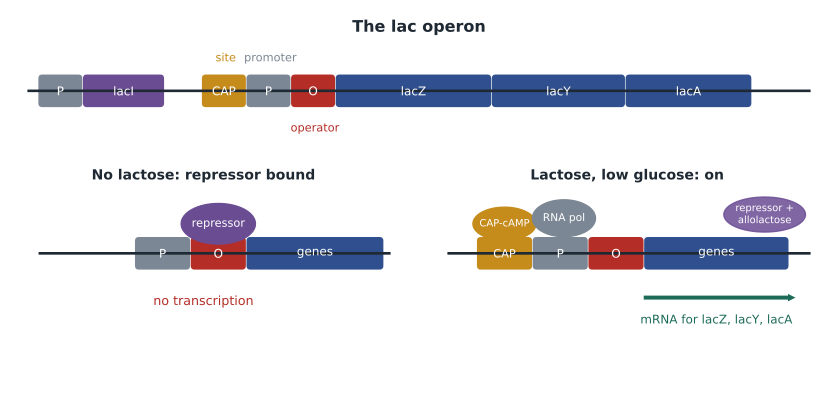
The lac operon contains three structural genes. LacZ encodes beta-galactosidase, which splits lactose into glucose and galactose and also converts some lactose into allolactose. LacY encodes a permease that brings lactose into the cell. LacA encodes a transacetylase. Upstream lie the promoter and operator. A separate gene, lacI, has its own promoter and is expressed constantly; it encodes the lac repressor.
Control works in two layers. The first is negative control by the repressor. Without lactose, the repressor binds the operator and blocks transcription. When lactose is present, some is converted into allolactose, which binds the repressor, changes its shape and releases it from the operator. The second layer is positive control by the catabolite activator protein (CAP). When glucose is scarce, cyclic AMP (cAMP) levels rise. CAP bound to cAMP binds a site upstream of the promoter and helps RNA polymerase bind. When glucose is abundant, cAMP is low, CAP is inactive and transcription is weak even if lactose is present. This is catabolite repression: the cell prefers glucose.
| Glucose | Lactose | Repressor | CAP-cAMP | Lac operon transcription |
|---|---|---|---|---|
| Present | Absent | Bound to operator | Low | Off |
| Present | Present | Released | Low | Low (basal) |
| Absent | Absent | Bound to operator | High | Off |
| Absent | Present | Released | High | High |
Lac operon mutants
Jacob and Monod used mutants to work out the model, and the MCAT uses the same reasoning. The terms cis and trans are central. A cis-acting element is a DNA sequence that affects only the genes on the same DNA molecule; the operator and promoter are cis-acting. A trans-acting factor is a diffusible molecule, usually a protein, that can act on any copy of the target in the cell; the repressor and CAP are trans-acting. Researchers tested this with partial diploids, bacteria carrying a second copy of part of the operon on a plasmid.
| Mutation | Effect | Dominant in a partial diploid? |
|---|---|---|
| lacI minus (repressor cannot bind operator) | Constitutive expression: genes on even without lactose | No; a normal repressor from the other copy acts in trans and restores control |
| lacO constitutive (operator cannot bind repressor) | Constitutive expression of genes on the same DNA | Yes, but only for genes on the same DNA (cis-dominant) |
| lacI superrepressor (repressor cannot bind allolactose) | Genes never induced | Yes; the mutant repressor binds both operators and cannot be removed |
| Promoter mutation | Little or no transcription of that copy | Affects only genes on the same DNA (cis) |
Worked problem
Reasoning with a partial diploid
A strain has a mutant operator that cannot bind repressor on its chromosome, linked to a lacZ gene that makes non-functional beta-galactosidase. A plasmid carries a normal operator and a normal lacZ. Both copies have normal lacI. Is functional beta-galactosidase made without lactose?
Show solution
- The mutant operator is cis-acting, so it causes constitutive expression only of the lacZ on the chromosome.
- But the chromosomal lacZ is non-functional, so constitutive expression there yields no active enzyme.
- The plasmid copy has a normal operator; normal repressor binds it when lactose is absent.
- So the functional lacZ on the plasmid is off without lactose.
Answer: No. Functional enzyme appears only when lactose is added. The constitutive operator affects only the gene beside it, which is defective.
The trp operon and attenuation
The trp operon encodes five enzymes that make tryptophan. The trp repressor is made in an inactive form. When tryptophan is abundant, it acts as a corepressor: it binds the repressor, which then binds the operator and blocks transcription. When tryptophan is scarce, the repressor is inactive and the genes are transcribed.
The trp operon also has a second, finer control called attenuation, which depends on the coupling of transcription and translation in bacteria. The beginning of the mRNA, the leader, contains two tryptophan codons and four regions that can pair in different ways. If tryptophan is plentiful, ribosomes translate the leader quickly and the RNA folds into a terminator hairpin that stops transcription early. If tryptophan is scarce, ribosomes stall at the tryptophan codons, the RNA folds into an alternative antiterminator structure and transcription continues. Attenuation cannot work in eukaryotes, because their transcription and translation happen in different compartments.
Chromosome organization in eukaryotes
Lesson 1 introduced nucleosomes. Here is the fuller picture, because chromatin structure is itself a level of gene control. Each nucleosome core contains two copies each of histones H2A, H2B, H3 and H4, with DNA wrapped around them; histone H1 binds the linker DNA between nucleosomes. Histones are rich in positively charged lysine and arginine, which bind the negatively charged DNA backbone. Chromatin folds into loops and domains, and during cell division it condenses into the compact chromosomes seen under a microscope.
Euchromatin is less condensed and generally accessible to transcription machinery. Heterochromatin is densely packed and generally silent. Constitutive heterochromatin, found at centromeres and telomeres, stays condensed in all cells; facultative heterochromatin varies between cell types and over time. A striking example of facultative heterochromatin is the inactive X chromosome in female mammals. Early in development, one X in each cell is silenced at random, coated by the long non-coding RNA XIST and condensed into a Barr body. This is why female mammals heterozygous for some X-linked genes show patches of different cells, as in the coat colors of calico cats.
DNA in cells is also supercoiled. Topoisomerases add or remove supercoils, and negative supercoiling, which slightly underwinds the helix, makes it easier to separate the strands for replication and transcription.
Chromatin and epigenetic regulation
Epigenetic changes alter gene expression without changing the DNA sequence and can be inherited through cell division. Two main mechanisms appear on the MCAT.
Histone modification changes how tightly chromatin is packed. Histone acetyltransferases add acetyl groups to lysines on histone tails, neutralizing their positive charge, loosening DNA binding and generally increasing transcription. Histone deacetylases remove them, generally decreasing transcription. Histone methylation can activate or repress, depending on which residue is modified. Chromatin remodeling complexes use ATP to slide or remove nucleosomes.
DNA methylation, in vertebrates mostly the addition of a methyl group to cytosines in CG dinucleotides, is generally associated with silencing, especially when it occurs in CpG-rich promoter regions called CpG islands. Methylation patterns are copied after replication by maintenance methyltransferases. Genomic imprinting depends on methylation: for a small number of genes, the copy inherited from one parent is silenced, so only the other parent's allele is expressed. Prader-Willi and Angelman syndromes involve the same chromosome region but differ according to which parent's copy is lost.
Transcription factors, enhancers and combinatorial control
Beyond the general transcription factors introduced in lesson 2, eukaryotic genes are controlled by specific transcription factors that bind regulatory DNA. Activators usually have two parts: a DNA-binding domain that recognizes a specific sequence and an activation domain that recruits coactivators, the Mediator complex or chromatin-modifying enzymes. Common DNA-binding structures include zinc fingers, helix-turn-helix motifs and leucine zippers. Repressors can block activators or recruit enzymes that close chromatin.
Enhancers are regulatory sequences that can lie far from the gene they control, upstream, downstream or inside an intron, and they work in either orientation. DNA loops so that activators bound at an enhancer contact the machinery at the promoter. Silencers are the repressive counterparts. Because each gene usually has several elements, and each cell type has a particular set of active factors, a gene's expression depends on the combination of factors present. This combinatorial control lets a limited number of factors produce many distinct patterns of expression.
Some transcription factors respond directly to signals. Steroid hormone receptors, for example, bind their hormones, move to the nucleus and act as transcription factors at genes containing hormone response elements. Other factors are activated by phosphorylation in signaling cascades. Lesson 10 links these pathways to the cell cycle.
Regulation after transcription
Gene expression is also controlled after transcription. Alternative splicing (lesson 2) can produce different proteins in different cells. Small regulatory RNAs act on mRNAs. MicroRNAs are made from hairpin precursors, cut to about 21 to 23 nucleotides by the enzyme Dicer and loaded into an RNA-induced silencing complex. If the match with a target mRNA is perfect or nearly so, the complex cuts the mRNA; if the match is partial, as is common for animal microRNAs, it represses translation and speeds mRNA decay. Small interfering RNAs work by the same machinery and are used in the laboratory and in some approved drugs to knock down specific genes, a technique called RNA interference.
Translation can be regulated too. Iron-responsive elements in some mRNAs bind proteins that block translation or protect the mRNA depending on iron levels. Proteins themselves can be activated by cleavage or phosphorylation and removed by ubiquitin-directed degradation.
Gene regulation and cancer
Cancer is, in large part, a disease of gene regulation. Proto-oncogenes are normal genes that promote cell growth and division, such as genes for growth factor receptors or for proteins in signaling pathways like Ras. A gain-of-function mutation, amplification or translocation can turn a proto-oncogene into an oncogene that drives division even without signals. Because only one altered copy is needed, oncogenes act dominantly at the cellular level. In chronic myeloid leukemia, a translocation between chromosomes 9 and 22 creates the BCR-ABL fusion gene, which makes a constantly active kinase.
Tumor suppressor genes restrain growth or trigger repair and cell death. Loss-of-function mutations in both copies are usually needed before a cell loses control, which is the basis of Alfred Knudson's two-hit hypothesis, developed from studies of retinoblastoma. People who inherit one mutant copy of RB1 need only one further hit in a retinal cell, which is why hereditary retinoblastoma often appears earlier and in both eyes. TP53, which encodes the protein p53, is the most frequently mutated tumor suppressor gene in human cancers. Epigenetic silencing of tumor suppressor promoters by DNA methylation is another route to the same loss.
| Feature | Oncogene | Tumor suppressor gene |
|---|---|---|
| Normal role | Promotes growth and division (as proto-oncogene) | Restrains division, repairs DNA or triggers apoptosis |
| Kind of mutation | Gain of function | Loss of function |
| Copies that must change | Usually one | Usually both |
| Examples | RAS, MYC, HER2 (ERBB2), BCR-ABL fusion | TP53, RB1, BRCA1, BRCA2, APC |
Common mistakes
MistakeLactose itself binds the lac repressor.
InsteadThe inducer is allolactose, made from lactose by beta-galactosidase.
MistakeHigh glucose increases cAMP and activates the lac operon.
InsteadHigh glucose lowers cAMP, so CAP is inactive and transcription stays low.
MistakeA constitutive operator mutation affects every lac operon in the cell.
InsteadOperators are cis-acting; the mutation affects only genes on the same DNA.
MistakeDNA methylation in a promoter usually activates a gene.
InsteadPromoter methylation in vertebrates is usually associated with silencing.
MistakeTumor suppressor mutations are usually dominant at the cellular level.
InsteadBoth copies usually must be lost; oncogene mutations are the ones that act dominantly.
Summary and key terms
- Cells regulate gene expression at many steps, most often at transcription initiation.
- The lac operon is inducible: allolactose releases the repressor, and CAP-cAMP boosts transcription when glucose is low.
- The trp operon is repressible: tryptophan activates its repressor, and attenuation fine-tunes transcription in bacteria.
- Operators and promoters act in cis; repressors and activators act in trans.
- Eukaryotic chromatin structure, histone modification and DNA methylation control access to genes; X inactivation and imprinting are epigenetic examples.
- Specific transcription factors, enhancers and silencers produce combinatorial control; microRNAs and siRNAs silence mRNAs.
- Oncogenes arise by gain of function in one copy; tumor suppressor genes usually require loss of both copies.
- Operon
- A cluster of bacterial genes transcribed from one promoter and controlled together.
- Operator
- A DNA sequence where a repressor binds to block transcription.
- Inducer
- A molecule that switches on an inducible operon, usually by inactivating a repressor.
- Corepressor
- A molecule that activates a repressor, switching off a repressible operon.
- Cis-acting
- Affecting only genes on the same DNA molecule.
- Enhancer
- A regulatory sequence that increases transcription and can act at a distance.
- Epigenetic
- Describing heritable changes in gene expression that do not change the DNA sequence.
- Tumor suppressor gene
- A gene whose loss of function contributes to uncontrolled cell division.
Practice problems
Work each problem on paper first, then reveal the answer to check.
In a lacI minus strain, is beta-galactosidase made without lactose?
Show answer
Yes; with no functional repressor, the operon is expressed constitutively.
A cell is given a drug that inhibits histone deacetylases. What happens to transcription of many genes?
Show answer
It generally increases, because histones stay acetylated and chromatin stays more open.
Why can attenuation regulate the trp operon in E. coli but not genes in human cells?
Show answer
Attenuation depends on ribosomes translating the leader while it is transcribed, which requires coupled transcription and translation.
A person inherits one mutant copy of RB1. Why are tumors likely to appear earlier?
Show answer
Every cell already has one hit, so a single additional mutation in any retinal cell can remove RB1 function.
Moving an enhancer 5,000 base pairs farther away and reversing its orientation leaves expression unchanged. What does this show?
Show answer
That the element works at a distance and in either orientation, typical of an enhancer.
Lesson quiz · 5 questions
Score 60% or more to complete this lesson.
Create a free account to save your progress, take quizzes and earn a certificate.