
MCAT-111 · Lesson 12 of 12 · 23 min
Capstone: a cell and molecular biology passage set
▶ Video coming soon A video version of this lesson is on the way.
For the last session of the cell and molecular biology block, Thandiwe wrote a timed set in the format of the Bio/Biochem section: three passages with five questions each and five independent questions, twenty questions in 32 minutes, close to the pace of the real section (59 questions in 95 minutes). 'Treat it as a dress rehearsal,' she said. 'Timed first, then blind review, then we talk.' The passages and questions below are original and written for this course; all data are invented.
This lesson gives you the full set, followed by explanations and the group's debrief. Take it under timed conditions before reading the explanations: about 9 minutes for each passage and 5 minutes for the independent questions. Mark any answer you are unsure of, then do a blind review, reconsidering marked questions without a time limit before you check the key. Each explanation names the reasoning skill involved, using the AAMC's four scientific inquiry and reasoning skills: knowledge of scientific concepts (skill 1), scientific reasoning and problem solving (skill 2), reasoning about research design (skill 3) and data-based and statistical reasoning (skill 4).
Passage 1: a stress-responsive enhancer
Cells respond to heat by increasing transcription of genes that encode chaperones. Researchers studied a gene, here called CHP1, whose mRNA rises sharply after heat shock in cultured human cells. They suspected a regulatory element 1,800 base pairs upstream of the transcription start site. To test it, they built reporter constructs in which the CHP1 promoter, with or without upstream DNA, was placed before a luciferase gene. Each construct was introduced into cells, which were kept at 37 degrees Celsius or heated to 42 degrees for 1 hour, and luciferase activity was measured 4 hours later.
Construct A contained the core promoter only. Construct B contained the core promoter plus the upstream region in its normal orientation. Construct C contained the upstream region in the reverse orientation. Construct D contained the upstream region with a 12-base-pair sequence, called element H, deleted. Construct E contained the upstream region but no core promoter. In a second experiment, the researchers introduced construct B into cells in which the gene for a transcription factor called HF1 had been knocked out using CRISPR-Cas9.
| Construct | Luciferase at 37 degrees (relative units) | Luciferase at 42 degrees (relative units) |
|---|---|---|
| A: core promoter only | 1.0 | 1.2 |
| B: upstream region + promoter | 1.1 | 18.5 |
| C: upstream region reversed + promoter | 1.0 | 17.9 |
| D: upstream region lacking element H + promoter | 1.0 | 1.4 |
| E: upstream region, no promoter | 0.1 | 0.2 |
| B in HF1 knockout cells | 1.0 | 1.3 |
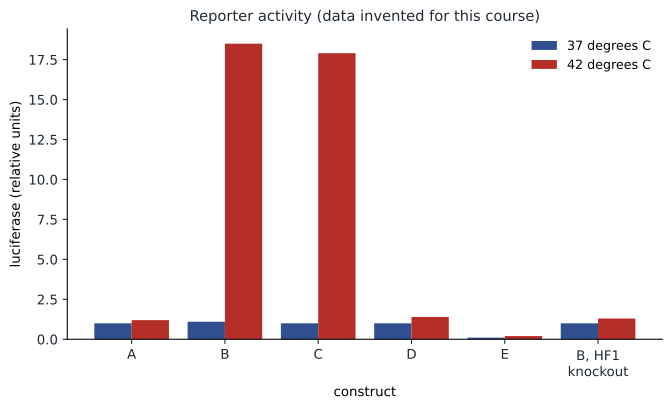
Questions 1 to 5 refer to passage 1.
1. The results for constructs B and C best support which conclusion? (A) The upstream region acts only in its normal orientation. (B) The upstream region behaves as an enhancer that works in either orientation. (C) The upstream region contains the core promoter. (D) Heat shock increases luciferase activity regardless of upstream DNA.
2. What is the most likely purpose of construct E? (A) To show that the upstream region alone cannot drive transcription without a promoter. (B) To measure the effect of heat on luciferase stability. (C) To test whether element H binds HF1. (D) To provide a positive control for heat induction.
3. Based on the data, which statement about element H is best supported? (A) It is required for basal expression at 37 degrees. (B) It is part of the coding sequence of luciferase. (C) It represses expression at 42 degrees. (D) It is required for heat-induced expression.
4. Which additional experiment would most directly test whether HF1 binds element H? (A) Measuring CHP1 mRNA by northern blot in normal cells. (B) An electrophoretic mobility shift assay using labeled element H DNA with and without purified HF1. (C) Sequencing the luciferase gene in construct D. (D) Measuring luciferase in construct A at 45 degrees.
5. HF1 knockout cells grown at 37 degrees show normal growth but die after heat shock that normal cells survive. Which explanation is most consistent with the passage? (A) HF1 is required for DNA replication. (B) Heat inactivates the CHP1 promoter in normal cells. (C) HF1 encodes luciferase. (D) Without HF1, cells cannot raise chaperone production in response to heat.
Passage 2: a transporter inhibitor
Intestinal epithelial cells absorb glucose from the gut lumen by a sodium-glucose symporter in the apical membrane and release it into the blood through a GLUT transporter in the basolateral membrane. A sodium-potassium pump in the basolateral membrane keeps intracellular sodium low. Researchers studied a compound, here called compound K, using a layer of cultured intestinal cells grown on a porous filter that separates an apical chamber from a basolateral chamber. Tight junctions between the cells prevent glucose from leaking around them.
In Experiment 1, researchers added radioactive glucose to the apical chamber and measured its appearance in the basolateral chamber over 30 minutes, with or without compound K added to the basolateral side. Glucose transport fell by 85 percent with compound K. In Experiment 2, they measured the uptake of radioactive glucose into isolated membrane vesicles containing only the GLUT transporter; compound K had no effect. In Experiment 3, they measured ATP hydrolysis by purified sodium-potassium pump; compound K reduced it by 90 percent.
Questions 6 to 10 refer to passage 2.
6. Which mechanism moves glucose from the lumen into the intestinal cell against its concentration gradient? (A) Simple diffusion. (B) Primary active transport using ATP. (C) Secondary active transport driven by the sodium gradient. (D) Facilitated diffusion through GLUT.
7. Based on Experiments 1 to 3, how does compound K most likely reduce glucose transport? (A) It blocks the GLUT transporter directly. (B) It increases glucose metabolism inside the cells. (C) It disrupts tight junctions. (D) It inhibits the sodium-potassium pump, dissipating the sodium gradient that powers the symporter.
8. If compound K were added and the experiment run for several hours, what would happen to the cells' resting membrane potential? (A) It would become more negative. (B) It would become less negative. (C) It would not change. (D) It would reverse to strongly positive values immediately.
9. What is the main purpose of Experiment 2? (A) To show that compound K enters the cells. (B) To rule out direct inhibition of GLUT as the explanation. (C) To measure the sodium gradient. (D) To confirm that tight junctions are intact.
10. Researchers add a dye that cannot cross membranes to the apical chamber and find almost none in the basolateral chamber after 30 minutes, with or without compound K. What does this show? (A) Compound K does not disrupt tight junctions, so glucose must cross through the cells. (B) Compound K blocks endocytosis. (C) The dye is transported by GLUT. (D) The cells have no basolateral membrane.
Passage 3: an inherited enzyme deficiency
An autosomal recessive deficiency of a lysosomal enzyme, here called LZ1, occurs in about 1 in 3,600 births in a large, isolated population thought to have been founded about 300 years ago by a small number of families. In the general population of the surrounding region, the condition occurs in about 1 in 250,000 births. The most common disease allele in the isolated population is a missense mutation that changes a single amino acid. Cells from affected people make normal amounts of LZ1 mRNA and protein, but the protein is retained in the endoplasmic reticulum and degraded. A second, rarer allele in the surrounding region is a nonsense mutation in exon 2 of a 10-exon gene; cells homozygous for it contain very little LZ1 mRNA.
Questions 11 to 15 refer to passage 3.
11. Assuming Hardy-Weinberg proportions, approximately what fraction of the isolated population are carriers? (A) 1 in 30. (B) 1 in 60. (C) 1 in 120. (D) 1 in 3,600.
12. Which evolutionary mechanism best explains the higher frequency of the disease allele in the isolated population? (A) Heterozygote advantage. (B) A founder effect followed by genetic drift. (C) Gene flow from the surrounding region. (D) A high mutation rate at the LZ1 locus.
13. Why do cells with the missense allele lack LZ1 activity in lysosomes despite normal protein levels? (A) The protein lacks a signal sequence. (B) The protein is secreted because it lacks mannose 6-phosphate. (C) The mRNA is not exported from the nucleus. (D) The misfolded protein is held in the endoplasmic reticulum by quality control and degraded.
14. Why do cells homozygous for the nonsense allele contain very little LZ1 mRNA? (A) The promoter is mutated. (B) Introns are not removed. (C) The nonsense codon prevents transcription. (D) Nonsense-mediated decay degrades mRNAs with premature stop codons far upstream of the last exon junction.
15. Two carriers from the isolated population have two children. What is the probability that both children are unaffected? (A) 1/16. (B) 3/8. (C) 9/16. (D) 3/4.
Independent questions
16. A DNA sample is 34 percent thymine. What percentage is guanine? (A) 16 percent. (B) 32 percent. (C) 34 percent. (D) 66 percent.
17. Which pair correctly matches a structure with the organism type in which it is found? (A) Peptidoglycan cell wall: animal cells. (B) 9 + 2 axoneme: bacterial flagella. (C) 70S ribosomes: mitochondria. (D) Nuclear envelope: archaea.
18. A cell in G2 is treated with a drug that prevents spindle microtubules from forming. At which point will it most likely arrest? (A) G1/S checkpoint. (B) S phase. (C) The spindle assembly checkpoint in mitosis. (D) Telophase.
19. A mutation in the lac operator prevents the repressor from binding. In a cell with no glucose and no lactose, the lac genes are: (A) expressed at a high level. (B) off, because there is no inducer. (C) off, because CAP is inactive. (D) expressed only if lactose is added.
20. A virus has a single-stranded RNA genome that cannot be translated directly and carries an RNA-dependent RNA polymerase in its virion. It is best described as: (A) a positive-sense RNA virus. (B) a retrovirus. (C) a negative-sense RNA virus. (D) a DNA virus.
Answers and explanations: passage 1
1. B (skill 4). Constructs B and C both give about 18 units at 42 degrees, so the region works in either orientation, and it lies far upstream: the definition of an enhancer. Choice D is contradicted by construct A, which barely responds to heat.
2. A (skill 3). Construct E lacks the core promoter and gives almost no signal, showing that the upstream region regulates transcription from a promoter but cannot start it alone. It is a control for the claim that the region is an enhancer, not a promoter.
3. D (skill 4). Deleting element H leaves basal expression unchanged (1.0) but abolishes heat induction (1.4 compared with 18.5), so H is required for the heat response, not for basal expression.
4. B (skill 3). A mobility shift assay tests binding directly: if HF1 binds the labeled DNA, the complex migrates more slowly in a gel. The knockout result shows HF1 is needed, but not whether it binds H itself; it could act through another protein.
5. D (skill 2). HF1 is needed for heat induction of the CHP1 reporter, and CHP1 encodes a chaperone. Without HF1, cells cannot raise chaperone levels to cope with heat-damaged proteins, so they die after heat shock while growing normally at 37 degrees.
Answers and explanations: passage 2
6. C (skill 1). The sodium-glucose symporter uses the inward sodium gradient to move glucose against its gradient: secondary active transport. GLUT moves glucose out of the cell by facilitated diffusion, down its gradient.
7. D (skill 2). Compound K does not affect GLUT (Experiment 2) but strongly inhibits the pump (Experiment 3). Without the pump, intracellular sodium rises, the gradient that drives the symporter collapses and glucose uptake falls.
8. B (skill 2). The pump maintains the potassium and sodium gradients that underlie the resting potential. As the gradients run down over hours, the potential becomes less negative. The change is gradual, not an immediate reversal.
9. B (skill 3). Experiment 2 isolates GLUT from the rest of the system. Because compound K does not change GLUT-mediated uptake, the explanation that compound K blocks GLUT can be ruled out.
10. A (skill 3). The membrane-impermeant dye stays in the apical chamber, so the tight junctions remain sealed with compound K present. Glucose therefore must cross through the cells, and the drop in transport reflects an effect on cellular transport, not on leakage.
Answers and explanations: passage 3
11. A (skill 4). q squared is 1/3,600, so q is 1/60 and p is about 59/60. Carriers are 2pq, about 2 times 1/60, or 1/30.
12. B (skill 2). The population was founded by a few families and has remained isolated, so a founder effect followed by drift best explains the high frequency. The passage gives no evidence of a heterozygote advantage, and gene flow from the region, where the allele is rare, would lower its frequency, not raise it.
13. D (skill 2). The passage says the mutant protein is retained in the endoplasmic reticulum and degraded, which is what ER quality control does to misfolded proteins. Choice B describes I-cell disease, which affects many enzymes rather than one protein.
14. D (skill 1). A stop codon in exon 2 of a 10-exon gene lies far upstream of the last exon junction, so the mRNA is targeted by nonsense-mediated decay. Transcription itself is unaffected.
15. C (skill 2). Each child is unaffected with probability 3/4, independently, so both are unaffected with probability 3/4 times 3/4, which is 9/16.
Answers and explanations: independent questions
16. A (skill 1). T equals A at 34 percent each, totaling 68 percent; G plus C is 32 percent, so G is 16 percent.
17. C (skill 1). Mitochondria have 70S ribosomes, consistent with their bacterial origin. Animal cells lack peptidoglycan, bacterial flagella lack the 9 + 2 axoneme and archaea lack a nuclear envelope.
18. C (skill 2). Without spindle microtubules, kinetochores cannot attach, and the spindle assembly checkpoint holds the cell in mitosis before anaphase.
19. A (skill 2). The repressor cannot bind the mutant operator, so the operon is not repressed even without inducer. With no glucose, cAMP is high and CAP is active, so expression is high.
20. C (skill 1). A genome that cannot be translated directly is negative-sense, and such viruses must carry their own RNA-dependent RNA polymerase because host cells lack one.
The debrief
After blind review, the group compared notes. Elliot scored 19 of 20 timed and 20 of 20 after blind review; his one miss was question 8, where he chose "immediately reversed" because he had read "compound K" and pictured a channel opening. Devika scored 17 timed and 18 after blind review, missing questions 11 and 15 under time pressure and question 4 in both rounds; she had chosen the northern blot because it "measured the real gene", although it says nothing about binding. Ezequiel scored 15 timed and 17 after blind review. His misses clustered in passage 1, where he spent too long on the table, and in question 12, where he chose heterozygote advantage because sickle cell was fresh in his memory.
Thandiwe pointed out three patterns. First, most misses came from reasoning about design (skill 3) and data (skill 4), not from missing content. Second, questions 11 and 15 were simple arithmetic that went wrong only under time pressure; the fix is a habit, not more content review: write the setup (q squared equals 1/3,600) before computing. Third, question 12 showed the risk of answering from a memorable example instead of from the passage. 'The passage told you the population was small, isolated and founded by a few families,' she said. 'It did not mention malaria or any advantage to carriers. Answer from what the passage gives you.'
| Miss type | Example from the set | Fix |
|---|---|---|
| Content gap | Not knowing that GLUT is facilitated diffusion | Review the topic, then do 10 recall questions on it |
| Design reasoning (skill 3) | Choosing a northern blot instead of a binding assay in question 4 | For every experiment, ask what each control rules out |
| Data reading (skill 4) | Spending too long on Table 1 | Read column headings and units first; find the comparison the question needs |
| Arithmetic under time pressure | Hardy-Weinberg carrier frequency in question 11 | Write the setup before calculating; use simple fractions |
| Outside knowledge overriding the passage | Heterozygote advantage in question 12 | Underline the passage evidence that supports your choice |
Reading strategy for science passages
The set illustrates a reading approach that works across Bio/Biochem passages. Read the first paragraph for the question the researchers are asking. Skim the methods for what was varied and what was measured, and label each experiment with its purpose in a few words in your noteboard notes. Read tables and figures by their headings and units first and look for the comparison that matters, such as with and without the element, or with and without the drug. Do not try to memorize every value. When you reach a question, return to the specific data it needs.
Experimental passages often include constructs or conditions that exist only as controls. In passage 1, construct A showed the baseline, construct E showed that the region could not act as a promoter, and the knockout showed that HF1 was needed. Asking "what does this condition rule out?" for each one turns a crowded table into a short argument. That habit answers most skill 3 questions.
Connecting the course
This set drew on nearly every lesson in the course: enhancers and transcription factors (lessons 2 and 4), CRISPR knockouts and reporter assays (lesson 5), membrane transport and the resting potential (lesson 8), ER quality control and lysosomes (lessons 3 and 9), Hardy-Weinberg and probability (lesson 6), founder effects (lesson 7), nonsense-mediated decay (lessons 2 and 3), base pairing (lesson 1), cell cycle checkpoints (lesson 10), the lac operon (lesson 4), endosymbiosis (lesson 9) and viral genomes (lesson 11). That integration is typical of the real section: passages are built around experiments, and experiments rarely respect chapter boundaries.
Thandiwe closed by asking each member to add three lines to their error log and one change to their plan. Elliot planned a weekly mixed set of experimental passages to keep his reasoning sharp while he focused on CARS. Devika added a daily five-minute drill of genetics arithmetic. Ezequiel decided to practice reading tables with a timer, giving himself 60 seconds to state the main comparison in any table before looking at the questions.
Common mistakes
MistakeIf a factor is needed for expression, it must bind the element directly.
InsteadNeed shows a requirement; only a binding assay shows direct binding.
MistakeControls in a passage can be skipped because they show "nothing".
InsteadEach control rules out an alternative explanation; identify what it rules out.
MistakeA familiar textbook example is probably what the passage is about.
InsteadAnswer from the passage's evidence, even when a memorable example comes to mind.
MistakeSimple arithmetic can be done in your head under time pressure.
InsteadWrite the setup first; most arithmetic misses are setup errors made in haste.
MistakeBlind review is a waste of time after a timed set.
InsteadBlind review separates gaps in understanding from errors caused by time pressure.
Summary and key terms
- A Bio/Biochem passage set combines content from many lessons; this capstone used regulation, biotechnology, transport, trafficking, genetics, evolution, cell division and microbiology.
- Enhancers work at a distance and in either orientation; a binding assay, not a knockout, shows direct binding.
- Blocking the sodium-potassium pump stops secondary active transport and gradually depolarizes cells.
- Founder effects and drift explain high frequencies of rare alleles in small, isolated populations.
- Classify misses by cause (content, design, data, arithmetic, outside knowledge) and choose a fix for each.
- For every experimental condition, ask what it rules out; read tables by headings, units and the key comparison.
- Reporter gene
- A gene whose product is easy to measure, used to report on the activity of a regulatory sequence.
- Electrophoretic mobility shift assay
- A method that detects protein-DNA binding by the slower migration of the complex in a gel.
- Knockout
- An organism or cell line in which a gene has been inactivated.
- Blind review
- Reconsidering marked questions without a time limit before checking answers.
- Control condition
- A condition included to rule out an alternative explanation.
- Skill 3
- The AAMC reasoning skill concerned with research design and execution.
Practice problems
Work each problem on paper first, then reveal the answer to check.
In passage 1, why was construct E necessary?
Show answer
It showed that the upstream region could not drive transcription without the core promoter, supporting the conclusion that it is an enhancer rather than a promoter.
In passage 2, what result would have suggested that compound K blocks GLUT directly?
Show answer
Reduced glucose uptake in the GLUT-only vesicles of Experiment 2.
In passage 3, what is the carrier frequency in the surrounding region, where the condition occurs in 1 in 250,000 births?
Show answer
q is 1/500, so carriers are about 2/500, or 1 in 250.
Ezequiel chose heterozygote advantage in question 12. What passage evidence argues against it?
Show answer
The passage describes a small founding population and isolation, and says nothing about any advantage to carriers.
Lesson quiz · 5 questions
Score 60% or more to complete this lesson.
Create a free account to save your progress, take quizzes and earn a certificate.