
MCAT-111 · Lesson 2 of 12 · 22 min
DNA and gene expression: transcription and RNA processing
▶ Video coming soon A video version of this lesson is on the way.
Elliot had a habit of saying "the gene makes the protein". Thandiwe let it pass twice, then stopped him. 'Genes do not make anything,' she said. 'Polymerases make RNA from genes, ribosomes make protein from RNA, and at every step the cell decides how much. The MCAT lives in those steps.' She drew three boxes on the screen, DNA, RNA and protein, and two arrows between them. 'Today is the first arrow.'
This lesson covers the central dogma, the types of RNA, how RNA polymerase transcribes a gene in bacteria and in eukaryotes, and how eukaryotic pre-mRNA is processed into mature mRNA. It belongs to content category 1B on the AAMC outline, under the headings genetic code, transcription and, in part, eukaryotic chromosome organization. Passages in this area often describe a mutation in a promoter, a splice site or a processing enzyme, and ask what happens to the RNA or protein that results.
The central dogma and its exceptions
Francis Crick's central dogma describes the usual flow of sequence information: DNA is copied to DNA by replication, DNA is copied to RNA by transcription, and RNA is used to make protein by translation. Information does not flow from protein back to nucleic acid. The dogma has well-known extensions that the MCAT tests. Retroviruses such as HIV use reverse transcriptase to copy RNA into DNA. Many RNA viruses copy RNA into RNA using an RNA-dependent RNA polymerase. Telomerase, from lesson 1, is a cellular reverse transcriptase. None of these breaks the rule that protein sequence is not copied back into nucleic acid.
Types of RNA
Cells make many kinds of RNA. Three are central to protein synthesis, and several others regulate it.
| RNA | Role | Notes |
|---|---|---|
| Messenger RNA (mRNA) | Carries the coding sequence from DNA to the ribosome | In eukaryotes, processed from pre-mRNA; usually a small fraction of total RNA |
| Transfer RNA (tRNA) | Brings amino acids to the ribosome and reads codons with its anticodon | About 75 to 95 nucleotides; folded into a cloverleaf and an L-shaped structure |
| Ribosomal RNA (rRNA) | Forms the structural and catalytic core of the ribosome | The most abundant RNA in most cells; catalyzes peptide bond formation |
| Small nuclear RNA (snRNA) | Part of the spliceosome that removes introns | Found in the nucleus of eukaryotes |
| MicroRNA (miRNA) and small interfering RNA (siRNA) | Silence specific mRNAs by base pairing | Covered in lesson 4 |
| Long non-coding RNA (lncRNA) | Regulates chromatin and gene expression | Example: XIST, which helps silence one X chromosome in female mammals |
An RNA molecule that catalyzes a reaction is a ribozyme. The ribosome's peptidyl transferase activity is carried out by rRNA, and the spliceosome's chemistry is carried out largely by snRNA. Ribozymes are a key piece of evidence for the "RNA world" hypothesis that early life used RNA both to store information and to catalyze reactions.
How transcription works
RNA polymerase reads a DNA template strand 3' to 5' and builds RNA 5' to 3', using ribonucleoside triphosphates (ATP, GTP, CTP and UTP). Unlike DNA polymerase, RNA polymerase does not need a primer, and it unwinds the DNA itself, opening a short transcription bubble of about 12 to 14 base pairs. RNA polymerase has much weaker proofreading than DNA polymerase, so transcription is less accurate than replication, but errors are tolerable because each RNA is one of many temporary copies.
The two DNA strands have names that students often mix up. The template strand (also called the antisense or non-coding strand) is the one RNA polymerase reads. The coding strand (also called the sense strand) has the same sequence as the RNA, except that it has T where the RNA has U. Gene sequences in databases and in most passages are written as the coding strand, 5' to 3'. If a passage gives you a template strand, reverse it and complement it to get the RNA.
Worked problem
From template strand to mRNA
A template strand reads 3'-TACGGATTC-5'. What is the sequence of the RNA transcribed from it, and what is the coding strand?
Show solution
- The RNA is complementary and antiparallel to the template, so read the template 3' to 5' and write the RNA 5' to 3'.
- Complement each base: T becomes A, A becomes U, C becomes G, G becomes C.
- The RNA is 5'-AUGCCUAAG-3'.
- The coding strand has the same sequence as the RNA, with T for U: 5'-ATGCCTAAG-3'.
Answer: RNA 5'-AUGCCUAAG-3'; coding strand 5'-ATGCCTAAG-3'. The RNA begins with AUG, the usual start codon.
Transcription has three stages. In initiation, RNA polymerase binds a promoter, a DNA sequence upstream of the gene, opens the helix and begins synthesis at the transcription start site. Positions are numbered relative to that site: +1 is the first transcribed nucleotide, positive numbers run downstream (in the direction of transcription) and negative numbers run upstream into the promoter. In elongation, the polymerase moves along the template, adding nucleotides. In termination, specific sequences cause the polymerase to release the RNA and leave the DNA.
Transcription in bacteria
Bacteria have a single RNA polymerase. Its core enzyme performs synthesis, and a detachable sigma factor recognizes promoters. A typical bacterial promoter has two conserved elements: a sequence centered near -10 (often called the Pribnow box, with a consensus close to TATAAT) and one near -35. Different sigma factors recognize different promoter sequences, which lets a bacterium switch large sets of genes on together, for example in response to heat shock.
Bacterial termination happens in two main ways. In rho-independent (intrinsic) termination, the RNA forms a GC-rich hairpin followed by a run of uracils; the hairpin stalls the polymerase and the weak A-U pairs let the RNA slip off. In rho-dependent termination, a helicase called rho binds the RNA, moves along it and pulls it free of the polymerase.
In bacteria, transcription and translation are coupled. There is no nucleus, so ribosomes begin translating an mRNA while it is still being made. Bacterial mRNAs are often polycistronic: one mRNA carries several coding sequences, usually for proteins in the same pathway, each with its own start and stop codons. That arrangement is the basis of the operons covered in lesson 4.
Transcription in eukaryotes
Eukaryotes have three nuclear RNA polymerases with distinct jobs, a frequent recall question.
| Polymerase | Main products | Location |
|---|---|---|
| RNA polymerase I | Most rRNAs (the large precursor that yields 28S, 18S and 5.8S rRNA) | Nucleolus |
| RNA polymerase II | mRNA precursors, most snRNAs and microRNA precursors | Nucleoplasm |
| RNA polymerase III | tRNA, 5S rRNA and some other small RNAs | Nucleoplasm |
Eukaryotic RNA polymerase II cannot recognize a promoter on its own. General transcription factors assemble first. A common core promoter element is the TATA box, about 25 to 30 base pairs upstream of the start site, bound by TATA-binding protein as part of the factor TFIID. Other general factors then recruit the polymerase and open the DNA. Many genes also have proximal elements and distant enhancers that bind specific activators, which can lie thousands of base pairs away and work in either orientation by looping the DNA. These regulatory elements are the subject of lesson 4. Mitochondria have their own small genome and their own polymerase, a reminder of their bacterial origin.
A practical comparison helps with passage questions. A mutation in the -10 region of a bacterial promoter reduces sigma binding and therefore reduces transcription of that gene; it does not change the protein's sequence. A mutation in a eukaryotic TATA box similarly reduces initiation. A mutation in the coding sequence leaves the amount of RNA unchanged but may change the protein. Always ask where a mutation lies before predicting its effect.
Processing eukaryotic pre-mRNA
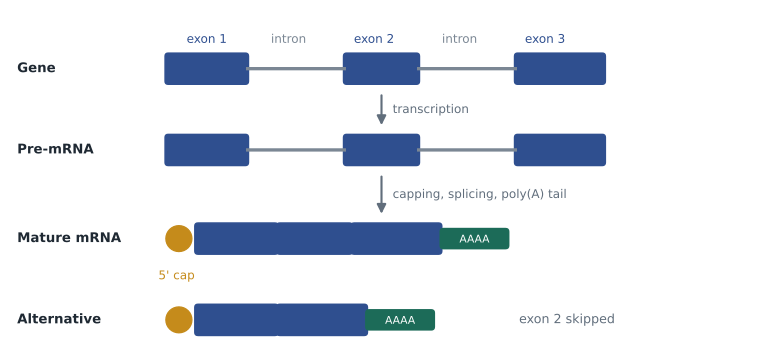
A eukaryotic gene transcribed by polymerase II yields a primary transcript, the pre-mRNA, which must be processed before it leaves the nucleus. Processing happens largely while transcription is still under way and involves three changes.
- A 5' cap is added: a 7-methylguanosine attached to the first nucleotide by an unusual 5' to 5' triphosphate linkage. The cap protects the mRNA from 5' exonucleases, helps export and is recognized by the translation machinery.
- A 3' poly(A) tail of roughly 100 to 250 adenines is added after the RNA is cut downstream of a polyadenylation signal (often AAUAAA). The tail protects the mRNA and helps translation; it gradually shortens in the cytoplasm, and once it becomes short the mRNA is typically degraded.
- Introns are removed and exons joined by splicing.
Introns are intervening sequences that are transcribed but removed; exons are the sequences that remain in the mature mRNA, including the 5' and 3' untranslated regions as well as the coding sequence. Most human genes contain introns, and introns are often much longer than exons. A typical intron begins with GU at its 5' end and ends with AG at its 3' end, with a branch point adenine upstream of the 3' end.
The spliceosome, a large complex of snRNAs and proteins (small nuclear ribonucleoproteins, or snRNPs), recognizes these sequences. In the first step, the 2' hydroxyl of the branch point adenine attacks the 5' splice site, cutting the RNA and forming a looped structure called a lariat. In the second step, the free 3' end of the upstream exon attacks the 3' splice site, joining the two exons and releasing the lariat intron. You do not need to memorize every snRNP name, but you should know that splice sites are defined by short sequences and that mutations in them change the mature mRNA.
Alternative splicing and its consequences
Many pre-mRNAs can be spliced in more than one way. An exon might be included in one cell type and skipped in another, or an alternative 5' or 3' splice site might be used. Alternative splicing lets one gene encode several related proteins, called isoforms, and helps explain how humans make a very diverse set of proteins from roughly 20,000 protein-coding genes. A frequently cited estimate is that more than 90 percent of human multi-exon genes undergo alternative splicing.
Splice-site mutations are an important cause of disease. A mutation in the GU at the start of an intron can cause the intron to be retained or an exon to be skipped. Some forms of beta thalassemia arise from mutations that create or destroy splice sites in the beta-globin gene. If exon skipping removes a number of nucleotides that is a multiple of three, the reading frame is preserved and the protein simply lacks a segment; otherwise, the frame shifts downstream and the protein is usually truncated. That reasoning links this lesson to lesson 3.
RNA editing, export and stability
Some mRNAs are changed after transcription by RNA editing, in which individual bases are altered. A well-known example is apolipoprotein B: in intestinal cells, a cytidine deaminase converts one C to U, creating a stop codon and a shorter protein than the one made in the liver from the same gene. Mature mRNAs are exported through nuclear pores with the help of export proteins. In the cytoplasm, the half-life of an mRNA can range from minutes to many hours, and changes in stability are one way cells adjust how much protein a gene produces.
Eukaryotic cells also check mRNA quality. Nonsense-mediated decay targets mRNAs that contain a premature stop codon well upstream of the final exon junction. This protects the cell from accumulating truncated proteins that might interfere with normal ones. In a passage, a nonsense mutation in an early exon may therefore reduce the amount of mRNA, not just shorten the protein.
Comparing bacteria and eukaryotes
| Feature | Bacteria | Eukaryotes |
|---|---|---|
| RNA polymerases | One, with sigma factors | Three nuclear polymerases, plus mitochondrial |
| Promoter recognition | Sigma factor binds -10 and -35 elements | General transcription factors, often at a TATA box, recruit polymerase II |
| Location | Cytoplasm (nucleoid) | Nucleus |
| Coupling with translation | Yes, simultaneous | No; processing and export first |
| Processing | Minimal; no cap, tail or introns in most mRNAs | 5' cap, poly(A) tail and splicing |
| Genes per mRNA | Often several (polycistronic) | Usually one (monocistronic) |
Reading a transcription passage
Passages in this area often present data from a reporter assay, in which a promoter of interest is placed upstream of a gene whose product is easy to measure, such as luciferase or green fluorescent protein. Researchers mutate or delete parts of the promoter and measure the reporter. A deletion that reduces expression removes an activating element; a deletion that increases expression removes a repressing one. If deleting a distant element changes expression in one cell type but not another, that element is probably an enhancer bound by a cell-type-specific activator. Read the axis labels and the controls before you read the conclusion; an MCAT passage will usually include a construct with no promoter as a baseline.
Devika practiced one such passage after the session. The data showed that deleting a region 2,000 base pairs upstream reduced expression by about 90 percent in liver cells but had no effect in kidney cells. She wrote in her error log: "Distant, tissue-specific, orientation not tested: enhancer bound by a liver activator. Check whether the question asks about the element or the factor." Her note captures a common trap: a question may ask what kind of DNA element the region is, or what kind of protein binds it, and the answers differ.
Common mistakes
MistakeThe coding strand is the strand RNA polymerase reads.
InsteadThe template strand is read; the coding strand has the same sequence as the RNA, with T for U.
MistakeRNA polymerase needs a primer, like DNA polymerase.
InsteadRNA polymerase starts chains on its own; only DNA polymerase needs a primer.
MistakeIntrons are never transcribed.
InsteadIntrons are transcribed into pre-mRNA and then removed by splicing.
MistakeEukaryotic polymerase II binds promoters directly through a sigma factor.
InsteadSigma factors are bacterial; polymerase II is recruited by general transcription factors.
MistakeA promoter mutation changes the amino acid sequence of the protein.
InsteadPromoter mutations usually change how much RNA is made, not the sequence of the protein.
Summary and key terms
- Transcription copies a DNA template strand into RNA, read 3' to 5' and built 5' to 3', without a primer.
- Bacteria use one RNA polymerase with sigma factors that recognize -10 and -35 promoter elements; transcription and translation are coupled.
- Eukaryotes use three nuclear RNA polymerases; polymerase II makes pre-mRNA after general transcription factors assemble at the promoter.
- Pre-mRNA receives a 5' cap, a 3' poly(A) tail and splicing by the spliceosome before export.
- Alternative splicing produces several protein isoforms from one gene; splice-site mutations can skip exons or retain introns.
- Ribozymes, RNA editing and nonsense-mediated decay show that RNA does more than carry messages.
- Template strand
- The DNA strand read by RNA polymerase; complementary to the RNA.
- Coding strand
- The DNA strand with the same sequence as the RNA, except T in place of U.
- Promoter
- A DNA sequence where RNA polymerase and its factors bind to start transcription.
- Sigma factor
- A bacterial protein that directs RNA polymerase to specific promoters.
- TATA box
- A eukaryotic core promoter element about 25 to 30 base pairs upstream of the start site.
- Spliceosome
- A complex of snRNAs and proteins that removes introns from pre-mRNA.
- Alternative splicing
- Joining of exons in different combinations to make different mRNAs from one gene.
- Ribozyme
- An RNA molecule with catalytic activity.
Practice problems
Work each problem on paper first, then reveal the answer to check.
A coding strand reads 5'-ATGGCTTGA-3'. What is the mRNA?
Show answer
5'-AUGGCUUGA-3', the same as the coding strand with U in place of T.
Which eukaryotic RNA polymerase is most affected by a drug that blocks tRNA synthesis?
Show answer
RNA polymerase III, which makes tRNA and 5S rRNA.
An intron's first two nucleotides are changed from GU to AU. What is a likely result?
Show answer
The 5' splice site is not recognized, so the intron may be retained or a nearby cryptic site used, changing the mature mRNA.
Why can bacterial ribosomes begin translating an mRNA before transcription ends?
Show answer
Bacteria have no nucleus separating the two processes, and their mRNA needs no capping or splicing first.
A pre-mRNA lacks its polyadenylation signal. What happens to the mRNA?
Show answer
It is not properly cleaved and polyadenylated, so it is poorly exported and quickly degraded.
Lesson quiz · 5 questions
Score 60% or more to complete this lesson.
Create a free account to save your progress, take quizzes and earn a certificate.