
MBA-613 · Lesson 6 of 12 · 22 min
Vision, narrative and communicating change
Grace Mwangi has six months left at Fairway Grocers before she leaves to run Second Ascent, and she wants the automated ordering system for dry grocery items to outlast her. Lesson 4's analysis showed that store managers overrode 61 percent of the system's suggested orders in the first month, for four distinct reasons. Fairway's communications so far have consisted of a launch email from the vice-president of operations, a two-page guide and a webinar that thirty-one of the forty managers attended, most with their cameras off. The email described the system as 'a best-in-class forecasting platform that will drive efficiency and optimize inventory across the network'. Grace asks the cohort what a store manager in a small town would make of that sentence.
Daniel says he would assume it meant fewer staff hours. Owen says it sounds like a vendor wrote it. Hana says it does not tell her anything about her own store. Dr. Morin says all three answers are reasonable interpretations, and that is the problem: the email left the meaning of the change to each reader's imagination, and imagination under uncertainty is usually pessimistic. This lesson is about how leaders give change a meaning that people can understand, believe and act on.
What a vision is for
A change vision is a picture of the future that explains, in a few sentences, what the organization is trying to become and why it is worth the effort. Kotter argued that an effective vision is imaginable, conveying a picture of what the future will look like; desirable, appealing to the long-term interests of employees, customers and owners; feasible, with realistic goals; focused enough to guide decisions; flexible enough to allow initiative; and communicable, explainable in five minutes. He suggested a test: if you cannot describe the vision in five minutes and get a reaction that shows both understanding and interest, it is not yet ready.
The vision is not the plan. A plan says what will happen when; a vision says why and toward what. It guides the thousands of small decisions that no plan can anticipate. A Fairway store manager who understands that the purpose of the ordering system is to free her from three hours a week of counting cans so she can spend that time on fresh produce and staff, while keeping shelves full, can make sensible decisions about when to override. A manager who only knows that the system will 'optimize inventory' cannot.
Sensemaking and sensegiving
Karl Weick described organizations as places where people constantly try to make sense of ambiguous events, by noticing cues, connecting them to what they already believe and building a plausible story. During change, sensemaking intensifies. People look for clues in everything: the words in an announcement, who was invited to a meeting, who left, what happened to the last change. Dennis Gioia and Kumar Chittipeddi, studying a new president's strategic change at a university in 1991, described the leader's corresponding task as sensegiving: offering an interpretation of the change that people can adopt. Sensegiving works through stories, symbols and actions more than through formal announcements.
The implication is that communication does not begin when the communications team sends the first message. It began with the first rumor. Fairway's store managers had already made sense of the ordering system before the launch email, based on the head office's record of withdrawing two of its last three systems and on a rumor that the system would be used to cut store labor budgets. The launch email confirmed their story by saying nothing about either.
Narrative
People remember and repeat stories far more than they remember slides. A change narrative has a simple shape. It explains where we have come from and what we are proud of, so that the change does not appear to dismiss the past. It describes what has changed in the world around us, with concrete evidence. It sets out what we are going to do and why this choice rather than others. It acknowledges what will be hard and what people will lose. It describes what the future will look like for the listener. And it says what will happen next and what is asked of the listener now.
Grace drafts a narrative for Fairway's store managers. It begins with the stores' record: Fairway's managers have kept shelves fuller than the national chains in four of the last five years, and that is because they know their stores. It describes what has changed: the number of dry grocery items has grown by a third in five years, and managers now spend an average of three hours a week on ordering, much of it on items that sell steadily. It says what Fairway is doing: letting the system handle steady items, so that managers can spend their judgment where it matters, on fresh food, local events and promotions. It acknowledges the difficulty: the system will make mistakes in its first months, especially around local events, and managers will need to correct it. It describes the future: shelves at least as full as today, two to three hours a week back for each manager, and a system that gets smarter because managers teach it. It ends with what is asked: flag local events in the system, review exceptions daily and tell the project team what the system gets wrong. It also states plainly that store labor budgets will not be cut because of the system, a commitment the vice-president has agreed to make in writing.
Fear, hope and the burning platform
Many change leaders believe that people change only when frightened. The most famous image is the burning platform, popularized by Daryl Conner, who told the story of a worker on the Piper Alpha oil platform in the North Sea in 1988 who jumped into the freezing sea because staying meant certain death. Stephen Elop, then chief executive of Nokia, used the image in a widely leaked memo in 2011 to argue that the company had to abandon its own smartphone software. The memo created urgency, but critics have argued that it also undermined confidence among customers, partners and employees at a fragile moment.
Research on fear appeals in health communication offers a more careful conclusion. Fear can motivate change when people also believe that there is an effective response and that they are able to carry it out. Fear without a credible path produces denial, defensiveness and paralysis. In change, this suggests pairing an honest account of the threat with a clear, achievable set of actions, and emphasizing the future people can build more than the disaster they must avoid. Chip and Dan Heath, in their 2010 book Switch, used a metaphor from the psychologist Jonathan Haidt: a rational rider sitting on an emotional elephant. Change requires directing the rider with clear steps, motivating the elephant with feeling, and shaping the path by changing the environment so that the desired behavior is easier.
Who should communicate
Employees do not trust all sources equally. TJ and Sandar Larkin's 1994 book Communicating Change argued, from surveys and their own consulting, that frontline employees prefer to hear about change from their immediate supervisor, face to face, rather than from senior executives through mass media. Later surveys of employees in many countries have reported similar preferences, although the details vary. The reason is not that supervisors are better speakers. It is that they can answer the question every employee asks first: what does this mean for me and my job?
Research on adoption of innovations in schools, the concerns-based adoption model developed by Gene Hall and Shirley Hord, found that people's concerns about a change move through stages: first about information (what is it?), then personal (how will it affect me?), then management (how do I do it?), and only later consequences (is it working for customers?), collaboration and refinement. Communications that begin with the organization's strategic rationale answer a question that most people are not yet asking. Effective communication answers personal concerns early and then moves on.
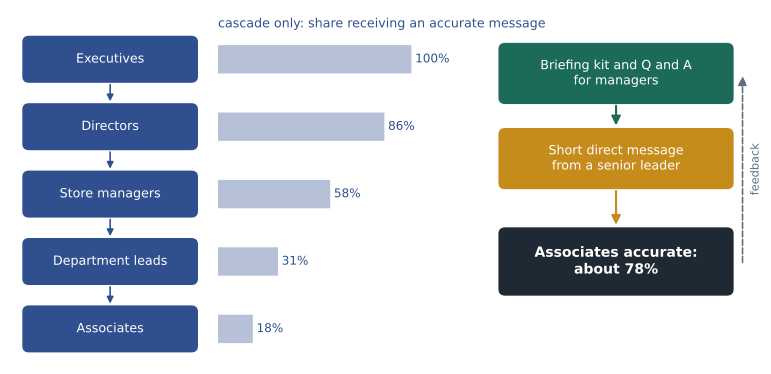
This makes managers the most important channel and also the weakest link. Managers who have not been briefed, do not understand the change, disagree with it or are themselves anxious about it pass on a distorted message, or none at all. Communication plans that rely on a cascade, in which each level briefs the level below, often find that the message has faded or changed by the time it reaches the front line.
# How much of a change message reaches the front line accurately?
levels = ["directors", "store managers", "department leads", "associates"]
pass_on = [0.95, 0.85, 0.75, 0.80]      # chance each level briefs the next at all
accuracy = [0.90, 0.80, 0.70, 0.75]     # chance the briefing is accurate if it happens

def cascade(pass_on, accuracy):
    reach = 1.0
    out = []
    for p, a in zip(pass_on, accuracy):
        reach *= p * a
        out.append(reach)
    return out

plain = cascade(pass_on, accuracy)
# With a briefing kit and Q and A for managers, accuracy rises; a short direct video
# from the vice-president reaches associates without passing through every level.
kit = cascade([0.98, 0.95, 0.90, 0.90], [0.95, 0.92, 0.88, 0.88])
direct_reach = 0.55   # share of associates who watch and understand the direct message
combined = 1 - (1 - kit[-1]) * (1 - direct_reach)

for name, val in zip(levels, plain):
    print(f"cascade only   - {name:17s} accurate {val:5.1%}")
print(f"cascade with kit - associates     accurate {kit[-1]:5.1%}")
print(f"kit plus direct message - associates accurate {combined:5.1%}")cascade only - directors accurate 85.5% cascade only - store managers accurate 58.1% cascade only - department leads accurate 30.5% cascade only - associates accurate 18.3% cascade with kit - associates accurate 51.0% kit plus direct message - associates accurate 78.0%
The numbers are illustrative but the pattern is robust. A plain cascade through four levels, even with fairly good odds at each step, delivers an accurate message to fewer than a fifth of frontline associates. Briefing kits, practice sessions and a question-and-answer sheet for managers more than double that. Adding a short direct message from a senior leader, explaining the change and its commitments in plain words, raises accurate understanding to about three-quarters. Neither channel alone does as well as the combination, because the direct message provides consistency and the manager provides interpretation for each person's job.
Repeat, listen and act consistently
Kotter wrote that leaders undercommunicate their vision by a factor of ten, and many practitioners would say he was conservative. People need to hear a message several times, through several channels, before it registers, especially when they are busy and when the message competes with other changes. Repetition is not the same as broadcasting the same email repeatedly. It means returning to the core message in meetings, decisions, recognition and answers to questions, using stories and examples from people's own work.
Communication must also flow upward. Two-way channels, such as question sessions, site visits, pulse surveys and simple ways to report problems, show people that they are being heard and give change leaders early warning of trouble. Grace sets up a weekly fifteen-minute call open to all store managers, where the project team reports the most common override reasons and what has been done about them. The first call has six participants. By the fourth, after managers see that their reports led to two fixes, it has twenty-three.
Most important of all, actions must match words. If Fairway's vice-president promises that labor budgets will not be cut and then cuts one store's budget a month later for an unrelated reason, every manager will connect the two. Leaders should audit their own decisions during a change for inconsistency with the message: who is promoted, what is funded, what is praised, and what leaders spend their own time on. Edgar Schein argued that what leaders pay attention to, measure and control is the most powerful message they send.
A communication plan
A practical communication plan has five parts. Audiences: who is affected, and how differently, so that each group gets messages relevant to it. Messages: the core narrative and the specific answers each audience needs. Channels: which media and messengers will reach each audience, combining face-to-face and written, direct and through managers. Timing: what is said when, with the principle that people should hear important news from their manager before they hear it from the media or a rumor. Feedback: how questions and reactions will be collected and answered.
| Audience | Main concern | Key message | Channel and messenger | Feedback |
|---|---|---|---|---|
| Store managers | Blame for stockouts; loss of role | You decide where judgment matters; no scorecard penalty for system stockouts in the first six months | Regional manager in person; briefing kit; weekly call | Override reasons logged; weekly call |
| Department leads | More or less work? | Less counting, more time on fresh and customers | Store manager huddle using a one-page guide | Questions to store manager |
| Associates | Jobs and hours | No cut to store labor budgets because of the system | Two-minute video from the vice-president; store huddle | Anonymous question box |
| Head office buyers | Supplier relations | Steadier orders, fewer rush deliveries | Category director at team meeting | Monthly review |
| Suppliers | Order patterns | More regular orders; earlier forecasts | Buyers in annual reviews | Supplier scorecards |
Worked problem
A message for Cedarline's stores
Cedarline will reduce its product range by about a fifth, end most storewide promotions and train store associates to advise customers on durability and repair. Store associates are paid partly through a bonus based on sales. Draft the core narrative for associates in no more than six sentences, then identify the inconsistency that would undermine it.
Show solution
- Past: Cedarline's associates built the brand's reputation for knowing gear and helping customers choose things that last.
- What changed: customers have learned to wait for sales, the range has grown so large that associates cannot know it, and the company's returns have fallen below what it needs to invest.
- What we will do: carry fewer, better products; stop storewide discounts; and make repair and durability advice part of every sale.
- What will be hard: some customers will ask for sales that are no longer offered, and associates will need to learn new products and repair options.
- Future and ask: associates will spend more time advising and less time marking down, and each store will be asked to suggest which products customers ask about most.
- Inconsistency: if the sales-based bonus remains unchanged, associates will hear that durability advice matters but be paid to sell more new products; the scorecard bonus from the people strategy must be in place before the message is delivered.
Answer: The narrative respects the past, explains the change with evidence and is honest about difficulty. It will fail if the bonus contradicts it, which is why communication and design (lesson 7) must be planned together.
Common mistakes
MistakeA clear announcement is enough.
InsteadPeople make sense of change through many cues; a single announcement competes with rumors, history and leaders' actions.
MistakeFrighten people into changing.
InsteadFear without a credible, achievable response produces denial and paralysis; pair honest threat with a clear path.
MistakeThe executive should deliver every message.
InsteadFrontline employees usually prefer their own supervisor, who can explain what the change means for their work.
MistakeCommunication is the communications team's job.
InsteadEvery leader's decisions and attention communicate; inconsistency between words and actions undoes messages.
Summary and key terms
- A change vision should be imaginable, desirable, feasible, focused, flexible and communicable in five minutes.
- People make sense of change from many cues; leaders give sense through stories, symbols and actions.
- A change narrative honors the past, explains what has changed, sets out the choice, admits what is hard and describes the future for the listener.
- Fear motivates only with a credible path; supervisors are the most trusted channel but cascades lose accuracy without support.
- Communication must be repeated, two-way and consistent with leaders' actions.
- Change vision
- A short picture of the future that explains what the organization seeks to become and why.
- Sensemaking
- The process by which people interpret ambiguous events and build plausible stories.
- Sensegiving
- A leader’s attempt to shape how others interpret a change.
- Burning platform
- A metaphor for creating urgency by emphasizing that the current state is untenable.
- Communication cascade
- Passing a message down through successive levels of management.
- Concerns-based adoption model
- A model in which people’s concerns about a change move from information and personal effects to management and consequences.
Practice problems
Work each problem on paper first, then reveal the answer to check.
Rewrite the sentence 'a best-in-class forecasting platform that will drive efficiency and optimize inventory across the network' for a store manager.
Show answer
For example: 'The system will order the steady sellers for you, so you get back two or three hours a week for fresh food and your team, and you can still change any order it gets wrong.'
Using the cascade code, what share of associates receive an accurate message if every pass-on and accuracy probability is 0.9?
Show answer
0.81 to the fourth power, about 43 percent.
Why should personal concerns be addressed before strategic rationale?
Show answer
People's first question is how the change affects them; until that is answered they do not attend to the organization's reasons.
Give two actions by a leader that could contradict a message that 'quality comes first'.
Show answer
Praising a team that shipped on time despite known defects, or cutting the inspection budget while announcing the quality program.
Lesson quiz · 5 questions
Score 60% or more to complete this lesson.
Create a free account to save your progress, take quizzes and earn a certificate.