
MBA-613 · Lesson 2 of 12 · 24 min
Theories of organizational change: from Lewin to complexity
Dr. Morin begins the second weekend by asking the cohort to draw, without discussion, a picture of how change happens in their organizations. The drawings vary more than anyone expects. Daniel draws a staircase: a decision at the top, then steps of planning, training and launch. Hana draws a tangle of arrows between physicians, nurses, the information technology department and the vendor, with a small circle labeled 'the plan' off to one side. Owen draws two circles, gas and renewables, slowly overlapping. Leo draws a growth curve with a series of crises along it. Dr. Morin says that each drawing is a theory of change, held without being stated, and that the theories managers hold shape what they do: whether they plan in detail or experiment, whether they announce or involve, whether they push or try to remove obstacles.
This lesson surveys the main theories of organizational change. None is complete, and each is useful for some situations and misleading in others. The aim is to give managers several lenses, so that they can recognize what kind of change they are facing and choose an approach that fits.
Kurt Lewin and the origins of the field
Most histories of the field begin with Kurt Lewin, a German-born psychologist who emigrated to the United States in 1933 and worked there until his death in 1947. Lewin's contributions were several. His field theory held that behavior is a function of the person and the environment, and that at any moment it reflects a balance of forces pushing in different directions. His group decision experiments during the Second World War, which tried to change families' food habits, found that people who discussed a change in a group and decided together were more likely to change than people who heard a lecture. He developed action research, in which researchers and practitioners study a problem together, act, observe the results and adjust. And he described change as a process of unfreezing an existing equilibrium, moving to a new level and refreezing behavior at that level.
The three-step model of unfreezing, moving and refreezing became the most famous idea in the field. It is also contested. In 2016 Stephen Cummings, Todd Bridgman and Kenneth Brown argued in the journal Human Relations that Lewin wrote only a few sentences about the three steps and never presented them as a model for managing change; the tidy linear model, they argued, was built by later writers who packaged his ideas for management education. The broader Lewin, they suggested, was more interested in participation, experimentation and the forces acting on groups than in a recipe. Dr. Morin presents both readings. The three steps remain a useful reminder that people need a reason to let go of the old before they can adopt the new, and that new behavior fades unless something holds it in place. But the participative, experimental Lewin may be the more valuable legacy.
Lewin's force field analysis remains in daily use. A manager lists the driving forces that push toward a change and the restraining forces that hold the current state in place, estimates their strength and asks which can be changed. Lewin's insight was that increasing driving forces, for instance by adding pressure from above, often provokes an equal increase in resistance, whereas reducing restraining forces, such as fear of losing skills or a reward system that punishes the new behavior, moves the equilibrium with less tension. Lesson 4 uses force field analysis with numbers.
Planned change models
From the 1950s to the 1990s, organization development practitioners built a family of planned change models on Lewin's foundations. Their common structure is a sequence: recognize the need, diagnose, plan, intervene, evaluate and stabilize. The most influential modern version is John Kotter's eight-step model, first published in a 1995 Harvard Business Review article titled 'Leading Change: Why Transformation Efforts Fail' and expanded in his 1996 book. Kotter studied about a hundred companies attempting major change and identified eight errors, which he turned into eight steps.
The steps are: establish a sense of urgency; form a powerful guiding coalition; create a vision; communicate the vision; empower others to act on the vision by removing obstacles; plan for and create short-term wins; consolidate improvements and produce still more change; and institutionalize the new approaches in the culture. The first four steps resemble Lewin's unfreezing, the next three his moving, and the last his refreezing. Kotter's emphasis on urgency and on a guiding coalition of influential people has been especially influential, and lessons 5 and 6 draw on both.
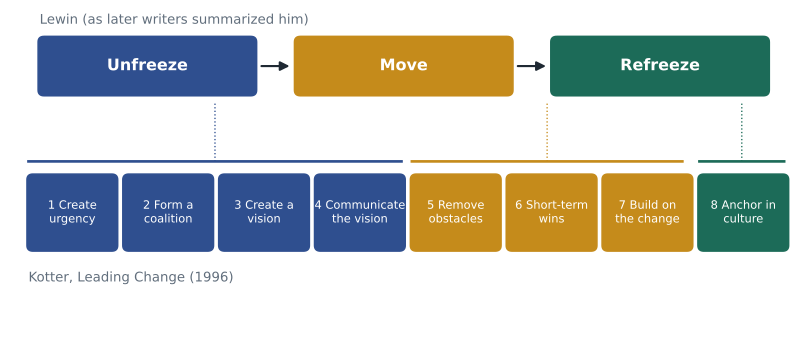
Kotter's model has critics. It was derived from his consulting experience rather than from a systematic study with comparison groups, and empirical tests have found partial support at best: the steps seem to matter, but not always in the order given, and organizations often cycle back. Its emphasis on urgency can encourage leaders to manufacture crises, a tactic that wears thin when used repeatedly. In his 2014 book Accelerate, Kotter himself proposed a 'dual operating system' in which a volunteer network works alongside the hierarchy on a continuing stream of changes, which reads as a partial response to these criticisms.
Another widely used model, ADKAR, was developed by Jeffrey Hiatt of the consulting firm Prosci and published in 2006. It focuses on the individual rather than the organization. People move through five states: awareness of the need for change, desire to take part, knowledge of how to change, ability to put that knowledge into practice, and reinforcement that sustains the change. Its practical value is diagnostic: if store managers at Fairway are aware of the new ordering system and know how it works but do not want to use it, more training will not help, whereas if they want to use it but cannot get the forecasts to match their stores, more persuasion will not help either.
Transitions: the human side
William Bridges, a consultant and former professor of literature, drew a distinction that the cohort finds immediately useful. Change, he argued in Managing Transitions (1991), is situational: a new structure, a new manager, a new system, effective on a given date. Transition is psychological: the process people go through to come to terms with the change. Transitions begin with an ending, in which people let go of the old identity and way of working. They pass through a neutral zone, a period of confusion in which the old way is gone and the new one does not yet feel natural; productivity and morale often fall here, but it is also the period of greatest creativity. Only then comes a new beginning, in which people commit to the new way.
Bridges' point is that leaders usually plan the change and ignore the transition. They announce the new beginning before anyone has dealt with the ending. Owen recognizes the pattern at Prairie Ridge. The merger of the gas and renewables divisions took effect on a date in September, with new reporting lines and a new name. But the gas plant operators, who were proud of thirty years without a serious incident, still describe themselves as gas people and regard the renewables teams as careless. Nobody has acknowledged what they are losing: a distinct identity, a familiar manager and a safety system they built themselves. In Bridges' terms the change is complete and the transition has barely started.
Two theories of change: E and O
In a 2000 Harvard Business Review article, 'Cracking the Code of Change', Michael Beer and Nitin Nohria described two archetypes. Theory E change aims to create economic value quickly, mainly through top-down decisions about structure, systems and portfolio: layoffs, divestments, cost programs and financial incentives. Theory O change aims to build organizational capability, mainly through participation, learning and culture. Both work in some conditions and fail in others. Theory E can produce fast results but often leaves an organization unable to adapt again. Theory O builds capability but can be too slow when a company faces a crisis. Beer and Nohria argued that the most successful changes they studied combined the two deliberately: clear economic goals with broad participation in how to meet them, and hard structural decisions sequenced alongside investment in people.
Cedarline's transformation contains both. The range reduction, the end of most promotions and the decision not to open eighteen new stores are Theory E choices, made by the board on economic grounds. The new planning process, the repair service, durability training and the agreement with the warehouse union depend on Theory O: they will work only if people learn, contribute ideas and come to believe in them.
Episodic and continuous change
A further group of theories challenges the assumption that organizations are normally stable and occasionally change. Michael Tushman and Elaine Romanelli proposed in 1985 a punctuated equilibrium model: organizations go through long periods of incremental adjustment in which their strategy, structure and culture reinforce each other, punctuated by short, revolutionary periods in which many elements change at once, often after a crisis or a change of leader. Incremental change within a period is relatively easy; revolutionary change is hard and risky but sometimes necessary, because piecemeal adjustment cannot move a tightly interlocked system to a new configuration.
Karl Weick and Robert Quinn, in a 1999 review, contrasted this episodic view with continuous change, in which organizations are always changing through the accumulation of small adjustments by people trying to do their jobs better. In the continuous view the leader's role is not to unfreeze and refreeze but to redirect change that is already happening: to notice useful adaptations, amplify them and make sense of them for others. The two views are not exclusive. Cedarline's board decision is a punctuation; the repair service will succeed only through thousands of small adjustments by technicians and store staff.
Complexity and emergence
The most recent family of theories draws on the study of complex adaptive systems. In this view an organization is a network of people and groups, each acting on local information and rules, whose interactions produce patterns that nobody designed. Small changes can be amplified into large ones; large interventions can be absorbed with little effect. Outcomes cannot be predicted precisely, but patterns can be influenced by changing the connections between people, the information they see and the simple rules they follow.
Dave Snowden and Mary Boone's 2007 Cynefin framework, published in Harvard Business Review, offers a practical bridge. In simple and complicated situations, cause and effect can be known in advance, by common sense or by experts, and planned change works. In complex situations cause and effect can be seen only in hindsight; the right approach is to probe with small, safe-to-fail experiments, sense what happens and respond by amplifying what works. In chaotic situations, such as a crisis, leaders must act first to stabilize. Hana sees her documentation system in these terms. Its technical installation was complicated but knowable. Its adoption by 120 physicians, each with different specialties, habits and relationships with the vendor's trainers, is complex: no one could have predicted which physicians would take to it, and the right move now is to learn from those who have.
Complexity theory has a practical implication that runs through this course. Change can be modeled as stocks and flows with feedback loops. Adoption grows through a reinforcing loop: the more people use a new practice, the more colleagues see it working and the more they adopt it. It is held back by balancing loops: fatigue, the effort of learning, and drift back to old habits when support is withdrawn. Dr. Morin shows a simple model.
# A stock-and-flow model of adoption with a reinforcing and a balancing loop
# 120 physicians; adopters persuade colleagues (reinforcing), some drift back (balancing)
total = 120
adopters = 10.0
contact_rate = 0.045    # monthly chance an adopter persuades a given non-adopter, scaled by share
support_drift = 0.02    # monthly drift back to old habits while support is in place
no_support_drift = 0.10 # monthly drift back once coaching and fixes stop

def run(months, stop_support_at=None):
    a = adopters
    path = []
    for m in range(1, months + 1):
        drift = no_support_drift if stop_support_at and m > stop_support_at else support_drift
        new = contact_rate * a * (total - a) / total * 4   # word of mouth among peers
        lost = drift * a
        a = max(0.0, min(total, a + new - lost))
        path.append(round(a))
    return path

full = run(24)
early_stop = run(24, stop_support_at=6)
print("month:          ", list(range(3, 25, 3)))
print("support kept:   ", full[2::3])
print("support stopped:", early_stop[2::3])month: [3, 6, 9, 12, 15, 18, 21, 24] support kept: [15, 22, 31, 42, 55, 67, 78, 88] support stopped: [15, 22, 25, 28, 31, 34, 37, 40]
The model is a sketch, not a forecast, but its behavior is instructive. With support kept in place, adoption grows slowly at first and then accelerates as more colleagues use the system, reaching 88 of the 120 physicians by month 24 and still rising. If coaching and fixes stop after six months, the balancing loop strengthens and growth almost stalls: after two years only about 40 physicians use the system, fewer than half as many. The early months look identical in both runs, which is exactly why cutting support early is tempting and costly. Hana notes that Lakeview reduced the vendor's on-site coaching in month five to save money, which may explain why adoption stalled at 38 physicians.
Appreciative and dialogic approaches
A last strand of thinking treats change as a matter of conversation and meaning. David Cooperrider and Suresh Srivastva developed appreciative inquiry in 1987 as an alternative to problem-solving: instead of diagnosing what is wrong, groups explore what works best, imagine what could be, design ways to get there and commit to action. Gervase Bushe and Robert Marshak later grouped such methods under the label dialogic organization development, in which change happens by changing the stories people tell and the conversations they have, rather than by implementing a designed solution. These approaches are especially suited to complex, transformational change, where no expert knows the answer.
The change formula
Dr. Morin closes the theory survey with a formula that practitioners have used since the 1960s. Credited to David Gleicher of the consulting firm Arthur D. Little and popularized by Richard Beckhard and Reuben Harris, and later by Kathleen Dannemiller, it states that change happens when dissatisfaction with the present, a vision of what is possible and concrete first steps together outweigh the resistance to change:
The multiplication is the point. If any of the three is close to zero, the product is small however large the others are. A compelling vision with no dissatisfaction produces polite agreement and no movement; dissatisfaction with no first steps produces frustration. The formula is a heuristic rather than a measurement, but it is a useful checklist.
| Theory | View of change | Leader’s main role | Fits best |
|---|---|---|---|
| Lewin, planned change | Unfreeze, move, refreeze | Create the need, guide the move, stabilize | Transitional change with known end state |
| Kotter | Eight-step sequence | Urgency, coalition, vision, wins, anchoring | Large top-sponsored change |
| ADKAR | Individual progress through five states | Diagnose and remove the blocking state | Adoption of new tools and processes |
| Bridges | Psychological transition | Manage endings and the neutral zone | Mergers, restructurings, role changes |
| Beer and Nohria | Economic value and capability | Combine hard choices with participation | Turnarounds and transformations |
| Punctuated equilibrium | Long stability, short revolutions | Recognize when piecemeal change will not work | Strategic reorientation |
| Complexity, Cynefin | Emergent patterns in a network | Probe, sense, amplify what works | Novel, uncertain change |
Worked problem
Choosing lenses for the Prairie Ridge merger
Owen's team must merge two divisions into one operations organization with one safety management system. Which theories help, and what does each suggest?
Show solution
- Punctuated equilibrium: the two divisions had stable but different configurations; merging them requires changing structure, systems and culture together rather than piecemeal.
- Bridges: the gas operators are in the ending phase; acknowledging what they lose, such as their safety record and identity, is a precondition for commitment.
- Beer and Nohria: the merger's economic goal (fewer duplicated roles, shared maintenance) is Theory E; the single safety culture can only be built through Theory O participation.
- Cynefin: the new safety system's procedures are complicated and can be designed by experts, but how the two workforces will come to trust each other is complex and calls for small experiments, such as mixed crews on joint maintenance shutdowns.
- Change formula: dissatisfaction is low among gas operators, who see no problem with their own system; the team needs to build it with evidence, for example near-miss data from the combined sites.
Answer: No single theory captures the merger. The structural and procedural work can be planned; the cultural integration must be led through participation and experiments, starting with the people who have most to lose.
Common mistakes
MistakeLewin gave us a three-step recipe.
InsteadLewin wrote little about the three steps; his broader legacy is participation, experimentation and force field thinking.
MistakeKotter's eight steps must be followed in order.
InsteadThe steps are useful reminders, but research finds that organizations often revisit them and that the order varies.
MistakeOnce the change is announced, people have changed.
InsteadChange is situational; transition is psychological and often lags by months.
MistakeEvery change can be designed in advance by experts.
InsteadComplex changes call for experiments and learning; only complicated, knowable changes suit detailed planning.
Summary and key terms
- Lewin's legacy includes field theory, group decision, action research, force field analysis and the idea of unfreezing and refreezing, although the three-step model was largely built by later writers.
- Planned change models such as Kotter's eight steps and ADKAR describe change as a sequence; they are useful checklists but imperfect descriptions.
- Bridges distinguishes situational change from psychological transition, which passes through an ending, a neutral zone and a new beginning.
- Beer and Nohria's Theories E and O contrast economic and capability-building change; successful transformations often combine them.
- Punctuated equilibrium, continuous change and complexity theories show that change can be revolutionary, incremental or emergent, and that leaders must recognize which they face.
- Force field analysis
- Listing and weighing the forces driving and restraining a change.
- Action research
- A cycle of joint diagnosis, action, observation and adjustment by researchers and practitioners.
- Neutral zone
- Bridges’ term for the confused period between letting go of the old and committing to the new.
- Theory E
- Change aimed at rapid economic value through top-down structural decisions.
- Theory O
- Change aimed at building organizational capability through participation and learning.
- Punctuated equilibrium
- Long periods of incremental change interrupted by short revolutionary periods.
- Cynefin
- A framework distinguishing simple, complicated, complex and chaotic situations.
Practice problems
Work each problem on paper first, then reveal the answer to check.
Using the change formula, explain why a vision presentation to Fairway's store managers might produce no change.
Show answer
If store managers feel no dissatisfaction with their current ordering, or see no concrete first steps, the product is small however good the vision; the plan must address all three.
In the stock-and-flow model, what happens if the drift back without support is 0.05 instead of 0.10? Predict the direction before running the code.
Show answer
Adoption after support stops falls less sharply and settles at a higher level, because the balancing loop is weaker.
Give an example of a Theory E decision and a Theory O initiative in your own organization.
Show answer
Answers vary; for example, closing an underperforming site (E) and a cross-functional improvement program in which teams redesign their own processes (O).
Why might manufacturing urgency repeatedly be counterproductive?
Show answer
People learn to discount warnings, trust in leaders falls, and constant crisis produces fatigue and short-term thinking rather than commitment.
Lesson quiz · 5 questions
Score 60% or more to complete this lesson.
Create a free account to save your progress, take quizzes and earn a certificate.