
MBA-613 · Lesson 4 of 12 · 24 min
Readiness, resistance and the psychology of change
Hana Kowalski arrives at the third weekend with a folder of interview notes. Lakeview Health's ambient documentation system listens to a consultation, with the patient's consent, and drafts the physician's note for review. The vendor's trials elsewhere reported that physicians saved an hour or more a day on documentation. Lakeview bought licenses for 120 physicians six months ago. Today 38 use the system regularly, about 30 tried it and stopped, and the rest have never logged in. The chief medical officer's view is that physicians are resistant to change. Hana's notes suggest something more varied.
An emergency physician told her the system was the best thing that had happened to her shifts in years. A cardiologist said its drafts of his notes confused two medications in the first week, and he would not trust it again. A family physician said she liked the idea but had never been shown how to fix a draft quickly, so it took her longer than typing. A surgeon said he had not been asked whether he wanted it and did not see why the hospital was spending money on software when the operating rooms were short of nurses. A semi-retired internist said, politely, that he had five years left and was not going to learn a new way of working.
Dr. Morin says that the word resistance has just done what it usually does: it has put five different responses, with five different causes, into one box labeled as the physicians' fault. This lesson takes them apart. It examines what makes people ready for change, why they resist, what resistance tells a change leader, and what can be done about it.
Readiness for change
Achilles Armenakis, Stanley Harris and Kevin Mossholder proposed in 1993 that readiness for change is built from a message with five components, which people must believe before they commit. Discrepancy: there is a real gap between where we are and where we need to be. Appropriateness: this particular change is the right way to close the gap. Efficacy: we are able to make the change work. Principal support: leaders are committed to it and will see it through. Personal valence: the change will be good for me, or at least not bad. The model is useful because each component suggests a different action. People who doubt discrepancy need evidence; people who doubt appropriateness need to see alternatives considered; people who doubt efficacy need training, resources and early success; people who doubt principal support need to see leaders' own behavior change; people who see negative valence need to know what is in it for them, or an honest account of what they will lose and how the loss will be eased.
Daniel Holt and colleagues developed a validated survey in 2007 that measures four of these beliefs: appropriateness, management support, change efficacy and personal valence. Hana adapted a short version, three items per belief on a five-point scale, and sent it to all 120 physicians. Eighty-six replied. Dr. Morin shows how to score it, using five respondents from each of four departments to keep the example short.
# Readiness for change by physician group: mean scores on four beliefs (1 to 5)
from statistics import mean

beliefs = ["appropriateness", "support", "efficacy", "valence"]
# mean of three items per belief, one tuple per respondent, grouped by department
responses = {
    "emergency":       [(4.3,3.7,4.0,4.7),(4.0,3.3,3.7,4.3),(4.7,4.0,4.3,4.7),(3.7,3.3,3.7,4.0),(4.3,3.7,4.0,4.3)],
    "family practice": [(4.0,3.3,2.3,3.7),(3.7,3.0,2.0,3.3),(4.3,3.7,2.7,4.0),(3.7,3.3,2.3,3.7),(4.0,3.0,2.0,3.3)],
    "cardiology":      [(2.7,3.3,3.3,2.3),(2.3,3.0,3.7,2.0),(3.0,3.3,3.3,2.7),(2.0,3.0,3.0,2.0),(2.7,3.3,3.7,2.3)],
    "surgery":         [(2.0,2.0,3.7,2.3),(2.3,1.7,4.0,2.7),(1.7,2.3,3.3,2.0),(2.3,2.0,3.7,2.3),(2.0,1.7,3.3,2.0)],
}
threshold = 3.0
print(f"{'group':16s}" + "".join(f"{b:>16s}" for b in beliefs) + "   weakest belief")
for group, rows in responses.items():
    scores = [mean(r[i] for r in rows) for i in range(4)]
    weakest = beliefs[scores.index(min(scores))]
    flags = "".join(f"{s:12.2f}{'  *' if s < threshold else '   '} " for s in scores)
    print(f"{group:16s}{flags}  {weakest}")
print("* below the readiness threshold of", threshold)group appropriateness support efficacy valence weakest belief emergency 4.20 3.60 3.94 4.40 support family practice 3.94 3.26 2.26 * 3.60 efficacy cardiology 2.54 * 3.18 3.40 2.26 * valence surgery 2.06 * 1.94 * 3.60 2.26 * support * below the readiness threshold of 3.0
The table turns one problem into four. Emergency physicians are ready on every belief; they are the natural early adopters, and many already use the system. Family physicians believe the change is appropriate and good for them but doubt they can make it work: their weakest belief is efficacy, which training and quick-fix tools would address. Cardiologists doubt appropriateness and personal valence, because of the medication errors; they need evidence that the vendor has fixed the specialist note templates, ideally from a cardiologist they respect. Surgeons doubt appropriateness, management support and personal valence; they were not consulted, see the money as better spent elsewhere and need a conversation, not a training session. A single campaign against resistance would have been wrong for at least three of the four groups.
Why people resist
Resistance to change has been studied since Lester Coch and John French's 1948 experiments at the Harwood Manufacturing Company, a clothing factory in Virginia. When the company changed jobs and piece rates, groups whose members merely heard the changes explained showed falling output, hostility and quitting. Groups that sent representatives to help design the changes recovered faster, and groups in which all members took part in the design recovered fastest and surpassed their previous output. The study, though small and not tightly controlled by modern standards, established a finding that has been confirmed many times: participation reduces resistance, mainly because it gives people some control and lets them shape the change to fit their work.
Later research identified several sources of resistance, which often appear together. Self-interest: the change threatens pay, status, power or job security. Loss of competence: people who were expert at the old way become novices at the new one. Uncertainty: people do not know what the change will mean for them and fill the gap with the worst case. Habit and the status quo bias described by William Samuelson and Richard Zeckhauser in 1988: people prefer the current state simply because it is current. Loss aversion: as Daniel Kahneman and Amos Tversky showed, losses weigh roughly twice as heavily as equal gains, so a change that trades certain small losses for uncertain larger gains looks worse to those affected than it does to its designers. Distrust: people who have seen past changes fail or used against them assume the same will happen again. And genuine disagreement: people think the change is a bad idea, and sometimes they are right.
Edgar Schein offered a compact way to think about the psychology. People face two anxieties during change. Survival anxiety is the fear that if they do not change they will suffer, for instance because the company will fail or their skills will become obsolete. Learning anxiety is the fear of trying something new: of looking incompetent, losing status, or failing in front of others. Change happens only when survival anxiety exceeds learning anxiety. Schein's advice was not to raise survival anxiety, which produces fear and defensiveness, but to lower learning anxiety by creating psychological safety: training, practice without penalty, coaches, support groups and visible tolerance of early mistakes.
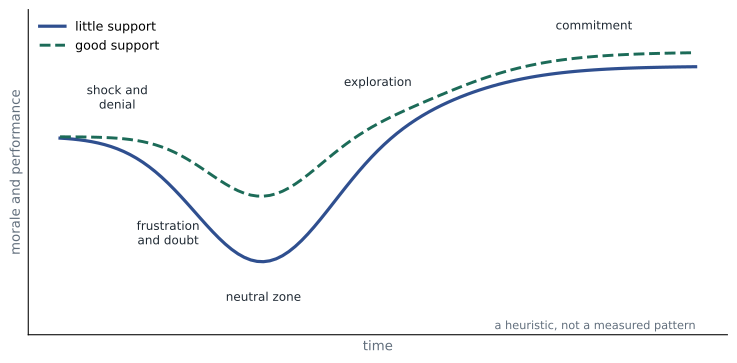
Many managers have seen a version of this change curve, often attributed to Elisabeth Kübler-Ross's 1969 work on grief. Dr. Morin urges caution. Kübler-Ross described the experience of terminally ill patients, not employees, and even in her own field the stages have not been found to occur in a fixed order. As a reminder that performance and morale often dip before they improve, and that leaders should expect and support the dip rather than panic, the curve is helpful. As a script that tells people which emotion they should be feeling this month, it is not.
Resistance as information
In 2008 Jeffrey Ford, Laurie Ford and Angelo D'Amelio published an influential article titled 'Resistance to Change: The Rest of the Story'. They argued that the usual account puts all resistance in the recipients and none in the change agents, who are assumed to be right. In practice, they found, change agents contribute to resistance by breaking agreements, failing to restore trust after past changes, communicating poorly and ignoring legitimate objections. And resistance can be a resource. It keeps a change visible and under discussion; it brings out problems the designers missed; and people who argue about a change are engaged with it, which is closer to commitment than indifference is.
Sandy Kristin Piderit made a related point in 2000. People's responses to change are often ambivalent: they may believe a change is necessary, feel anxious about it and intend to go along with it, all at once. Treating every doubt as opposition pushes ambivalent people into the opposing camp. The cardiologist at Lakeview is not opposed to documentation software; he is opposed to software that confuses medications, and his objection, properly handled, is the most valuable piece of testing the hospital has received.
Dr. Morin and Hana discuss what this means for the semi-retired internist. Some resistance is not information about the change but a rational choice by someone whose remaining time in the job makes learning a poor investment. The right response may be to accept it: he can continue to type his notes, provided the hospital's records standards are met. Not every person needs to adopt every change, and insisting on universal adoption can cost more goodwill than it gains.
Commitment, compliance and the forms of support
Lynne Herscovitch and John Meyer distinguished in 2002 three forms of commitment to a change. Affective commitment is a desire to support the change because one believes in its benefits. Normative commitment is a sense of obligation to support it. Continuance commitment is support because the costs of not supporting it are too high. All three produce compliance, meaning people do what is required. But Herscovitch and Meyer found that affective and, to a lesser degree, normative commitment were associated with cooperation and championing, going beyond the minimum to make the change work, while continuance commitment was not. A change that relies on pressure gets people who comply when watched.
Strategies for dealing with resistance
John Kotter and Leonard Schlesinger's 1979 Harvard Business Review article 'Choosing Strategies for Change' set out six approaches, each suited to different situations. Education and communication suit resistance based on lack of information; they are slow if many people are involved. Participation and involvement suit situations where the change agents lack information or need commitment; they can be slow and can produce poor solutions if badly managed. Facilitation and support, such as training and emotional support, suit resistance rooted in anxiety about adjustment; they cost time and money. Negotiation and agreement suit situations where a group will clearly lose and has power to resist; they can be expensive and invite others to demand the same. Manipulation and co-optation, such as giving a resister a token role, are quick but can backfire badly if people realize what is happening. Explicit and implicit coercion is fast and can overcome any resistance but leaves people angry and is risky when the leader depends on their goodwill.
Dr. Morin adds that the choice also depends on time and on the power of those affected. Where there is time and the people affected have important knowledge or power, participation pays. Where a crisis leaves no time and the change is non-negotiable, more directive approaches may be necessary, and leaders should be honest that they are being directive rather than staging consultation whose result is decided in advance. Fake participation is worse than none.
| Physician group | Main source of resistance | Strategy | Concrete action |
|---|---|---|---|
| Emergency | Little resistance | Involvement as champions | Ask two emergency physicians to coach colleagues and report problems |
| Family practice | Low efficacy; time to fix drafts | Facilitation and support | Hands-on sessions on editing drafts; templates for common visits |
| Cardiology | Appropriateness after errors | Participation; evidence | A cardiologist joins vendor testing of specialist templates; share error rates before and after |
| Surgery | Not consulted; doubts about priorities | Education and negotiation | Chief of surgery meets the chief medical officer; link savings to nurse hiring |
| Near retirement | Low return on learning | Accept non-adoption | Continue typed notes that meet records standards |
Force field analysis with numbers
Lewin's force field analysis, introduced in lesson 2, becomes more useful when forces are scored. For each driving and restraining force, a team estimates its strength and how far the organization can change it. Forces that are strong and changeable are the best targets. Lewin's warning applies: pushing harder on driving forces tends to provoke more resistance, so the most efficient actions usually weaken restraining forces.
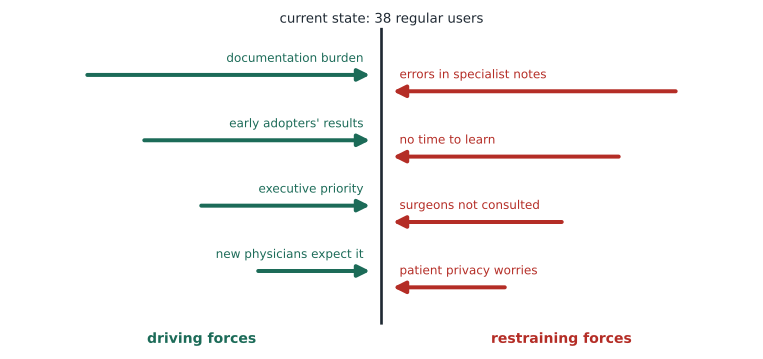
# Force field analysis: strength (1-5) and how changeable each force is (0-1)
driving = {
    "documentation burden on physicians": (5, 0.0),
    "early adopters' time savings":       (4, 0.6),   # can be made visible
    "executive priority":                 (3, 0.3),
    "new physicians expect the tool":     (2, 0.2),
}
restraining = {
    "errors in specialist notes":         (5, 0.8),   # vendor can fix templates
    "no time to learn editing":           (4, 0.7),   # protected training time
    "surgeons not consulted":             (3, 0.6),
    "privacy worries of patients":        (2, 0.5),
}
net = sum(s for s, _ in driving.values()) - sum(s for s, _ in restraining.values())
print("net force now:", net)
# Leverage = strength x changeability: how much each force could shift the balance
options = [(name, s * c, "strengthen") for name, (s, c) in driving.items()] + \
          [(name, s * c, "weaken") for name, (s, c) in restraining.items()]
for name, lev, action in sorted(options, key=lambda x: -x[1]):
print(f"{action:10s} {name:38s} leverage {lev:4.1f}")net force now: 0 weaken errors in specialist notes leverage 4.0 weaken no time to learn editing leverage 2.8 strengthen early adopters' time savings leverage 2.4 weaken surgeons not consulted leverage 1.8 weaken privacy worries of patients leverage 1.0 strengthen executive priority leverage 0.9 strengthen new physicians expect the tool leverage 0.4 strengthen documentation burden on physicians leverage 0.0
The scores are judgments, and the arithmetic is only a way of making them explicit and comparable. The net force is close to zero, which matches the stall at 38 users. The highest leverage lies in weakening restraining forces: fixing the specialist templates, which is both strong and largely within the vendor's control, and giving physicians protected time to learn. Strengthening driving forces is less promising, except for making early adopters' time savings visible to colleagues, which lesson 5 will connect to the role of peer influence. Hana's recommendation to the chief medical officer is to stop describing the problem as resistance and to fund three things: a template fix tested by cardiologists, two hours of protected training per physician and a meeting between the chief of surgery and the executive team.
Worked problem
Diagnosing resistance at Fairway
Grace's forty store managers have been asked to accept automated orders for dry grocery items. In the first month, managers overrode 61 percent of the system's suggested orders. Interviews reveal four themes: managers believe the system does not know local events; they will be blamed for empty shelves; overriding is how they show their experience; and the head office has launched three systems in five years, two of which were withdrawn. Classify each theme using the ideas of this lesson and propose a response.
Show solution
- Local knowledge: a doubt about appropriateness that may be partly correct. Response: let managers flag local events in the system, and track whether flagged forecasts improve.
- Blame for empty shelves: negative personal valence and fear of loss. Response: agree that stockouts caused by system orders will not count against managers' scorecards during the first six months.
- Overriding as expertise: loss of competence and identity. Response: redefine the manager's role as reviewing exceptions and coaching staff, and recognize good overrides publicly.
- Past systems withdrawn: distrust and doubt about principal support. Response: leaders commit publicly to a review date and criteria, and report progress against them.
- Overall: use participation and facilitation rather than pressure; measure override rates by category to see which concerns are being resolved.
Answer: The override rate is not a sign of stubbornness but of four distinct concerns. Each calls for a different response, and one of them, local knowledge, may improve the system if it is captured rather than suppressed.
Common mistakes
MistakeResistance is the employees' problem.
InsteadChange agents often contribute to resistance through broken promises, poor communication and ignored objections.
MistakeAll resistance must be overcome.
InsteadSome resistance carries valuable information; some reflects choices that are reasonable to accept.
MistakeRaise the pressure to overcome resistance.
InsteadPressure raises survival anxiety and defensiveness; lowering learning anxiety through support is usually more effective.
MistakeEveryone passes through the same change curve.
InsteadThe curve is a heuristic; responses vary, are often ambivalent and do not follow a fixed order.
Summary and key terms
- Readiness for change rests on beliefs about discrepancy, appropriateness, efficacy, principal support and personal valence; each calls for a different action.
- Resistance arises from self-interest, loss of competence, uncertainty, habit, loss aversion, distrust and genuine disagreement.
- Participation has reduced resistance since the Harwood studies of 1948; lowering learning anxiety through psychological safety helps people change.
- Resistance can be information about flaws in a change, and responses are often ambivalent rather than simply opposed.
- Strategies for dealing with resistance range from education and participation to negotiation and coercion and should match the source of resistance, the time available and the power of those affected.
- Readiness for change
- Beliefs and attitudes that dispose people to support a change.
- Personal valence
- A person’s belief about whether a change will benefit or harm him or her.
- Learning anxiety
- Schein’s term for the fear of trying something new and failing.
- Survival anxiety
- The fear of what will happen if one does not change.
- Status quo bias
- A preference for the current state simply because it is current.
- Affective commitment to change
- Support for a change based on belief in its benefits.
- Force field analysis
- Scoring the forces driving and restraining a change to find where to act.
Practice problems
Work each problem on paper first, then reveal the answer to check.
A group scores 4.2 on appropriateness, 3.9 on support, 2.4 on efficacy and 3.8 on valence. What should a change leader do first?
Show answer
Address efficacy with training, practice time, tools and early wins, since the group already believes in the change and its leaders.
Why might an overtly consultative process with a decided outcome increase resistance?
Show answer
People soon realize their input did not matter, which destroys trust and confirms suspicions about the change and its leaders.
In the force field code, what is the leverage of a restraining force of strength 4 that is 0.25 changeable?
Show answer
4 × 0.25 = 1.0, lower than the template fix (4.0) or training time (2.8).
Distinguish compliance from affective commitment using an example from your workplace.
Show answer
Compliance is doing the minimum required, such as filling in a new form; affective commitment is improving the form and helping colleagues use it because one believes it helps.
Lesson quiz · 5 questions
Score 60% or more to complete this lesson.
Create a free account to save your progress, take quizzes and earn a certificate.