
MATH-447 · Lesson 8 of 12 · 26 min
Tychonoff’s theorem, compactification and local compactness
Lesson 7 proved that a finite product of compact spaces is compact. The great theorem of Andrey Tychonoff says that the same holds for arbitrary products, of any number of factors, provided the product carries the product topology of lesson 4. This lesson proves it, using Zorn's lemma, and then turns from making big compact spaces to making small ones: how a space that is almost compact, in the sense that each point has a compact neighborhood, can be made compact by adding a single point at infinity.
Tychonoff's theorem
Theorem (Tychonoff). An arbitrary product of compact spaces is compact in the product topology.
Tychonoff proved the theorem for products of closed intervals in 1930 and stated the general case in 1935; Eduard Čech gave a complete proof in 1937. The proof below follows the approach by maximal families with the finite intersection property, a version of Henri Cartan's filter method. It uses the reformulation of compactness from lesson 7: a space is compact if and only if every family of closed sets with the finite intersection property has nonempty intersection. It is convenient to state the condition for families of arbitrary sets: \(X\) is compact if and only if for every family \(\mathcal{A}\) of subsets with the finite intersection property, \(\bigcap_{A \in \mathcal{A}} \overline{A} \ne \varnothing\). This follows by applying the closed-set form to the closures.
Lemma 1. Every family \(\mathcal{A}\) of subsets of \(X\) with the finite intersection property is contained in a maximal such family \(\mathcal{D}\).
Proof. Order the families with the finite intersection property that contain \(\mathcal{A}\) by inclusion. The union of a chain of such families still has the finite intersection property, since any finitely many members of the union already lie in one family of the chain. By Zorn's lemma there is a maximal element.
Lemma 2. Let \(\mathcal{D}\) be maximal with the finite intersection property. (a) Every finite intersection of members of \(\mathcal{D}\) belongs to \(\mathcal{D}\). (b) If a set \(A\) meets every member of \(\mathcal{D}\), then \(A \in \mathcal{D}\).
Proof. (a) Let \(B\) be a finite intersection of members of \(\mathcal{D}\). Adding \(B\) to \(\mathcal{D}\) preserves the finite intersection property, since an intersection of finitely many members together with \(B\) is again a finite intersection of members of \(\mathcal{D}\), hence nonempty. By maximality \(B \in \mathcal{D}\). (b) If \(A\) meets every member of \(\mathcal{D}\), then by (a) it meets every finite intersection of members, so \(\mathcal{D} \cup \{A\}\) has the finite intersection property, and maximality gives \(A \in \mathcal{D}\).
Proof of the theorem. Let \(X = \prod_\alpha X_\alpha\) with every \(X_\alpha\) compact, and let \(\mathcal{A}\) be a family of subsets of \(X\) with the finite intersection property. By Lemma 1 enlarge it to a maximal family \(\mathcal{D}\). It suffices to find a point \(x\) lying in \(\overline{D}\) for every \(D \in \mathcal{D}\). For each index \(\alpha\), the family \(\{\pi_\alpha(D) : D \in \mathcal{D}\}\) of subsets of \(X_\alpha\) has the finite intersection property, because the image of a nonempty intersection is nonempty and \(\pi_\alpha(D_1 \cap \cdots \cap D_n) \subseteq \pi_\alpha(D_1) \cap \cdots \cap \pi_\alpha(D_n)\). Since \(X_\alpha\) is compact, choose a point \(x_\alpha\) in the intersection of the closures \(\overline{\pi_\alpha(D)}\). Choosing one point in each of possibly infinitely many factors uses the axiom of choice again. Let \(x = (x_\alpha)\).
Now let \(U_\beta\) be an open set of \(X_\beta\) containing \(x_\beta\), and consider the subbasic set \(\pi_\beta^{-1}(U_\beta)\). For every \(D \in \mathcal{D}\), the point \(x_\beta\) lies in the closure of \(\pi_\beta(D)\), so \(U_\beta\) meets \(\pi_\beta(D)\); that is, \(\pi_\beta^{-1}(U_\beta)\) meets \(D\). By Lemma 2(b), every subbasic set containing \(x\) belongs to \(\mathcal{D}\), and by Lemma 2(a) so does every basic set containing \(x\), these being finite intersections of subbasic ones. Since members of \(\mathcal{D}\) meet each other, every basic neighborhood of \(x\) meets every \(D \in \mathcal{D}\). Hence \(x \in \overline{D}\) for every \(D \in \mathcal{D}\), and in particular for every member of \(\mathcal{A}\).
The proof needed the product topology at exactly one point: a basic open set is a finite intersection of subbasic sets. In the box topology a basic set can be an infinite intersection, and the theorem fails. The product \(\{0, 1\}^\omega\) of two-point discrete spaces is discrete in the box topology, since each point is the box of its own coordinates, and it is infinite, so it is not compact in the box topology. In 1950 John Kelley showed that Tychonoff's theorem implies the axiom of choice, so the two are equivalent over the other axioms of set theory. For products of compact Hausdorff spaces, the weaker Boolean prime ideal theorem suffices.
Applications
The Hilbert cube \([0, 1]^\omega\) is compact, and since a countable product of metric spaces is metrizable with \(D(x, y) = \sum_n 2^{-n}|x_n - y_n|\), it is a compact metric space. Urysohn's metrization proof in lesson 5 embedded every regular second countable space into it, so every compact metrizable space is homeomorphic to a closed subset of the Hilbert cube.
The Cantor space \(\{0, 1\}^\omega\) is compact. It is homeomorphic to the middle-thirds Cantor set \(C \subseteq [0, 1]\) by the map \((a_n) \mapsto \sum_n 2a_n/3^n\), which is continuous because points agreeing in the first \(N\) coordinates map within \(3^{-N}\) of each other, injective because ternary expansions using only the digits 0 and 2 are unique, and therefore a homeomorphism onto its image by lesson 7. A theorem of Alexandroff and Hausdorff states that every compact metric space is a continuous image of the Cantor set, which explains in a sense why space-filling curves exist.
Tychonoff's theorem is also the topological heart of the compactness theorem of first-order logic, which says that a set of sentences has a model whenever each finite subset has one: the space of possible truth assignments is a product of two-point spaces, and the assignments satisfying a single sentence form a closed set. The finite intersection property of these closed sets then gives a point in all of them.
Example: pointwise convergence. Let \(\mathcal{F}\) be the set of all functions from \([0, 1]\) to \([0, 1]\), continuous or not. A function is a choice of one value in \([0, 1]\) for each point of \([0, 1]\), so \(\mathcal{F}\) is the product \([0, 1]^{[0, 1]}\), and a sequence or net of functions converges in the product topology exactly when it converges at every point. By Tychonoff, \(\mathcal{F}\) is compact in the topology of pointwise convergence. It is not metrizable and not sequentially compact, as lesson 7 noted, but compactness alone is enough for many arguments in functional analysis, such as the Banach–Alaoglu theorem of MATH-445, whose proof embeds the unit ball of a dual space into a product of compact intervals of this kind.
Local compactness
Definition. A space \(X\) is locally compact at \(x\) if some compact set \(K\) contains an open neighborhood of \(x\). It is locally compact if it is locally compact at every point.
Every compact space is locally compact. The real line is locally compact, with \([x - 1, x + 1]\) a compact set containing a neighborhood of \(x\), and so is \(\mathbb{R}^n\). Every discrete space is locally compact, using the compact sets \(\{x\}\). Open and closed subsets of locally compact Hausdorff spaces are locally compact, so every manifold is locally compact. The rationals are not locally compact: a compact set containing a neighborhood of 0 would contain the closure in \(\mathbb{Q}\) of some \((-\varepsilon, \varepsilon) \cap \mathbb{Q}\), which is closed in the compact set and so compact, yet it is not closed in \(\mathbb{R}\). The infinite product \(\mathbb{R}^\omega\) is not locally compact either, since every basic open set has infinitely many coordinates ranging over all of \(\mathbb{R}\).
Theorem. In a locally compact Hausdorff space, every point has arbitrarily small compact neighborhoods: for every open \(U \ni x\) there is an open \(V\) with \(x \in V \subseteq \overline{V} \subseteq U\) and \(\overline{V}\) compact.
Proof. Let \(K\) be compact with an open neighborhood of \(x\) inside it. The space \(K\) is compact Hausdorff, hence normal and regular by lesson 7. Shrink the neighborhood: let \(W\) be the interior of \(K\) intersected with \(U\), an open set containing \(x\). The set \(K \setminus W\) is closed in \(K\), so by regularity of \(K\) there are disjoint open sets of \(K\) separating \(x\) from it, and hence an open set \(V \ni x\) of \(K\) with closure in \(K\) contained in \(W\). Since \(V \subseteq W\) which is open in \(X\), \(V\) is open in \(X\); its closure in \(K\) is compact, so closed in \(X\), and equals \(\overline{V}\). Thus \(\overline{V} \subseteq W \subseteq U\) is compact.
The one-point compactification
Stereographic projection shows that the sphere minus its north pole is homeomorphic to the plane. Turning this around, the sphere is the plane with one point added at infinity. The construction works for every locally compact Hausdorff space.
Definition. Let \(X\) be a space and \(\infty\) a point not in \(X\). On \(X^* = X \cup \{\infty\}\), declare open (i) the open subsets of \(X\), and (ii) the sets \(X^* \setminus K\) with \(K\) compact and closed in \(X\). The space \(X^*\) is the one-point compactification of \(X\).
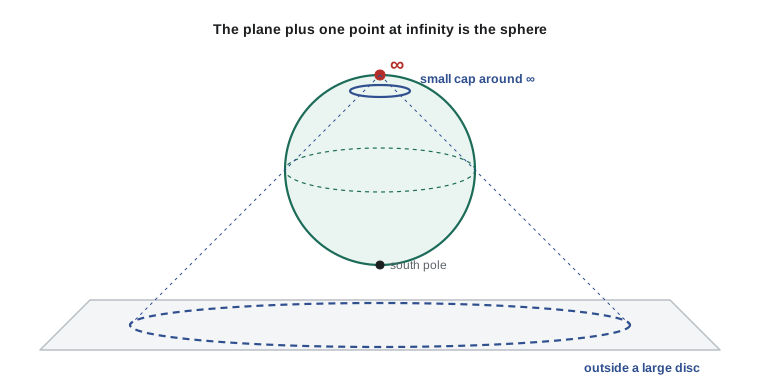
Theorem. \(X^*\) is a compact space containing \(X\) as a subspace. If \(X\) is locally compact Hausdorff and not compact, then \(X^*\) is Hausdorff and \(X\) is dense in it.
Proof. The open sets form a topology: unions and finite intersections of type (i) sets are of type (i); the intersection of two type (ii) sets is \(X^* \setminus (K_1 \cup K_2)\), again type (ii); a union of type (ii) sets is \(X^* \setminus \bigcap K_\alpha\), and an intersection of compact closed sets is closed, and compact as a closed subset of one of them; and a type (i) set \(U\) meets a type (ii) set in \(U \setminus K\), which is open in \(X\), while their union is \(X^* \setminus (K \setminus U)\), and \(K \setminus U\) is closed in \(K\), so compact, and closed in \(X\). The subspace topology on \(X\) consists of the type (i) sets together with the sets \(X \setminus K\), which are open in \(X\) anyway; so \(X\) is a subspace. For compactness, any open cover of \(X^*\) contains a type (ii) set \(X^* \setminus K\) covering \(\infty\), and finitely many members cover the compact set \(K\). For the Hausdorff property, two points of \(X\) are separated by open sets of \(X\). A point \(x \in X\) and \(\infty\) are separated using local compactness: if \(K\) is a compact set containing an open \(U \ni x\), then \(U\) and \(X^* \setminus K\) are disjoint, and \(K\) is closed in \(X\) because \(X\) is Hausdorff. Finally, if \(X\) is not compact, every open set containing \(\infty\) has the form \(X^* \setminus K\) with \(K \ne X\), so it meets \(X\), and \(\infty\) is in the closure of \(X\).
Examples. The one-point compactification of \(\mathbb{R}\) is the circle, and that of \(\mathbb{R}^n\) is the sphere \(S^n\), by stereographic projection: the projection extends to a continuous bijection from \(S^n\) to \((\mathbb{R}^n)^*\) sending the north pole to \(\infty\), with continuous inverse, because the complements of large closed balls in \(\mathbb{R}^n\) correspond to small caps around the pole. The one-point compactification of the natural numbers \(\mathbb{N}\), a discrete space, is homeomorphic to \(\{0\} \cup \{1/n : n \ge 1\}\), with \(\infty\) corresponding to 0: a sequence converges to \(\infty\) exactly when it eventually leaves every finite set. The one-point compactification of the open interval \((0, 1)\) is a circle, while gluing in two endpoints instead gives \([0, 1]\), a different compactification. The largest compactification of a space, the Stone–Čech compactification of 1937, is far more complicated; that of \(\mathbb{N}\) has \(2^{2^{\aleph_0}}\) points.
In complex analysis the one-point compactification of the complex plane is the Riemann sphere, on which rational functions become continuous maps, with \(1/0 = \infty\). In topology the construction converts questions about maps that behave well at infinity into questions about compact spaces. A continuous map \(f : X \to Y\) between locally compact Hausdorff spaces extends to a continuous map \(X^* \to Y^*\) sending \(\infty\) to \(\infty\) exactly when \(f\) is proper, meaning that preimages of compact sets are compact. Polynomial maps of the complex plane of positive degree are proper, which is one way to view the fact that they extend to the Riemann sphere.
Experiments
The first part of the program checks the homeomorphism between Cantor space and the Cantor set on finite approximations. The second part runs the diagonal argument that proves directly that the Hilbert cube is sequentially compact: from a sequence of points, extract nested subsequences converging in coordinate 1, then 2, and so on, and take the diagonal.
import itertools, random
from fractions import Fraction

def cantor_point(bits):
    return sum(Fraction(2 * b, 3 ** (n + 1)) for n, b in enumerate(bits))

N = 8
pts = sorted(cantor_point(bits) for bits in itertools.product([0, 1], repeat=N))
print(f"{len(pts)} points from bit strings of length {N}; all distinct:", len(set(pts)) == len(pts))
inside = all(not (Fraction(1, 3) < p < Fraction(2, 3)) for p in pts)
print("none lies in the removed middle third (1/3, 2/3):", inside)
gaps = [float(b - a) for a, b in zip(pts, pts[1:])]
print(f"smallest gap {min(gaps):.6f}, largest gap {max(gaps):.6f}")

def close_bits(k):
    """two bit strings agreeing in the first k places map within 3^-k of each other."""
    worst = 0
    for trial in range(2000):
        a = [random.randint(0, 1) for _ in range(30)]
        b = a[:k] + [random.randint(0, 1) for _ in range(30 - k)]
        worst = max(worst, abs(cantor_point(a) - cantor_point(b)))
    return float(worst), 3.0 ** -k
random.seed(447)
for k in [2, 5, 10]:
    w, bound = close_bits(k)
    print(f"agree in {k:2d} places: max distance {w:.2e} <= 3^-{k} = {bound:.2e}")

# diagonal argument in the Hilbert cube, first 4 coordinates
random.seed(7)
seq = [[random.random() for _ in range(4)] for _ in range(100000)]
idx = list(range(len(seq)))
for coord in range(4):
    lo, hi = 0.0, 1.0
    for halving in range(3):            # keep the half holding more of the remaining terms
        mid = (lo + hi) / 2
        left = [i for i in idx if lo <= seq[i][coord] <= mid]
        right = [i for i in idx if mid < seq[i][coord] <= hi]
        idx, (lo, hi) = (left, (lo, mid)) if len(left) >= len(right) else (right, (mid, hi))
print(f"coordinate {coord + 1}: {len(idx):5d} terms remain, all in [{lo:.4f}, {hi:.4f}]")256 points from bit strings of length 8; all distinct: True none lies in the removed middle third (1/3, 2/3): True smallest gap 0.000305, largest gap 0.333486 agree in 2 places: max distance 1.11e-01 <= 3^-2 = 1.11e-01 agree in 5 places: max distance 4.11e-03 <= 3^-5 = 4.12e-03 agree in 10 places: max distance 1.69e-05 <= 3^-10 = 1.69e-05 coordinate 1: 12664 terms remain, all in [0.5000, 0.6250] coordinate 2: 1631 terms remain, all in [0.1250, 0.2500] coordinate 3: 218 terms remain, all in [0.5000, 0.6250] coordinate 4: 32 terms remain, all in [0.2500, 0.3750]
The 256 points from bit strings of length 8 are distinct and avoid the middle third, as the ternary description predicts; strings that agree in the first \(k\) places map to points within \(3^{-k}\) of each other, which is the continuity estimate in the proof. In the second part, each round of halving keeps the half interval containing more of the remaining terms. In the true argument, with an infinite sequence, one keeps a half containing infinitely many terms, which always exists by pigeonhole; after infinitely many halvings in each coordinate and a diagonal choice, the subsequence converges in every coordinate, which is convergence in the product topology.
Worked problem
Identifying a one-point compactification
Show that the one-point compactification of \([0, 1)\) is homeomorphic to \([0, 1]\).
Show solution
- The space \([0, 1)\) is locally compact Hausdorff and not compact, so its one-point compactification is a compact Hausdorff space.
- Define \(h : [0, 1)^* \to [0, 1]\) by \(h(x) = x\) for \(x \in [0, 1)\) and \(h(\infty) = 1\). It is a bijection.
- Continuity at points of \([0, 1)\) is clear, since \([0, 1)\) is open in both spaces and \(h\) is the identity there.
- At \(\infty\): a neighborhood of 1 in \([0, 1]\) contains \((1 - \varepsilon, 1]\), whose preimage is \(\{\infty\} \cup (1 - \varepsilon, 1)\), the complement of the compact set \([0, 1 - \varepsilon]\), which is open in \([0, 1)^*\).
- A continuous bijection from a compact space to a Hausdorff space is a homeomorphism.
Answer: Adding the point at infinity to \([0, 1)\) gives back the closed interval.
Common mistakes
MistakeApplying Tychonoff’s theorem to the box topology.
InsteadIt fails there: \(\{0, 1\}^\omega\) is infinite and discrete in the box topology.
MistakeUsing the one-point compactification of a non-locally-compact space and expecting it to be Hausdorff.
InsteadFor \(\mathbb{Q}\), the point at infinity cannot be separated from rational points.
MistakeCalling a space locally compact because it is a subspace of a compact space.
Instead\(\mathbb{Q} \cap [0, 1]\) lies in the compact interval but is not locally compact.
MistakeAssuming the one-point compactification is the only compactification.
InsteadThe interval \((0, 1)\) has both the circle and \([0, 1]\) as compactifications, and many more.
MistakeForgetting that the proof of Tychonoff uses the axiom of choice.
InsteadZorn’s lemma provides the maximal family, and choice picks a coordinate in each factor; the theorem is equivalent to the axiom of choice.
Summary and key terms
- Tychonoff’s theorem: every product of compact spaces is compact in the product topology; the proof uses maximal families with the finite intersection property and Zorn’s lemma.
- Tychonoff’s theorem is equivalent to the axiom of choice and fails for the box topology.
- The Hilbert cube and the Cantor space are compact metric spaces; the Cantor space is homeomorphic to the middle-thirds Cantor set.
- A space is locally compact if each point has a compact neighborhood; Euclidean spaces and manifolds are, the rationals are not.
- Adding one point at infinity makes a locally compact Hausdorff space into a compact Hausdorff space; for Euclidean space the result is the sphere.
- Tychonoff’s theorem
- Arbitrary products of compact spaces are compact.
- maximal family with the finite intersection property
- A family with the finite intersection property not contained in any larger such family.
- Hilbert cube
- The countable product \([0, 1]^\omega\).
- Cantor space
- The countable product \(\{0, 1\}^\omega\) of two-point discrete spaces.
- locally compact
- Every point has a compact set containing one of its neighborhoods.
- one-point compactification
- A space with one point added whose neighborhoods are complements of compact closed sets.
- proper map
- A map under which preimages of compact sets are compact.
Practice problems
Work each problem on paper first, then reveal the answer to check.
Show that \(\prod_n [-n, n]\), the product of the intervals \([-n, n]\), is compact.
Show answer
Each factor is compact, so Tychonoff’s theorem applies.
Is \(S^1 \times S^1 \times \cdots\), the countable product of circles, compact? Metrizable?
Show answer
Compact by Tychonoff, and metrizable by \(D(x, y) = \sum 2^{-n} d(x_n, y_n)\), so it is a compact metric space.
Show that \(\mathbb{Z}\) with the discrete topology has one-point compactification homeomorphic to \(\{0\} \cup \{\pm 1/n : n \ge 1\}\).
Show answer
Send \(k > 0\) to \(1/k\), \(k \le 0\) to \(-1/(1 - k)\), and \(\infty\) to 0. This is a bijection. Neighborhoods of 0 in the target contain all but finitely many of its points, just as neighborhoods of \(\infty\) are complements of finite sets, so the map is continuous, and a continuous bijection from a compact space to a Hausdorff space is a homeomorphism.
Why is the one-point compactification of the plane minus the origin not a sphere?
Show answer
The plane minus a point is homeomorphic to the sphere minus two points, by stereographic projection. Both missing points become the single new point, so the compactification is a sphere with its north and south poles glued together, which is not a surface near the glued point.
Prove that a closed subset of a locally compact Hausdorff space is locally compact.
Show answer
If \(C\) is closed and \(x \in C\), take a compact \(K\) containing a neighborhood \(U\) of \(x\). Then \(K \cap C\) is compact and contains the neighborhood \(U \cap C\) of \(x\) in \(C\).
State where the product topology is used in the proof of Tychonoff’s theorem.
Show answer
A basic open set is a finite intersection of subbasic sets, so Lemma 2(a) puts it in the maximal family.
Lesson quiz · 5 questions
Score 60% or more to complete this lesson.
Create a free account to save your progress, take quizzes and earn a certificate.