
MATH-447 · Lesson 12 of 12 · 27 min
Capstone: surfaces, Euler characteristic and the classification theorem
The course has assembled every tool needed for one of the landmark results of topology: the complete list of closed surfaces. Quotients from lesson 4 build surfaces by gluing polygons; compactness and the Hausdorff property from lessons 5 and 7 make the gluings well behaved; the fundamental group from lessons 9 to 11 distinguishes the results. This capstone defines surfaces and their Euler characteristic, introduces the connected sum, states and sketches the proof of the classification theorem, and shows how to identify any surface given by a gluing word, by hand and by computer.
Surfaces
Definition. A surface is a second countable Hausdorff space in which every point has an open neighborhood homeomorphic to an open subset of \(\mathbb{R}^2\). A closed surface is a compact connected surface. The sphere, the torus, the projective plane and the Klein bottle are closed surfaces; the plane, the open disc and the open Möbius strip are surfaces that are not closed, because they are not compact. A surface with boundary allows neighborhoods homeomorphic to open subsets of the half plane as well; the closed disc, the annulus and the closed Möbius strip are examples.
The Hausdorff and second countable conditions exclude pathologies. The line with two origins of lesson 4, crossed with a line, is locally Euclidean but not Hausdorff. The long line, built from uncountably many intervals, is locally Euclidean and Hausdorff but not second countable. With both conditions, lesson 5 shows that every surface is metrizable.
Connected sums
Given two closed surfaces \(M\) and \(N\), remove a small open disc from each and glue the two boundary circles together by a homeomorphism. The result is the connected sum \(M \# N\), well defined up to homeomorphism. The sphere is an identity element: \(M \# S^2 \cong M\), since removing a disc from the sphere leaves a disc, which simply fills the hole. The connected sum of two tori is the surface of genus 2, a doughnut with two holes, and the connected sum of \(g\) tori is the orientable surface \(\Sigma_g\) of genus \(g\). The connected sum of two projective planes is the Klein bottle, and the connected sum of \(k\) projective planes is the nonorientable surface \(N_k\).
In terms of polygons, connected sum concatenates words. The torus is the square with word \(aba^{-1}b^{-1}\); cutting along a diagonal from a corner and regluing shows that \(\Sigma_2\) is the octagon with word \(a_1b_1a_1^{-1}b_1^{-1}a_2b_2a_2^{-1}b_2^{-1}\), and in general \(\Sigma_g\) is a \(4g\)-gon with word \(a_1b_1a_1^{-1}b_1^{-1} \cdots a_gb_ga_g^{-1}b_g^{-1}\). The projective plane is a disc with word \(aa\), each half of the boundary glued to the other half with the same orientation, and \(N_k\) is a \(2k\)-gon with word \(a_1a_1a_2a_2 \cdots a_ka_k\).
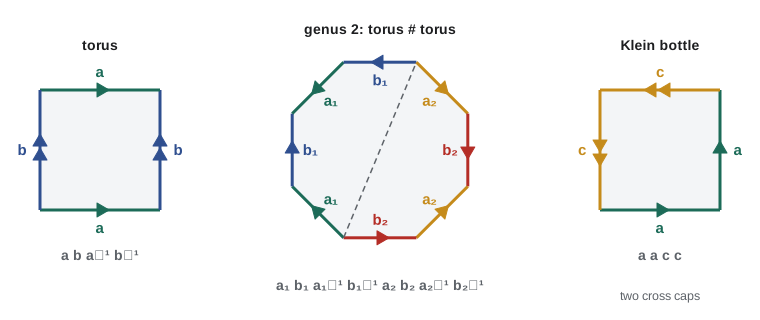
Is the Klein bottle really \(\mathbb{RP}^2 \# \mathbb{RP}^2\)? Its square word is \(abab^{-1}\), while the connected sum of two projective planes has the word \(aacc\). One can pass from the first to the second by cutting the square along a diagonal into two triangles, turning one triangle over, and gluing the triangles back together along one of the original pairs of edges; cutting and regluing changes the polygon but not the surface, since the cut edge is glued back. Rather than follow the pictures, the invariants below settle the question at once: both words give nonorientable surfaces with Euler characteristic 0, and by the classification theorem that determines the surface.
Orientability
A surface is orientable if it contains no Möbius strip, and nonorientable otherwise. Informally, an orientable surface has two consistent sides, or a consistent notion of clockwise, while carrying a small oriented circle around a Möbius strip brings it back reversed. In a polygon word, a pair of edges appearing with the same exponent, as in \(\cdots a \cdots a \cdots\), produces a Möbius strip: a thin band crossing the polygon from one copy of the edge to the other is glued with a half twist. A word in which every letter appears once with exponent \(+1\) and once with \(-1\) gives an orientable surface. The torus and \(\Sigma_g\) are orientable; the projective plane, the Klein bottle and every \(N_k\) are not. The connected sum of two surfaces is orientable exactly when both are.
The Euler characteristic
A triangulation of a surface is a decomposition into finitely many triangles, any two of which meet in a common edge, a common vertex, or not at all. Tibor Radó proved in 1925 that every closed surface admits a triangulation. More generally one can use any decomposition into polygonal faces glued along edges, a cell structure. If such a decomposition has \(V\) vertices, \(E\) edges and \(F\) faces, the Euler characteristic is \(\chi = V - E + F\).
Theorem. The Euler characteristic does not depend on the decomposition: homeomorphic closed surfaces have equal Euler characteristic.
Two decompositions have a common refinement, up to a small perturbation, and the basic moves of refinement do not change \(V - E + F\): subdividing an edge by a new vertex adds one vertex and one edge, and splitting a face by a new edge joining two of its vertices adds one edge and one face. A full proof of invariance under homeomorphism, as opposed to under refinement, requires either Radó's theorem with a careful common refinement argument or homology theory, in which \(\chi\) is the alternating sum of the ranks of homology groups. For surfaces there is a direct route through the fundamental group: the abelianization of \(\pi_1\) of a closed surface is \(\mathbb{Z}^{2 - \chi}\) in the orientable case and \(\mathbb{Z}^{1 - \chi} \oplus \mathbb{Z}/2\) in the nonorientable case, and the fundamental group is a topological invariant.
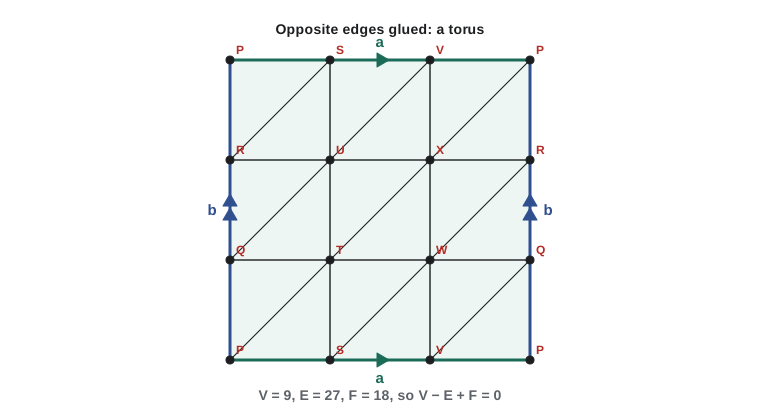
Computing from polygon words. A single polygon with \(2n\) edges glued in pairs gives a cell structure with one face and \(n\) edges, and \(V\) equal to the number of classes of polygon corners after gluing. For the torus square all four corners become one point, so \(\chi = 1 - 2 + 1 = 0\). For the sphere word \(aa^{-1}\) on a disc with two edges, there are two vertex classes, so \(\chi = 2 - 1 + 1 = 2\). For the projective plane word \(aa\), the two corners are glued to one point, so \(\chi = 1 - 1 + 1 = 1\). For \(\Sigma_g\), all \(4g\) corners become one vertex, so \(\chi = 1 - 2g + 1 = 2 - 2g\), and for \(N_k\), similarly \(\chi = 1 - k + 1 = 2 - k\). The Klein bottle has \(\chi = 0\), like the torus, so the Euler characteristic alone does not distinguish them; orientability does.
Theorem. \(\chi(M \# N) = \chi(M) + \chi(N) - 2\).
Proof. Choose triangulations of \(M\) and \(N\) and remove the interior of one triangle from each; the removed discs are triangles. Glue the two boundary triangles, matching vertices with vertices and edges with edges. The result is a triangulation of \(M \# N\) in which the two removed faces are gone, and the three vertices and three edges of the two boundary triangles have been identified in pairs. So \(V = V_M + V_N - 3\), \(E = E_M + E_N - 3\) and \(F = F_M + F_N - 2\), giving \(\chi = \chi(M) + \chi(N) - 2\).
The formula confirms \(\chi(\Sigma_g) = 2 - 2g\) by induction from \(\chi(T^2) = 0\), and \(\chi(N_k) = 2 - k\) from \(\chi(\mathbb{RP}^2) = 1\). Euler stated \(V - E + F = 2\) for convex polyhedra in 1758, and Descartes had found an equivalent relation around 1630. Its interpretation as a topological invariant of surfaces of every genus took most of the nineteenth century, through Lhuilier, who in 1813 found polyhedra with holes violating Euler's formula, and Riemann, Möbius and Jordan. MATH-430 proves the Gauss–Bonnet theorem, which says that the total Gaussian curvature of a closed surface is \(2\pi\chi\), linking the topological count to geometry.
The classification theorem
Theorem (classification of closed surfaces). Every closed surface is homeomorphic to exactly one of the following: the sphere \(S^2\); a connected sum \(\Sigma_g\) of \(g \ge 1\) tori; a connected sum \(N_k\) of \(k \ge 1\) projective planes. Two closed surfaces are homeomorphic if and only if they have the same orientability and the same Euler characteristic.
Uniqueness: the surfaces on the list are pairwise distinct. Their abelianized fundamental groups, computed from their polygon words with the method of lesson 11, are \(\mathbb{Z}^{2g}\) for \(\Sigma_g\), including \(g = 0\) for the sphere, and \(\mathbb{Z}^{k-1} \oplus \mathbb{Z}/2\) for \(N_k\). These groups are pairwise non-isomorphic, so the surfaces are pairwise non-homeomorphic. The torsion part detects orientability and the rank detects the Euler characteristic.
Existence, in outline. (1) Triangulate the surface, by Radó's theorem. (2) Because the surface is connected, the triangles can be arranged one by one into a single polygon, each new triangle glued along one edge to the polygon built so far, so that the surface is a quotient of one polygon with its edges glued in pairs. (3) Simplify the word by moves that change the polygon but not the surface. Cancel adjacent pairs \(aa^{-1}\), which fold together. Cut and reglue to reduce the number of vertex classes until all corners are glued to a single point. Gather each pair of same-exponent letters into adjacent position \(cc\), a cross cap, by a cut-and-reglue move. Gather each remaining interlinked pair \(a \cdots b \cdots a^{-1} \cdots b^{-1}\) into a commutator \(aba^{-1}b^{-1}\), a handle. (4) The word is now a product of handles, or of handles and cross caps. If there is at least one cross cap, convert each handle into two more cross caps using the relation \(T^2 \# \mathbb{RP}^2 \cong \mathbb{RP}^2 \# \mathbb{RP}^2 \# \mathbb{RP}^2\), discovered by Walther von Dyck in 1888. The result is one of the normal forms.
The classification has a long history. Möbius in 1863 and Camille Jordan in 1866 classified orientable surfaces under assumptions about smoothness and embedding. Max Dehn and Poul Heegaard gave a rigorous combinatorial treatment in 1907, assuming a triangulation, and Henry Brahana completed the proof for all triangulated surfaces in 1921. Radó's theorem of 1925 removed the triangulation assumption. A popular modern proof, John Conway's ZIP proof presented by George Francis and Jeffrey Weeks in 1999, avoids most of the bookkeeping by building every surface from a sphere with handles, cross caps and holes attached by zips.
Beyond surfaces
In dimension 3 no such simple list exists, and the analog of the statement that a simply connected closed surface is a sphere was Poincaré's famous conjecture of 1904: a closed simply connected 3-manifold is homeomorphic to \(S^3\). It was proved by Grigori Perelman in 2002 and 2003, using Richard Hamilton's Ricci flow, as part of William Thurston's geometrization program, which describes every closed 3-manifold by gluing pieces carrying one of eight geometries. Perelman declined both the Fields Medal in 2006 and the Clay Millennium Prize in 2010. In dimension 4 and above, a theorem of Andrey Markov Jr. from 1958 shows that no algorithm can classify closed manifolds, because every finitely presented group is the fundamental group of a closed 4-manifold, and deciding whether a presentation defines the trivial group is algorithmically unsolvable. Dimension 2 is the last place where topology has a complete, computable classification, and the methods of this course are exactly the ones it needs.
Identifying surfaces by computer
The program takes a polygon word, glues the corners to count vertex classes, computes \(\chi = V - E + F\) and orientability, and names the surface in normal form. It also checks two famous minimal triangulations: the 7-vertex torus found by Möbius and studied by Ákos Császár, in which every pair of vertices is joined by an edge, and the 6-vertex projective plane, half of an icosahedron. For each it verifies that every edge lies in exactly two triangles, computes \(\chi\), and tests orientability by trying to orient the triangles consistently.
from itertools import combinations

def classify_word(word):
    """word: list of (letter, +1 or -1) going around one polygon; each letter appears exactly twice."""
    n = len(word)
    # corner k sits between edge k-1 and edge k; edge k runs from corner k to corner k+1
    parent = list(range(n))
    def find(v):
        while parent[v] != v:
            parent[v] = parent[parent[v]]
            v = parent[v]
        return v
    def union(a, b):
        parent[find(a)] = find(b)
    places = {}
    for k, (letter, e) in enumerate(word):
        tail, head = (k, (k + 1) % n) if e == 1 else ((k + 1) % n, k)
        places.setdefault(letter, []).append((tail, head))
    for letter, ((t1, h1), (t2, h2)) in places.items():
        union(t1, t2)
        union(h1, h2)
    V = len({find(v) for v in range(n)})
    E = n // 2
    F = 1
    chi = V - E + F
    exps = {}
    for letter, e in word:
        exps.setdefault(letter, []).append(e)
    orientable = all(sum(v) == 0 for v in exps.values())
    if orientable:
        name = "sphere" if chi == 2 else f"orientable surface of genus {(2 - chi) // 2}"
    else:
        name = "projective plane" if chi == 1 else f"connected sum of {2 - chi} projective planes"
    return V, E, chi, orientable, name

def parse(s):
    out = []
    for token in s.split():
        out.append((token.rstrip("'"), -1 if token.endswith("'") else 1))
    return out

words = {
    "a a'": "a a'",
    "torus": "a b a' b'",
    "Klein bottle": "a b a b'",
    "projective plane": "a a",
    "genus 2": "a b a' b' c d c' d'",
    "torus # projective plane": "a b a' b' c c",
    "mystery": "a b c a' d b' c' d'",
    "another": "a b c b a' c",
}
for label, w in words.items():
    V, E, chi, ori, name = classify_word(parse(w))
    print(f"{label:25s} {w:22s} V={V} E={E} chi={chi:+d} {'orientable' if ori else 'nonorientable'}: {name}")

def check_triangulation(tris):
    verts = sorted({v for t in tris for v in t})
    edges = {}
    for t in tris:
        for e in combinations(sorted(t), 2):
            edges[e] = edges.get(e, 0) + 1
    closed = all(c == 2 for c in edges.values())
    chi = len(verts) - len(edges) + len(tris)
    # orientability: orient triangles so each shared edge is traversed in opposite directions
    orient = {0: tuple(tris[0])}
    queue, ok = [0], True
    def directed(t):
        return {(t[0], t[1]), (t[1], t[2]), (t[2], t[0])}
    while queue:
        i = queue.pop()
        for j, t in enumerate(tris):
            if j == i or len(set(t) & set(orient[i])) != 2:
                continue
            cand = tuple(t)
            if directed(cand) & directed(orient[i]):
                cand = (t[1], t[0], t[2])
            if j in orient:
                ok = ok and orient[j] in [cand, cand[1:] + cand[:1], cand[2:] + cand[:2]]
            else:
                orient[j] = cand
                queue.append(j)
    return len(verts), len(edges), len(tris), closed, chi, ok

torus7 = [(i, (i + 1) % 7, (i + 3) % 7) for i in range(7)] + [(i, (i + 2) % 7, (i + 3) % 7) for i in range(7)]
rp2_6 = [(0, 1, 2), (0, 2, 3), (0, 3, 4), (0, 4, 5), (0, 5, 1), (1, 2, 4), (2, 3, 5), (3, 4, 1), (4, 5, 2), (5, 1, 3)]
for label, tris in [("7-vertex torus", torus7), ("6-vertex projective plane", rp2_6)]:
    V, E, F, closed, chi, ok = check_triangulation(tris)
print(f"{label}: V={V} E={E} F={F}, every edge in two triangles: {closed}, chi={chi}, orientable: {ok}")a a' a a' V=2 E=1 chi=+2 orientable: sphere torus a b a' b' V=1 E=2 chi=+0 orientable: orientable surface of genus 1 Klein bottle a b a b' V=1 E=2 chi=+0 nonorientable: connected sum of 2 projective planes projective plane a a V=1 E=1 chi=+1 nonorientable: projective plane genus 2 a b a' b' c d c' d' V=1 E=4 chi=-2 orientable: orientable surface of genus 2 torus # projective plane a b a' b' c c V=1 E=3 chi=-1 nonorientable: connected sum of 3 projective planes mystery a b c a' d b' c' d' V=3 E=4 chi=+0 orientable: orientable surface of genus 1 another a b c b a' c V=1 E=3 chi=-1 nonorientable: connected sum of 3 projective planes 7-vertex torus: V=7 E=21 F=14, every edge in two triangles: True, chi=0, orientable: True 6-vertex projective plane: V=6 E=15 F=10, every edge in two triangles: True, chi=1, orientable: False
The program recovers the familiar answers: \(aa^{-1}\) is the sphere, the square words give the torus, the Klein bottle as two projective planes, and the projective plane, the octagon gives genus 2, and the torus plus a projective plane comes out as the connected sum of three projective planes, which is von Dyck's relation. The two unnamed words are identified by their invariants alone, with no cutting and regluing: the first is a torus, although its corners glue to three vertices rather than one, and the second is the connected sum of three projective planes. In the 7-vertex torus every one of the \(\binom{7}{2} = 21\) pairs of vertices is an edge, and \(7 - 21 + 14 = 0\); the 6-vertex projective plane has \(6 - 15 + 10 = 1\) and admits no consistent orientation.
Worked problem
Identifying a surface from its word
Identify the surface given by the hexagon word \(abca^{-1}cb\).
Show solution
- The letter \(c\) appears twice with exponent \(+1\), and so does \(b\), so the surface is nonorientable.
- Count vertices. Label the corners 0 to 5 so that edge \(k\) runs from corner \(k\) to corner \(k + 1\). Gluing \(a\) at positions 0 and 3 (the second reversed) identifies corners 0 with 4 and 1 with 3. Gluing \(b\) at positions 1 and 5 identifies 1 with 5 and 2 with 0. Gluing \(c\) at positions 2 and 4 identifies 2 with 4 and 3 with 5.
- Following the identifications, \(0 \sim 4 \sim 2\) and \(1 \sim 3 \sim 5\), so there are two vertex classes.
- So \(V = 2\), \(E = 3\), \(F = 1\), and \(\chi = 0\).
- A nonorientable closed surface with \(\chi = 0\) is \(N_2\).
Answer: The surface is the Klein bottle, \(\mathbb{RP}^2 \# \mathbb{RP}^2\).
Common mistakes
MistakeDistinguishing the torus and the Klein bottle by Euler characteristic.
InsteadBoth have Euler characteristic 0; orientability, or the torsion in the abelianized fundamental group, tells them apart.
MistakeCounting vertices of a polygon word as the number of corners.
InsteadCorners are glued together; count the classes after all identifications.
MistakeAssuming connected sum with the sphere changes a surface.
InsteadThe sphere is the identity for connected sum.
MistakeTreating any decomposition as a triangulation.
InsteadIn a triangulation two triangles meet in a common edge, a common vertex or not at all; more general cell structures still compute the Euler characteristic.
MistakeExpecting the torus plus a projective plane to be a new surface.
InsteadIt is the connected sum of three projective planes, by von Dyck’s relation.
Summary and key terms
- A closed surface is a compact connected Hausdorff second countable space locally homeomorphic to the plane.
- Connected sum concatenates polygon words; the sphere is its identity.
- The Euler characteristic V − E + F is independent of the decomposition, and it drops by 2 under connected sum.
- Orientable closed surfaces are the sphere and connected sums of tori, with χ = 2 − 2g; nonorientable ones are connected sums of projective planes, with χ = 2 − k.
- Orientability and Euler characteristic together determine a closed surface, and the abelianized fundamental group detects both.
- The classification is proved by triangulating, arranging the triangles into one polygon and simplifying the word to a normal form.
- surface
- A second countable Hausdorff space locally homeomorphic to the plane.
- closed surface
- A compact connected surface.
- connected sum
- The surface obtained by removing a disc from each of two surfaces and gluing the boundary circles.
- orientable
- Containing no Möbius strip.
- triangulation
- A decomposition into triangles meeting in common edges, common vertices or not at all.
- Euler characteristic
- The number V − E + F for any cell decomposition.
- genus
- The number of tori in the connected sum decomposition of an orientable surface.
Practice problems
Work each problem on paper first, then reveal the answer to check.
Identify the surface with word \(abab^{-1}cdc^{-1}d^{-1}\).
Show answer
Nonorientable, since \(a\) appears twice with the same exponent. All corners glue to one vertex, so \(\chi = 1 - 4 + 1 = -2\), and the surface is \(N_4\), consistent with Klein bottle plus torus being \(N_2 \# T = N_4\).
What is \(\chi\) of the connected sum of three tori and two projective planes?
Show answer
\(3 \cdot 0 + 2 \cdot 1 - 2 \cdot 4 = -6\), and it is nonorientable, so it is \(N_8\).
Is there a closed surface with Euler characteristic 3?
Show answer
No: the largest value is 2, for the sphere, since \(\chi = 2 - 2g\) or \(2 - k\) with \(g \ge 0\) and \(k \ge 1\).
Show that a triangulation of a closed surface satisfies \(3F = 2E\).
Show answer
Each triangle has three edges and each edge lies in exactly two triangles; count incident pairs in two ways.
Use \(3F = 2E\) and \(E \le \binom{V}{2}\) to show a triangulated torus has at least 7 vertices.
Show answer
With \(\chi = 0\), \(V - E + 2E/3 = 0\), so \(E = 3V\). Then \(3V \le V(V - 1)/2\), giving \(V \ge 7\), and the 7-vertex torus attains it.
Which surface has abelianized fundamental group \(\mathbb{Z}^3 \oplus \mathbb{Z}/2\)?
Show answer
Nonorientable with \(k - 1 = 3\), so \(N_4\).
Lesson quiz · 5 questions
Score 60% or more to complete this lesson.
Create a free account to save your progress, take quizzes and earn a certificate.