
MATH-447 · Lesson 4 of 12 · 27 min
Product and quotient topologies
Most interesting spaces are built from simpler ones. The plane is a product of two lines, the torus a product of two circles; the circle itself is an interval with its ends glued together, and the Klein bottle is a square with its edges glued in a twisted pattern. This lesson defines the two constructions that make such descriptions precise: the product topology, which puts spaces side by side, and the quotient topology, which glues points together. Each is characterized by a universal property that says exactly which maps into or out of the new space are continuous, and that property is what makes the constructions useful.
The product of two spaces
Definition. Let \(X\) and \(Y\) be topological spaces. The product topology on \(X \times Y\) is the topology with basis the sets \(U \times V\), where \(U\) is open in \(X\) and \(V\) is open in \(Y\). These products of open sets are called basic open rectangles.
The family of rectangles is a basis because it covers \(X \times Y\), which is itself a rectangle, and because \((U_1 \times V_1) \cap (U_2 \times V_2) = (U_1 \cap U_2) \times (V_1 \cap V_2)\) is again a rectangle. Not every open set of the product is a rectangle: an open disc in \(\mathbb{R}^2\) is a union of rectangles but not itself one. If \(\mathcal{B}\) and \(\mathcal{C}\) are bases for \(X\) and \(Y\), the products \(B \times C\) form a basis for \(X \times Y\). In particular the product topology on \(\mathbb{R} \times \mathbb{R}\) has the open rectangles \((a, b) \times (c, d)\) as a basis, so by the worked example of lesson 2 it is the Euclidean topology on the plane. The same argument shows that \(\mathbb{R}^n\) with the product topology is Euclidean space.
The projections \(\pi_1 : X \times Y \to X\) and \(\pi_2 : X \times Y \to Y\) are continuous, since \(\pi_1^{-1}(U) = U \times Y\) is a rectangle. They are also open maps, since the projection of a rectangle \(U \times V\) with \(V\) nonempty is \(U\), and projection commutes with unions. They need not be closed: the hyperbola \(\{xy = 1\}\) is closed in the plane, but its projection to the first axis is \(\mathbb{R} \setminus \{0\}\), which is not closed.
Theorem (universal property of the product). A function \(f : Z \to X \times Y\), written \(f(z) = (f_1(z), f_2(z))\), is continuous if and only if both component functions \(f_1 = \pi_1 \circ f\) and \(f_2 = \pi_2 \circ f\) are continuous.
Proof. If \(f\) is continuous, so are its compositions with the continuous projections. Conversely, suppose \(f_1\) and \(f_2\) are continuous. For a basic open set, \(f^{-1}(U \times V) = f_1^{-1}(U) \cap f_2^{-1}(V)\), which is open. Since every open set of the product is a union of basic ones and preimages commute with unions, \(f\) is continuous.
The product topology is therefore the coarsest topology on \(X \times Y\) making both projections continuous: any topology with that property contains the sets \(U \times Y\) and \(X \times V\), and hence their intersections \(U \times V\). Products of familiar spaces give familiar spaces: \(S^1 \times S^1\) is the torus, \(S^1 \times [0, 1]\) the cylinder, \(S^1 \times \mathbb{R}\) the infinite cylinder, which is homeomorphic to the plane minus a point by \((\theta, t) \mapsto e^t(\cos\theta, \sin\theta)\).
Example: the Sorgenfrey plane. The product \(\mathbb{R}_\ell \times \mathbb{R}_\ell\) has as a basis the half-open squares \([a, b) \times [c, d)\). On the antidiagonal line \(L = \{(x, -x)\}\), the basic set \([x, x + 1) \times [-x, -x + 1)\) meets \(L\) only in the single point \((x, -x)\), so the subspace \(L\) is discrete. It is also closed. Lesson 5 uses this uncountable closed discrete subspace to show that the Sorgenfrey plane is not normal, even though the Sorgenfrey line is.
Infinite products
For an indexed family of spaces \(X_\alpha\), \(\alpha \in J\), the Cartesian product \(\prod_\alpha X_\alpha\) consists of all choice functions \(x = (x_\alpha)\) with \(x_\alpha \in X_\alpha\). There are two natural candidate topologies. The box topology has as basis all products \(\prod U_\alpha\) of open sets. The product topology has as basis the products \(\prod U_\alpha\) in which \(U_\alpha\) is open and \(U_\alpha = X_\alpha\) for all but finitely many \(\alpha\). Equivalently, it is the topology with subbasis the sets \(\pi_\beta^{-1}(U_\beta)\), and so it is the coarsest topology making all the projections continuous. For finite products the two coincide.
Theorem. With the product topology, a function \(f : Z \to \prod X_\alpha\) is continuous if and only if every component \(\pi_\alpha \circ f\) is continuous. With the box topology, this fails in general.
Proof. The first statement follows from the subbasis test of lesson 3: \(f^{-1}(\pi_\beta^{-1}(U_\beta)) = (\pi_\beta \circ f)^{-1}(U_\beta)\) is open when the components are continuous. For the failure in the box topology, let \(\mathbb{R}^\omega\) be the countable product of real lines and \(f : \mathbb{R} \to \mathbb{R}^\omega\) the diagonal map \(f(t) = (t, t, t, \ldots)\). Each component is the identity, which is continuous. But the box \(B = \prod_n (-1/n, 1/n)\) is open in the box topology and \(f^{-1}(B)\) is the set of \(t\) with \(|t| < 1/n\) for all \(n\), which is \(\{0\}\), not open. So \(f\) is not continuous into the box topology.
For this reason the product topology is the standard choice, and whenever this course writes \(\prod X_\alpha\) without comment, the product topology is meant. It is also the topology in which Tychonoff's theorem in lesson 8 holds: any product of compact spaces is compact. In the product topology a sequence converges exactly when it converges in every coordinate, which is why the space \(\mathbb{R}^\omega\) with the product topology is sometimes called the space of all sequences with pointwise convergence. MATH-341 used the same idea, under the name pointwise convergence of functions, for the product \(\mathbb{R}^{[0, 1]}\) of uncountably many lines.
Quotient topologies
Definition. Let \(X\) be a space and \(q : X \to Y\) a surjection onto a set \(Y\). The quotient topology on \(Y\) declares \(V \subseteq Y\) open exactly when \(q^{-1}(V)\) is open in \(X\). A continuous surjection \(q : X \to Y\) between spaces is called a quotient map if \(Y\) carries the quotient topology, that is, \(V\) is open if and only if \(q^{-1}(V)\) is open.
The quotient topology is a topology because preimages commute with unions and intersections. It is the finest topology on \(Y\) making \(q\) continuous. The most common source of surjections is an equivalence relation \(\sim\) on \(X\): the set of equivalence classes \(X/{\sim}\) receives the quotient topology from the map \(q(x) = [x]\). A set of classes is open when the union of those classes is open in \(X\). Informally, \(X/{\sim}\) is \(X\) with equivalent points glued together.
Theorem (universal property of the quotient). Let \(q : X \to Y\) be a quotient map and \(g : X \to Z\) a continuous map that is constant on each fiber \(q^{-1}(y)\). Then there is a unique function \(\bar g : Y \to Z\) with \(\bar g \circ q = g\), and \(\bar g\) is continuous. Moreover a function \(h : Y \to Z\) is continuous if and only if \(h \circ q\) is continuous.
Proof. Define \(\bar g(y) = g(x)\) for any \(x\) with \(q(x) = y\); this is well defined because \(g\) is constant on fibers, and unique because \(q\) is surjective. For an open \(W \subseteq Z\), \(q^{-1}(\bar g^{-1}(W)) = g^{-1}(W)\) is open, so \(\bar g^{-1}(W)\) is open by the definition of the quotient topology. The last statement is the same argument applied to \(g = h \circ q\), together with the fact that compositions of continuous maps are continuous.
Example: the circle as a quotient. On \([0, 1]\) let \(0 \sim 1\) and every other point be equivalent only to itself. The map \(g(t) = (\cos 2\pi t, \sin 2\pi t)\) is continuous and takes the same value at 0 and 1, so it induces a continuous bijection \(\bar g : [0, 1]/{\sim} \to S^1\). Is it a homeomorphism? Unlike the wrapping map of lesson 3, yes: lesson 7 proves that a continuous bijection from a compact space to a Hausdorff space is always a homeomorphism, and the quotient of \([0, 1]\) is compact. So gluing the ends of an interval produces a circle, as intuition says.
Gluing a square
Many surfaces are quotients of the unit square \(I^2 = [0, 1]^2\) obtained by gluing its edges in pairs. Label the edges and mark each with an arrow; edges with the same letter are identified so that the arrows match. Reading the labels around the boundary gives a word. Gluing one pair of opposite edges with arrows the same way gives a cylinder; with arrows opposite, a Möbius strip. Gluing both pairs gives the torus \(aba^{-1}b^{-1}\) when both pairs match without a twist, the Klein bottle \(abab^{-1}\) when one pair is twisted, and the projective plane \(abab\) when both pairs are twisted. Gluing adjacent edges as \(aa^{-1}bb^{-1}\) gives the sphere.
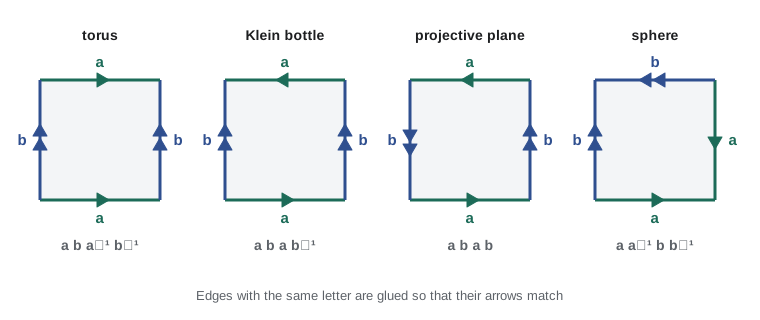
The torus quotient is homeomorphic to \(S^1 \times S^1\): the map \((s, t) \mapsto (e^{2\pi i s}, e^{2\pi i t})\) is constant on the glued classes, so it induces a continuous bijection from the quotient onto the product, which is a homeomorphism by the compact-to-Hausdorff theorem of lesson 7. The Klein bottle and the projective plane cannot be embedded in \(\mathbb{R}^3\), although both can be embedded in \(\mathbb{R}^4\); the familiar glass Klein bottle passes through itself. Lesson 12 shows that these few gluings, together with connected sums, account for every closed surface.
The projective plane has another description: the set \(\mathbb{RP}^2\) of lines through the origin in \(\mathbb{R}^3\), which is the quotient of the sphere \(S^2\) by the relation identifying each point with its antipode \(-x\). Every such line meets the closed upper hemisphere, which is a disc, and it meets it once except on the equator, where it meets it in two antipodal points. So \(\mathbb{RP}^2\) is also a disc with antipodal boundary points glued, which matches the square with word \(abab\) after straightening the disc into a square.
Collapsing a subspace is another standard quotient. If \(A \subseteq X\), the space \(X/A\) is formed by gluing all of \(A\) to a single point. The disc modulo its boundary circle, \(D^2/S^1\), is homeomorphic to the sphere \(S^2\): think of drawing the edge of a cloth bag together with a string. The interval modulo its endpoints is a circle, and the plane modulo the closed unit disc is homeomorphic to the plane again.
Quotients can misbehave
Quotients of very nice spaces can be strange. The line with two origins is the quotient of two copies of \(\mathbb{R}\) in which each point \(x \ne 0\) of the first copy is glued to the same point of the second copy. The two origins cannot be separated by disjoint open sets: any open set around either one contains a punctured interval \((-\varepsilon, 0) \cup (0, \varepsilon)\), and these always overlap. So limits are not unique there: the sequence \(1/n\) converges to both origins. Yet every point has a neighborhood homeomorphic to an open interval. Lesson 5 names the missing property: the line with two origins is not Hausdorff.
Worse, the quotient \(\mathbb{R}/\mathbb{Q}\), where \(x \sim y\) whenever \(x - y\) is rational, has the indiscrete topology. If \(V\) is a nonempty open set of classes, its preimage \(U\) is a nonempty open set of reals that is invariant under translation by every rational. It contains some interval \((a, b)\), hence every translate \((a + r, b + r)\) with \(r\) rational, and these translates cover the whole line. So the only open sets are \(\varnothing\) and everything. Quotients by group actions are well behaved only under conditions on the action, a theme that returns with covering spaces in lesson 11. Products also interact badly with quotients in general: the product of two quotient maps need not be a quotient map, although it is when one of the spaces is locally compact.
Gluing by computer
A quotient of a square can be computed combinatorially. Cut the square into a grid of small squares, identify boundary grid points according to the edge word with union-find, and count the vertices, edges and faces that remain. The number \(V - E + F\) of the resulting decomposition is the Euler characteristic, which lesson 12 shows is a topological invariant of the surface.
def glue(word, n=4):
    """Glue the edges of an n x n grid on the unit square according to a 4-letter edge word.
    word lists the edges bottom, right, top, left, read counterclockwise, e.g. ['a', 'b', 'a-', 'b-']."""
    parent = {}
    def find(v):
        parent.setdefault(v, v)
        while parent[v] != v:
            parent[v] = parent[parent[v]]
            v = parent[v]
        return v
    def union(a, b):
        parent[find(a)] = find(b)
    def edge(p, r):
        return ('edge',) + tuple(sorted([p, r]))
    # boundary edges as lists of grid points in counterclockwise order
    sides = [[(i, 0) for i in range(n + 1)],
             [(n, j) for j in range(n + 1)],
             [(n - i, n) for i in range(n + 1)],
             [(0, n - j) for j in range(n + 1)]]
    seen = {}
    for side, label in zip(sides, word):
        letter = label.rstrip('-')
        pts = side if not label.endswith('-') else side[::-1]
        if letter in seen:
            old = seen[letter]
            for k in range(n + 1):
                union(old[k], pts[k])                                 # glue vertices
            for k in range(n):
                union(edge(old[k], old[k + 1]), edge(pts[k], pts[k + 1]))   # glue edges
        else:
            seen[letter] = pts
    verts = [(i, j) for i in range(n + 1) for j in range(n + 1)]
    edges = [edge((i, j), (i + di, j + dj)) for i in range(n + 1) for j in range(n + 1)
             for di, dj in [(1, 0), (0, 1)] if i + di <= n and j + dj <= n]
    V = len({find(v) for v in verts})
    E = len({find(e) for e in edges})
    F = n * n
    return V, E, F

surfaces = {
    'sphere           a a- b b-': ['a', 'a-', 'b', 'b-'],
    'torus            a b a- b-': ['a', 'b', 'a-', 'b-'],
    'Klein bottle     a b a b-': ['a', 'b', 'a', 'b-'],
    'projective plane a b a b': ['a', 'b', 'a', 'b'],
}
for name, word in surfaces.items():
    V, E, F = glue(word)
print(f"{name:28s} V={V:2d} E={E:2d} F={F:2d} V-E+F = {V - E + F}")sphere a a- b b- V=18 E=32 F=16 V-E+F = 2 torus a b a- b- V=16 E=32 F=16 V-E+F = 0 Klein bottle a b a b- V=16 E=32 F=16 V-E+F = 0 projective plane a b a b V=17 E=32 F=16 V-E+F = 1
The counts give Euler characteristic 2 for the sphere, 0 for the torus and the Klein bottle, and 1 for the projective plane. The same answers come out for any grid size, which is a first hint that \(V - E + F\) depends only on the surface. The program glues edges as well as vertices, so two different grid edges that happen to join the same pair of glued vertices are still counted separately; a decomposition in which faces and edges meet in such awkward ways is still a valid cell structure. Lesson 12 explains why the Euler characteristic, together with orientability, distinguishes the torus from the Klein bottle and classifies all closed surfaces.
Worked problem
Recognizing a quotient
Show that the quotient of \(\mathbb{R}\) by the relation \(x \sim y\) if \(x - y \in \mathbb{Z}\) is homeomorphic to the circle.
Show solution
- Let \(g(x) = (\cos 2\pi x, \sin 2\pi x)\). It is continuous and \(g(x) = g(y)\) exactly when \(x - y \in \mathbb{Z}\).
- By the universal property, \(g\) induces a continuous bijection \(\bar g : \mathbb{R}/\mathbb{Z} \to S^1\).
- To see that \(\bar g\) is open, let \(V\) be open in the quotient, so \(U = q^{-1}(V)\) is open in \(\mathbb{R}\) and invariant under integer translation.
- Then \(\bar g(V) = g(U)\), and \(g\) is an open map: it sends small open intervals onto open arcs, and every open set is a union of small intervals.
- So \(\bar g\) is a continuous open bijection, hence a homeomorphism.
Answer: The quotient \(\mathbb{R}/\mathbb{Z}\) is homeomorphic to the circle; lesson 11 reinterprets the quotient map as the universal covering of the circle.
Common mistakes
MistakeUsing the box topology on infinite products.
InsteadUse the product topology, in which only finitely many coordinates are restricted; the diagonal map into the box topology is not continuous.
MistakeThinking every open set of a product is a rectangle.
InsteadOpen sets are unions of rectangles; an open disc is not a rectangle.
MistakeAssuming quotients of nice spaces are nice.
InsteadThe line with two origins and the quotient by the rationals show that gluing can destroy separation of points.
MistakeForgetting to check that a map is constant on equivalence classes before inducing a map on the quotient.
InsteadThe induced map is defined only if equivalent points have the same image.
MistakeReading a square word with arrows the wrong way round.
InsteadFix a direction of travel around the boundary, write \(a\) when the arrow agrees and \(a^{-1}\) when it opposes.
Summary and key terms
- The product topology on two spaces has the open rectangles as a basis; its projections are continuous and open.
- A map into a product is continuous exactly when its components are; this holds for infinite products in the product topology but not the box topology.
- The quotient topology makes a set open when its preimage is open; it is the finest topology making the quotient map continuous.
- A map out of a quotient is continuous exactly when its composition with the quotient map is.
- Gluing the edges of a square produces the torus, Klein bottle, projective plane and sphere; collapsing the boundary of a disc gives a sphere.
- Quotients can fail to separate points, as the line with two origins shows.
- product topology
- The coarsest topology on a product making all projections continuous.
- box topology
- The topology on a product generated by all products of open sets.
- quotient map
- A continuous surjection such that a set is open exactly when its preimage is open.
- quotient space
- The set of equivalence classes of a relation, with the quotient topology.
- Möbius strip
- The quotient of a square in which one pair of opposite edges is glued with a half twist.
- Klein bottle
- The quotient of a square with edge word \(abab^{-1}\).
- projective plane
- The space of lines through the origin in three-dimensional space, or a disc with antipodal boundary points glued.
Practice problems
Work each problem on paper first, then reveal the answer to check.
Show that \(\pi_1 : \mathbb{R}^2 \to \mathbb{R}\) is open but not closed.
Show answer
Projections of rectangles are open intervals, so open sets project to open sets. The closed set \(\{xy = 1\}\) projects to \(\mathbb{R} \setminus \{0\}\), which is not closed.
In \(\mathbb{R}^\omega\) with the product topology, does the sequence \(x_k = (1/k, 1/k, \ldots)\) converge to 0? In the box topology?
Show answer
In the product topology yes, since each coordinate converges. In the box topology no: the box \(\prod (-1/n, 1/n)\) contains no \(x_k\), because the \(n\)-th coordinate of \(x_k\) is \(1/k \ge 1/n\) once \(n \ge k\).
Which surface has square word \(a b a^{-1} b\)?
Show answer
The Klein bottle: one pair of edges matches and the other is reversed, as in \(abab^{-1}\) after relabeling.
Describe \(\mathbb{R}^2/{\sim}\) where \((x, y) \sim (x', y')\) when \(y = y'\).
Show answer
Each class is a horizontal line, and the map \((x, y) \mapsto y\) induces a homeomorphism of the quotient with \(\mathbb{R}\), since the projection is a continuous open surjection.
Show that \([0, 1] \times [0, 1]\) with \((0, t) \sim (1, t)\) is homeomorphic to \(S^1 \times [0, 1]\).
Show answer
The map \((s, t) \mapsto ((\cos 2\pi s, \sin 2\pi s), t)\) is constant on classes, giving a continuous bijection from the compact quotient to a Hausdorff space, hence a homeomorphism by lesson 7.
Explain why the line with two origins has unique limits for sequences avoiding 0 but not in general.
Show answer
Away from 0 it looks like the line. The sequence \(1/n\) converges to both origins, since every neighborhood of either contains a punctured interval about 0.
Lesson quiz · 5 questions
Score 60% or more to complete this lesson.
Create a free account to save your progress, take quizzes and earn a certificate.