
MATH-322 · Lesson 8 of 12 · 25 min
Homomorphisms and isomorphisms
So far we have studied groups one at a time. The real power of group theory comes from maps between groups that respect the operation. Such maps, homomorphisms, let us transport information from one group to another, recognize when two groups that look different are really the same, and break a complicated group into simpler pieces. This lesson defines homomorphisms and isomorphisms, works out their basic properties, and proves Cayley's theorem of 1854: every group is, up to renaming, a group of permutations.
Definition and examples
Let \(G\) and \(H\) be groups. A homomorphism is a function \(\varphi : G \to H\) such that
\[ \varphi(ab) = \varphi(a)\varphi(b) \quad \text{for all } a, b \in G. \]
The product on the left is taken in \(G\) and the one on the right in \(H\). In words: it makes no difference whether you combine first and then map, or map first and then combine. Many familiar rules are statements that some map is a homomorphism.
- The determinant \(\det : GL_n(\mathbb{R}) \to \mathbb{R}^\times\), since \(\det(AB) = \det A \det B\).
- The exponential \(\exp : (\mathbb{R}, +) \to (\mathbb{R}_{>0}, \times)\), since \(e^{x+y} = e^x e^y\). Its inverse, the logarithm, is also a homomorphism, which is why logarithm tables turned multiplication into addition for three centuries of navigators and astronomers.
- Reduction modulo \(n\), \(\mathbb{Z} \to \mathbb{Z}_n\), \(k \mapsto k \bmod n\), since the remainder of a sum is the sum of the remainders, reduced.
- The sign \(\operatorname{sgn} : S_n \to \{1, -1\}\), since \(\operatorname{sgn}(\sigma\tau) = \operatorname{sgn}\sigma \operatorname{sgn}\tau\) (lesson 4).
- The map \(D_n \to \{1, -1\}\) sending rotations to 1 and reflections to \(-1\), which records whether a symmetry turns the polygon over.
- For fixed \(g \in G\), conjugation \(c_g : G \to G\), \(c_g(x) = gxg^{-1}\), since \(gxyg^{-1} = (gxg^{-1})(gyg^{-1})\).
- The trivial homomorphism \(G \to H\) sending everything to \(e_H\).
A non-example: \(x \mapsto x + 1\) on \(\mathbb{Z}\) is not a homomorphism, since \((a + b) + 1 \ne (a + 1) + (b + 1)\). Nor is \(x \mapsto x^2\) on \(S_3\): \(((1\,2)(1\,3))^2 = (1\,3\,2)^2 = (1\,2\,3)\), while \((1\,2)^2(1\,3)^2 = e\).
Basic properties
Theorem. Let \(\varphi : G \to H\) be a homomorphism. Then: (i) \(\varphi(e_G) = e_H\); (ii) \(\varphi(a^{-1}) = \varphi(a)^{-1}\), and \(\varphi(a^k) = \varphi(a)^k\) for all integers \(k\); (iii) if \(a\) has finite order \(n\), then the order of \(\varphi(a)\) divides \(n\); (iv) the image of a subgroup of \(G\) is a subgroup of \(H\), and the preimage of a subgroup of \(H\) is a subgroup of \(G\).
Proof: (i) \(\varphi(e) = \varphi(ee) = \varphi(e)\varphi(e)\), and canceling in \(H\) gives \(\varphi(e) = e_H\). (ii) \(\varphi(a)\varphi(a^{-1}) = \varphi(aa^{-1}) = \varphi(e) = e_H\), so \(\varphi(a^{-1})\) is the inverse of \(\varphi(a)\); the power rule follows by induction. (iii) \(\varphi(a)^n = \varphi(a^n) = \varphi(e) = e_H\), and an element whose \(n\)th power is the identity has order dividing \(n\) (lesson 3). (iv) For \(K \le G\), the set \(\varphi(K)\) contains \(e_H\), and \(\varphi(a)\varphi(b)^{-1} = \varphi(ab^{-1}) \in \varphi(K)\), so the one-step test applies. The preimage argument is similar.
Property (iii) is a quick way to rule out homomorphisms. There is no nontrivial homomorphism from \(\mathbb{Z}_3\) to \(\mathbb{Z}_4\): the image of a generator must have order dividing both 3 and 4, so order 1. In general a homomorphism from a cyclic group \(\langle a \rangle\) is determined by where it sends \(a\), and \(\mathbb{Z}_m \to \mathbb{Z}_n\), \(1 \mapsto k\), is a well-defined homomorphism exactly when the order of \(k\) divides \(m\), which gives \(\gcd(m, n)\) homomorphisms in all.
Kernel and image
The kernel of \(\varphi : G \to H\) is \(\ker\varphi = \{g \in G : \varphi(g) = e_H\}\), and the image is \(\varphi(G) = \{\varphi(g) : g \in G\}\). Both are subgroups, by property (iv). For the determinant the kernel is \(SL_n(\mathbb{R})\); for the sign it is \(A_n\); for reduction modulo \(n\) it is \(n\mathbb{Z}\); for the exponential it is \(\{0\}\).
Theorem. A homomorphism is one-to-one if and only if its kernel is \(\{e\}\). More precisely, \(\varphi(a) = \varphi(b)\) if and only if \(a^{-1}b \in \ker\varphi\).
Proof: \(\varphi(a) = \varphi(b) \iff \varphi(a)^{-1}\varphi(b) = e_H \iff \varphi(a^{-1}b) = e_H \iff a^{-1}b \in \ker\varphi\). If the kernel is trivial this forces \(a = b\). Conversely, if \(\varphi\) is one-to-one, only \(e\) can map to \(e_H = \varphi(e)\).
The second statement says, by the coset lemma of lesson 7, that \(\varphi(a) = \varphi(b)\) exactly when \(a\) and \(b\) lie in the same left coset of the kernel. So a homomorphism collapses each coset of its kernel to a single point, and different cosets go to different points. For finite groups this gives \(|G| = |\ker\varphi| \cdot |\varphi(G)|\), the seed of the first isomorphism theorem in lesson 10.
Worked problem
Kernel and image of a power map
Let \(\varphi : \mathbb{Z}_{12} \to \mathbb{Z}_{12}\) be \(\varphi(x) = 3x\). Show it is a homomorphism and find its kernel and image.
Show solution
- \(\varphi(x + y) = 3(x + y) = 3x + 3y = \varphi(x) + \varphi(y)\) modulo 12.
- Kernel: \(3x \equiv 0 \pmod{12}\) means \(4 \mid x\), so \(\ker\varphi = \{0, 4, 8\}\), of order 3.
- Image: the multiples of 3, \(\{0, 3, 6, 9\}\), of order 4.
- Check: \(|\ker\varphi| \cdot |\varphi(G)| = 3 \cdot 4 = 12\).
Answer: The kernel is \(\langle 4 \rangle\) and the image is \(\langle 3 \rangle\).
Isomorphisms
An isomorphism is a homomorphism that is a bijection. If one exists, \(G\) and \(H\) are isomorphic, written \(G \cong H\). The inverse of an isomorphism is again a homomorphism: if \(\varphi(a) = x\) and \(\varphi(b) = y\) then \(\varphi(ab) = xy\), so \(\varphi^{-1}(xy) = ab = \varphi^{-1}(x)\varphi^{-1}(y)\). Isomorphic groups have identical Cayley tables after renaming the elements, so for algebraic purposes they are the same group.
Examples: \((\mathbb{R}, +) \cong (\mathbb{R}_{>0}, \times)\) via \(\exp\). The rotation group of a regular \(n\)-gon is isomorphic to \(\mathbb{Z}_n\) via \(r^k \mapsto k\). The group of complex \(n\)th roots of unity is isomorphic to \(\mathbb{Z}_n\) via \(e^{2\pi i k/n} \mapsto k\). \(D_3 \cong S_3\) (lesson 5). \(U(8) \cong \mathbb{Z}_2 \times \mathbb{Z}_2\) and \(U(10) \cong \mathbb{Z}_4\) (lesson 7). Indeed every cyclic group of order \(n\) is isomorphic to \(\mathbb{Z}_n\), and every infinite cyclic group to \(\mathbb{Z}\), via \(a^k \mapsto k\).
To prove that two groups are not isomorphic, find a property that isomorphisms preserve and that one group has and the other lacks. Isomorphisms preserve the order of the group, the order of each element (by (iii) applied to \(\varphi\) and \(\varphi^{-1}\)), the number of elements of each order, being abelian, being cyclic, the size of the center, and the number of subgroups of each order. So \(\mathbb{Z}_4 \not\cong \mathbb{Z}_2 \times \mathbb{Z}_2\) (one has an element of order 4, the other does not), \(\mathbb{Z}_6 \not\cong S_3\) (abelian versus not), and \(D_4 \not\cong Q_8\) (five elements of order 2 versus one). Matching invariants do not by themselves prove isomorphism; for that one must exhibit the map.
Worked problem
Identifying groups of units
Decide which familiar group each of \(U(9)\), \(U(12)\) and \(U(15)\) is isomorphic to.
Show solution
- \(U(9) = \{1, 2, 4, 5, 7, 8\}\) has order 6. The powers of 2 are \(2, 4, 8, 7, 5, 1\), so 2 has order 6 and \(U(9) \cong \mathbb{Z}_6\) via \(2^k \mapsto k\).
- \(U(12) = \{1, 5, 7, 11\}\): \(5^2 = 25 \equiv 1\), \(7^2 = 49 \equiv 1\), \(11^2 = 121 \equiv 1\). Every nonidentity element has order 2, so by lesson 7 it is a Klein four-group, \(U(12) \cong \mathbb{Z}_2 \times \mathbb{Z}_2\).
- \(U(15) = \{1, 2, 4, 7, 8, 11, 13, 14\}\) has order 8 and is abelian. The element 2 has order 4 (\(2, 4, 8, 1\)), and squaring every element gives only 1 and 4, so no element has order 8 and the group is not cyclic.
- Among abelian groups of order 8, \(\mathbb{Z}_8\) has an element of order 8 and \(\mathbb{Z}_2^3\) has none of order 4, so the only candidate left is \(\mathbb{Z}_2 \times \mathbb{Z}_4\). The map sending \((a, b)\) to \(14^a \cdot 2^b\) is an isomorphism, since 14 has order 2, 2 has order 4, and the eight products are distinct.
Answer: \(U(9) \cong \mathbb{Z}_6\), \(U(12) \cong \mathbb{Z}_2 \times \mathbb{Z}_2\), \(U(15) \cong \mathbb{Z}_2 \times \mathbb{Z}_4\).
Theorem. \(\mathbb{Z}_m \times \mathbb{Z}_n \cong \mathbb{Z}_{mn}\) if and only if \(\gcd(m, n) = 1\).
Proof: by lesson 3 the element \((1, 1)\) has order \(\operatorname{lcm}(m, n)\), and every element \((a, b)\) has order dividing \(\operatorname{lcm}(m, n)\). If \(\gcd(m, n) = 1\) then \(\operatorname{lcm}(m, n) = mn\), so \((1, 1)\) generates and the group is cyclic of order \(mn\). If \(\gcd(m, n) > 1\), every element has order at most \(\operatorname{lcm}(m, n) < mn\), so the group is not cyclic. In number theory this is the Chinese remainder theorem.
Cayley's theorem
Arthur Cayley's paper of 1854 was the first to define a group abstractly, as a set with a multiplication table satisfying the axioms, rather than as a collection of permutations. He immediately showed that nothing was lost.
Theorem (Cayley). Every group \(G\) is isomorphic to a group of permutations. If \(|G| = n\), then \(G\) is isomorphic to a subgroup of \(S_n\).
Proof: for \(g \in G\) define \(\lambda_g : G \to G\) by \(\lambda_g(x) = gx\). It is a bijection of the set \(G\), with inverse \(\lambda_{g^{-1}}\), so \(\lambda_g\) is a permutation of \(G\). The map \(\lambda : G \to \operatorname{Sym}(G)\), \(g \mapsto \lambda_g\), is a homomorphism because \(\lambda_{gh}(x) = ghx = \lambda_g(\lambda_h(x))\), so \(\lambda_{gh} = \lambda_g \circ \lambda_h\). Its kernel is trivial, since \(\lambda_g = \text{id}\) gives \(g = ge = e\). So \(\lambda\) is an isomorphism onto its image, a subgroup of the permutations of \(G\). Numbering the elements of \(G\) as \(1, \dots, n\) identifies this with a subgroup of \(S_n\).
In table language, \(\lambda_g\) is the permutation read off from row \(g\) of the Cayley table, which by the Latin square property of lesson 2 is indeed a permutation. Cayley's theorem justifies the study of permutation groups: every finite group appears inside some \(S_n\). It is not an efficient representation, though. \(D_n\) appears inside \(S_n\) via its action on vertices, while Cayley's construction embeds it in the far larger \(S_{2n}\).
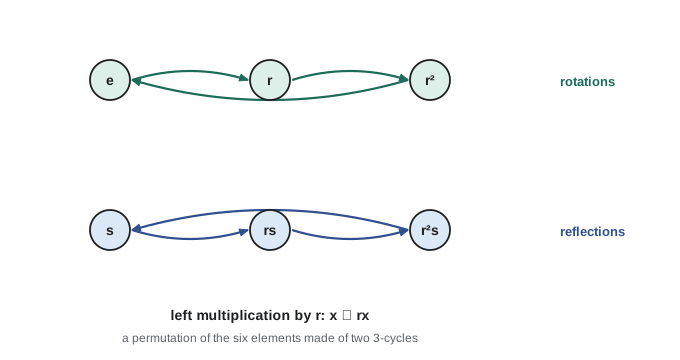
The code below carries out Cayley's construction for \(D_3\), writing each element as the permutation of \(\{0, \dots, 5\}\) given by its row of the table, and checks that \(g \mapsto \lambda_g\) is an injective homomorphism. It also counts the homomorphisms \(\mathbb{Z}_m \to \mathbb{Z}_n\) for a few pairs and compares the count with \(\gcd(m, n)\).
from math import gcd

def mul(x, y):                       # (a, b) means r^a s^b in D3
    (a, b), (c, d) = x, y
    return ((a + (-1) ** b * c) % 3, (b + d) % 2)

G = [(a, b) for b in (0, 1) for a in range(3)]
idx = {g: i for i, g in enumerate(G)}
lam = {g: tuple(idx[mul(g, x)] for x in G) for g in G}

def compose(p, q):                   # p after q
    return tuple(p[q[i]] for i in range(len(q)))

hom = all(lam[mul(g, h)] == compose(lam[g], lam[h]) for g in G for h in G)
injective = len(set(lam.values())) == len(G)
print("lambda is a homomorphism:", hom, " injective:", injective)
print("lambda_r  =", lam[(1, 0)])
print("lambda_s  =", lam[(0, 1)])

def count_homs(m, n):
    total = 0
    for k in range(n):               # candidate image of 1
        phi = [(k * x) % n for x in range(m)]
        if all(phi[(x + y) % m] == (phi[x] + phi[y]) % n for x in range(m) for y in range(m)):
            total += 1
    return total

for m, n in [(3, 4), (6, 4), (12, 18), (8, 12), (5, 5)]:
print(f"homs Z{m} -> Z{n}: {count_homs(m, n)} gcd = {gcd(m, n)}")lambda is a homomorphism: True injective: True lambda_r = (1, 2, 0, 4, 5, 3) lambda_s = (3, 5, 4, 0, 2, 1) homs Z3 -> Z4: 1 gcd = 1 homs Z6 -> Z4: 2 gcd = 2 homs Z12 -> Z18: 6 gcd = 6 homs Z8 -> Z12: 4 gcd = 4 homs Z5 -> Z5: 5 gcd = 5
In the output, \(\lambda_r\) is a product of two 3-cycles and \(\lambda_s\) a product of three transpositions, matching the figure, and each homomorphism count equals the gcd.
Automorphisms
An isomorphism from a group to itself is an automorphism, and the automorphisms of \(G\) form a group \(\operatorname{Aut}(G)\) under composition. The conjugations \(c_g\) are automorphisms, called inner automorphisms; they are trivial exactly when \(g\) is in the center. For cyclic groups the automorphisms are easy to describe: an automorphism of \(\mathbb{Z}_n\) must send the generator 1 to another generator \(k\), with \(\gcd(k, n) = 1\) by lesson 3, and \(x \mapsto kx\) is then an automorphism. Composition multiplies the values of \(k\), so \(\operatorname{Aut}(\mathbb{Z}_n) \cong U(n)\). For example \(\operatorname{Aut}(\mathbb{Z}_8) \cong U(8)\) is a Klein four-group. The automorphism group of the Klein four-group itself permutes its three nonidentity elements in every possible way and is isomorphic to \(S_3\).
Common mistakes
MistakeAssuming \(\varphi(e_G)\) must be checked separately.
InsteadIt follows from the homomorphism property by cancellation: \(\varphi(e) = e_H\) always.
MistakeDefining a map on \(\mathbb{Z}_m\) by \(1 \mapsto k\) without checking it is well defined.
InsteadIt is well defined only when \(mk \equiv 0\) in the target, that is, when the order of \(k\) divides \(m\).
MistakeConcluding two groups are isomorphic because they have the same order.
Instead\(\mathbb{Z}_6\) and \(S_3\) both have order 6 but only one is abelian.
MistakeThinking \(\mathbb{Z}_2 \times \mathbb{Z}_4 \cong \mathbb{Z}_8\).
InsteadSince \(\gcd(2, 4) = 2\), every element has order at most 4; the groups are not isomorphic.
MistakeReading Cayley’s theorem as saying \(G\) is isomorphic to all of \(S_n\).
Instead\(G\) is isomorphic to a subgroup of \(S_n\), usually a very small one.
Summary and key terms
- A homomorphism satisfies \(\varphi(ab) = \varphi(a)\varphi(b)\); it sends \(e\) to \(e\), inverses to inverses and powers to powers.
- The order of \(\varphi(a)\) divides the order of \(a\); there are \(\gcd(m, n)\) homomorphisms \(\mathbb{Z}_m \to \mathbb{Z}_n\).
- Kernels and images are subgroups; \(\varphi\) is one-to-one exactly when \(\ker\varphi = \{e\}\).
- Isomorphic groups have the same structure; invariants such as element orders distinguish non-isomorphic groups.
- \(\mathbb{Z}_m \times \mathbb{Z}_n \cong \mathbb{Z}_{mn}\) exactly when \(\gcd(m, n) = 1\).
- Cayley (1854): every group of order \(n\) is isomorphic to a subgroup of \(S_n\); \(\operatorname{Aut}(\mathbb{Z}_n) \cong U(n)\).
- homomorphism
- A map with \(\varphi(ab) = \varphi(a)\varphi(b)\).
- kernel
- \(\ker\varphi\), the elements mapped to the identity.
- image
- \(\varphi(G)\), the set of values of \(\varphi\).
- isomorphism
- A bijective homomorphism.
- isomorphic
- \(G \cong H\): related by an isomorphism.
- automorphism
- An isomorphism from a group to itself.
- inner automorphism
- A conjugation map \(x \mapsto gxg^{-1}\).
- Cayley’s theorem
- Every group is isomorphic to a group of permutations.
Practice problems
Work each problem on paper first, then reveal the answer to check.
Is \(\varphi : \mathbb{Z} \to \mathbb{Z}\), \(\varphi(x) = 5x\), a homomorphism? Find its kernel and image.
Show answer
Yes; kernel \(\{0\}\), image \(5\mathbb{Z}\). So \(\mathbb{Z} \cong 5\mathbb{Z}\).
How many homomorphisms are there from \(\mathbb{Z}_{10}\) to \(\mathbb{Z}_{15}\)?
Show answer
\(\gcd(10, 15) = 5\).
Show that \(U(5) \cong \mathbb{Z}_4\).
Show answer
\(U(5) = \langle 2 \rangle\) is cyclic of order 4; \(2^k \mapsto k\) is an isomorphism.
Are \(\mathbb{Z}_4 \times \mathbb{Z}_6\) and \(\mathbb{Z}_{24}\) isomorphic?
Show answer
No: \(\gcd(4, 6) = 2\), so the largest element order is 12.
Prove that a homomorphism from a group of order 7 to a group of order 10 is trivial.
Show answer
The image has order dividing 7, since \(|G| = |\ker\varphi|\,|\varphi(G)|\), and dividing 10, by Lagrange in the target; only order 1 works.
Find \(|\operatorname{Aut}(\mathbb{Z}_{12})|\).
Show answer
\(|U(12)| = 4\).
Lesson quiz · 5 questions
Score 60% or more to complete this lesson.
Create a free account to save your progress, take quizzes and earn a certificate.