
MATH-322 · Lesson 5 of 12 · 23 min
Dihedral groups and symmetries of figures
The dihedral groups are the symmetry groups of regular polygons. They are the first nonabelian groups most people meet, they are small enough to compute with by hand, and they show up constantly: in the symmetry of snowflakes and flowers, of molecules such as benzene, of road signs and hubcaps, and as subgroups of larger groups. This lesson describes them completely, with a pair of generators and three relations, and ends with Leonardo's theorem, which says that every finite group of symmetries of a plane figure is cyclic or dihedral.
The symmetries of a regular polygon
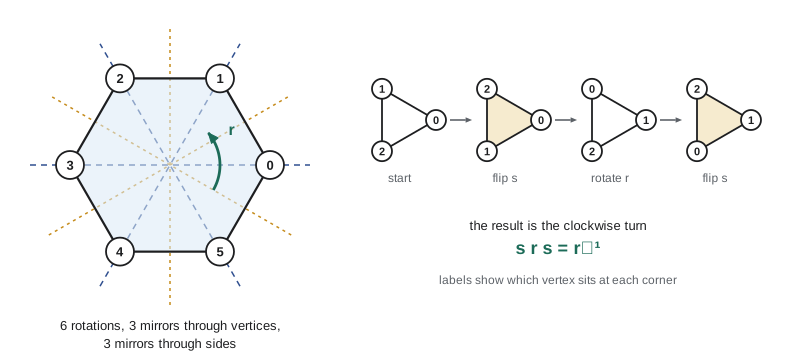
Let \(n \ge 3\) and consider a regular \(n\)-gon centered at the origin, with vertices numbered \(0, 1, \dots, n - 1\) counterclockwise. As in lesson 1, a symmetry is determined by where it sends vertex 0 (any of \(n\) places) and whether it preserves or reverses the counterclockwise order (two choices), so there are at most \(2n\) symmetries. All of them occur.
- The rotations \(e, r, r^2, \dots, r^{n-1}\), where \(r\) is the counterclockwise rotation by \(360^\circ/n\). They form a cyclic subgroup of order \(n\).
- The \(n\) reflections. If \(n\) is odd, each mirror line passes through a vertex and the midpoint of the opposite side. If \(n\) is even, \(n/2\) mirror lines pass through two opposite vertices and \(n/2\) pass through the midpoints of two opposite sides.
The group of all \(2n\) symmetries is the dihedral group \(D_n\). The name comes from the Greek for 'two faces': you can think of the polygon as a thin plate with two faces, and the reflections are the symmetries that turn it over.
Generators and relations
Fix one reflection \(s\), the reflection in the line through vertex 0. Then every element of \(D_n\) can be written using only \(r\) and \(s\). The rotations are \(r^k\). For the reflections, note that \(r^k s\) reverses orientation, because \(s\) does and rotations do not, so it is a reflection; and the \(n\) elements \(r^0 s, r^1 s, \dots, r^{n-1}s\) are all different, because \(r^i s = r^j s\) implies \(r^i = r^j\) by cancellation. So they are all \(n\) reflections, and
\[ D_n = \{e, r, r^2, \dots, r^{n-1}, s, rs, r^2s, \dots, r^{n-1}s\}. \]
Three relations hold: \(r^n = e\), \(s^2 = e\), and \(srs = r^{-1}\), which can also be written \(sr = r^{-1}s\). The third says that flipping the polygon over, rotating it counterclockwise and flipping it back amounts to rotating clockwise. You can see it with any cardboard polygon, or prove it by following vertices: with vertices labeled modulo \(n\), \(r(k) = k + 1\) and \(s(k) = -k\), so \(srs(k) = s(r(-k)) = s(-k + 1) = k - 1 = r^{-1}(k)\).
These relations are enough to multiply any two elements. Repeatedly applying \(sr = r^{-1}s\) gives \(sr^k = r^{-k}s\) for all \(k\). Hence
\[ r^a \cdot r^b = r^{a+b}, \qquad r^a \cdot r^b s = r^{a+b}s, \qquad r^a s \cdot r^b = r^{a-b}s, \qquad r^a s \cdot r^b s = r^{a-b}, \]
with exponents read modulo \(n\). In fact the relations determine the group completely: \(D_n\) is the group generated by \(r\) and \(s\) subject to \(r^n = s^2 = e\) and \(srs = r^{-1}\). This is called a presentation of \(D_n\), written \(\langle r, s \mid r^n = s^2 = e,\ srs = r^{-1} \rangle\). Making the notion of a presentation precise requires free groups, which are beyond this course, but the practical meaning is clear: any calculation in \(D_n\) can be done with these three rules alone.
Worked problem
Calculating in D_5
In \(D_5\), simplify \(x = r^3 s r^4 s r^2\) and find its order. Then find the inverse of \(r^2s\).
Show solution
- Use \(s r^4 = r^{-4}s\): \(x = r^3 \cdot r^{-4} s \cdot s r^2 = r^{-1} s^2 r^2 = r^{-1} r^2 = r\).
- So \(x = r\), a rotation by \(72^\circ\), which has order 5.
- For the inverse, every reflection is its own inverse: \((r^2s)(r^2s) = r^{2-2} = e\) by the last product rule. So \((r^2s)^{-1} = r^2s\).
Answer: \(r^3 s r^4 s r^2 = r\), of order 5, and \(r^2 s\) is its own inverse.
The square in detail
The case \(n = 4\) is worth writing out in full, because \(D_4\) is the smallest dihedral group whose structure is richer than that of \(S_3\). Its eight elements are \(e, r, r^2, r^3\) (rotations by \(0^\circ, 90^\circ, 180^\circ, 270^\circ\)) and \(s, rs, r^2s, r^3s\). With vertex 0 on the positive \(x\)-axis, \(s\) is the reflection in the \(x\)-axis, \(r^2s\) is the reflection in the \(y\)-axis, and \(rs\) and \(r^3s\) are the reflections in the two diagonals. The product rules above give the whole Cayley table without drawing a single picture.
| · | e | r | r² | r³ | s | rs | r²s | r³s |
|---|---|---|---|---|---|---|---|---|
| e | e | r | r² | r³ | s | rs | r²s | r³s |
| r | r | r² | r³ | e | rs | r²s | r³s | s |
| r² | r² | r³ | e | r | r²s | r³s | s | rs |
| r³ | r³ | e | r | r² | r³s | s | rs | r²s |
| s | s | r³s | r²s | rs | e | r³ | r² | r |
| rs | rs | s | r³s | r²s | r | e | r³ | r² |
| r²s | r²s | rs | s | r³s | r² | r | e | r³ |
| r³s | r³s | r²s | rs | s | r³ | r² | r | e |
Several features can be read off the table. The top left block of rotations is the table of the cyclic group of order 4. Rotation times reflection, in either order, is a reflection, and reflection times reflection is a rotation, so the bottom right block contains only rotations. The diagonal of the bottom right block is all \(e\), because every reflection has order 2. And the table is not symmetric about its main diagonal: row \(s\), column \(r\) gives \(r^3s\), while row \(r\), column \(s\) gives \(rs\). Inside \(D_4\) we can also find the subgroup \(\{e, r^2, s, r^2s\}\), the symmetries of a rectangle that is not a square, and the subgroup \(\{e, r^2, rs, r^3s\}\), the symmetries of a rhombus that is not a square; both are copies of the Klein four-group from lesson 2. Lesson 6 lists every subgroup of \(D_4\) and draws them as a lattice.
Orders, the center and conjugate reflections
Every reflection \(r^ks\) has order 2, and the rotation \(r^k\) has order \(n/\gcd(n, k)\) by lesson 3. So \(D_n\) has \(n\) elements of order 2 from reflections, plus one more, the half turn \(r^{n/2}\), when \(n\) is even.
The center of a group \(G\) is the set \(Z(G) = \{z \in G : zg = gz \text{ for all } g \in G\}\) of elements that commute with everything. For \(D_n\) with \(n \ge 3\), a rotation \(r^k\) commutes with \(s\) only if \(r^k s = s r^k = r^{-k}s\), that is \(r^{2k} = e\), so \(n \mid 2k\). A reflection \(r^ks\) commutes with \(r\) only if \(r^{k+1}s = r^{k-1}s\), that is \(r^2 = e\), impossible for \(n \ge 3\). So the center is \(\{e\}\) when \(n\) is odd and \(\{e, r^{n/2}\}\) when \(n\) is even. Geometrically the half turn of an even polygon commutes with everything because it sends every point to its opposite, and flipping commutes with that.
Two elements \(a, b\) are conjugate if \(b = gag^{-1}\) for some \(g\). Conjugation corresponds to doing the same motion from a different point of view: if \(s\) is the reflection in line \(\ell\), then \(gsg^{-1}\) is the reflection in the line \(g(\ell)\). In \(D_n\) with \(n\) odd, every mirror line can be rotated onto every other, so all reflections are conjugate. With \(n\) even, rotations take vertex-to-vertex lines to vertex-to-vertex lines and side-to-side lines to side-to-side lines, and so do reflections, so the reflections fall into two conjugacy classes of size \(n/2\). Lesson 9 shows why conjugation is central to the theory.
Dihedral groups as permutation groups
Each symmetry of the \(n\)-gon permutes its vertices, and different symmetries give different permutations, so \(D_n\) can be viewed as a subgroup of \(S_n\) of order \(2n\). For \(n = 3\) this subgroup has order \(6 = 3!\), so it is all of \(S_3\): every permutation of the corners of a triangle is a symmetry. For \(n = 4\), \(D_4\) has order 8 inside \(S_4\) of order 24; the permutation \((1\,2)\), swapping two adjacent corners while fixing the others, is not a symmetry of the square. The code below builds \(D_n\) from the two permutations \(r\) and \(s\) of the vertices, checks the relations, and computes the orders of elements and the center.
def compose(a, b):                 # a after b
    return tuple(a[b[i]] for i in range(len(b)))

def generate(gens):
    n = len(gens[0])
    e = tuple(range(n))
    group, frontier = {e}, [e]
    while frontier:
        new = []
        for g in frontier:
            for h in gens:
                x = compose(h, g)
                if x not in group:
                    group.add(x); new.append(x)
        frontier = new
    return group

def order(g):
    e, x, k = tuple(range(len(g))), g, 1
    while x != e:
        x, k = compose(g, x), k + 1
    return k

for n in [3, 4, 5, 6]:
    r = tuple((k + 1) % n for k in range(n))
    s = tuple((-k) % n for k in range(n))
    D = generate([r, s])
    rinv = tuple((k - 1) % n for k in range(n))
    rel = compose(s, compose(r, s)) == rinv
    centre = [g for g in D if all(compose(g, h) == compose(h, g) for h in D)]
    orders = sorted(order(g) for g in D)
print(f"D{n}: size {len(D)}, srs = r^-1: {rel}, centre size {len(centre)}, element orders {orders}")D3: size 6, srs = r^-1: True, center size 1, element orders [1, 2, 2, 2, 3, 3] D4: size 8, srs = r^-1: True, center size 2, element orders [1, 2, 2, 2, 2, 2, 4, 4] D5: size 10, srs = r^-1: True, center size 1, element orders [1, 2, 2, 2, 2, 2, 5, 5, 5, 5] D6: size 12, srs = r^-1: True, center size 2, element orders [1, 2, 2, 2, 2, 2, 2, 2, 3, 3, 6, 6]
The output shows \(|D_n| = 2n\), the relation \(srs = r^{-1}\) in each case, a center of size 1 for odd \(n\) and 2 for even \(n\), and \(n\) or \(n + 1\) elements of order 2 as predicted.
Leonardo's theorem
Which finite groups can occur as the full symmetry group of a figure in the plane? Leonardo da Vinci, designing chapels that could be extended symmetrically, is said to have found that the possibilities are limited, and the result is named after him.
Theorem (Leonardo). A finite group of isometries of the plane is either a cyclic group \(C_n\) of rotations about a point or a dihedral group \(D_n\).
Proof sketch: let \(G\) be a finite group of isometries. First, \(G\) fixes a point: the average of the images of any point under all elements of \(G\) is moved to itself by every element, because each element of \(G\) permutes the images. So every element of \(G\) is a rotation about this center or a reflection in a line through it; translations and glide reflections have no fixed point and cannot occur. The rotations in \(G\) form a finite group of rotations about one point; choosing the smallest positive angle \(\theta\) among them, a division argument like the one in lesson 3 shows that every rotation in \(G\) is a power of the rotation by \(\theta\), so the rotations form a cyclic group \(C_n\) with \(\theta = 360^\circ/n\). If \(G\) contains no reflection, \(G = C_n\). If it contains a reflection \(s\), then \(r^k s\) are \(n\) distinct reflections, and any reflection \(t\) in \(G\) satisfies \(ts \in C_n\), so \(t = r^k s\) for some \(k\); hence \(G\) has exactly \(2n\) elements and is \(D_n\).
The theorem explains what we see in nature and design. A snowflake has the symmetry of \(D_6\) because water ice crystallizes in a hexagonal lattice. A five-petalled flower such as a wild rose has \(D_5\) symmetry if its petals are mirror symmetric and only \(C_5\) symmetry if they twist like a pinwheel. A triskelion, three bent legs radiating from a center, has \(C_3\) symmetry but no mirror line. A stop sign has \(D_8\) symmetry once the lettering is ignored. In chemistry the benzene ring has the planar symmetry of \(D_6\), and a molecule's symmetry group determines which of its vibrations can absorb infrared light, which is why chemists classify molecules by their symmetry groups.
Beyond finite groups
If we allow infinitely many symmetries, new groups appear. The integers, viewed as equally spaced points on a line, have as symmetries all translations by integers and all reflections in integer and half-integer points; this is the infinite dihedral group \(D_\infty\), with a presentation like \(D_n\) but no relation \(r^n = e\). Border patterns on a strip, called frieze patterns, fall into exactly seven symmetry types, and wallpaper patterns into exactly seventeen, a classification completed by Fedorov in 1891. Each of those groups contains translations and so is infinite, but each is built from cyclic and dihedral pieces at the points where it fixes something.
Common mistakes
MistakeWriting \(sr = rs\) in a dihedral group.
InsteadThe correct rule is \(sr = r^{-1}s\); the elements commute only if \(r^2 = e\).
MistakeThinking \(D_n\) has order \(n\).
InsteadIt has \(2n\) elements: \(n\) rotations and \(n\) reflections. Some books call it \(D_{2n}\) for this reason.
MistakeForgetting the half turn when counting elements of order 2 in \(D_n\) for even \(n\).
InsteadFor even \(n\), \(r^{n/2}\) has order 2, giving \(n + 1\) elements of order 2.
MistakeAssuming all reflections in \(D_n\) are conjugate.
InsteadThat is true for odd \(n\); for even \(n\) they split into two classes, through vertices and through sides.
MistakeIncluding translations in the symmetries of a bounded figure.
InsteadA bounded figure has a fixed center, so its symmetries are rotations about it and reflections in lines through it.
Summary and key terms
- \(D_n\) is the group of \(2n\) symmetries of a regular \(n\)-gon: \(n\) rotations and \(n\) reflections.
- It is generated by a rotation \(r\) of order \(n\) and a reflection \(s\), with \(srs = r^{-1}\); every element is \(r^k\) or \(r^ks\).
- All products follow from \(sr^k = r^{-k}s\); every reflection has order 2.
- The center of \(D_n\) is trivial for odd \(n\) and \(\{e, r^{n/2}\}\) for even \(n\).
- \(D_n\) is a subgroup of \(S_n\); \(D_3\) is all of \(S_3\).
- Leonardo’s theorem: every finite group of plane isometries is cyclic or dihedral.
- dihedral group
- \(D_n\), the symmetry group of a regular \(n\)-gon, of order \(2n\).
- generators
- Elements from which every element of the group can be obtained by products and inverses.
- relation
- An equation such as \(srs = r^{-1}\) satisfied by the generators.
- presentation
- A description of a group by generators and the relations they satisfy.
- center
- \(Z(G)\), the elements that commute with every element of \(G\).
- conjugate
- Elements \(a\) and \(gag^{-1}\) for some \(g \in G\).
- isometry
- A distance-preserving map of the plane.
- Leonardo’s theorem
- The finite symmetry groups of plane figures are cyclic or dihedral.
Practice problems
Work each problem on paper first, then reveal the answer to check.
In \(D_6\), simplify \(s r^2 s r^5\).
Show answer
\(sr^2 = r^{-2}s\), so \(sr^2sr^5 = r^{-2}s^2r^5 = r^3\), the half turn.
List the elements of order 2 in \(D_4\).
Show answer
The four reflections \(s, rs, r^2s, r^3s\) and the half turn \(r^2\): five in all.
Show that \(r^k s\) has order 2 for every \(k\).
Show answer
\((r^ks)(r^ks) = r^k (s r^k) s = r^k r^{-k} s s = e\), and \(r^ks \ne e\).
What is the center of \(D_7\)? Of \(D_{10}\)?
Show answer
\(Z(D_7) = \{e\}\) since 7 is odd; \(Z(D_{10}) = \{e, r^5\}\).
Which symmetry group does the letter H have? The letter Z? The letter S?
Show answer
H has \(D_2\) (the Klein four-group: identity, half turn and two mirrors). Z and S have only the identity and the half turn, \(C_2\).
Prove that in \(D_n\), \(r^ks \cdot r^js = r^{k-j}\).
Show answer
\(r^k s r^j s = r^k r^{-j} s s = r^{k-j}\), using \(sr^j = r^{-j}s\) and \(s^2 = e\).
Lesson quiz · 5 questions
Score 60% or more to complete this lesson.
Create a free account to save your progress, take quizzes and earn a certificate.