
MATH-322 · Lesson 10 of 12 · 24 min
The isomorphism theorems
Homomorphisms, kernels and quotients are tied together by three theorems, usually called the first, second and third isomorphism theorems. They were used informally by Jordan, Hölder and others in the nineteenth century, and Emmy Noether gave them their clean general form in the 1920s, as statements that hold for groups, rings, modules and many other structures alike. The first theorem is by far the most important: it says that the image of every homomorphism is a quotient of its domain, which turns hard questions about quotients into easy questions about maps.
The first isomorphism theorem
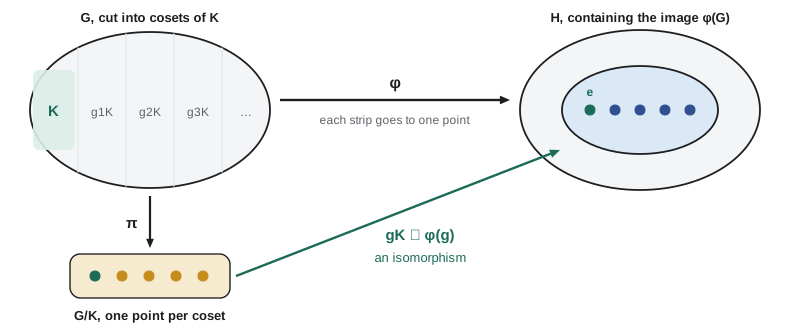
Theorem (first isomorphism theorem). Let \(\varphi : G \to H\) be a homomorphism with kernel \(K\). Then \(K \trianglelefteq G\), and
\[ G/K \cong \varphi(G), \]
via the map \(\bar\varphi(gK) = \varphi(g)\).
Proof: \(K\) is normal by lesson 9. We must check that \(\bar\varphi\) is well defined, a homomorphism, and a bijection onto \(\varphi(G)\). Well defined and one-to-one together: by lesson 8, \(gK = g'K \iff g^{-1}g' \in K \iff \varphi(g) = \varphi(g')\). Read left to right this says \(\bar\varphi\) does not depend on the name of the coset; read right to left it says different cosets have different images. Homomorphism: \(\bar\varphi(gK \cdot g'K) = \bar\varphi(gg'K) = \varphi(gg') = \varphi(g)\varphi(g') = \bar\varphi(gK)\bar\varphi(g'K)\). Onto \(\varphi(G)\): every \(\varphi(g)\) equals \(\bar\varphi(gK)\).
A useful way to remember it: \(\varphi\) factors as the projection \(\pi : G \to G/K\) followed by the isomorphism \(\bar\varphi : G/K \to \varphi(G)\), so that \(\varphi = \bar\varphi \circ \pi\). The projection does all the collapsing, and the isomorphism does no collapsing at all. For finite groups, comparing orders gives \(|G| = |K| \cdot |\varphi(G)|\), which we met in lesson 8.
Applications
To identify a quotient \(G/N\), find a homomorphism out of \(G\) whose kernel is \(N\); its image is the quotient. Each line below is one homomorphism.
| Homomorphism | Kernel | Image | Conclusion |
|---|---|---|---|
| \(\mathbb{Z} \to \mathbb{Z}_n\), reduce mod \(n\) | \(n\mathbb{Z}\) | \(\mathbb{Z}_n\) | \(\mathbb{Z}/n\mathbb{Z} \cong \mathbb{Z}_n\) |
| \(\det : GL_n(\mathbb{R}) \to \mathbb{R}^\times\) | \(SL_n(\mathbb{R})\) | \(\mathbb{R}^\times\) | \(GL_n/SL_n \cong \mathbb{R}^\times\) |
| \(\operatorname{sgn} : S_n \to \{\pm 1\}\) | \(A_n\) | \(\{\pm 1\}\) | \(S_n/A_n \cong \mathbb{Z}_2\) |
| \(x \mapsto e^{2\pi i x}\), \(\mathbb{R} \to \mathbb{C}^\times\) | \(\mathbb{Z}\) | unit circle | \(\mathbb{R}/\mathbb{Z} \cong \mathbb{T}\) |
| \(z \mapsto |z|\), \(\mathbb{C}^\times \to \mathbb{R}_{>0}\) | \(\mathbb{T}\) | \(\mathbb{R}_{>0}\) | \(\mathbb{C}^\times/\mathbb{T} \cong \mathbb{R}_{>0}\) |
| \(g \mapsto c_g\), \(G \to \operatorname{Aut}(G)\) | \(Z(G)\) | \(\operatorname{Inn}(G)\) | \(G/Z(G) \cong \operatorname{Inn}(G)\) |
The last line uses the conjugation homomorphism: \(c_g\) is the identity automorphism exactly when \(gxg^{-1} = x\) for all \(x\), that is, when \(g \in Z(G)\). So the group of inner automorphisms is a copy of \(G/Z(G)\). For \(D_4\) that is a Klein four-group, by lesson 9.
The theorem also limits what homomorphisms can exist. The image of a homomorphism from \(G\) is isomorphic to a quotient of \(G\), so its order divides \(|G|\). And a simple group has only two quotients, itself and the trivial group, so every homomorphism out of a simple group is either one-to-one or trivial. For instance, any homomorphism from \(A_5\) to a group of order less than 60 is trivial.
Worked problem
Quotients of a cyclic group
Show that \(\mathbb{Z}_{12}/\langle 4 \rangle \cong \mathbb{Z}_4\), and more generally that \(\mathbb{Z}_n/\langle d \rangle \cong \mathbb{Z}_d\) when \(d \mid n\).
Show solution
- Define \(\varphi : \mathbb{Z}_n \to \mathbb{Z}_d\) by \(\varphi(x) = x \bmod d\). This is well defined because \(d \mid n\): changing \(x\) by a multiple of \(n\) changes it by a multiple of \(d\).
- It is a homomorphism, since reduction respects addition, and it is onto, since \(\varphi(k) = k\) for \(0 \le k < d\).
- Its kernel is the set of multiples of \(d\) in \(\mathbb{Z}_n\), which is \(\langle d \rangle\).
- By the first isomorphism theorem, \(\mathbb{Z}_n/\langle d \rangle \cong \mathbb{Z}_d\). With \(n = 12\), \(d = 4\): \(\mathbb{Z}_{12}/\langle 4 \rangle \cong \mathbb{Z}_4\), matching the four cosets listed in lesson 7.
Answer: Every quotient of a cyclic group is cyclic: \(\mathbb{Z}_n/\langle d \rangle \cong \mathbb{Z}_d\).
The second isomorphism theorem
Theorem (second isomorphism theorem). Let \(H \le G\) and \(N \trianglelefteq G\). Then \(HN\) is a subgroup of \(G\), \(N \trianglelefteq HN\), \(H \cap N \trianglelefteq H\), and
\[ HN/N \cong H/(H \cap N). \]
Proof: since \(N\) is normal, \(hN = Nh\) for every \(h \in H\), so \(HN = NH\) and \(HN\) is a subgroup by lesson 6. \(N\) is normal in \(HN\) because it is normal in all of \(G\). Now define \(\varphi : H \to HN/N\) by \(\varphi(h) = hN\). It is the restriction of the projection \(\pi\), so it is a homomorphism. It is onto: a coset \(hnN\) equals \(hN = \varphi(h)\). Its kernel is \(\{h \in H : hN = N\} = H \cap N\). The first isomorphism theorem gives the rest, including the normality of \(H \cap N\) in \(H\).
It is sometimes called the diamond theorem, after the picture of the four subgroups \(H \cap N \le H, N \le HN\). Taking orders gives \(|HN| = |H|\,|N|/|H \cap N|\), the product formula of lesson 6. A striking instance: in \(S_4\), let \(N = V\), the normal Klein four-group of lesson 9, and let \(H \cong S_3\) be the permutations fixing 4. No nonidentity element of \(V\) fixes 4, so \(H \cap V = \{e\}\), and \(|HV| = 6 \cdot 4 = 24\), so \(HV = S_4\). The theorem gives \(S_4/V \cong S_3\). That isomorphism is the reason the general quartic equation can be solved by reducing it to a cubic, a step known to Ferrari and Cardano in the 1540s and explained by Lagrange in his memoir of 1771.
The third isomorphism theorem
Theorem (third isomorphism theorem). Let \(N \le K\) be normal subgroups of \(G\). Then \(K/N\) is a normal subgroup of \(G/N\), and
\[ (G/N)/(K/N) \cong G/K. \]
Proof: define \(\varphi : G/N \to G/K\) by \(\varphi(gN) = gK\). It is well defined: if \(gN = g'N\) then \(g^{-1}g' \in N \subseteq K\), so \(gK = g'K\). It is a homomorphism because both sides multiply cosets by multiplying names, and it is onto. Its kernel is \(\{gN : g \in K\} = K/N\). The first isomorphism theorem finishes the proof, and shows \(K/N\) is normal, being a kernel.
Informally, quotients can be taken in stages and the fractions 'cancel'. For example, \((\mathbb{Z}/12\mathbb{Z})/(4\mathbb{Z}/12\mathbb{Z}) \cong \mathbb{Z}/4\mathbb{Z}\).
The correspondence theorem
A fourth result, sometimes called the lattice or correspondence theorem, describes all the subgroups of a quotient. If \(N \trianglelefteq G\), then the subgroups of \(G/N\) correspond one to one with the subgroups of \(G\) that contain \(N\), via \(K \mapsto K/N\). The correspondence preserves inclusion, indices and normality. So the subgroup lattice of \(G/N\) is the part of the lattice of \(G\) lying above \(N\). For example, the subgroups of \(\mathbb{Z}/12\mathbb{Z}\) correspond to the subgroups \(d\mathbb{Z}\) of \(\mathbb{Z}\) containing \(12\mathbb{Z}\), that is, to the divisors \(d\) of 12, as lesson 3 found by other means. And the subgroups of \(D_4/Z(D_4)\), a Klein four-group with five subgroups, match the five subgroups of \(D_4\) that contain \(r^2\): \(\langle r^2 \rangle\), the three subgroups of order 4, and \(D_4\) itself, which can be checked against the lattice in lesson 6.
Abelian quotients and the commutator subgroup
Which quotients of a group are abelian? The answer involves the commutator \([a, b] = aba^{-1}b^{-1}\) of two elements, which measures how far \(a\) and \(b\) are from commuting: \([a, b] = e\) exactly when \(ab = ba\). The commutator subgroup, or derived subgroup, \(G'\) is the subgroup generated by all commutators.
Theorem. \(G'\) is normal in \(G\), and for a normal subgroup \(N\), the quotient \(G/N\) is abelian if and only if \(G' \le N\). In particular \(G/G'\) is abelian, and it is the largest abelian quotient of \(G\).
Proof: a conjugate of a commutator is a commutator, \(g[a, b]g^{-1} = [gag^{-1}, gbg^{-1}]\), so conjugation permutes the generators of \(G'\) among themselves and \(G'\) is normal. For the main statement, \(aN \cdot bN = bN \cdot aN\) means \(abN = baN\), which by the coset lemma means \((ba)^{-1}ab = a^{-1}b^{-1}ab \in N\). As \(a\) and \(b\) range over \(G\), the elements \(a^{-1}b^{-1}ab = [a^{-1}, b^{-1}]\) range over all commutators. So \(G/N\) is abelian exactly when every commutator lies in \(N\), that is, when \(G' \le N\). The last sentence follows from the third isomorphism theorem: any abelian quotient \(G/N\) is a quotient of \(G/G'\), since \((G/G')/(N/G') \cong G/N\).
Examples. An abelian group has \(G' = \{e\}\). In \(D_n\), \([r, s] = r s r^{-1} s^{-1} = r \cdot r s \cdot s = r^2\), and one checks that every commutator is a power of \(r^2\), so \(D_n' = \langle r^2 \rangle\). For odd \(n\) that is all the rotations and \(D_n/D_n' \cong \mathbb{Z}_2\); for even \(n\) it is half of them and \(D_n/D_n'\) is a Klein four-group, matching \(D_4/Z(D_4)\) from lesson 9. For \(n \ge 2\), \(S_n' = A_n\): every commutator is even, so \(S_n' \le A_n\), and every 3-cycle is a commutator, \((a\,b\,c) = [(a\,b), (a\,c)]\), so \(A_n \le S_n'\) since 3-cycles generate \(A_n\). Thus the sign is, in a precise sense, the only abelian information in a permutation. Finally \(A_5' = A_5\): the commutator subgroup is normal and nontrivial, so by simplicity it is everything, and \(A_5\) has no nontrivial abelian quotient at all.
Iterating, \(G \ge G' \ge G'' \ge \cdots\), gives the derived series. A group is called solvable if the series reaches \(\{e\}\). \(S_4\) is solvable, since \(S_4' = A_4\), \(A_4' = V\) and \(V' = \{e\}\). \(S_5\) is not, since the series stops at \(A_5\). The word solvable comes directly from equations: Galois showed that a polynomial is solvable by radicals exactly when its group is solvable.
Composition series
Repeated quotients lead to a finer analysis. A composition series of a finite group is a chain \(\{e\} = G_0 \trianglelefteq G_1 \trianglelefteq \cdots \trianglelefteq G_k = G\), each normal in the next, in which every factor \(G_{i+1}/G_i\) is simple. The Jordan–Hölder theorem, proved by Jordan in 1869 and completed by Hölder in 1889, says that the simple factors are the same, up to isomorphism and order, for every composition series of \(G\). So every finite group has a well-defined list of simple building blocks, like the prime factorization of an integer. For \(\mathbb{Z}_{12}\), the series \(\{0\} \le \langle 6 \rangle \le \langle 2 \rangle \le \mathbb{Z}_{12}\) has factors \(\mathbb{Z}_2, \mathbb{Z}_3, \mathbb{Z}_2\), and the series \(\{0\} \le \langle 4 \rangle \le \langle 2 \rangle \le \mathbb{Z}_{12}\) has factors \(\mathbb{Z}_3, \mathbb{Z}_2, \mathbb{Z}_2\): the same list in a different order, mirroring \(12 = 2 \cdot 3 \cdot 2 = 3 \cdot 2 \cdot 2\). For \(S_4\), the series \(\{e\} \le \langle (1\,2)(3\,4) \rangle \le V \le A_4 \le S_4\) has factors \(\mathbb{Z}_2, \mathbb{Z}_2, \mathbb{Z}_3, \mathbb{Z}_2\), all abelian. For \(S_5\), the series \(\{e\} \le A_5 \le S_5\) has factors \(A_5\) and \(\mathbb{Z}_2\), and one factor is nonabelian. That difference is exactly the difference, in Galois theory, between the quartic, which is solvable by radicals, and the quintic, which is not; MATH-323 develops that story.
The code below checks the second isomorphism theorem example \(S_4/V \cong S_3\) by computing the cosets of \(V\) and the permutations of \(\{1, 2, 3\}\) they induce, and checks the first isomorphism theorem for the homomorphism \(\mathbb{Z}_{24} \to \mathbb{Z}_{24}\), \(x \mapsto 10x\).
from itertools import permutations

def compose(a, b):
    return tuple(a[b[i]] for i in range(len(b)))

S4 = list(permutations(range(4)))
V = [(0, 1, 2, 3), (1, 0, 3, 2), (2, 3, 0, 1), (3, 2, 1, 0)]
cosets = {frozenset(compose(g, v) for v in V) for g in S4}
print("number of cosets of V in S4:", len(cosets))
reps = [next(p for p in C if p[3] == 3) for C in cosets]   # representative fixing the last point
print("each coset has exactly one element fixing 4:",
      all(sum(p[3] == 3 for p in C) == 1 for C in cosets))
print("the representatives form S3:", sorted(p[:3] for p in reps) == sorted(permutations(range(3))))

n, k = 24, 10
phi = {x: (k * x) % n for x in range(n)}
kernel = [x for x in range(n) if phi[x] == 0]
image = sorted(set(phi.values()))
print("kernel:", kernel, " image:", image)
print("|G| = |ker| * |im|:", n == len(kernel) * len(image))
well_defined = all(phi[x] == phi[(x + c) % n] for x in range(n) for c in kernel)
print("phi is constant on cosets of the kernel:", well_defined)number of cosets of V in S4: 6 each coset has exactly one element fixing 4: True the representatives form S3: True kernel: [0, 12] image: [0, 2, 4, 6, 8, 10, 12, 14, 16, 18, 20, 22] |G| = |ker| * |im|: True phi is constant on cosets of the kernel: True
The kernel of \(x \mapsto 10x\) on \(\mathbb{Z}_{24}\) is \(\langle 12 \rangle\), of order \(\gcd(10, 24) = 2\), and the image is \(\langle 2 \rangle\), of order 12, so \(\mathbb{Z}_{24}/\langle 12 \rangle \cong \mathbb{Z}_{12}\).
Common mistakes
MistakeWriting \(G/K \cong H\) when \(\varphi\) is not onto.
InsteadThe quotient is isomorphic to the image \(\varphi(G)\), which may be smaller than \(H\).
MistakeDefining \(\bar\varphi(gK) = \varphi(g)\) without checking it is well defined.
InsteadIt is well defined precisely because \(\varphi\) is constant on each coset of its kernel.
MistakeApplying the second theorem without normality of \(N\).
InsteadIf neither subgroup is normal, \(HN\) need not be a subgroup.
MistakeTreating quotients as subgroups.
Instead\(G/N\) is a group of cosets; it need not be isomorphic to any subgroup of \(G\). \(Q_8/Z(Q_8)\) is a Klein four-group, but \(Q_8\) contains no Klein four-group.
MistakeBelieving the composition factors determine the group.
Instead\(\mathbb{Z}_4\) and \(\mathbb{Z}_2 \times \mathbb{Z}_2\) both have factors \(\mathbb{Z}_2, \mathbb{Z}_2\).
Summary and key terms
- First theorem: \(G/\ker\varphi \cong \varphi(G)\), via \(g\ker\varphi \mapsto \varphi(g)\).
- To identify a quotient, find a homomorphism with that kernel and compute its image.
- Second theorem: \(HN/N \cong H/(H \cap N)\) when \(N\) is normal; for example \(S_4/V \cong S_3\).
- Third theorem: \((G/N)/(K/N) \cong G/K\) for normal \(N \le K\).
- Subgroups of \(G/N\) correspond to subgroups of \(G\) containing \(N\).
- Composition series break a finite group into simple factors, unique by the Jordan–Hölder theorem.
- first isomorphism theorem
- \(G/\ker\varphi \cong \varphi(G)\).
- second isomorphism theorem
- \(HN/N \cong H/(H \cap N)\) for \(N \trianglelefteq G\).
- third isomorphism theorem
- \((G/N)/(K/N) \cong G/K\).
- correspondence theorem
- Subgroups of \(G/N\) match subgroups of \(G\) containing \(N\).
- inner automorphism group
- \(\operatorname{Inn}(G) \cong G/Z(G)\).
- composition series
- A chain of subgroups, each normal in the next, with simple factors.
- composition factors
- The simple quotients in a composition series.
- Jordan–Hölder theorem
- The composition factors of a finite group are unique up to order and isomorphism.
Practice problems
Work each problem on paper first, then reveal the answer to check.
Use the first isomorphism theorem to show \(\mathbb{Z}_{20}/\langle 5 \rangle \cong \mathbb{Z}_5\).
Show answer
Reduce modulo 5: \(\mathbb{Z}_{20} \to \mathbb{Z}_5\) is onto with kernel \(\langle 5 \rangle\).
A homomorphism from a group of order 36 onto a group of order 9 has a kernel of what order?
Show answer
\(36/9 = 4\).
What is \(\mathbb{R}^2/L\) when \(L\) is a line through the origin?
Show answer
Projecting onto a perpendicular line is onto with kernel \(L\), so \(\mathbb{R}^2/L \cong \mathbb{R}\).
Find a composition series of \(D_4\) and its factors.
Show answer
\(\{e\} \le \langle r^2 \rangle \le \langle r \rangle \le D_4\), with factors \(\mathbb{Z}_2, \mathbb{Z}_2, \mathbb{Z}_2\).
Show every homomorphism from \(A_5\) to \(S_4\) is trivial.
Show answer
It is one-to-one or trivial since \(A_5\) is simple, and \(A_5\) (order 60) cannot embed in \(S_4\) (order 24).
How many subgroups does \(\mathbb{Z}_{36}/\langle 12 \rangle\) have?
Show answer
It is \(\cong \mathbb{Z}_{12}\), which has six subgroups, one for each divisor of 12.
Lesson quiz · 5 questions
Score 60% or more to complete this lesson.
Create a free account to save your progress, take quizzes and earn a certificate.