
MATH-241 · Lesson 4 of 12 · 25 min
Sequences and their limits
A sequence is an infinite list of real numbers \(a_1, a_2, a_3, \dots\). Formally it is a function \(a : \mathbb{N} \to \mathbb{R}\), and we write \(a_n\) for its value at \(n\) and \((a_n)\) for the whole sequence. Sequences are the simplest setting for the idea of a limit, and almost every later notion in this course, including continuity, the derivative, series and the integral, can be expressed through limits of sequences. This lesson gives the definition of convergence, proves that limits are unique, and develops the algebraic rules that let us compute limits without returning to epsilons every time.
The definition
Definition. A sequence \((a_n)\) converges to a real number \(L\) if for every \(\varepsilon > 0\) there is a natural number \(N\) such that \(|a_n - L| < \varepsilon\) for all \(n \ge N\). We write \(\lim_{n \to \infty} a_n = L\) or \(a_n \to L\), and call \(L\) the limit. A sequence that converges to some \(L\) is convergent; otherwise it is divergent.
In symbols, \(a_n \to L\) means \(\forall \varepsilon > 0 \; \exists N \in \mathbb{N} \; \forall n \ge N : |a_n - L| < \varepsilon\). The inequality \(|a_n - L| < \varepsilon\) says that \(a_n\) lies in the open interval \((L - \varepsilon, L + \varepsilon)\), called the \(\varepsilon\)-neighborhood of \(L\). So convergence says: every neighborhood of \(L\), however small, contains all but finitely many terms of the sequence.
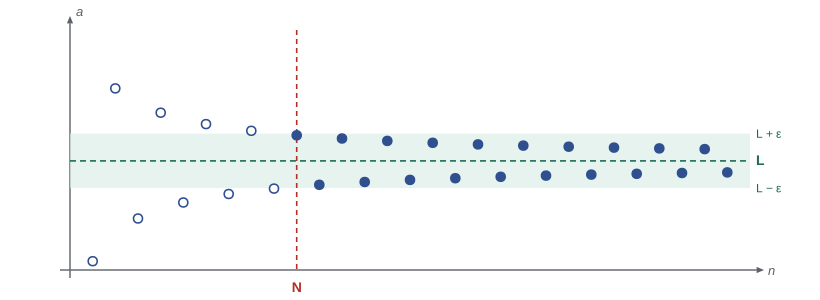
Negating the definition, as in MATH-228, tells us what it means for \(L\) not to be the limit: there is some \(\varepsilon > 0\) such that for every \(N\) there is an \(n \ge N\) with \(|a_n - L| \ge \varepsilon\). In words, infinitely many terms stay at least \(\varepsilon\) away from \(L\).
Proving limits from the definition
Worked problem
A rational sequence
Prove that \(\frac{3n^2 + 1}{n^2 + 2} \to 3\).
Show solution
- Scratch work: \(\big|\frac{3n^2 + 1}{n^2 + 2} - 3\big| = \big|\frac{3n^2 + 1 - 3n^2 - 6}{n^2 + 2}\big| = \frac{5}{n^2 + 2} < \frac{5}{n^2} \le \frac{5}{n}\). It is enough to have \(\frac{5}{n} < \varepsilon\).
- Proof: let \(\varepsilon > 0\) and choose \(N \in \mathbb{N}\) with \(N > \frac{5}{\varepsilon}\), by the Archimedean property.
- For \(n \ge N\): \(\big|\frac{3n^2 + 1}{n^2 + 2} - 3\big| = \frac{5}{n^2 + 2} < \frac{5}{n} \le \frac{5}{N} < \varepsilon\). \(\blacksquare\)
Answer: Simplify the error, then replace it by a cruder but simpler upper bound such as \(\frac{5}{n}\). We do not need the smallest \(N\), only one that works.
Worked problem
A sequence with a square root
Prove that \(\sqrt{n + 1} - \sqrt{n} \to 0\).
Show solution
- Rationalize: \(\sqrt{n + 1} - \sqrt{n} = \frac{(n + 1) - n}{\sqrt{n + 1} + \sqrt{n}} = \frac{1}{\sqrt{n + 1} + \sqrt{n}} < \frac{1}{\sqrt{n}}\).
- Let \(\varepsilon > 0\) and choose \(N > \frac{1}{\varepsilon^2}\).
- For \(n \ge N\), \(\sqrt{n} \ge \sqrt{N} > \frac{1}{\varepsilon}\), so \(0 < \sqrt{n + 1} - \sqrt{n} < \frac{1}{\sqrt{n}} < \varepsilon\). \(\blacksquare\)
Answer: Even though both terms grow without bound, their difference tends to 0.
Divergence can also be proved from the definition. The sequence \(a_n = (-1)^n\) does not converge. Suppose it converged to \(L\). Take \(\varepsilon = 1\). Then there is \(N\) with \(|a_n - L| < 1\) for all \(n \ge N\). Taking an even \(n \ge N\) and an odd \(n \ge N\) gives \(|1 - L| < 1\) and \(|-1 - L| < 1\), so by the triangle inequality \(2 = |1 - (-1)| \le |1 - L| + |L - (-1)| < 2\), a contradiction. \(\blacksquare\)
Uniqueness and boundedness
Theorem. A sequence has at most one limit.
Proof. Suppose \(a_n \to L\) and \(a_n \to M\) with \(L \ne M\). Let \(\varepsilon = \frac{|L - M|}{2} > 0\). There are \(N_1\) and \(N_2\) with \(|a_n - L| < \varepsilon\) for \(n \ge N_1\) and \(|a_n - M| < \varepsilon\) for \(n \ge N_2\). For \(n = \max(N_1, N_2)\), \(|L - M| \le |L - a_n| + |a_n - M| < 2\varepsilon = |L - M|\), a contradiction. \(\blacksquare\)
Taking the maximum of several thresholds, as here, is a step you will write constantly. If finitely many conditions each hold from some point on, they all hold from the largest of those points on.
Definition. A sequence is bounded if there is \(M > 0\) with \(|a_n| \le M\) for all \(n\).
Theorem. Every convergent sequence is bounded.
Proof. Let \(a_n \to L\). With \(\varepsilon = 1\) there is \(N\) such that \(|a_n - L| < 1\), and hence \(|a_n| < |L| + 1\), for \(n \ge N\). Only finitely many terms come before \(N\). Let \(M = \max(|a_1|, \dots, |a_{N-1}|, |L| + 1)\). Then \(|a_n| \le M\) for every \(n\). \(\blacksquare\)
The converse is false: \((-1)^n\) is bounded but divergent. Lesson 5 shows that a weaker converse holds: every bounded sequence has a convergent subsequence.
The algebra of limits
Theorem (limit laws). Suppose \(a_n \to a\) and \(b_n \to b\). Then
- \(a_n + b_n \to a + b\);
- \(c\,a_n \to c\,a\) for every constant \(c\);
- \(a_n b_n \to ab\);
- if \(b \ne 0\) and \(b_n \ne 0\) for all \(n\), then \(\frac{a_n}{b_n} \to \frac{a}{b}\).
Proof of the sum rule. Let \(\varepsilon > 0\). Choose \(N_1\) with \(|a_n - a| < \frac{\varepsilon}{2}\) for \(n \ge N_1\), and \(N_2\) with \(|b_n - b| < \frac{\varepsilon}{2}\) for \(n \ge N_2\). For \(n \ge \max(N_1, N_2)\), \(|(a_n + b_n) - (a + b)| \le |a_n - a| + |b_n - b| < \varepsilon\). \(\blacksquare\)
Proof of the product rule. The trick is to add and subtract a cross term:
\[a_n b_n - ab = a_n (b_n - b) + b(a_n - a).\]
Since \((a_n)\) converges it is bounded, say \(|a_n| \le M\) with \(M > 0\). Let \(\varepsilon > 0\). Choose \(N_1\) with \(|b_n - b| < \frac{\varepsilon}{2M}\) for \(n \ge N_1\), and \(N_2\) with \(|a_n - a| < \frac{\varepsilon}{2(|b| + 1)}\) for \(n \ge N_2\). For \(n \ge \max(N_1, N_2)\),
\[|a_n b_n - ab| \le |a_n|\,|b_n - b| + |b|\,|a_n - a| < M \cdot \frac{\varepsilon}{2M} + |b| \cdot \frac{\varepsilon}{2(|b| + 1)} < \varepsilon.\]
We used \(|b| + 1\) rather than \(|b|\) to avoid dividing by zero when \(b = 0\). \(\blacksquare\)
Proof of the quotient rule. It suffices to show \(\frac{1}{b_n} \to \frac{1}{b}\) and then use the product rule. First we keep \(b_n\) away from 0: with \(\varepsilon = \frac{|b|}{2}\) there is \(N_1\) such that \(|b_n - b| < \frac{|b|}{2}\), and hence \(|b_n| > \frac{|b|}{2}\), for \(n \ge N_1\). Then for \(n \ge N_1\),
\[\Big|\frac{1}{b_n} - \frac{1}{b}\Big| = \frac{|b - b_n|}{|b_n|\,|b|} < \frac{2}{|b|^2}\,|b_n - b|.\]
Given \(\varepsilon > 0\) choose \(N_2\) with \(|b_n - b| < \frac{|b|^2 \varepsilon}{2}\) for \(n \ge N_2\), and take \(N = \max(N_1, N_2)\). \(\blacksquare\)
With these rules we can find limits like \(\frac{3n^2 + 1}{n^2 + 2}\) quickly: divide top and bottom by \(n^2\) to get \(\frac{3 + 1/n^2}{1 + 2/n^2}\), and since \(\frac{1}{n^2} \to 0\) the limit is \(\frac{3 + 0}{1 + 0} = 3\). The epsilon proof is still there, hidden inside the limit laws.
Limits and inequalities
Theorem (order limit theorem). Suppose \(a_n \to a\) and \(b_n \to b\). If \(a_n \le b_n\) for all \(n\) (or for all \(n\) from some point on), then \(a \le b\).
Proof. Suppose \(a > b\) and let \(\varepsilon = \frac{a - b}{2}\). For large \(n\), \(a_n > a - \varepsilon = \frac{a + b}{2}\) and \(b_n < b + \varepsilon = \frac{a + b}{2}\), so \(b_n < a_n\), a contradiction. \(\blacksquare\)
Strict inequalities are not preserved: \(\frac{1}{n} > 0\) for every \(n\), but the limit is 0, not positive. In general, if \(a_n < b_n\) for all \(n\), we can conclude only \(a \le b\).
Theorem (squeeze theorem). If \(a_n \le x_n \le b_n\) for all \(n\) and \(a_n \to L\), \(b_n \to L\), then \(x_n \to L\).
Proof. Let \(\varepsilon > 0\). For large \(n\), \(L - \varepsilon < a_n\) and \(b_n < L + \varepsilon\), so \(L - \varepsilon < x_n < L + \varepsilon\). \(\blacksquare\)
Worked problem
Squeezing
Find \(\lim \frac{\sin n}{n}\) and \(\lim \frac{n!}{n^n}\).
Show solution
- Since \(-1 \le \sin n \le 1\), \(-\frac{1}{n} \le \frac{\sin n}{n} \le \frac{1}{n}\), and both bounds tend to 0. By the squeeze theorem the limit is 0.
- For the second, \(\frac{n!}{n^n} = \frac{1}{n} \cdot \frac{2}{n} \cdots \frac{n}{n}\). Each factor after the first is at most 1, so \(0 < \frac{n!}{n^n} \le \frac{1}{n}\).
- Again the squeeze theorem gives limit 0.
Answer: Both limits are 0. The squeeze theorem replaces a hard sequence by two easy ones.
Some standard limits
A few limits are used so often that they are worth proving once.
- If \(|r| < 1\) then \(r^n \to 0\). Proof for \(0 < r < 1\): write \(\frac{1}{r} = 1 + h\) with \(h > 0\). By Bernoulli's inequality \((1 + h)^n \ge 1 + nh\), proved by induction in MATH-228, so \(0 < r^n \le \frac{1}{1 + nh} < \frac{1}{nh}\), which tends to 0. For negative \(r\) use \(|r^n| = |r|^n\).
- If \(c > 0\) then \(c^{1/n} \to 1\). For \(c > 1\), write \(c^{1/n} = 1 + d_n\) with \(d_n > 0\); Bernoulli gives \(c = (1 + d_n)^n \ge 1 + n d_n\), so \(0 < d_n \le \frac{c - 1}{n}\).
- \(n^{1/n} \to 1\). Write \(n^{1/n} = 1 + d_n\). The binomial theorem gives \(n = (1 + d_n)^n \ge \frac{n(n - 1)}{2} d_n^2\) for \(n \ge 2\), so \(d_n^2 \le \frac{2}{n - 1}\) and \(d_n \to 0\).
- For every fixed \(k\) and every \(r > 1\), \(\frac{n^k}{r^n} \to 0\): exponentials beat polynomials. This follows from the ratio test in lesson 6.
import math

def first_N(a, L, eps, start=1, limit=10**7):
    """Smallest N such that |a(n) - L| < eps for every n from N up to a search bound."""
    last_bad = 0
    for n in range(start, limit):
        if abs(a(n) - L) >= eps:
            last_bad = n
        elif n > 4 * max(last_bad, 1) + 1000:
            break
    return last_bad + 1

seqs = {
    "(3n^2+1)/(n^2+2) -> 3": (lambda n: (3*n*n + 1) / (n*n + 2), 3.0),
    "sqrt(n+1)-sqrt(n) -> 0": (lambda n: math.sqrt(n + 1) - math.sqrt(n), 0.0),
    "n^(1/n) -> 1":           (lambda n: n ** (1 / n), 1.0),
}
for name, (a, L) in seqs.items():
    row = [first_N(a, L, eps) for eps in (0.1, 0.01, 0.001)]
print(f"{name:26s} N for eps = 0.1, 0.01, 0.001: {row}")(3n^2+1)/(n^2+2) -> 3 N for eps = 0.1, 0.01, 0.001: [7, 23, 71] sqrt(n+1)-sqrt(n) -> 0 N for eps = 0.1, 0.01, 0.001: [25, 2500, 250000] n^(1/n) -> 1 N for eps = 0.1, 0.01, 0.001: [39, 652, 9124]
The table shows how different sequences behave. For \(\frac{3n^2 + 1}{n^2 + 2}\), \(N\) grows like \(\varepsilon^{-1/2}\); for \(\sqrt{n + 1} - \sqrt{n}\) it grows like \(\varepsilon^{-2}\); and \(n^{1/n}\) converges very slowly, so for small \(\varepsilon\) we need enormous \(N\). Our proofs used cruder bounds, such as \(\frac{5}{n}\), that give larger \(N\) than necessary. That is fine: a proof needs some \(N\), not the best one.
Divergence to infinity
Definition. We say \(a_n \to \infty\) if for every \(M\) there is \(N\) with \(a_n > M\) for all \(n \ge N\). Similarly \(a_n \to -\infty\). Such sequences are still called divergent, because \(\infty\) is not a real number, but the notation records how they diverge. For example \(n^2 \to \infty\) and \(\sqrt{n} \to \infty\), while \((-1)^n n\) diverges but does not tend to \(\infty\) or \(-\infty\).
Changing finitely many terms
Convergence depends only on the tail of a sequence. If two sequences \((a_n)\) and \((b_n)\) agree for all \(n \ge K\), then either both converge to the same limit or both diverge. Proof: if \(a_n \to L\) with threshold \(N\) for a given \(\varepsilon\), then \(b_n\) satisfies the same inequality for \(n \ge \max(N, K)\). In particular, changing, inserting or deleting finitely many terms never affects convergence or the value of the limit. This is why we can say 'for \(n\) large enough' in proofs and ignore the first few terms, and why statements such as the order limit theorem only need the inequality to hold from some point on.
A related fact is that shifting the index does not matter: \(a_n \to L\) if and only if \(a_{n+1} \to L\). We used this in lesson 5's recursions, where the limit of \(a_{n+1}\) is needed to take limits on both sides of \(a_{n+1} = f(a_n)\).
Common mistakes
MistakeLetting \(N\) depend on \(n\).
Instead\(N\) may depend on \(\varepsilon\) only; it is chosen before \(n\) is considered.
MistakeConcluding \(a > 0\) from \(a_n > 0\) for all \(n\).
InsteadLimits keep only non-strict inequalities: \(\frac{1}{n} > 0\) but its limit is 0.
MistakeUsing the product rule with \(\frac{\varepsilon}{|b|}\) when \(b\) may be 0.
InsteadUse \(\frac{\varepsilon}{|b| + 1}\) or treat \(b = 0\) separately.
MistakeThinking bounded implies convergent.
Instead\((-1)^n\) is bounded and divergent.
MistakeApplying limit laws to divergent sequences.
Instead\(n\) and \(-n\) both diverge but their sum converges; the laws need both limits to exist.
Summary and key terms
- \(a_n \to L\) means every \(\varepsilon\)-neighborhood of \(L\) contains all terms from some \(N\) on.
- Limits are unique, and convergent sequences are bounded.
- Sums, constant multiples, products and quotients (with non-zero limit) of convergent sequences converge to the expected limits.
- Limits preserve non-strict inequalities, and the squeeze theorem traps a sequence between two with the same limit.
- Standard limits: \(r^n \to 0\) for \(|r| < 1\), \(c^{1/n} \to 1\) for \(c > 0\), and \(n^{1/n} \to 1\).
- Sequence
- A function \(\mathbb{N} \to \mathbb{R}\), written \((a_n)\).
- Convergent sequence
- A sequence with a real limit \(L\).
- \(\varepsilon\)-neighborhood
- The interval \((L - \varepsilon, L + \varepsilon)\).
- Bounded sequence
- There is \(M\) with \(|a_n| \le M\) for all \(n\).
- Squeeze theorem
- A sequence trapped between two sequences with limit \(L\) also tends to \(L\).
Practice problems
Work each problem on paper first, then reveal the answer to check.
Prove from the definition that \(\frac{2n - 1}{3n + 2} \to \frac{2}{3}\).
Show answer
The error is \(\frac{7}{3(3n + 2)} < \frac{1}{n}\); choose \(N > \frac{1}{\varepsilon}\).
Prove that if \(a_n \to a\) then \(|a_n| \to |a|\). Is the converse true?
Show answer
\(\big||a_n| - |a|\big| \le |a_n - a|\). The converse fails: \((-1)^n\) has \(|a_n| \to 1\).
Show that \(\frac{2^n}{n!} \to 0\).
Show answer
For \(n \ge 3\), \(\frac{2^n}{n!} = \frac{2}{1}\cdot\frac{2}{2}\cdot\frac{2}{3}\cdots\frac{2}{n} \le 2 \cdot \frac{2}{n}\); squeeze.
Prove that if \(a_n \to 0\) and \((b_n)\) is bounded, then \(a_n b_n \to 0\).
Show answer
If \(|b_n| \le M\), choose \(N\) with \(|a_n| < \frac{\varepsilon}{M}\); then \(|a_n b_n| < \varepsilon\).
Prove that \(a_n = \cos(n\pi/2)\) diverges.
Show answer
The terms cycle \(0, -1, 0, 1\); with \(\varepsilon = \frac{1}{2}\) no \(L\) is within \(\frac12\) of both 1 and \(-1\).
Lesson quiz · 5 questions
Score 60% or more to complete this lesson.
Create a free account to save your progress, take quizzes and earn a certificate.