
MATH-241 · Lesson 11 of 12 · 25 min
Taylor's theorem and L'Hôpital's rule
The mean value theorem says that \(f(b) = f(a) + f'(c)(b - a)\) for some \(c\) between \(a\) and \(b\): a linear approximation with an error controlled by the derivative. Taylor's theorem extends this to approximations by polynomials of any degree, with an error controlled by a higher derivative. It turns statements such as \(e \approx 2.71828\) or \(\ln 2 \approx 0.693\) into theorems with explicit error bounds. The same circle of ideas, through Cauchy's generalized mean value theorem, proves L'Hôpital's rule for indeterminate limits. This lesson proves both, and uses them to show that \(e\) is irrational and that the alternating harmonic series sums to \(\ln 2\).
L'Hôpital's rule
Theorem (L'Hôpital, 0/0 form). Let \(f\) and \(g\) be differentiable on an open interval containing \(c\), except possibly at \(c\), with \(g'(x) \ne 0\) for \(x \ne c\). Suppose \(\lim_{x \to c} f(x) = \lim_{x \to c} g(x) = 0\) and \(\lim_{x \to c} \frac{f'(x)}{g'(x)} = L\). Then \(\lim_{x \to c} \frac{f(x)}{g(x)} = L\).
Proof. Redefine \(f(c) = g(c) = 0\); this makes \(f\) and \(g\) continuous at \(c\) without changing the limits. Let \(x > c\) in the interval. On \([c, x]\), Cauchy's mean value theorem (lesson 10) gives \(t\) with \(c < t < x\) and \((f(x) - f(c))g'(t) = (g(x) - g(c))f'(t)\), that is \(f(x)g'(t) = g(x)f'(t)\). Here \(g(x) \ne 0\), since otherwise Rolle would give a zero of \(g'\) in \((c, x)\). So \(\frac{f(x)}{g(x)} = \frac{f'(t)}{g'(t)}\). As \(x \to c^+\), the point \(t\), squeezed between \(c\) and \(x\), tends to \(c\), so the right side tends to \(L\). The case \(x < c\) is identical. \(\blacksquare\)
The rule is named after the Marquis de L'Hôpital, whose 1696 book Analyze des infiniment petits was the first calculus textbook. The result itself was discovered by Johann Bernoulli, whom L'Hôpital paid for his mathematical discoveries. Versions also hold for \(x \to \infty\) and for the \(\frac{\infty}{\infty}\) form, where \(|g(x)| \to \infty\); the proof of the latter is more delicate and is given in MATH-341.
Worked problem
Using and misusing the rule
Evaluate \(\lim_{x \to 0} \frac{1 - \cos x}{x^2}\), and explain why the rule does not apply to \(\lim_{x \to 0} \frac{x^2 \sin(1/x)}{\sin x}\) even though that limit exists.
Show solution
- Both numerator and denominator tend to 0. The quotient of derivatives is \(\frac{\sin x}{2x} \to \frac{1}{2}\) by lesson 7, so the limit is \(\frac{1}{2}\).
- For the second limit, the quotient of derivatives is \(\frac{2x\sin(1/x) - \cos(1/x)}{\cos x}\), which has no limit as \(x \to 0\), so the hypothesis of the rule fails.
- Directly: \(\frac{x^2 \sin(1/x)}{\sin x} = \frac{x}{\sin x} \cdot x \sin\frac{1}{x} \to 1 \cdot 0 = 0\).
Answer: The limit in the first case is \(\frac{1}{2}\). In the second the limit is 0, and the rule is silent: it gives a sufficient condition, not a necessary one.
Taylor polynomials
If \(f\) has derivatives up to order \(n\) at \(a\), its Taylor polynomial of degree \(n\) at \(a\) is
\[P_n(x) = \sum_{k=0}^{n} \frac{f^{(k)}(a)}{k!}(x - a)^k = f(a) + f'(a)(x - a) + \frac{f''(a)}{2}(x - a)^2 + \dots + \frac{f^{(n)}(a)}{n!}(x - a)^n.\]
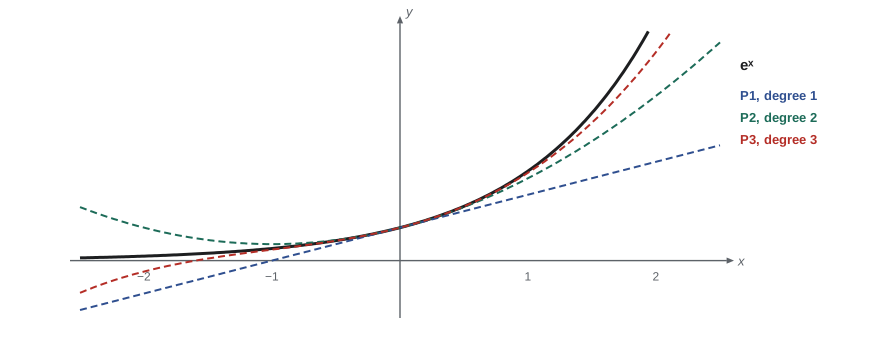
It is the unique polynomial of degree at most \(n\) whose value and first \(n\) derivatives at \(a\) agree with those of \(f\), as differentiating term by term shows. For \(f(x) = e^x\) at \(a = 0\), every derivative is 1 at 0, so \(P_n(x) = \sum_{k=0}^{n} \frac{x^k}{k!}\). For \(\ln(1 + x)\) at 0, \(f^{(k)}(0) = (-1)^{k+1}(k - 1)!\), so \(P_n(x) = x - \frac{x^2}{2} + \frac{x^3}{3} - \dots + (-1)^{n+1}\frac{x^n}{n}\).
The question is how well \(P_n\) approximates \(f\). The remainder is \(R_n(x) = f(x) - P_n(x)\).
Taylor's theorem
Theorem (Taylor, Lagrange remainder). Let \(f\) have \(n + 1\) derivatives on an open interval \(I\) containing \(a\). For every \(x \in I\) there is \(c\) between \(a\) and \(x\) with
\[f(x) = P_n(x) + \frac{f^{(n+1)}(c)}{(n+1)!}(x - a)^{n+1}.\]
Proof. Fix \(x \ne a\) and choose the number \(M\) so that \(f(x) = P_n(x) + M(x - a)^{n+1}\). We must show \(M = \frac{f^{(n+1)}(c)}{(n+1)!}\) for some \(c\). Define \(g(t) = f(t) - P_n(t) - M(t - a)^{n+1}\). Then \(g(x) = 0\) by the choice of \(M\), and \(g^{(k)}(a) = 0\) for \(k = 0, 1, \dots, n\), because \(P_n\) matches the first \(n\) derivatives of \(f\) at \(a\) and \((t - a)^{n+1}\) has all its first \(n\) derivatives zero at \(a\).
Apply Rolle repeatedly. Since \(g(a) = g(x) = 0\), there is \(x_1\) strictly between \(a\) and \(x\) with \(g'(x_1) = 0\). Since \(g'(a) = g'(x_1) = 0\), there is \(x_2\) between \(a\) and \(x_1\) with \(g''(x_2) = 0\). Continuing, we get \(x_{n+1}\) between \(a\) and \(x\) with \(g^{(n+1)}(x_{n+1}) = 0\). But \(P_n^{(n+1)} = 0\), since \(P_n\) has degree at most \(n\), and the \((n + 1)\)-th derivative of \(M(t - a)^{n+1}\) is \((n+1)!\,M\). So \(0 = f^{(n+1)}(c) - (n+1)!\,M\) with \(c = x_{n+1}\). \(\blacksquare\)
For \(n = 0\) this is the mean value theorem. Lagrange stated the remainder in this form in 1797. Brook Taylor had published the series in 1715, without any discussion of convergence; Colin Maclaurin popularized the case \(a = 0\).
Error bounds in practice
Worked problem
Computing e with a guaranteed error
Use Taylor's theorem to show \(\big|e - \sum_{k=0}^{n} \frac{1}{k!}\big| \le \frac{3}{(n+1)!}\), and find \(n\) giving six correct decimal places.
Show solution
- Apply the theorem to \(e^x\) at \(a = 0\), \(x = 1\): \(e = \sum_{k=0}^{n} \frac{1}{k!} + \frac{e^c}{(n+1)!}\) for some \(c \in (0, 1)\).
- Since \(e^c < e < 3\) (lesson 5 bounded \(e\) between 2 and 3), the remainder is positive and less than \(\frac{3}{(n+1)!}\).
- We need \(\frac{3}{(n+1)!} < 5 \times 10^{-7}\), that is \((n+1)! > 6 \times 10^6\). Since \(10! = 3628800\) and \(11! = 39916800\), \(n = 10\) suffices.
Answer: \(\sum_{k=0}^{10} \frac{1}{k!} = 2.7182818\ldots\), within \(10^{-7}\) of \(e\). The remainder bound is explicit, unlike a numerical guess.
Theorem. \(e\) is irrational.
Proof (after Fourier). Suppose \(e = \frac{p}{q}\) with positive integers \(p, q\). Taylor's theorem with \(n = q\) gives \(e = \sum_{k=0}^{q} \frac{1}{k!} + \frac{e^c}{(q+1)!}\) with \(0 < c < 1\). Multiply by \(q!\): the number \(q!\,e - \sum_{k=0}^{q} \frac{q!}{k!}\) is an integer, since \(q!\,e = (q-1)!\,p\) and each \(\frac{q!}{k!}\) is an integer. But it equals \(\frac{e^c}{q + 1}\), which lies strictly between 0 and \(\frac{3}{q+1}\). If \(q \ge 2\) then \(\frac{3}{q+1} \le 1\), and no integer lies strictly between 0 and 1. If \(q = 1\), \(e\) would be an integer, but \(2 < e < 3\). Either way we have a contradiction. \(\blacksquare\)
Worked problem
The alternating harmonic series
Prove that \(1 - \frac{1}{2} + \frac{1}{3} - \dots = \ln 2\).
Show solution
- Let \(f(x) = \ln(1 + x)\). Then \(f^{(n+1)}(x) = \frac{(-1)^n n!}{(1 + x)^{n+1}}\).
- Taylor at \(a = 0\), \(x = 1\): \(\ln 2 = \sum_{k=1}^{n} \frac{(-1)^{k+1}}{k} + R_n\) with \(R_n = \frac{(-1)^n n!}{(1 + c)^{n+1}(n+1)!} = \frac{(-1)^n}{(n+1)(1 + c)^{n+1}}\) for some \(c \in (0, 1)\).
- So \(|R_n| \le \frac{1}{n+1} \to 0\), and the partial sums converge to \(\ln 2\).
Answer: This completes the claim from lesson 6. The error bound \(\frac{1}{n+1}\) agrees with the alternating series estimate and shows how slowly this series converges.
When Taylor series fail
If \(f\) has derivatives of all orders and \(R_n(x) \to 0\), then \(f(x) = \sum_{k=0}^{\infty} \frac{f^{(k)}(a)}{k!}(x - a)^k\). For \(e^x\), \(\sin x\) and \(\cos x\) this holds for every \(x\), since \(\frac{|x|^{n+1}}{(n+1)!} \to 0\). But the remainder need not tend to zero, even for very smooth functions.
Cauchy's example. Let \(f(x) = e^{-1/x^2}\) for \(x \ne 0\) and \(f(0) = 0\). One shows by induction that for \(x \ne 0\), \(f^{(k)}(x) = p_k(\frac{1}{x}) e^{-1/x^2}\) for a polynomial \(p_k\), and that \(f^{(k)}(0) = 0\) for every \(k\), using the fact that \(t^m e^{-t^2} \to 0\) as \(t \to \infty\). So every Taylor polynomial of \(f\) at 0 is identically zero, while \(f(x) > 0\) for \(x \ne 0\). The Taylor series converges everywhere, to the wrong function. Functions equal to their Taylor series near each point are called analytic; this \(f\) is smooth but not analytic at 0. Such functions are indispensable in analysis because they can switch on smoothly, which analytic functions cannot.
The second derivative test
Taylor's theorem with \(n = 1\) gives the second derivative test. If \(f'(a) = 0\) and \(f''\) is continuous with \(f''(a) > 0\), then for \(x\) near \(a\), \(f(x) = f(a) + \frac{f''(c)}{2}(x - a)^2\) with \(c\) between \(a\) and \(x\), and \(f''(c) > 0\) by continuity. So \(f(x) > f(a)\) for \(x \ne a\) near \(a\): a strict local minimum. More generally, if the first non-zero derivative at a critical point has even order, the point is a local extremum; if it has odd order, it is not, as \(x^3\) at 0 shows.
from fractions import Fraction as F
import math

# e from its Taylor polynomials, with the Lagrange bound 3/(n+1)!
s = F(0)
for n in range(0, 13):
    s += F(1, math.factorial(n))
    if n in (2, 4, 6, 8, 10, 12):
        bound = F(3, math.factorial(n + 1))
        print(f"n = {n:2}: P_n(1) = {float(s):.12f}   true error = {math.e - float(s):.2e}   bound = {float(bound):.2e}")

# ln 2 from the alternating harmonic series, with the bound 1/(n+1)
print()
t = F(0)
for n in range(1, 10001):
    t += F((-1) ** (n + 1), n)
    if n in (10, 100, 1000, 10000):
print(f"n = {n:5}: partial sum = {float(t):.8f} true error = {abs(math.log(2) - float(t)):.2e} bound = {1 / (n + 1):.2e}")n = 2: P_n(1) = 2.500000000000 true error = 2.18e-01 bound = 5.00e-01 n = 4: P_n(1) = 2.708333333333 true error = 9.95e-03 bound = 2.50e-02 n = 6: P_n(1) = 2.718055555556 true error = 2.26e-04 bound = 5.95e-04 n = 8: P_n(1) = 2.718278769841 true error = 3.06e-06 bound = 8.27e-06 n = 10: P_n(1) = 2.718281801146 true error = 2.73e-08 bound = 7.52e-08 n = 12: P_n(1) = 2.718281828286 true error = 1.73e-10 bound = 4.82e-10 n = 10: partial sum = 0.64563492 true error = 4.75e-02 bound = 9.09e-02 n = 100: partial sum = 0.68817218 true error = 4.98e-03 bound = 9.90e-03 n = 1000: partial sum = 0.69264743 true error = 5.00e-04 bound = 9.99e-04 n = 10000: partial sum = 0.69309718 true error = 5.00e-05 bound = 1.00e-04
The two series show the two extremes. The error for \(e\) falls factorially and soon reaches the limits of floating-point arithmetic, while the error for \(\ln 2\) falls only like \(\frac{1}{n}\). Faster series for \(\ln 2\) come from applying Taylor's theorem at a point closer to the center, for instance \(\ln 2 = -\ln(1 - \frac{1}{2}) = \sum_{k=1}^{\infty} \frac{1}{k 2^k}\), whose terms fall geometrically.
Taylor expansions instead of L'Hôpital
Repeated use of L'Hôpital's rule can be replaced by Taylor's theorem, which often shows more clearly why a limit has its value. Write \(f(x) = P_n(x) + R_n(x)\) where \(|R_n(x)| \le C|x - a|^{n+1}\) near \(a\), whenever \(f^{(n+1)}\) is bounded there. For example \(\sin x = x - \frac{x^3}{6} + R(x)\) with \(|R(x)| \le \frac{|x|^5}{120}\), so
\[\frac{x - \sin x}{x^3} = \frac{1}{6} - \frac{R(x)}{x^3}, \qquad \Big|\frac{R(x)}{x^3}\Big| \le \frac{x^2}{120} \to 0.\]
The limit is \(\frac{1}{6}\), and the expansion also says how fast the quotient approaches it. Three applications of L'Hôpital's rule reach the same answer with less insight.
The \(\frac{\infty}{\infty}\) form handles limits at infinity such as \(\lim_{x \to \infty} \frac{x^m}{e^x} = 0\) for every \(m\): after \(m\) applications the quotient is \(\frac{m!}{e^x} \to 0\). Taylor's theorem gives a direct proof as well. For \(x > 0\) every term of the Taylor polynomial of \(e^x\) is positive, and the remainder is positive, so \(e^x > \frac{x^{m+1}}{(m+1)!}\). Hence \(0 < \frac{x^m}{e^x} < \frac{(m+1)!}{x} \to 0\). This is the continuous version of the fact, proved with the ratio test in lesson 6, that exponentials grow faster than every polynomial.
Common mistakes
MistakeApplying L'Hôpital's rule to a limit that is not indeterminate.
Instead\(\lim_{x \to 0} \frac{x + 1}{x + 2} = \frac{1}{2}\), but the quotient of derivatives is 1.
MistakeDifferentiating the quotient \(\frac{f}{g}\) instead of \(f\) and \(g\) separately.
InsteadThe rule uses \(\frac{f'}{g'}\), not \(\big(\frac{f}{g}\big)'\).
MistakeConcluding the limit does not exist because \(\frac{f'}{g'}\) has no limit.
InsteadThe rule is only sufficient; \(\frac{x^2\sin(1/x)}{\sin x} \to 0\) anyway.
MistakeAssuming a smooth function equals its Taylor series.
Instead\(e^{-1/x^2}\) has zero Taylor series at 0 but is positive elsewhere.
MistakeTreating the point \(c\) in the remainder as known.
Instead\(c\) depends on \(x\) and \(n\); only bounds on \(f^{(n+1)}\) over the interval are usable.
Summary and key terms
- L'Hôpital: if \(f, g \to 0\) and \(\frac{f'}{g'} \to L\), then \(\frac{f}{g} \to L\); the proof uses Cauchy's mean value theorem.
- The Taylor polynomial \(P_n\) matches \(f\) and its first \(n\) derivatives at \(a\).
- Taylor's theorem: \(f(x) = P_n(x) + \frac{f^{(n+1)}(c)}{(n+1)!}(x - a)^{n+1}\), proved by repeated Rolle.
- Remainder bounds give \(e\) to any accuracy, prove \(e\) irrational, and prove the alternating harmonic series sums to \(\ln 2\).
- Smooth functions need not equal their Taylor series: \(e^{-1/x^2}\) is the standard example.
- The second derivative test is the case n = 1 of Taylor's theorem.
- Indeterminate form
- A limit of type \(\frac{0}{0}\) or \(\frac{\infty}{\infty}\).
- Taylor polynomial
- \(\sum_{k \le n} \frac{f^{(k)}(a)}{k!}(x - a)^k\).
- Lagrange remainder
- \(\frac{f^{(n+1)}(c)}{(n+1)!}(x - a)^{n+1}\).
- Analytic function
- A function equal to its Taylor series near each point.
- Smooth function
- A function with derivatives of every order.
Practice problems
Work each problem on paper first, then reveal the answer to check.
Use L'Hôpital's rule to find \(\lim_{x \to 0} \frac{e^x - 1 - x}{x^2}\).
Show answer
The quotient of derivatives \(\frac{e^x - 1}{2x}\) is again of the form 0/0; its quotient of derivatives \(\frac{e^x}{2} \to \frac{1}{2}\). Applying the rule twice, the limit is \(\frac{1}{2}\).
Write the Taylor polynomial of degree 3 of \(\sin x\) at 0, and bound the error at \(x = 0.1\).
Show answer
\(x - \frac{x^3}{6}\). The next non-zero term is of degree 5, so taking \(n = 4\), the error is at most \(\frac{0.1^5}{5!} \approx 8.3 \times 10^{-8}\).
Prove \(\cos x \ge 1 - \frac{x^2}{2}\) for all \(x\).
Show answer
Taylor with \(n = 1\) at 0: \(\cos x = 1 - \frac{\cos c}{2}x^2\) for some \(c\), and \(\cos c \le 1\), so \(\cos x \ge 1 - \frac{x^2}{2}\).
How many terms of \(\sum \frac{1}{k!}\) are needed for \(e\) to within \(10^{-12}\)?
Show answer
Need \(\frac{3}{(n+1)!} < 10^{-12}\); \(15! \approx 1.3 \times 10^{12}\) is not enough, \(16! \approx 2.1 \times 10^{13}\) is, so \(n = 15\).
Show that \(f(x) = x^4\) has a minimum at 0 although \(f''(0) = 0\).
Show answer
The first non-zero derivative at 0 is \(f^{(4)}(0) = 24 > 0\), of even order; or directly \(x^4 \ge 0\).
Lesson quiz · 5 questions
Score 60% or more to complete this lesson.
Create a free account to save your progress, take quizzes and earn a certificate.