
LVT-310 · Lesson 2 of 12 · 21 min
Sound: frequency, level and decibels
Wendell starts Maya's AV term the way he starts every apprentice: with a sound level meter and a walk through the Hartwell warehouse at shift change. Forklifts beep, a conveyor rattles, a compressor cycles, a radio plays in the shipping office. The meter reads 82 dB here, 76 dB there, 88 dB beside the baler. "Every page we put in this building has to beat that," he says, "and every page in Riverside's library has to not frighten anyone. You can't design or tune either one until you can think in decibels." This lesson covers what sound is, frequency and the range of human hearing, sound pressure level and the decibel scale, adding sound levels, how level falls with distance, loudspeaker sensitivity and power, and how background noise sets the level a system must reach.
What sound is
Sound is a pressure wave traveling through air. A loudspeaker cone, a vibrating vocal cord or a slammed door pushes the air molecules next to it, which push the ones next to them, and a small ripple of pressure moves outward at about 1,125 ft/s at room temperature. The air itself does not travel; the pressure change does. The ear senses these pressure changes and the brain hears them as sound. Two properties describe a simple sound: how often the pressure swings back and forth each second, which is its frequency, and how large the swings are, which sets its level.
Real sounds, such as speech or music, contain many frequencies at once, at different levels, changing all the time. A sound system's job is to reproduce that mixture faithfully, or, for paging, to reproduce the parts that matter for understanding speech, at a level the listeners can hear over the noise around them.
Frequency and wavelength
Frequency is measured in hertz, Hz, cycles per second. Young, healthy ears hear from about 20 Hz, a deep rumble, to about 20,000 Hz, or 20 kHz, a high whistle; the upper limit falls with age and noise exposure. Speech sits mostly between about 100 Hz and 8 kHz, and the consonants that carry most of its meaning, the s, t, f and k sounds, are in the 2 kHz to 4 kHz range. That is why a paging system with weak high frequencies sounds muffled and is hard to understand, even when it is loud.
Each frequency has a wavelength, the distance one cycle occupies in the air, found by dividing the speed of sound by the frequency. A 100 Hz sound has a wavelength of about 11 ft; a 1 kHz sound about 13.5 in; a 10 kHz sound about 1.35 in. Wavelength explains much of how sound behaves in rooms. Low frequencies, with long wavelengths, bend around obstacles and spread in all directions from a loudspeaker. High frequencies, with short wavelengths, travel in narrower beams and are blocked by heads, shelving and columns. A ceiling speaker that sounds clear directly below it can sound dull off to the side, because its high frequencies do not spread as widely.
Audio engineers often group frequencies into octaves, where each band is twice the frequency of the one below: 125, 250, 500, 1,000, 2,000, 4,000 and 8,000 Hz are the standard octave band centers. Measurements of noise, reverberation and speaker response are often given per octave band, and lesson 11 uses them to tune a system.
Sound pressure level and the decibel
The pressure changes the ear can sense cover an enormous range: the loudest sound that does not cause pain has about a million times the pressure of the quietest sound that can be heard. Writing such numbers directly would be clumsy, so sound level is expressed on a logarithmic scale, in decibels, dB. Sound pressure level, SPL, compares a pressure to a reference pressure of 20 micropascals, about the threshold of hearing, and is twenty times the base-ten logarithm of the ratio.
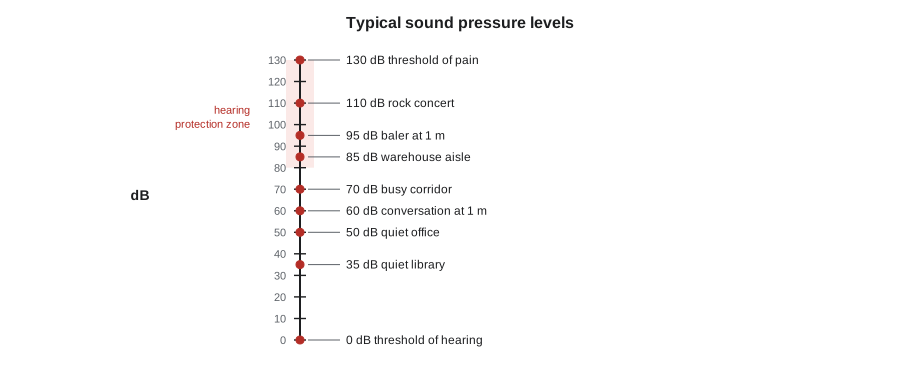
On that scale, the threshold of hearing is 0 dB, a quiet library about 35 dB, normal conversation at one meter about 60 dB, a busy warehouse 80 to 90 dB, and the threshold of pain about 120 to 130 dB. A few relationships are worth memorizing. A change of 1 dB is about the smallest a listener notices in a direct comparison. A change of 3 dB is clearly noticeable and is a doubling of acoustic power. A change of 6 dB is a doubling of sound pressure. A change of about 10 dB is heard as roughly twice as loud.
Sound level meters usually apply a weighting that matches the ear's lower sensitivity to low and very high frequencies. A-weighting, written dBA, is used for noise and for most speech system targets. C-weighting is flatter and is used where low-frequency content matters, such as music systems. Measurements can also be fast, slow or averaged over time; an equivalent continuous level, Leq, averages a changing noise into one number. When a specification says a page must be 15 dB above the ambient, check which weighting and averaging it uses.
Adding sound levels
Because decibels are logarithmic, they do not add like ordinary numbers. Two equal sources do not make twice the decibels; they make 3 dB more. Two machines each producing 80 dB at a point give 83 dB together, not 160. To add levels correctly, convert each to a power ratio, add the ratios, and convert back. A quick rule helps in the field: if two levels are equal, add 3 dB; if they differ by 3 dB, add about 2 dB to the higher; if they differ by 6 dB, add about 1 dB; if they differ by 10 dB or more, the quieter one hardly matters.
# Add sound levels from several sources at one point, and remove a source
import math
def add(levels):
    return 10 * math.log10(sum(10 ** (L / 10) for L in levels))
def remove(total, part):
    return 10 * math.log10(10 ** (total / 10) - 10 ** (part / 10))
print(f"Two equal 80 dB sources:         {add([80, 80]):5.1f} dB")
print(f"80 and 74 dB:                    {add([80, 74]):5.1f} dB")
print(f"80 and 70 dB:                    {add([80, 70]):5.1f} dB")
warehouse = [82, 79, 76, 71]          # conveyor, forklift alarm, compressor, radio at one aisle
total = add(warehouse)
print(f"Hartwell aisle 4, all sources:   {total:5.1f} dB")
print(f"Same aisle with the conveyor off: {remove(total, 82):5.1f} dB")Two equal 80 dB sources: 83.0 dB 80 and 74 dB: 81.0 dB 80 and 70 dB: 80.4 dB Hartwell aisle 4, all sources: 84.6 dB Same aisle with the conveyor off: 81.2 dB
The result explains a common surprise. Switching off the radio in the shipping office, the quietest source, changes the aisle level by a fraction of a decibel. Switching off the conveyor, the loudest, drops it by almost 4 dB. Noise control, and the choice of paging level, is driven by the loudest sources.
How level falls with distance
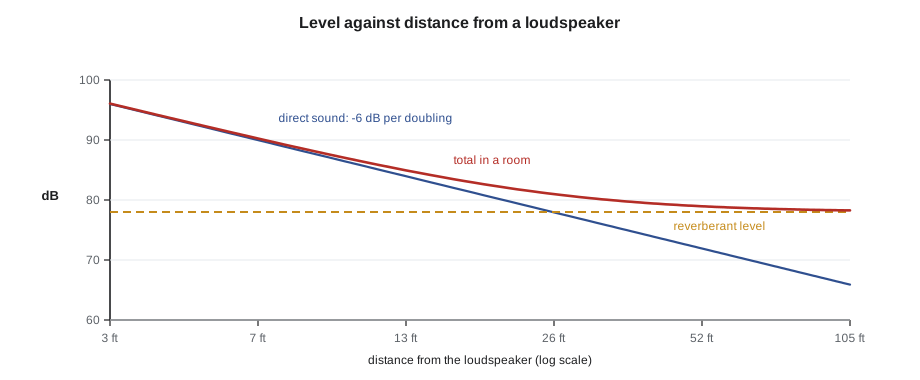
Sound spreading from a small source in open space covers a sphere that grows with distance, so the same power is spread over more area. The result is the inverse square law: the level falls by about 6 dB each time the distance doubles. A loudspeaker producing 90 dB at 3 ft gives about 84 dB at 6 ft, 78 dB at 12 ft and 72 dB at 24 ft. Indoors the fall is slower, because reflections from walls, floor and ceiling add to the direct sound; in a reverberant gym, the level far from a loudspeaker stops falling and levels off at the reverberant level. Lesson 4 returns to that when it covers coverage, and lesson 12 when it covers the gym.
Long lines of sources, such as a row of ceiling speakers along a corridor or a busy road, behave differently: close to the line, sound spreads as a cylinder and falls by only about 3 dB per doubling of distance. That is one reason distributed ceiling speakers give even coverage: a listener is always fairly close to one of them.
Loudspeaker sensitivity and power
A loudspeaker's data sheet gives its sensitivity: the SPL it produces on its axis, at 1 m, with 1 watt of input. Sensitivities for ceiling speakers are typically 86 to 92 dB; for paging horns, 100 dB or more. Because power doubles every 3 dB, the SPL with more power is the sensitivity plus ten times the logarithm of the power in watts. A speaker of 89 dB sensitivity fed 4 W produces about 95 dB at 1 m; at 16 W, about 101 dB. Combining that with the inverse square law gives the level at a listener.
Here S is the sensitivity in dB at 1 W and 1 m, P the power in watts and d the distance in meters. Data sheets in the United States usually still state sensitivity at 1 W and 1 m, so US designers often convert listener distances from feet to meters for this calculation. The speaker's maximum rated power, and the amplifier's, set the upper limit; driving a speaker beyond its rating distorts the sound and can damage it.
# Level at a listener from loudspeaker sensitivity, power and distance
import math
def spl(sens_db, watts, dist_m):
    return sens_db + 10 * math.log10(watts) - 20 * math.log10(dist_m)
FT = 0.3048   # meters per display unit (1.0 for meters, 0.3048 for feet)
cases = [  # name, sensitivity dB at 1 W 1 m, watts, distance in ft
    ("Classroom ceiling speaker, ear height below", 89, 1, 6.0),
    ("Corridor wall speaker, far end of zone",     91, 2, 20.0),
    ("Warehouse horn at aisle center",            104, 15, 40.0),
    ("Warehouse horn at the far rack",            104, 15, 80.0),
]
for name, s, w, d in cases:
print(f"{name:44s} {s} dB, {w:2d} W, {d:4.1f} ft -> {spl(s, w, d * FT):5.1f} dB")Classroom ceiling speaker, ear height below 89 dB, 1 W, 6.0 ft -> 83.8 dB Corridor wall speaker, far end of zone 91 dB, 2 W, 20.0 ft -> 78.3 dB Warehouse horn at aisle center 104 dB, 15 W, 40.0 ft -> 94.0 dB Warehouse horn at the far rack 104 dB, 15 W, 80.0 ft -> 88.0 dB
A classroom speaker at 1 W already gives about 84 dB at ear height, far more than a quiet room needs; it will normally run at a fraction of a watt. The warehouse horn delivers around 94 dB at the aisle center but only about 88 dB at the far rack, which is barely above the noise there. That is why Hartwell's design uses many horns spaced along the aisles rather than a few very powerful ones.
Background noise and the level a system must reach
A page or announcement must be louder than the background noise to be understood. Speech systems are usually designed for a speech level about 10 to 15 dB above the ambient noise, measured the same way, and not more than about 90 dBA or so, beyond which speech becomes uncomfortable and distorts in the ear. In a quiet classroom with 40 dBA background, a page at 55 to 65 dBA is plenty. In a warehouse at 85 dBA, the same rule would ask for 95 to 100 dBA, which is painful and still hard to understand; in very loud areas the design adds visual signals, such as flashing beacons, or relies on pages being short and repeated.
Background noise is measured at the start of a project, at representative places and times, ideally in octave bands. Wendell's warehouse walk is exactly that survey: the readings at each aisle, at shift change and at full production, set the target for each paging zone. Noise also varies: a school corridor is quiet during class and loud between bells, which is why some systems adjust their volume automatically with ambient noise sensors, a feature lesson 5 covers.
# Paging level needed in each zone: ambient plus margin, capped for comfort
ZONES = [  # zone, measured ambient dBA
    ("Hartwell office", 52), ("Hartwell shipping", 74), ("Hartwell aisles", 84), ("Hartwell baler", 92),
    ("Riverside classroom", 42), ("Riverside corridor (bell change)", 68), ("Riverside gym (game)", 80),
]
MARGIN, CAP = 12, 95
for zone, amb in ZONES:
    target = amb + MARGIN
    note = ""
    if target > CAP:
        note = "  -> capped; add beacons or local signals"
        target = CAP
print(f"{zone:34s} ambient {amb} dBA, target {target} dBA{note}")Hartwell office ambient 52 dBA, target 64 dBA Hartwell shipping ambient 74 dBA, target 86 dBA Hartwell aisles ambient 84 dBA, target 95 dBA -> capped; add beacons or local signals Hartwell baler ambient 92 dBA, target 95 dBA -> capped; add beacons or local signals Riverside classroom ambient 42 dBA, target 54 dBA Riverside corridor (bell change) ambient 68 dBA, target 80 dBA Riverside gym (game) ambient 80 dBA, target 92 dBA
Worked problem
A page nobody understands
At Hartwell, pickers in aisle 9 complain that they hear the page tone but cannot make out names. The horn at the aisle entrance is set to its 7.5 W tap. Wendell measures 84 dBA ambient at mid-aisle and 86 dBA during the page at the same spot. The horn's sensitivity is 104 dB at 1 W and 1 m, and mid-aisle is 50 ft from it. What is wrong and what would Maya suggest?
Show solution
- A page only 2 dB above the noise is far too little; the design target is about 12 dB above ambient.
- Predicted level at mid-aisle from the horn: 104 + 10 log 7.5 − 20 log 15.2, with the distance in meters, ≈ 104 + 8.8 − 23.6 ≈ 89 dB on axis; measured with the aisle's reflections and absorbers, 86 dBA.
- Raising the tap to 15 W adds only 3 dB, still far short.
- A second horn at the far end of the aisle, facing back toward the first, halves the worst distance and roughly adds 6 dB where the two cover; together with the 15 W tap, mid-aisle reaches about 95 dBA.
Answer: Maya proposes a second horn at the far end of aisle 9 and the 15 W tap on both, which reaches about 95 dBA at mid-aisle, around 11 dB over the noise; the designer agrees and adds a beacon at the baler, where no reasonable page level beats 92 dBA.
Common mistakes
MistakeAdding decibels like ordinary numbers.
InsteadConvert to power, add, and convert back; two equal sources add 3 dB.
MistakeExpecting doubling the amplifier power to double loudness.
InsteadDoubling power adds only 3 dB; about 10 dB is heard as twice as loud.
MistakeTurning up a paging system to beat very loud noise.
InsteadAbove about 90 to 95 dBA add speakers closer to listeners, beacons or local signals.
MistakeComparing readings taken with different weightings.
InsteadState dBA, dBC, fast, slow or Leq with every reading.
MistakeMeasuring noise once at a quiet time.
InsteadSurvey at representative places and times, including the noisiest.
Summary and key terms
- Sound is a pressure wave; frequency sets pitch and pressure sets level.
- People hear about 20 Hz to 20 kHz; speech consonants in the 2 to 4 kHz range carry intelligibility.
- Wavelength explains why low frequencies spread and high frequencies beam.
- SPL in dB is 20 log of pressure over 20 micropascals; 3 dB doubles power, 6 dB doubles pressure, 10 dB sounds twice as loud.
- Levels add on a power basis; the loudest sources dominate.
- Direct sound falls about 6 dB per doubling of distance; reflections set a floor indoors.
- Listener level is sensitivity plus 10 log power minus 20 log distance.
- Speech systems aim for about 10 to 15 dB above ambient, within a comfortable maximum.
- Frequency
- The number of pressure cycles per second, in hertz.
- Wavelength
- The length of one cycle of a sound wave in air.
- SPL
- Sound pressure level, in decibels relative to 20 micropascals.
- dBA
- Sound level with A-weighting, which follows the ear's sensitivity.
- Inverse square law
- The fall of about 6 dB in direct sound for each doubling of distance.
- Sensitivity
- A loudspeaker's SPL at 1 meter with 1 watt of input.
- Ambient noise
- The background noise in a space without the system running.
Practice problems
Work each problem on paper first, then reveal the answer to check.
Two sources each give 76 dB at a point. What is the total?
Show answer
About 79 dB.
A speaker gives 92 dB at 3 ft. About what level does it give at 12 ft in open space?
Show answer
About 80 dB, 12 dB lower.
A ceiling speaker has 88 dB sensitivity. What does it give at 1 m with 2 W?
Show answer
About 91 dB.
A corridor's ambient is 66 dBA. What paging level would you aim for?
Show answer
About 76 to 81 dBA.
Lesson quiz · 5 questions
Score 60% or more to complete this lesson.
Create a free account to save your progress, take quizzes and earn a certificate.