
LVT-120 · Lesson 10 of 12 · 21 min
Labeling and documentation (TIA-606)
A cabling system that cannot be identified cannot be managed. Every cable in a building looks like every other cable of its type, and without labels and records nobody can tell which port in the telecommunications room serves which desk, which fiber strands are spare or which cable can be removed. ANSI/TIA-606, the administration standard, now in its D revision of 2021, sets out how to identify every element of the infrastructure, how to label it and what records to keep. Cobalt Line treats administration as part of the installation, not as paperwork after it: no link is complete until it is labeled at both ends, tested and entered in the records.
What is administered
TIA-606 covers far more than horizontal cables. It assigns identifiers to the spaces of the system, such as telecommunications rooms and equipment rooms; to racks and cabinets; to patch panels and their ports; to horizontal links; to backbone cables and their individual pairs or strands; to pathways such as conduits and sleeves; to firestopping locations; and to the bonding and grounding system's busbars and conductors. Each identifier is unique within its scope, and each is linked in the records to the things it connects. The cable from panel A, port 12 in room 2B to the outlet in classroom 214 is one record, holding its identifier, both ends, its category, its route and its test result.
Classes of administration
The standard scales administration to the size of the system with four classes.
- Class 1 serves a single telecommunications space that serves the whole building, such as a small office with one room. Identifiers are needed for the space, the horizontal links and the bonding busbar.
- Class 2 serves one building with several telecommunications spaces. It adds identifiers for backbone cables, their pairs and strands, the bonding system and firestopping.
- Class 3 serves a campus of several buildings, adding building identifiers and campus backbone cables.
- Class 4 serves several sites, such as an owner with campuses in several cities, adding site identifiers.
Riverside school, with three telecommunications rooms and a separate gymnasium building, is a Class 3 system. The Kellerman Building's ninth-floor tenant space, with its own small room, is Class 1 within the tenant's scope, but it must fit into the building owner's Class 2 records for the building's backbone and risers.
The identifier format
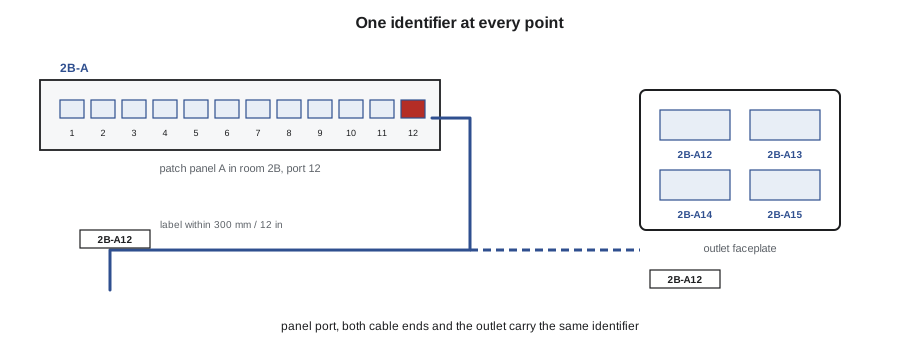
TIA-606 builds identifiers from short codes for each level, joined by separators. Within a building, a telecommunications space is identified by the floor number and a letter for the space: 2B is the second space on floor 2. Patch panels in the space get letters, and ports get two-digit numbers. A horizontal link takes its identifier from the panel port where it terminates in the telecommunications room, written in the form fs-an: floor and space, a hyphen, the panel letter and the port number. Link 2B-A12 terminates on port 12 of panel A in room 2B, and the outlet at the other end carries the same identifier.
Backbone cables are identified by the two spaces they connect and a sequence number, written with a slash: 1A/2B-1 is the first backbone cable between room 1A and room 2B. Individual pairs or strands add a number after a dot: 1A/2B-1.07 is strand 7 of that cable. In Class 3 and 4 systems, a building or site code is added in front, such as RSS for Riverside's main building and GYM for the gymnasium, so that the campus cable RSS-1A/GYM-1A-1 runs from the main building's room 1A to the gymnasium's room. Other elements follow the same logic, with their own letters: a rack identified by its floor-grid location in the room, a bonding busbar as the primary or secondary bonding busbar of its space, a firestop location by its space and number.
| Element | Example identifier | Meaning |
|---|---|---|
| Telecommunications space | 2B | Floor 2, space B |
| Patch panel port | 2B-A12 | Room 2B, panel A, port 12 |
| Horizontal link | 2B-A12 | The link ending at that port, and its outlet |
| Backbone cable | 1A/2B-1 | First backbone cable between rooms 1A and 2B |
| Backbone strand | 1A/2B-1.07 | Strand 7 of that cable |
| Campus backbone cable | RSS-1A/GYM-1A-1 | Main building room 1A to the gymnasium's room 1A |
| Firestop location | 2B-FS03 | Third firestopped penetration of room 2B (owner format) |
Owners often adapt the format. A university may use its own building numbers, a hospital its own room numbers instead of the floor-and-letter scheme, and a school board may require the room number of the outlet on the faceplate as well. Where the owner's standard differs from TIA-606, the owner's standard governs, but Sanjay always checks that it still makes every identifier unique and still lets a technician find both ends of a link from either end.
# Generate and check horizontal link identifiers in the fs-an format
import re
PATTERN = re.compile(r"(?P<floor>\d{1,2})(?P<space>[A-Z])-(?P<panel>[A-Z]{1,2})(?P<port>\d{2})")

def make_ids(floor, space, panel, first, count):
    return [f"{floor}{space}-{panel}{port:02d}" for port in range(first, first + count)]

ids = make_ids(2, "B", "A", 13, 4)
print("outlet faceplate in classroom 214:", ", ".join(ids))
for tag in ids + ["2b-A7", "2B-A100", "12C-AB04"]:
    m = PATTERN.fullmatch(tag)
    if m:
        print(f"{tag:9} ok: floor {m['floor']}, space {m['space']}, panel {m['panel']}, port {int(m['port'])}")
    else:
print(f"{tag:9} not a valid fs-an identifier")outlet faceplate in classroom 214: 2B-A13, 2B-A14, 2B-A15, 2B-A16 2B-A13 ok: floor 2, space B, panel A, port 13 2B-A14 ok: floor 2, space B, panel A, port 14 2B-A15 ok: floor 2, space B, panel A, port 15 2B-A16 ok: floor 2, space B, panel A, port 16 2b-A7 not a valid fs-an identifier 2B-A100 not a valid fs-an identifier 12C-AB04 ok: floor 12, space C, panel AB, port 4
Generating labels from the design, rather than typing them on site, is what keeps a large job consistent. Sanjay's design database produces the label files for the label printers, the panel elevations and the outlet schedule from the same list, so the identifier on a faceplate, a panel and a test result can never disagree unless someone types one by hand.
Labels
TIA-606 requires labels to be durable, legible and machine-printed. Handwritten labels fade, smear and are misread. Each horizontal cable is labeled at both ends, within about 12 in of its termination, with wrap-around self-laminating labels whose clear tail covers the printing; each panel port and each outlet jack or faceplate is labeled with the same identifier. Backbone cables are labeled at each end and, in long risers, where they pass through each floor. Labels must suit their environment: outdoor and high-temperature labels are made of different materials, and labels on pathways and firestops must be visible without opening anything.
Many systems also use color to identify the function of termination fields in a cross-connect. TIA-606 assigns colors to fields by long convention: orange for the demarcation point, green for the customer side of network connections, purple for common equipment such as switches and telephone systems, white for first-level backbone, gray for second-level backbone, blue for horizontal cabling, brown for interbuilding backbone, yellow for auxiliary and alarm circuits and red for key telephone systems. The colors appear on the label strips of the termination fields, not necessarily on the cable jackets, which owners color for their own purposes. Riverside's board standard, for example, uses blue jackets for data and white for the security network, while its termination field labels follow TIA-606.
Records
Labels identify things; records connect them. TIA-606 calls for records that, for each element, hold its identifier, its type, its location and the identifiers of everything it connects to. For a horizontal link, the record holds the panel port, the outlet location, the cable type and category, the length and the test result. For a backbone cable, it holds both ends, the cable type and count, and the status of each strand or pair: in use, spare or damaged. For pathways, it holds the route and fill.
On small systems, records may be a spreadsheet and a set of marked-up drawings. On large ones, they are kept in cable management software that links the records to floor plans and rack elevations and updates them as changes are made. Either way, the deliverables at the end of a Cobalt Line job are the same: as-built drawings showing every outlet with its identifier and every pathway; rack and panel elevations; the cable records; and the test reports for every link. Many owners also require the records in a particular file format so that they can be imported into their own systems.
Records are only valuable if they are kept current. Every move, add and change must update them, and an owner who lets the records drift for a few years ends up with a system that is again unidentifiable. Cobalt Line's service technicians close a change order only after the records are updated, and Dev reminds Maya that the record update is part of the work, not something to do later.
Worked problem
A labeling problem at St. Brendan's
During the east wing renovation, Maya is asked to connect a new nurse call station to the existing outlet in room 3112. The faceplate reads 3-117, handwritten. In telecommunications room 3A, the panels are labeled 3A-A to 3A-F, and no port carries 3-117. The as-built drawings from the original installation show outlet 3112-1. How should she proceed?
Show solution
- She does not guess. A wrong patch on a hospital network could disconnect a clinical device.
- She uses a tone generator and probe, or the cable tester's identification function, to trace the outlet's cable to its panel port: it ends at 3A-C17.
- She reports the discrepancy to Dev, who raises it with the hospital's network group, which manages the records.
- The hospital approves relabeling the outlet with a machine-printed 3A-C17 label, and Maya updates the record to link 3A-C17, room 3112 and the new nurse call station.
Answer: The outlet was traced, not guessed, and the label and record were corrected through the owner before the connection was made.
Administration during construction
On a large job, administration starts on the first day, not the last. Cobalt Line's crews receive their labels printed in batches by area, with a marked-up drawing showing each outlet and its identifier. As cables are pulled, each is labeled at both ends before it is dressed into the tray or the rack, because an unlabeled cable in a bundle of two hundred is almost impossible to identify later without a tester. As outlets are terminated and tested, the foreman marks them complete on the drawing, and the test results are uploaded daily so that failures are found while the crew is still in the area.
Changes during construction are recorded as they happen. When a tenant moves an outlet or adds one, the change is given an identifier from the design list, the label is printed from the same source and the change is marked on the drawings that will become the as-builts. A field change that bypasses the list, with a handwritten label, is exactly how records drift from the building, and Colette's project closeout checks for it.
Pathway and firestop administration often gets less attention than cable records, and it matters as much. A firestop identifier, placed on a label beside each sealed penetration, lets an inspector find the record of the listed system used, the installer and the date. A conduit or sleeve identifier tells the next contractor where a pathway goes and how full it is. The bonding busbar in each room, covered in LVT-330, is identified and recorded too, with each bonding conductor labeled at both ends so that a missing or loose conductor can be traced.
At handover, the owner receives everything needed to keep the system identifiable: the records in the required format, the label files so that replacement labels can be printed in the same style, the as-built drawings and the test reports. Dev's test of a good handover is the one from Lesson 1: a stranger, five years later, should be able to find both ends of any link from the records alone.
Maya keeps one more habit from Dev: when she finds a label that is wrong, damaged or missing on any job, even one outside her own work, she reports it rather than ignoring it. A record system is only as reliable as its least reliable label.
Common mistakes
MistakeHandwriting labels on site.
InsteadPrint labels from the design database with a label printer.
MistakeLabeling only one end of a cable.
InsteadLabel both ends, within about 12 in of each termination, plus the port and the outlet.
MistakeInventing a label format on the job.
InsteadUse TIA-606 or the owner's standard, as the specification requires.
MistakePatching an unidentified outlet by guesswork.
InsteadTrace it, report the discrepancy and correct the record first.
MistakeLeaving record updates for later.
InsteadUpdate records as part of every change.
Summary and key terms
- TIA-606-D, the administration standard, covers identifiers, labels and records for every element of the infrastructure.
- Four classes scale administration from a single room (Class 1) to multiple sites (Class 4).
- Horizontal links are identified fs-an, such as 2B-A12; backbone cables join the two spaces with a slash, such as 1A/2B-1.
- Labels are machine-printed and durable, on both cable ends, the port and the outlet.
- Termination field colors follow TIA-606: orange demarcation, green network, purple equipment, white and gray backbone, blue horizontal, brown interbuilding.
- Records link every identifier to its connections and test results and must be updated with every change.
- Administration
- The identification, labeling and record keeping of a telecommunications infrastructure.
- Identifier
- A unique code assigned to an element of the infrastructure.
- fs-an
- The TIA-606 format for a horizontal link: floor and space, then panel letter and port number.
- Class of administration
- One of four TIA-606 levels of record keeping, set by the size of the system.
- Self-laminating label
- A wrap-around label with a clear tail that covers and protects the printing.
- Termination field
- A group of terminations of the same function in a cross-connect, identified by color.
- As-built drawings
- Drawings updated to show the system as actually installed.
Practice problems
Work each problem on paper first, then reveal the answer to check.
What does the identifier 3A-C17 mean?
Show answer
Floor 3, space A, patch panel C, port 17.
Write the identifier for strand 4 of the second backbone cable between rooms 1A and 3A.
Show answer
1A/3A-2.04.
What class of administration applies to a campus of several buildings?
Show answer
Class 3.
What color identifies the horizontal cabling termination field?
Show answer
Blue.
Name four deliverables in a typical set of cabling records.
Show answer
As-built drawings with outlet identifiers, rack and panel elevations, cable records and test reports.
Lesson quiz · 5 questions
Score 60% or more to complete this lesson.
Create a free account to save your progress, take quizzes and earn a certificate.