
LVT-120 · Lesson 1 of 12 · 22 min
Why structured cabling
Every network, telephone, wireless access point, camera, card reader and building controller in a modern building is connected by cable, and most of that cable is installed long before the owner knows exactly what equipment will be plugged into it. Structured cabling is the discipline that makes this possible. It is a way of designing and installing cable as a permanent, standardized part of the building, organized in a known pattern, built from interchangeable parts and tested to a defined performance, so that it will carry many generations of equipment that have not yet been designed. This course is about that discipline. It follows Maya Okonkwo, now in her second term as an apprentice at Cobalt Line Systems, as she moves from pulling and dressing cable to understanding why every cable is where it is.
This first lesson explains what structured cabling is, how it came to exist, who writes its rules and how those rules reach a job site. The rest of the course builds the model piece by piece: the spaces cabling connects, the backbone and horizontal subsystems, the cable categories and their performance, connectors and outlets, optical fiber, pathways, labeling and documentation, and finally the design rules that turn a floor plan into a cable count. The installation, termination and testing of copper cable are the subject of LVT-130, optical fiber installation of LVT-210, and bonding, grounding and the code rules of LVT-330.
Before standards: cabling by vendor
Until the late 1980s, a building's cabling was usually installed by whoever sold the equipment. The telephone company ran its own multipair copper to every desk for voice. A mainframe or minicomputer vendor ran its own cable, often coaxial or twinaxial, to each terminal. Early local area networks used thick or thin coaxial cable in a bus, with each computer tapped onto a shared cable. Each system had its own connectors, its own distance limits and its own installers, and none of it could be reused when the equipment changed. Moving an employee to a different desk could mean a new cable from the computer room, and replacing a computer system often meant abandoning thousands of meters of cable in the ceiling.
Two changes made a better approach possible. Networking moved from coaxial cable to twisted pair, the same kind of cable the telephone industry had used for a century, and a star topology replaced the shared bus. Once data and voice could both run on twisted pair in a star from a central room, one cabling system could serve both, and it could be designed once, independent of any vendor. The first North American standard for this, EIA/TIA-568, was published in 1991. Its successors, now ANSI/TIA-568 in its E revision, and the international equivalent, ISO/IEC 11801, are the foundation of this course.
What makes cabling structured
The word structured describes five properties that distinguish a standards-based cabling system from a collection of cables.
- A defined topology. Cabling follows a hierarchical star: every outlet is cabled back to a telecommunications room, every telecommunications room is cabled back to an equipment room or main cross-connect, and buildings on a campus are cabled back to a central point. There are no taps, daisy chains or rings in the permanent cable.
- Generic, application-independent design. The cabling is designed to a performance class, not to one network. A Category 6A link built today will carry 10 gigabit Ethernet, Power over Ethernet, a voice-over-IP telephone, a wireless access point or a building automation controller, and whatever later application is designed for that performance.
- Standard components. Cable, jacks, patch panels and cords from different manufacturers are built to the same performance specifications and the same connector interface, so they work together and can be replaced individually.
- Defined limits. Lengths, bend radii, pulling tensions, separation from power and the number of connections in a channel are all specified, so that a link built within the rules will perform as its category promises.
- Administration. Every cable, panel, port, pathway and space has an identifier, a label and a record. Structured cabling is maintained by its records as much as by its hardware.
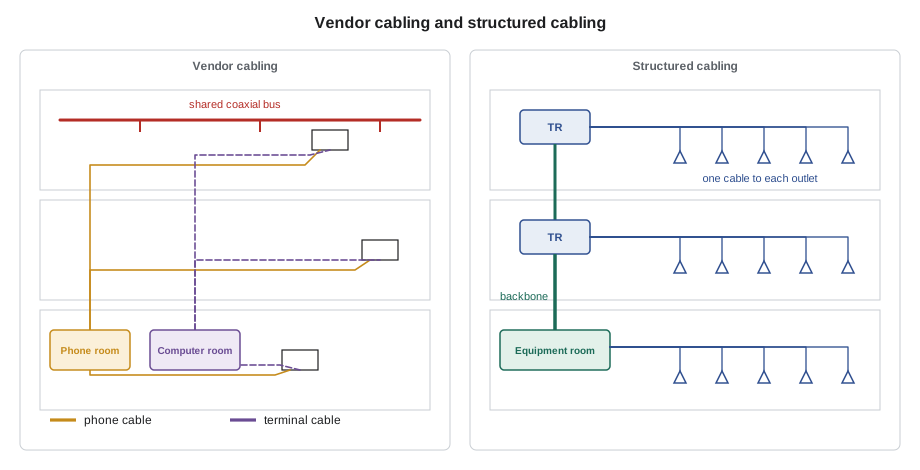
Because the cabling is generic, the active equipment, the switches, telephone systems and controllers, can be replaced on its own schedule. A typical cabling system is designed to last fifteen to twenty years or more, through three or four generations of network equipment. That difference in lifespan is the economic argument for structured cabling: cable is cheap to install while the ceilings are open and expensive to replace once a building is occupied.
Moves, adds and changes
The day-to-day value of structured cabling shows up in what the industry calls moves, adds and changes, abbreviated MACs. When an employee moves, a new device is added or a desk is reassigned, a well-designed system needs only a patch cord change in the telecommunications room and perhaps a new equipment cord at the desk. Nobody enters the ceiling and no new cable is pulled. In an office with frequent reorganization, the cost of MACs over the life of the building can exceed the cost of the original installation, and the design choices that reduce them, such as enough outlets in each work area, spare capacity in the backbone and accurate records, pay for themselves many times over.
Dev puts it to Maya in practical terms during her first week on the Kellerman Building job: the tenant on the ninth floor will rearrange its desks every few years, but the cable they installed will still be in the ceiling when the building's next tenant arrives. If the cable is good, documented and in a standard pattern, the next contractor can reuse it. If it is not, the next contractor will pull it out and start again, and the owner will pay twice.
# Fifteen-year cost of cabling: point-to-point vs structured (illustrative)
years = 15
outlets = 240
moves_per_year = 0.25 * outlets        # a quarter of the outlets change each year

# Point-to-point: each change needs a new cable pulled to the desk
p2p_install = outlets * 230
p2p_change = 380                      # pull, terminate, test one new cable
# Structured: more outlets and panels up front, changes are patching only
str_install = outlets * 300
str_change = 40                      # patch cord change and record update

p2p_total = p2p_install + years * moves_per_year * p2p_change
str_total = str_install + years * moves_per_year * str_change
print(f"changes over {years} years: {years * moves_per_year:.0f}")
print(f"point-to-point: install {p2p_install:,.0f}, total {p2p_total:,.0f} USD")
print(f"structured:     install {str_install:,.0f}, total {str_total:,.0f} USD")
print(f"structured saves {p2p_total - str_total:,.0f} USD ({100 * (1 - str_total / p2p_total):.0f} %)")changes over 15 years: 900 point-to-point: install 55,200, total 397,200 USD structured: install 72,000, total 108,000 USD structured saves 289,200 USD (73 %)
The figures are illustrative, but the pattern is real: the structured system costs more to install because it has more outlets, patch panels and testing, and it costs far less to live with. The calculation also leaves out what is hardest to price, the disruption of working in an occupied office and the risk of damaging other cables each time a new one is pulled through an existing ceiling.
Who writes the rules
Structured cabling is governed by standards written by industry committees, not by government. In North America the main body is the Telecommunications Industry Association, whose engineering committee TR-42 writes the ANSI/TIA cabling standards. Internationally, the joint ISO and IEC technical committee writes ISO/IEC 11801 and its related documents, and in Europe CENELEC publishes the EN 50173 series. The three families are closely aligned: the categories, classes and limits differ in names and details, but a link built to one will usually meet the others. Canadian projects normally specify the ANSI/TIA standards directly. CSA Group adopted earlier editions as the CSA T568 series, but most current Canadian specifications name the TIA documents.
The other key organization is BICSI, a professional association for the information and communications technology industry. BICSI does not write the TIA standards, though many of its members sit on the committees. It publishes design and installation manuals, the best known being the Telecommunications Distribution Methods Manual, whose 15th edition appeared in January 2024, and it runs the credentials of the trade: Installer 1, Installer 2 Copper and Optical Fiber, Technician, and the Registered Communications Distribution Designer, or RCDD. Sanjay Iyer, Cobalt Line's designer, holds the RCDD, and the drawings Maya works from carry his stamp.
| Standard | Subject | Covered in |
|---|---|---|
| ANSI/TIA-568.0 | Generic cabling for customer premises: topology, general requirements | Lessons 2 and 11 |
| ANSI/TIA-568.1 | Commercial building cabling: the subsystems and their limits | Lessons 2 to 5 |
| ANSI/TIA-568.2 | Balanced twisted-pair components and performance | Lessons 6 and 7 |
| ANSI/TIA-568.3 | Optical fiber components and loss budgets | Lesson 8 |
| ANSI/TIA-569 | Pathways and spaces | Lessons 3 and 9 |
| ANSI/TIA-606 | Administration: identifiers, labels, records | Lesson 10 |
| ANSI/TIA-607 | Bonding and grounding for telecommunications | LVT-330 |
| ANSI/TIA-942, -1179, -4966, -570 | Data centers, healthcare, education, residential | Lessons 2, 11 |
| ISO/IEC 11801 series | International generic cabling | Lesson 2 |
Standards, codes and specifications
Maya learned in LVT-110 that the National Electrical Code is law: the state or city adopts it, and an inspector enforces it. Cabling standards are different. Nobody is fined for a link that fails a Category 6A test, and the TIA documents are not adopted by regulation. The code deals with safety: fire ratings of cable jackets, separation from power circuits, firestopping and bonding. The standards deal with performance: whether the cabling will carry the signals it was designed for.
Standards become binding on a contractor through the contract. The project specification, usually organized in the MasterFormat system used across North American construction, puts communications cabling in Division 27, with sections such as 27 05 53 for identification, 27 11 00 for communications equipment rooms, 27 13 00 for backbone cabling and 27 15 00 for horizontal cabling. Each section names the standards the work must meet, the products that may be used and the tests that must be submitted. Once Cobalt Line signs the contract, the TIA standards named in it are as binding on them as the code.
Many owners go further and publish their own design standards. A hospital network, a university or a school board will often specify a single manufacturer's product line, require a manufacturer's extended warranty, set its own outlet counts and color codes and require its own label format. Where an owner standard and a TIA standard differ, the contract decides which governs; usually the owner's requirements are additions to the TIA minimums, not replacements for them. Riverside school's board standard, for example, requires Category 6A everywhere and blue jackets for data, and the Kellerman Building's owner requires that every tenant's cabling be documented in the building's records.
Manufacturer warranties
A common requirement in large specifications is an extended manufacturer warranty, often called a system warranty, typically lasting twenty-five years. The manufacturer guarantees that the installed links will meet the performance of their category for that period, but only if the installation was done by a contractor certified in the manufacturer's program, using that manufacturer's matched cable and connectivity, and only after the contractor submits complete test results for every link. The warranty is why Cobalt Line trains its technicians on specific product lines, why Dev is careful never to mix a jack from one manufacturer with a panel from another on a warranted job, and why the test results in LVT-130 matter so much.
Worked problem
Choosing what to tell a tenant
The Kellerman Building's property manager asks Colette why Cobalt Line's price for the ninth-floor tenant includes patch panels, testing of every link and as-built drawings, when another contractor offered simply to run cables from the switch to the desks. How does Colette explain the difference?
Show solution
- The other price describes point-to-point cabling: cables run from a switch to a desk. It leaves the building with cable that is tied to one tenant's equipment and has no records.
- Cobalt Line's price describes structured cabling: each outlet terminates on a patch panel in the telecommunications room, so equipment can be changed by patching, and each link is tested to its category.
- The building owner's own standard requires tenant cabling to be documented and reusable, so the second approach is what the lease requires.
- Over the life of the floor, the structured approach costs less: changes are patch cord changes, and the next tenant can reuse tested, labeled cable.
Answer: Colette explains that the price buys a permanent, tested and documented part of the building that the owner can reuse, not a one-time connection for one tenant's equipment.
Dev adds one practical point for Maya: the best evidence of a good installation is that a stranger can walk into the telecommunications room five years later, read the labels and the records, and know exactly where every cable goes. Everything in this course, from the topology to the label format, serves that goal.
Common mistakes
MistakeThinking structured cabling means a particular brand or category.
InsteadIt means a standards-based design: star topology, generic components, defined limits and administration.
MistakeTreating cabling standards as optional because they are not law.
InsteadThe contract makes them binding, and warranties depend on them.
MistakeDesigning cabling around today's equipment.
InsteadDesign to a performance class that will outlast several generations of equipment.
MistakeMixing manufacturers' components on a warranted job.
InsteadUse the matched system the warranty requires.
MistakeLeaving records for the end of the job.
InsteadAdministration is part of the system; records are built as the work proceeds.
Summary and key terms
- Structured cabling is a permanent, standards-based, application-independent cabling system organized as a hierarchical star.
- It replaced vendor-specific cabling once data and voice could share twisted pair in a star.
- Its value lies in long life, multivendor components, low-cost moves and changes, and records that make it reusable.
- TIA TR-42, ISO/IEC and CENELEC write the standards; BICSI publishes design manuals and runs the trade's credentials.
- Codes govern safety and are law; standards govern performance and become binding through the contract and Division 27 specifications.
- Owner standards and manufacturer warranties add requirements on top of the TIA minimums.
- Structured cabling
- A standards-based, generic cabling system organized in a hierarchical star, built from standard components and fully documented.
- Hierarchical star
- A topology in which each outlet connects to a telecommunications room, and each room connects to a central cross-connect.
- Moves, adds and changes (MACs)
- The routine changes to connected equipment and users over the life of a cabling system.
- ANSI/TIA-568
- The North American family of standards for generic and commercial building telecommunications cabling.
- ISO/IEC 11801
- The international standard for generic cabling for customer premises.
- BICSI
- A professional association that publishes cabling design manuals and runs credentials such as the RCDD.
- Division 27
- The MasterFormat division of a construction specification that covers communications systems.
- System warranty
- A manufacturer's long-term performance guarantee for an installation done with its matched components by a certified contractor.
Practice problems
Work each problem on paper first, then reveal the answer to check.
Name the five properties that make cabling structured.
Show answer
A hierarchical star topology, generic application-independent design, standard components, defined limits and administration.
Why does structured cabling usually outlast the network equipment connected to it?
Show answer
It is designed to a performance class rather than to one application, so it carries several generations of equipment; typical design life is fifteen to twenty years or more.
Which organization writes the ANSI/TIA cabling standards?
Show answer
The Telecommunications Industry Association, through its engineering committee TR-42.
How does a TIA standard become binding on a contractor?
Show answer
The contract specification, usually in Division 27, names it as a requirement.
What conditions usually apply to a manufacturer's 25-year system warranty?
Show answer
A certified contractor, the manufacturer's matched components, and complete passing test results for every link.
Lesson quiz · 5 questions
Score 60% or more to complete this lesson.
Create a free account to save your progress, take quizzes and earn a certificate.