
LES-213 · Lesson 5 of 12 · 20 min
Online child exploitation, sextortion and intimate images
▶ Video coming soon A video version of this lesson is on the way.
Desjardins begins this lesson by telling the class what it will not contain. There will be no images, no descriptions of abuse, and no detail about how offenders find or share material. The purpose is to prepare officers to recognize these crimes, respond to victims safely and lawfully, and hand cases to the specialists who investigate them. He also reminds the class that some of them may find the subject personally hard, and that the college's counseling service and the 988 Suicide and Crisis Lifeline are available to anyone at any time.
In April 2026, a 15-year-old boy at a Port Ardent high school, who the course will call Owen, accepted a follow request on a photo-sharing app from an account that appeared to belong to a girl his age from a nearby town. Within an hour the conversation turned flirtatious, the account sent a photo it claimed was of herself, and asked for one of him. He sent one. Minutes later the tone changed. The account sent him a collage of the photo beside screenshots of his followers, including his mother and his hockey coach, and demanded 300 dollars in gift cards within two hours or the photo would be sent to all of them. Owen paid 100 dollars from his savings. The account demanded more. At eleven that night, frightened, he told his older sister, who told their mother, who called the police.
Financially motivated sextortion
What happened to Owen is called financially motivated sextortion, and it has grown sharply in recent years. Child protection agencies on both sides of the border have reported large increases in reports, and police agencies have issued repeated public warnings. The offenders are usually not local and are usually not who they appear to be. Many work in organized groups, often based abroad, using scripts and stolen or fake profiles, and they target teenage boys in particular. The pattern is fast: contact, a quick shift to sexual conversation, an image obtained through deception, and an immediate threat with a short deadline. The offenders count on panic, shame and isolation. Tragically, some young people targeted this way have died by suicide. For that reason, the response to a sextortion report is first of all a response to a young person in crisis.
Park, who worked on several sextortion cases before joining the fraud unit, tells the class the four things she says to every young person in Owen's position. It is not your fault: you were targeted by criminals who do this for a living. You are not in trouble: you are the victim, not a suspect. Stop paying and stop responding: paying almost never ends the demands and usually leads to more. And do not delete anything: the account names, messages and payment details are the evidence that can get images taken down and lead to the offender.
Responding to a young victim
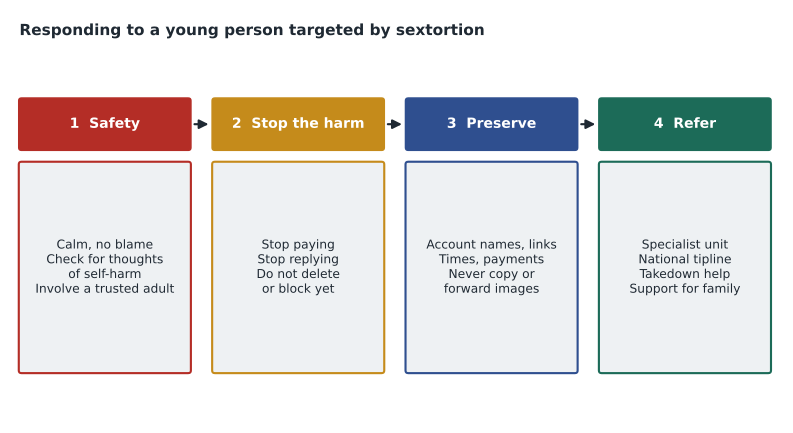
The first priority is the young person's safety and wellbeing. The officer should speak calmly, avoid any hint of blame or judgment, and check whether the young person is thinking of harming themselves. If there is any sign of that, the response becomes a mental health response first, as the crisis response course described. Parents or caregivers should be involved unless doing so would put the young person at risk, and they often need guidance too: anger at the child makes things worse.
The second priority is to stop further harm. The young person should stop all contact with the offender but not block or delete the account until the evidence has been preserved, because blocking can make the conversation disappear on some apps. The officer should record the offender's account name, display name, profile link and any other identifiers, the platform, the dates and times of contact, the payment method and any gift card numbers or receipts, and any other accounts or phone numbers the offender used. Screenshots taken by the young person of the conversation, showing the account name and dates, can help, but officers must follow policy closely here for the reason explained below.
The third priority is getting the case and the images to the right places. Reports go to the department's specialists or the regional Internet Crimes Against Children task force, which in Ohio is led by the Cuyahoga County Prosecutor's Office and includes many local agencies, and to the CyberTipline run by the National Center for Missing and Exploited Children. NCMEC also runs a free service called Take It Down that helps young people have images of themselves removed from participating platforms without sending the image to anyone. Platforms can be asked to preserve the offender's account records and remove the images.
Handling images lawfully
Desjardins slows down for the most important legal point in the lesson. A sexual image of a person under eighteen is child sexual abuse material in law, and making, possessing, accessing or distributing it is a serious offense, whatever the purpose. Officers must never copy such an image to their own phone or computer, never forward it by email or message, never ask a young person to send it to them, and never show it to colleagues outside the investigation. Even a well-meant screenshot sent to a supervisor is distribution. Specialist units have secure systems and strict procedures for receiving, storing and viewing such material, and the first officer's job is to make sure the device holding it is preserved and handed to them, or that the platform and tipline are given the information needed to find it.
The same caution applies to the young person's family. Parents sometimes want to collect screenshots of everything, including the image. The officer should explain that the image itself should not be copied or shared, and that the account names, messages and payment details are what matter. NCMEC can work with platforms to find and remove the image using its identifying information.
The legal framework
Producing, distributing, receiving or possessing child sexual abuse material is a federal crime under 18 U.S.C. sections 2251 to 2252A, and Ohio's pandering offenses in sections 2907.321 and 2907.322 cover the same conduct under state law. Using a computer to entice a minor is a federal crime under 18 U.S.C. section 2422(b), and importuning, section 2907.07, covers soliciting a minor in Ohio. Sextortion is now sexual extortion under Ohio section 2905.11 and may be federal extortion. Electronic service providers must report apparent child sexual abuse material on their services to NCMEC's CyberTipline under 18 U.S.C. section 2258A; a 2024 federal law extended the time they must preserve the related records to one year. The federal TAKE IT DOWN Act, signed May 19, 2025, made it a crime to knowingly publish nonconsensual intimate images, including AI-generated ones, and required covered platforms to remove them within 48 hours of a valid request from May 19, 2026.
| Situation | Main offense | Where to report |
|---|---|---|
| Threat to share a minor's image unless paid | Sexual extortion, ORC 2905.11; federal offenses | ICAC task force; CyberTipline |
| Adult's intimate image shared without consent | ORC 2917.211; TAKE IT DOWN Act | Police; platform takedown |
| Adult arranges to meet a child after online chats | Importuning, ORC 2907.07; 18 U.S.C. 2422(b) | Specialist unit, urgently |
| Sexual deepfake of a classmate | TAKE IT DOWN Act; ORC offenses | Police; platform; school |
Intimate images between young people
Not every case involving a young person's image involves an adult predator. Teenagers sometimes share images of themselves with a boyfriend or girlfriend, and those images are sometimes passed on, often after a breakup, causing serious harm. These cases raise hard questions. Charging young people with child sexual abuse material offenses for consensual sharing between peers can do more harm than good, and many prosecutors handle consensual peer sharing outside the criminal courts. Ohio law gives juvenile courts options for minors who share images of minors, and the emphasis on diversion in juvenile justice applies. The officer's focus is on stopping the spread, getting the images removed and supporting the young person whose image was shared, with charging decisions made by specialists and prosecutors using the policies the youth justice course described.
Owen's case
The officer who attended Owen's home that night had taken her service's training on sextortion. She sat with Owen and his mother at the kitchen table, told him it was not his fault, and asked whether he was safe and whether he had had any thoughts of hurting himself; he said he had been scared but not that. She asked him to stop replying and not to delete the app or the conversation. She photographed the account's profile page and the messages showing the account name and times, without photographing the image he had sent, and recorded the gift card numbers from the receipts in his room. She told the family about the CyberTipline and Take It Down, gave them the specialist unit's contact, and arranged a call from victim services the next morning. Owen's phone stayed with the family, switched to airplane mode, until the specialist unit collected it the next day with the family's consent.
The platform disabled the account within a day of the specialist unit's request and preserved its records. The account had been created eleven days earlier from an internet address outside the country and had contacted more than 200 teenage accounts. The image was never posted publicly, as far as anyone could tell. The gift cards had been redeemed within twenty minutes. No one has been charged in Owen's case, but the records were shared with national and international partners investigating the same group. Owen saw a counselor for several weeks. When Park asked his mother, months later, whether the family had any feedback, she said the most important thing was the officer's first sentence.
Deepfakes and AI-generated images
Image-generating software can now create realistic sexual images of real people from ordinary photos, such as school pictures or social media posts. These images cause the same humiliation and fear as real ones, and they have been used for harassment, bullying and sextortion, including among students. The TAKE IT DOWN Act covers AI-generated intimate images, which it calls digital forgeries, as well as real ones, and federal child exploitation law covers some computer-generated images of identifiable minors. Ohio legislators have also considered changes addressing fabricated sexual images, so officers should check the current state law. The response principles are the same: support the person depicted, stop the spread, preserve the account and posting details without copying the image, and refer to specialists. Officers should never assume that an image is fake, or that a fake image causes less harm.
Worked problem
A call from a school
A vice-principal calls to say that a 14-year-old girl has told a teacher that an older teenager is sharing a sexual image of her around the school. The vice-principal says she has collected three students' phones and has looked at the image to confirm what it is. What should the officer do?
Show solution
- Ensure the girl is safe and supported, with a parent or caregiver and a trusted adult, and that she knows she is not in trouble.
- Ask the vice-principal not to view, copy or forward the image again and not to have anyone else do so, explaining that it is child sexual abuse material in law.
- Secure the three phones as they are, without searching them, and consider the authority needed to keep and search them, which may require consent or a warrant.
- Notify the specialist unit, which will decide on the investigation, the handling of the image and any charges.
- Help the girl and her family use Take It Down and request removal from the platforms involved.
- Record what the vice-principal did and when, because it may matter later, without criticizing her for acting quickly to stop the spread.
Answer: Support the girl, stop further viewing and sharing, preserve the phones lawfully and hand the case to specialists.
Common mistakes
MistakeOfficers can collect screenshots of an image to send to a specialist.
InsteadCopying or forwarding a sexual image of a minor is itself an offense; only specialists handle images, on secure systems.
MistakeA teen who sent an image is partly to blame.
InsteadThe young person is the victim of a crime designed to deceive them, and must be told so.
MistakePaying the sextortionist once will end the threats.
InsteadPayment usually leads to more demands; stop paying and preserve evidence.
MistakeVictims should block and delete the account at once.
InsteadPreserve the account names and messages first; blocking can remove the conversation on some apps.
Summary and key terms
- Financially motivated sextortion targets teenagers, especially boys, and moves fast; the response begins with the young person's safety.
- Tell young victims it is not their fault, they are not in trouble, to stop paying and replying, and not to delete anything.
- Officers must never copy, forward or view sexual images of minors outside specialist procedures.
- Preserve account names, profile links, times and payment details, and refer to the specialist unit and national tipline.
- Federal child exploitation statutes, Ohio's sexual extortion and pandering offenses, and the TAKE IT DOWN Act are the main laws.
- Image sharing between young people calls for support, takedown and careful charging decisions by specialists.
- CyberTipline
- NCMEC's national reporting system for the online sexual exploitation of children.
- ICAC task force
- A regional Internet Crimes Against Children task force of federal, state and local agencies.
- Sextortion
- Threatening to share a person's intimate images unless they pay or send more.
- Child sexual abuse material
- Sexual images or recordings of a person under eighteen; the preferred term for what older laws call child pornography.
- Takedown
- Removal of content from a platform at the request of a victim or authority.
Practice problems
Work each problem on paper first, then reveal the answer to check.
What did Owen pay, and why should he not have paid more?
Show answer
100 dollars in gift cards; payment almost never ends the demands and usually leads to more.
What did the officer photograph at Owen's home, and what did she not photograph?
Show answer
The profile page and messages showing the account name and times, and the gift card receipts; not the image he had sent.
Why should a victim not block the account before preserving evidence?
Show answer
On some apps blocking makes the conversation disappear.
How many teenage accounts had the offender's account contacted?
Show answer
More than 200.
Lesson quiz · 5 questions
Score 60% or more to complete this lesson.
Create a free account to save your progress, take quizzes and earn a certificate.