
LES-213 · Lesson 2 of 12 · 19 min
Cybercrime offenses in federal and Ohio law
▶ Video coming soon A video version of this lesson is on the way.
On Thursday, March 19, 2026, five weeks after Grace Whitford lost her savings, an 84-year-old Port Ardent man named Harold Mercer received a call from someone claiming to be his grandson. Mercer's bank had been warned about grandparent scams by Detective Ellen Park's unit, and when he asked to withdraw 12,000 dollars in cash, the teller quietly called the police. Mercer was told by the caller that a courier would come to his door at four o'clock to collect the bail money. At 4:05 a young man in a gray car parked outside Mercer's house, walked to the door and was arrested by two plainclothes officers waiting inside. His name was Jordan Pike, he was 22, and he had a phone in his hand with an open conversation on a messaging app.
Park joins Desjardins as a guest for the whole course. She tells the class that the moment Pike was arrested, she had to answer a question that sounds simple: arrested for what? Choosing the right offense matters for the arrest itself, for the grounds in any warrant application, for what evidence must be gathered, and for the eventual charge. This lesson surveys the offenses that apply to cybercrime and shows how they fit the facts of Grace's and Mercer's cases.
The approach of the law
The United States has both federal and state cybercrime laws, and most conduct can be prosecuted under either. The main federal statute is the Computer Fraud and Abuse Act, 18 U.S.C. section 1030, first passed in 1984 and amended many times. Most other online crime is prosecuted under general federal offenses such as wire fraud, identity theft and interstate threats, or under state law. Ohio has its own computer crime offenses in Chapter 2913 of the Revised Code, along with general offenses that apply whatever the means. The United States is also a party to the Council of Europe's Budapest Convention on Cybercrime. The result is that an officer rarely needs a special cybercrime charge. Most of the time the question is which ordinary offense the facts prove.
Offenses against computers and data
The Computer Fraud and Abuse Act makes it a federal crime to intentionally access a computer without authorization, or to exceed authorized access, and obtain information, as well as to cause damage by transmitting a program or command, to traffic in passwords, and to extort by threatening damage to a computer. In Van Buren v. United States (2021), the Supreme Court read 'exceeds authorized access' narrowly. A person exceeds authorized access only by entering parts of a computer, such as files, folders or databases, that are off limits to them, not by misusing information they were entitled to see. The case involved a police sergeant who searched a license plate database for a bribe; the Court held that his improper purpose did not make his access unauthorized. Misuse of data a person is allowed to reach may still be another crime, but it is not a computer access crime under the federal statute.
Ohio Revised Code section 2913.04(B) makes it an offense to knowingly gain access to, attempt to gain access to, or cause access to be gained to a computer, computer system, computer network, telecommunications device or information service without the consent of the owner or beyond the scope of that consent. The basic offense is a fifth-degree felony. It becomes more serious when it is committed to defraud or for another crime and the loss is larger, and the thresholds are lower when the victim is elderly or disabled. Damaging or altering data can also be prosecuted as tampering with records or criminal mischief.
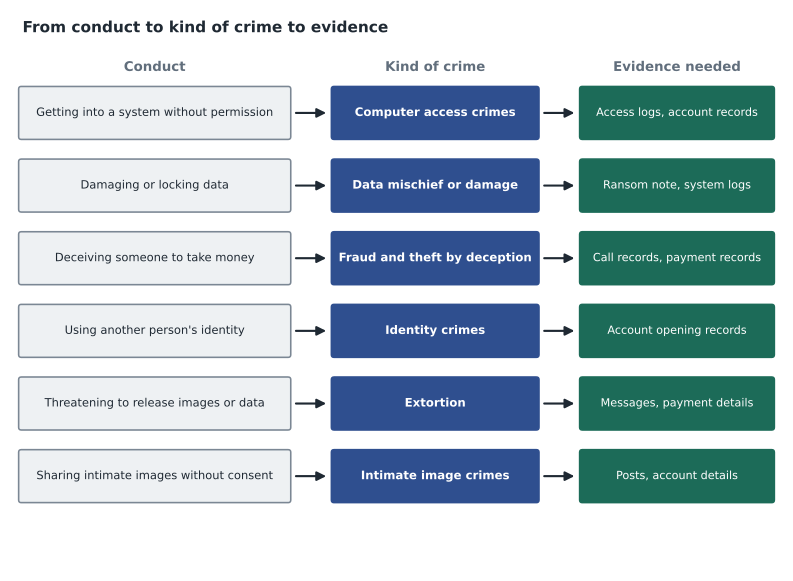
Fraud and identity offenses
Wire fraud, 18 U.S.C. section 1343, is a scheme to defraud using interstate or foreign wire communications, which include phone calls, emails, texts and electronic transfers. It carries up to twenty years, and up to thirty when it affects a financial institution. Aggravated identity theft, section 1028A, adds a mandatory two-year consecutive sentence when someone uses another person's identity during certain felonies, including wire fraud. Money laundering statutes, 18 U.S.C. sections 1956 and 1957, apply to people who move the proceeds. In Ohio, theft under section 2913.02 covers obtaining property by deception, with higher degrees when the victim is elderly or disabled; telecommunications fraud, section 2913.05, covers schemes to defraud carried out by wire or electronic communication; and identity fraud, section 2913.49, covers using another person's personal identifying information without consent.
Park explains how she thought about Pike. He had not made the calls to Grace or Mercer, and there was no evidence yet that he knew Grace's case existed. But he had come to Mercer's door to collect money he had reason to know was obtained by a lie. The arrest was for attempted theft by deception from an elderly person and complicity in telecommunications fraud. Under Ohio's complicity statute, section 2923.03, a person who aids or abets another in committing an offense can be prosecuted as if they were the principal offender. Later evidence from Pike's phone would decide whether more could be charged.
| Conduct in the Whitford and Mercer cases | Possible offense | Key evidence needed |
|---|---|---|
| Callers lying about a grandson's arrest to obtain money | Wire fraud, 18 U.S.C. 1343; theft by deception, ORC 2913.02 | Call records, the script, payment records |
| Courier collecting cash from Mercer | Attempted theft and complicity, ORC 2923.02, 2923.03 | Arrest observations, phone messages, the planned meeting |
| Account holders receiving and forwarding wires | Money laundering, 18 U.S.C. 1956 or 1957; receiving stolen property | Bank records, knowledge of the source |
| Accounts opened in stolen names | Identity fraud, ORC 2913.49; aggravated identity theft, 18 U.S.C. 1028A | Account opening records, the real person's statement |
Extortion, threats and harassment
Ohio's extortion statute, section 2905.11, covers threats made with purpose to obtain anything of value. Since April 9, 2025, a division added by House Bill 531, known as Braden's Law, makes it a separate offense of sexual extortion to threaten to release or distribute another person's private sexual images to obtain something of value, more images, or to make the person do something against their will. The basic offense is a third-degree felony and it is a second-degree felony when the victim is under 18, elderly or disabled, with higher degrees for repeat offenders. Menacing by stalking, section 2903.211, and telecommunications harassment, section 2917.21, cover repeated online threats and harassment. Federal law makes it a crime to send interstate threats to injure or to extort, 18 U.S.C. section 875, and to use electronic communications to stalk, section 2261A.
Intimate images and the exploitation of children
Ohio's section 2917.211 makes it an offense to knowingly disseminate an image of another person who can be identified, who is eighteen or older, who is nude or engaged in sexual activity, without that person's consent and with intent to harm them. Offenses involving children online include the pandering and illegal use of a minor in nudity-oriented material under sections 2907.321 to 2907.323, importuning under section 2907.07, and federal offenses under 18 U.S.C. sections 2251 to 2252A. Lesson 5 covers how these cases are handled.
Proving the elements online
Each offense has elements that must be proved beyond a reasonable doubt, and online offenses present particular problems of proof. The first is identity: showing that the accused, not someone else using the same account or device, did the act. Account records, device possession, passwords, location data and patterns of use are pieced together to answer it. The second is intent or knowledge. Pike might say he thought he was picking up a legitimate package for a delivery job. His messages, what he was paid, and what he was told would decide whether that was believable. The third is jurisdiction: showing that the offense has a real and substantial link to the state or the United States, which is usually easy when the victim is local, even if the offender was abroad.
Desjardins tells the class that the most common mistake in cybercrime charging is not choosing the wrong section but failing to collect the evidence the right section needs. An officer who seizes a phone but does not record who had it, where, and whether it was unlocked, makes the identity element harder. An officer who takes the victim's account of the call but not the time and the number shown makes the link to call records harder. Every later lesson connects back to the elements.
# Checking whether a draft file covers each element of the charge
elements = {
    "deceit or other fraudulent means": ["victim statement", "call recording or script"],
    "deprivation or risk of it": ["bank records", "victim statement"],
    "the accused did the act": ["arrest observations", "phone in hand", "messages"],
    "knowledge": ["messages", "payment to the accused"],
}
collected = {"victim statement", "bank records", "arrest observations", "phone in hand"}
for element, sources in elements.items():
    have = [s for s in sources if s in collected]
    missing = [s for s in sources if s not in collected]
    status = "covered" if have else "GAP"
print(f"{element:35} {status:8} have={have} missing={missing}")deceit or other fraudulent means covered have=['victim statement'] missing=['call recording or script'] deprivation or risk of it covered have=['bank records', 'victim statement'] missing=[] the accused did the act covered have=['arrest observations', 'phone in hand'] missing=['messages'] knowledge GAP have=[] missing=['messages', 'payment to the accused']
The check shows the gap Park saw in the first hours after the arrest. Deceit, deprivation and the act were covered by Mercer's statement, the bank's records and the officers' observations. Knowledge was not covered at all, because the messages on Pike's phone had not yet been lawfully examined. That gap shaped what came next: the phone had to be preserved untouched and a warrant obtained to search it, which lessons 8 to 10 follow.
Attempts, conspiracy and organized crime
Many cybercrime schemes are interrupted before they succeed, and many involve several people who never meet. Ohio's attempt statute, section 2923.02, applies when a person purposely or knowingly engages in conduct that, if successful, would constitute the offense; conspiracy under section 2923.01 requires an agreement and an overt act; and engaging in a pattern of corrupt activity under section 2923.32, Ohio's racketeering law, can apply to networks that commit repeated frauds. Federal conspiracy, 18 U.S.C. section 371, and wire fraud conspiracy, section 1349, are commonly charged in large fraud cases. Pike's arrival at Mercer's door to collect the money was conduct that would have completed the theft if successful.
Desjardins notes that conspiracy and organized crime charges are usually laid by specialists after long investigations, because they require proof of the agreement and of each person's role. A patrol officer's contribution is to record what is seen and said carefully, so that a small local arrest can later become part of a larger case. The messages on Pike's phone, preserved properly, were what made that possible.
Worked problem
Choosing offenses for a sextortion report
A 19-year-old college student reports that a person she met on a dating app persuaded her to share intimate photos, then threatened to send them to her family and classmates unless she paid 500 dollars in gift cards. She paid once and the person demanded more. What offenses may apply?
Show solution
- Sexual extortion under Ohio section 2905.11, the division added by Braden's Law: a threat to distribute private images to obtain something of value.
- If any image has been shared, nonconsensual dissemination under section 2917.211.
- Possibly menacing by stalking or telecommunications harassment, and federal interstate extortion under 18 U.S.C. 875 if the offender is in another state.
- Because she is an adult, the child exploitation offenses do not apply, but the evidence steps are similar: preserve the messages, account names and payment details, and do not let her delete the conversation.
Answer: Sexual extortion, nonconsensual dissemination if an image has been shared, and federal extortion if interstate.
Common mistakes
MistakeCybercrime needs a special cybercrime charge.
InsteadMost cybercrime is charged under general offenses such as fraud, extortion and harassment.
MistakeMisusing data you are allowed to access is a CFAA violation.
InsteadAfter Van Buren, exceeding authorized access means entering off-limits areas, not misusing permitted data.
MistakeThe person who collects or moves the money cannot be charged if they did not make the calls.
InsteadCouriers and account holders may be parties to the fraud or commit separate offenses such as possession or laundering, if knowledge is proved.
MistakeIdentity is proved by showing the account belongs to the accused.
InsteadAccounts can be shared or stolen; identity is proved by combining account, device, location and usage evidence.
Summary and key terms
- Federal law centers on the CFAA, wire fraud and identity theft; Ohio has computer offenses in Chapter 2913 and general offenses.
- After Van Buren, exceeding authorized access means entering off-limits parts of a system.
- Ohio's sexual extortion offense took effect April 9, 2025; section 2917.211 covers nonconsensual dissemination of images.
- Couriers, money mules and account holders may be parties to the fraud or commit possession or laundering offenses.
- Identity, knowledge and jurisdiction are the elements most often hard to prove online.
- Evidence collection should be planned around the elements of the likely offense.
- CFAA
- The Computer Fraud and Abuse Act, 18 U.S.C. 1030, the main federal computer crime law.
- Sexual extortion
- Threatening to release private images to obtain something, an Ohio offense since April 9, 2025.
- Party to an offense
- A person who commits, aids or abets an offense and can be convicted of it.
- Extortion
- Using threats, accusations or menaces to obtain something.
- Money mule
- A person who receives and moves the proceeds of crime, knowingly or not.
- Budapest Convention
- The Council of Europe treaty on cybercrime, setting common offenses, powers and cooperation.
Practice problems
Work each problem on paper first, then reveal the answer to check.
What was Jordan Pike doing when he was arrested?
Show answer
Arriving at Harold Mercer's door to collect 12,000 dollars in cash, with a messaging conversation open on his phone.
Which element was not yet covered in the code example?
Show answer
Knowledge, because the messages on Pike's phone had not yet been lawfully examined.
What did Van Buren decide?
Show answer
That exceeding authorized access means entering off-limits parts of a computer, not misusing information one may access.
Why does the most common charging mistake involve evidence rather than sections?
Show answer
Officers fail to collect the evidence that the right offense's elements require, such as proof of identity or knowledge.
Lesson quiz · 5 questions
Score 60% or more to complete this lesson.
Create a free account to save your progress, take quizzes and earn a certificate.