
LES-103 · Lesson 6 of 12 · 21 min
Assault and offenses against the person
▶ Video coming soon A video version of this lesson is on the way.
Assault is the offense Port Ardent officers charge more than any other violent crime, and it comes in every form: a shove outside a bar, a punch in a schoolyard, a slap during an argument at home, a bottle swung at a stranger, a bite, a kick to the head of someone already on the ground. Ms. Liu tells the class that in her office, assault files outnumber every other violence file several times over, and that most of the arguments in court are about three questions: was there really an application of force or a threat, did the victim consent, and how serious was the harm or the weapon. The answers decide whether a case is a first-degree misdemeanor or a first- or second-degree felony. This lesson covers the definition of assault, consent, the aggravated forms and related offenses against the person.
What counts as an assault
The traditional common law distinguished battery, an unlawful touching, from assault, an attempted battery or an act placing someone in fear of an imminent battery. Ohio, like most Model Penal Code states, has merged the two. R.C. 2903.13(A) says no person shall knowingly cause or attempt to cause physical harm to another or to another's unborn, and division (B) says no person shall recklessly cause serious physical harm to another or to another's unborn. Threatening conduct that does not involve an attempt to cause harm is dealt with by the menacing offenses covered in lesson 8. The Model Penal Code's simple assault, in section 211.1, covers attempting to cause or purposely, knowingly or recklessly causing bodily injury, negligently causing bodily injury with a deadly weapon, and attempting by physical menace to put another in fear of imminent serious bodily injury.
The force involved can be slight. In Ohio, physical harm means any injury, illness or other physiological impairment, regardless of its gravity or duration, so a slap that causes pain can be enough; spitting or throwing a drink that causes no harm is usually charged instead under other offenses, such as disorderly conduct or, for spitting on certain people, specific statutes. The threat form requires more than words alone. An attempt to cause physical harm, such as swinging a punch that misses, is an assault; threats of harm without an attempt are menacing or aggravated menacing.
Consent
Consent turns many touchings that would otherwise be assaults into lawful acts: a handshake, a tackle in a football game, a haircut, surgery. In Ohio, consent is generally not a defense to an assault that causes serious harm, and mutual combat is not a defense to a charge arising from a fight, though it may be relevant to the degree of the offense or to self-defense. Consent is a defense to contact that is a normal part of an activity people voluntarily join, such as contact sports, within the rules and reasonable expectations of the game. Consent must also come from someone capable of giving it. Children, people who are unconscious or severely intoxicated, and people with some cognitive disabilities may be unable to consent, an issue that becomes central in the sexual offenses of lesson 8.
Ohio law permits parents to use reasonable corporal punishment. The endangering children statute, R.C. 2919.22, makes it a crime to administer corporal punishment or other physical disciplinary measure that is excessive under the circumstances and creates a substantial risk of serious physical harm to the child, and Ohio prohibits corporal punishment in public schools. Officers called to a report of a parent striking a child must assess the force used, the injury, the child's age and the circumstances, and involve child protection services where required.
The aggravated forms of assault
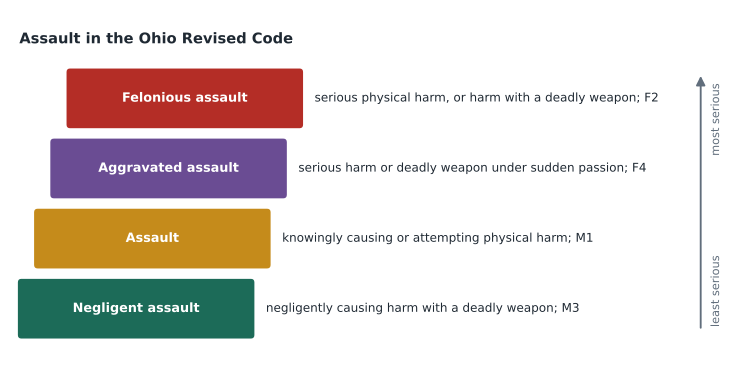
Ohio's ladder has several steps. Negligent assault, R.C. 2903.14, is negligently causing physical harm by means of a deadly weapon, a third-degree misdemeanor. Assault, R.C. 2903.13, is generally a first-degree misdemeanor, but it becomes a felony when the victim is in certain protected groups, including peace officers, firefighters and emergency medical workers performing their duties, corrections officers and some other public-facing workers. Felonious assault, R.C. 2903.11, is knowingly causing serious physical harm to another, or causing or attempting to cause physical harm by means of a deadly weapon or dangerous ordnance; it is a felony of the second degree, or of the first degree when the victim is a peace officer, with a mandatory prison term when the officer suffers serious physical harm. Aggravated assault, R.C. 2903.12, covers the same conduct when the offender acted while under the influence of sudden passion or a sudden fit of rage, brought on by serious provocation by the victim that was reasonably sufficient to incite the use of deadly force; it is a felony of the fourth degree. A deadly weapon is any instrument capable of inflicting death and designed or specially adapted for use as a weapon, or possessed, carried or used as one, so a bottle or a bat can qualify. Since 2023 Ohio has also had a separate strangulation offense, R.C. 2903.18, reflecting research on strangulation as a predictor of later homicide.
The aggravating facts decide the charge, so they must be documented with care. Injuries should be photographed, with a scale, when first seen and again a day or two later, when bruising often becomes more visible. Medical records should be obtained with consent or proper authority, because they describe injuries in clinical detail that can establish physical harm or serious physical harm. Any object used should be seized and described, including how it was held and used, because whether it was a weapon can depend on its use. And in strangulation cases, officers should ask specific questions and look for signs such as voice changes, difficulty swallowing, petechiae, which are tiny red spots in the eyes or on the face, and loss of consciousness or bladder control, because visible marks are often absent.
| Offense and section | Key added element | Degree |
|---|---|---|
| Negligent assault, R.C. 2903.14 | Negligently causing harm with a deadly weapon | M3 |
| Assault, R.C. 2903.13 | Knowingly causing or attempting physical harm | M1; felony for protected victims |
| Strangulation, R.C. 2903.18 | Impeding breathing or circulation by pressure on the throat or neck | F5 to F2 depending on harm and relationship |
| Felonious assault, R.C. 2903.11 | Serious physical harm, or harm with a deadly weapon | F2; F1 when the victim is a peace officer |
| Assault on a peace officer, R.C. 2903.13(C)(5) | Victim is a peace officer performing official duties | F4 |
Assaults on police and other public safety workers
Ohio raises assault to a felony when the victim is a peace officer, firefighter, investigator of the Bureau of Criminal Investigation or emergency medical services person in the performance of official duties, and felonious assault on a peace officer is a felony of the first degree, with a mandatory prison term when the officer suffers serious physical harm. Resisting arrest, R.C. 2921.33, makes it an offense to recklessly or by force resist or interfere with a lawful arrest, and is more serious when the offender causes physical harm to an officer or has a deadly weapon. The arrest must be lawful for resisting arrest; courts have held that this requires only that the officer had probable cause, not that the person was ultimately convicted.
These provisions exist because officers face assault at rates few other workers do, and because attacks on officers threaten the rule of law itself. But Ms. Liu cautions the class that judges and juries examine these charges closely, and that a charge of assault on an officer laid after a struggle that began with an unlawful stop, or that seems to be added to justify force used by the officer, can damage the officer's credibility in every later case. The best protection is a lawful, well-documented reason for every contact, and body-worn camera footage that shows the whole encounter.
Other offenses against the person
Several related offenses fill out Ohio's chapter on offenses against the person. Kidnapping, R.C. 2905.01, involves removing or restraining a person by force, threat or deception for purposes such as holding for ransom, facilitating a felony, terrorizing or inflicting serious physical harm, or engaging in sexual activity against the victim's will. Abduction, R.C. 2905.02, covers removing or restraining someone by force or threat in circumstances that create a risk of physical harm or place the person in fear, and unlawful restraint, R.C. 2905.03, is the misdemeanor of restraining someone's liberty without privilege. Domestic violence, R.C. 2919.25, is knowingly causing or attempting to cause physical harm, recklessly causing serious physical harm, or by threat of force knowingly causing a family or household member to believe the offender will cause imminent physical harm, and it becomes a felony with prior convictions. Patient abuse and neglect, and abuse of a vulnerable adult, are covered by other sections.
The code below classifies a set of Port Ardent assault files by applying the ladder in order from the most serious level down, which is how a prosecutor reviews a charge: start with the most serious offense the facts could support, and step down until every element is met.
# Classify an assault file by stepping down the ladder (Ohio R.C. 2903.11 to 2903.18, simplified)
def classify(f):
    if not (f["caused_or_attempted_harm"] or f["serious_harm_recklessly"]):
        return "no assault (consider menacing)"
    if f["serious_harm_knowingly"] or f["deadly_weapon"]:
        if f["sudden_passion_serious_provocation"]:
            return "aggravated assault, R.C. 2903.12 (F4)"
        return "felonious assault, R.C. 2903.11 (F2)"
    if f["strangulation"]:
        return "strangulation, R.C. 2903.18 (felony; degree depends on harm)"
    if f["victim_peace_officer_on_duty"]:
        return "assault on a peace officer, R.C. 2903.13(C)(5) (F4)"
    return "assault, R.C. 2903.13 (M1)"
base = dict(caused_or_attempted_harm=True, serious_harm_recklessly=False, serious_harm_knowingly=False,
            deadly_weapon=False, sudden_passion_serious_provocation=False, strangulation=False,
            victim_peace_officer_on_duty=False)
files = {
    "shove outside bar, scraped hand": {},
    "punch, broken nose": {"serious_harm_knowingly": True},
    "bottle swung, missed": {"deadly_weapon": True},
    "hands on throat during argument": {"strangulation": True},
    "stabbed after catching spouse with lover": {"deadly_weapon": True, "sudden_passion_serious_provocation": True},
    "kicked officer during arrest": {"victim_peace_officer_on_duty": True},
}
for name, facts in files.items():
print(f"{name:40s} -> {classify({**base, **facts})}")shove outside bar, scraped hand -> assault, R.C. 2903.13 (M1) punch, broken nose -> felonious assault, R.C. 2903.11 (F2) bottle swung, missed -> felonious assault, R.C. 2903.11 (F2) hands on throat during argument -> strangulation, R.C. 2903.18 (felony; degree depends on harm) stabbed after catching spouse with lover -> aggravated assault, R.C. 2903.12 (F4) kicked officer during arrest -> assault on a peace officer, R.C. 2903.13(C)(5) (F4)
Real classification decisions are more nuanced than a function can capture. Whether a broken nose is serious physical harm, whether a bottle was used as a weapon, and whether a provocation was serious enough are questions of fact for the court. A broken nose is usually bodily harm; whether it also disfigures, and so could support aggravated assault, depends on the evidence. The code is a reminder of the order of the questions, which is the habit Ms. Liu wants the students to take into the field.
Worked problem
A choking complaint
At 11:40 p.m., Dev Malhotra and his partner attend a townhouse after a 911 call from a neighbor who heard screaming. A woman says her boyfriend pushed her against the wall and squeezed her throat with one hand for a few seconds during an argument about money, then left. She has faint red marks on her neck and a hoarse voice, and says she felt dizzy. She does not want him charged. What should the officers do?
Show solution
- Safety and care first: check for injury, offer medical assessment, because strangulation injuries can be serious and delayed, and locate the boyfriend.
- Identify the offense: pressure on the throat that impeded breathing is strangulation under R.C. 2903.18, and the act is also domestic violence under R.C. 2919.25 because they live together.
- Document the elements: exact words used by the woman, the duration of pressure, voice changes, dizziness, any loss of consciousness, photographs of the marks now and a follow-up photograph later, and the neighbor's statement.
- Charging: Ohio law makes arrest the preferred course where there are reasonable grounds to believe domestic violence occurred, and prosecutors can proceed without the victim's cooperation using other evidence, because victims are often under pressure and strangulation is a strong predictor of later homicide.
- Safety planning: connect her with victim services, explain bail or protection order conditions, and do a risk assessment.
Answer: The officers should treat this as a serious assault, document it thoroughly, arrest the boyfriend when located and connect the victim with support, explaining that the decision to charge rests with the police and prosecutor rather than with her.
Common mistakes
MistakeIf there is no visible injury, it is not an assault.
InsteadA knowing attempt to cause physical harm is an assault even if it misses, and any physical harm, however slight, is enough.
MistakeConsent to a fight is a full defense.
InsteadMutual combat is not a defense to assault, though it may affect the degree of the offense or self-defense.
MistakeA weapon must be designed as a weapon.
InsteadOrdinary objects such as bottles, boots or cars can be weapons depending on how they are used.
MistakeAssault on a peace officer applies whenever the victim is an officer.
InsteadThe officer must have been performing official duties, and resisting arrest requires a lawful arrest.
Summary and key terms
- Ohio assault is knowingly causing or attempting to cause physical harm, or recklessly causing serious physical harm.
- Consent is generally no defense to serious harm, and mutual combat is no defense to assault.
- The ladder runs from negligent assault to assault to felonious assault, with aggravated assault for sudden passion and a separate strangulation offense.
- Aggravating facts such as injuries, weapons and strangulation must be documented carefully, including follow-up photographs and medical records.
- Assault on a peace officer and resisting arrest depend on the officer performing official duties and making a lawful arrest.
- Prosecutors review assault charges from the most serious possible offense downward until every element is met.
- Physical harm
- Any injury, illness or other physiological impairment, regardless of its gravity or duration.
- Serious physical harm
- Harm involving, for example, substantial risk of death, permanent or prolonged incapacity, disfigurement or acute prolonged pain.
- Deadly weapon
- An instrument capable of inflicting death and designed for use as a weapon, or possessed, carried or used as one.
- Felonious assault
- Knowingly causing serious physical harm, or causing or attempting physical harm with a deadly weapon.
- Aggravated assault
- Felonious assault committed under sudden passion brought on by serious provocation.
- Resisting arrest
- Recklessly or by force resisting or interfering with a lawful arrest.
Practice problems
Work each problem on paper first, then reveal the answer to check.
What are the two ways of committing assault under R.C. 2903.13?
Show answer
Knowingly causing or attempting to cause physical harm; recklessly causing serious physical harm.
Why are strangulation cases treated so seriously?
Show answer
Because strangulation is a strong predictor of later homicide in intimate partner violence and can cause serious internal injury with few visible marks.
What makes an ordinary object such as a bottle a weapon?
Show answer
Its use, or intended use, to cause injury or to threaten or intimidate.
Why must officers document their lawful grounds when charging an assault on police?
Show answer
Because the charge requires the officer to have been acting lawfully, and the defense will challenge the grounds for the contact.
Lesson quiz · 5 questions
Score 60% or more to complete this lesson.
Create a free account to save your progress, take quizzes and earn a certificate.