
LES-103 · Lesson 2 of 12 · 18 min
Classifying crimes: felonies, misdemeanors and minor offenses
▶ Video coming soon A video version of this lesson is on the way.
In week two Ms. Liu brings in a stack of real charging documents from Port Ardent, with the names blacked out, and asks the students to sort them into piles. Marco sorts them by how serious they look: a stolen bicycle in one pile, a stabbing in another. Priya sorts them by type: violence, property, drugs. Ms. Liu says both are reasonable but neither is how the system sorts them. The legal classification of an offense decides which court hears it, how the accused can be arrested and released, how long the state has to begin a prosecution, what the maximum sentence is and what kind of record follows the person afterward. An officer who does not know whether an offense is a felony or a misdemeanor, and of what degree, cannot know whether he or she may arrest without a warrant or must issue a citation. This lesson is about that sorting system.
Felonies and misdemeanors
American law divides crimes into felonies and misdemeanors. The traditional dividing line, used in federal law and most states, is the possible punishment: a felony is punishable by death or imprisonment for more than one year, usually in a state prison, while a misdemeanor is punishable by up to a year, usually in a local jail. The Model Penal Code adds lesser categories: petty misdemeanors and violations, which carry only a fine and are not crimes at all in the Code's sense. Ohio grades its offenses more finely. Felonies run from the first degree, the most serious, to the fifth degree; misdemeanors run from the first degree to the fourth, followed by minor misdemeanors, which carry only a fine. Aggravated murder and murder sit above all degrees with their own penalties.
Each Ohio degree has its own penalty range, set out in Revised Code sections 2929.14 for felonies and 2929.24 for misdemeanors. A first-degree misdemeanor carries up to 180 days in jail and a 1,000 dollar fine, falling to 30 days and 250 dollars for the fourth degree, and a minor misdemeanor carries a fine of up to 150 dollars and no jail. Felony prison terms range from 6 to 12 months for the fifth degree up to 3 to 11 years for the first degree, and since 2019 the Reagan Tokes Law makes most first- and second-degree felony sentences indefinite, with a minimum and a maximum term. The statute defining the crime says what degree it is, and many statutes raise the degree when aggravating facts are present, such as the value of property stolen or the victim being a police officer.
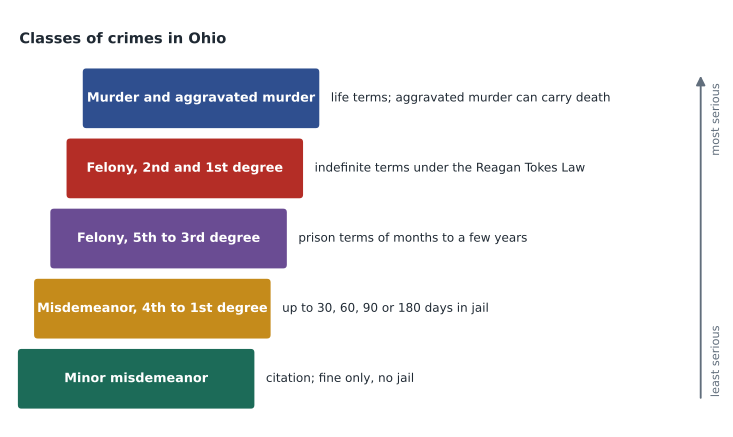
| Ohio class | Example | Maximum penalty | Usual court |
|---|---|---|---|
| Minor misdemeanor | Disorderly conduct (first instance) | Fine up to 150 dollars, no jail | Municipal or county court |
| Misdemeanor, 4th to 1st degree | Assault (M1) | 30 to 180 days in jail and fines up to 1,000 dollars | Municipal or county court |
| Felony, 5th to 3rd degree | Theft of 1,000 to 7,500 dollars (F5); breaking and entering an unoccupied structure (F5) | 6 months to 3 years, or up to 5 years for some third-degree felonies | Court of common pleas |
| Felony, 2nd and 1st degree | Robbery (F2); aggravated robbery (F1) | 2 to 8 years (F2) and 3 to 11 years (F1), often indefinite | Court of common pleas |
The courts that hear criminal cases
In Ohio, misdemeanors are tried in municipal or county courts, or in some places a mayor's court for minor matters, and the accused can usually ask for a jury if jail is possible. Felony cases begin in municipal or county court with an initial appearance and a preliminary hearing, at which a judge decides whether there is probable cause; if so, the case is bound over to the court of common pleas and presented to a grand jury, which decides whether to return an indictment. The Ohio Constitution requires an indictment for any felony unless the accused waives it. The Sixth Amendment guarantees a jury trial for any offense punishable by more than six months in jail. Federal crimes are tried in the United States District Court, which in Toledo sits as part of the Northern District of Ohio.
Statutes of limitations: how long the state has to prosecute
A statute of limitations sets the time within which a prosecution must begin. Ohio's general rule, in Revised Code section 2901.13, is six years for a felony, two years for a misdemeanor and six months for a minor misdemeanor. There is no limit for aggravated murder or murder, and the limit for rape and several other serious offenses is twenty-five years. The period starts when the offense is committed and can be paused, or tolled, while the accused is out of state or hiding, and for some offenses involving fraud or a breach of duty it starts only when the offense is discovered. A prosecution begins when an indictment, information or complaint is filed, or when a warrant or summons is issued. Federal crimes generally have a five-year limit.
The code below checks a list of cases from the Port Ardent file room against the time limits. Priya points out that it is the same kind of calculation her bank used to decide whether a fraud claim was still within its window, and Ms. Liu says that prosecutors' offices run exactly this kind of check when files are transferred.
# Is a prosecution still in time? R.C. 2901.13 general limits (simplified; no tolling).
from datetime import date
def add_months(d, months):
    y, m = divmod(d.month - 1 + months, 12)
    return date(d.year + y, m + 1, min(d.day, 28))
limits = {"felony": 72, "misdemeanor": 24, "minor misdemeanor": 6, "murder": None}
files = [("theft, M1", "misdemeanor", date(2024, 1, 10)), ("assault, M1", "misdemeanor", date(2025, 11, 2)),
         ("disorderly conduct, MM", "minor misdemeanor", date(2025, 3, 30)),
         ("burglary, F2", "felony", date(2019, 5, 4)), ("murder", "murder", date(1998, 7, 1))]
today = date(2026, 2, 16)
for charge, kind, when in files:
    months = limits[kind]
    if months is None:
        status = "no limit"
    else:
        deadline = add_months(when, months)
        status = f"file by {deadline}" if today <= deadline else f"EXPIRED on {deadline}"
print(f"{charge:24s} {when} {kind:17s} {status}")theft, M1 2024-01-10 misdemeanor EXPIRED on 2026-01-10 assault, M1 2025-11-02 misdemeanor file by 2027-11-02 disorderly conduct, MM 2025-03-30 minor misdemeanor EXPIRED on 2025-09-28 burglary, F2 2019-05-04 felony EXPIRED on 2025-05-04 murder 1998-07-01 murder no limit
The output shows why classification is the first thing a file reviewer checks. The January 2024 theft charge expired in January 2026, two years after the offense, and cannot be filed. The minor misdemeanor expired after six months. The burglary is still in time because felonies have six years, and murder has no limit. Delay costs cases, and the cost falls on victims.
Minor misdemeanors, traffic offenses and ordinances
Most of what officers enforce every day are minor offenses: traffic violations, minor misdemeanors such as a first disorderly conduct offense or possession of a small amount of a controlled substance in some forms, and city ordinances. In Ohio, most traffic offenses are minor misdemeanors or misdemeanors under Title 45, prosecuted on the uniform traffic ticket. Revised Code section 2935.26 requires an officer to issue a citation rather than arrest for a minor misdemeanor unless the person needs medical care, cannot or will not provide satisfactory identification, refuses to sign the citation or has previously failed to appear on a citation. Many of these offenses are strict liability, a category explained in lesson 4, meaning the state does not have to prove a culpable mental state.
These offenses are lighter, but they are not trivial. They are how the law regulates the ordinary risks of daily life, such as speeding, and they are often the first contact a person has with police. They also lead to more serious matters. A routine traffic stop can reveal a suspended driver, an impaired driver or a person wanted on a warrant. Officers should know the most common provisions well enough to explain them to the people they stop, because an explanation is part of procedural justice, the idea from LES-101 that people accept outcomes more readily when they feel the process was fair.
Why classification matters to an officer
Classification affects police powers directly. Officers may arrest without a warrant when they have probable cause to believe a person has committed a felony, even if it happened out of their sight. For misdemeanors, the traditional rule allows a warrantless arrest only for an offense committed in the officer's presence, though Ohio and many states make exceptions, for example for domestic violence and for theft. For minor misdemeanors, Ohio generally requires a citation. Classification affects bail, the right to appointed counsel, the court and the collateral consequences of conviction: a felony conviction can bar a person from possessing firearms, serving on a jury or holding some licenses. Ohio expanded record sealing and expungement in 2023, so many people with older lower-level convictions can now apply to have their records sealed after waiting periods.
Classification also shapes how a case is investigated. The more serious the offense, the more resources it receives and the more carefully every step is documented, because it is more likely to be contested at trial. A minor theft may be handled entirely by the patrol officer who took the call; a robbery is handed to investigators; a homicide becomes a major case with a team, a file coordinator and prosecutor involvement from the start. Knowing the class of offense helps officers set priorities and know when to call for help.
Worked problem
A late report
On February 16, 2026, a store manager tells Officer Dev Malhotra that a former employee stole about 900 dollars of merchandise in January 2025, more than a year ago. He has receipts and video. What should Dev consider?
Show solution
- Identify the offense: theft under R.C. 2913.02; at under 1,000 dollars, a misdemeanor of the first degree.
- Check the time limit: the two-year misdemeanor limit runs to January 2027, so a complaint can still be filed if done promptly.
- Consider the consequence: the case can proceed in municipal court, and a first offender may be offered a diversion program.
- Document: secure the video and receipts, record exactly when the manager learned of the theft and why it was reported late, and identify the value of each item, because value determines the level of the offense.
Answer: The charge is still within time, but only by months. Dev should complete the file quickly so the complaint is filed well before the limit.
Common mistakes
MistakeEvery crime with jail time is a felony.
InsteadOnly crimes punishable by more than a year in prison are felonies; misdemeanors carry up to a year, and in Ohio up to 180 days.
MistakeClassification only matters to lawyers and judges.
InsteadIt determines arrest powers, release, fingerprinting, the court, the time limit and the maximum sentence.
MistakeThere is no time limit for any felony.
InsteadOhio felonies generally have a six-year limit; only aggravated murder and murder have none.
MistakeMinor offenses are not real law enforcement.
InsteadTraffic and other minor offenses regulate daily risks, are the public's most common contact with police and often lead to more serious matters.
Summary and key terms
- Crimes are felonies or misdemeanors; Ohio grades felonies from the first to the fifth degree and misdemeanors from the first to the fourth degree, plus minor misdemeanors.
- Each degree has a penalty range; the statute defining the crime states its degree, often raised by aggravating facts.
- Misdemeanors are tried in municipal or county court; felonies go through a preliminary hearing and grand jury to the court of common pleas.
- Ohio's limits are six years for felonies, two for misdemeanors and six months for minor misdemeanors, with no limit for murder.
- Classification determines arrest and release powers, the court, the time limit, the sentence and the record.
- Minor misdemeanors generally require a citation rather than an arrest under R.C. 2935.26.
- Felony
- A crime punishable by more than one year of imprisonment; Ohio grades them from the first to the fifth degree.
- Misdemeanor
- A less serious crime punishable by up to a year in jail; in Ohio, up to 180 days for the first degree.
- Minor misdemeanor
- The least serious Ohio offense, punishable by a fine of up to 150 dollars and no jail.
- Indictment
- A formal charge returned by a grand jury, required in Ohio for felonies unless waived.
- Statute of limitations
- The time within which a prosecution must begin; in Ohio six years for most felonies.
- Citation
- A written notice to appear in court, used instead of arrest for minor offenses.
Practice problems
Work each problem on paper first, then reveal the answer to check.
Why does it matter whether an offense is a felony or a misdemeanor when making an arrest?
Show answer
Because a felony arrest can be made on probable cause for an offense outside the officer's presence, while misdemeanor arrests are generally limited to offenses committed in the officer's presence, with exceptions.
What is the limit for a first-degree misdemeanor theft in Ohio?
Show answer
Two years from the offense.
Give two consequences of classification other than the maximum sentence.
Show answer
Examples: the court that tries the case, the time limit, arrest and release powers, fingerprinting and the effect on the person's record.
Why should an officer complete a minor file promptly?
Show answer
Delay can push a case past a time limit or reduce the prosecutor's options, which harms victims and wastes the investigation.
Lesson quiz · 5 questions
Score 60% or more to complete this lesson.
Create a free account to save your progress, take quizzes and earn a certificate.