
LES-103 · Lesson 11 of 12 · 20 min
Defenses: self-defense, necessity, duress, insanity and intoxication
▶ Video coming soon A video version of this lesson is on the way.
Every lesson so far has asked whether the elements of an offense are proved. This lesson asks a different question: even when the prohibited act and the guilty mind are both there, does the law excuse or justify what the person did? Professor Desjardins tells the class about a call early in his career. A woman had stabbed her husband in the kitchen of their apartment. She had the knife in her hand when he arrived, and she said so. On the elements alone it was a felonious assault. But the apartment also held the evidence of years of abuse, a fresh injury on her neck and a 911 recording that captured the husband's threats seconds before the stabbing. The case was never charged. Officers do not decide defenses, which are for the prosecutor and the courts, but they must recognize them, because the evidence that supports a defense is gathered at the scene or not at all, and prosecution charging standards take likely defenses into account.
Justifications and excuses
Defenses fall into a few families. Some deny an element: a mistake of fact, from lesson 4, can show the accused lacked the required mental state, and an alibi denies the act. Justifications say the act was right or at least permitted in the circumstances, as with self-defense, where society accepts the use of force to repel an attack. Excuses say the act was wrong but the person should not be blamed, as with duress, where a threat leaves no realistic choice, or mental disorder, where illness prevents the person from understanding the act. The distinction matters because justified acts, unlike excused ones, can be lawfully resisted only in limited ways and do not carry the same moral weight. In Ohio, most defenses are affirmative defenses that the defendant must prove by a preponderance of the evidence under R.C. 2901.05, including duress, necessity and insanity. Self-defense is now the main exception: since March 2019, once the evidence tends to support self-defense, the prosecution must prove beyond a reasonable doubt that the accused did not act in self-defense.
Self-defense, stand your ground and the castle doctrine
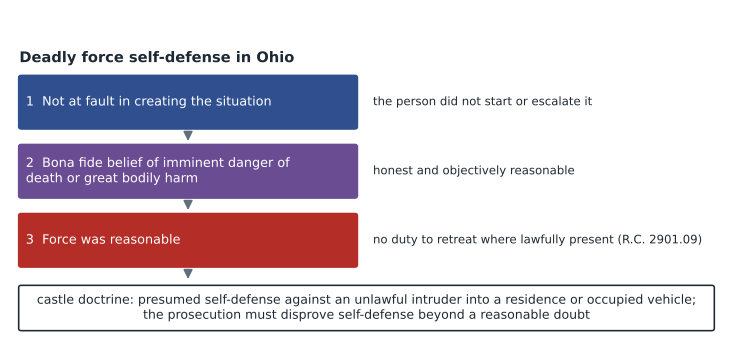
Ohio's self-defense law was changed twice in recent years. Under R.C. 2901.05, as amended in 2019, if there is evidence that tends to support that the accused used force in self-defense, defense of another or defense of residence, the prosecution must prove beyond a reasonable doubt that the accused did not. Under the traditional Ohio test for deadly force, the person must not have been at fault in creating the situation, must have had a bona fide belief that he or she was in imminent danger of death or great bodily harm and that deadly force was the only means of escape, and the force must have been reasonable. Since April 2021, R.C. 2901.09 says a person has no duty to retreat before using force if the person is in a place where he or she lawfully has a right to be, and the trier of fact may not consider the possibility of retreat in deciding whether the force was reasonable. The castle doctrine, in R.C. 2901.05(B), presumes that a person acted in self-defense when using defensive force against someone who was unlawfully and without privilege entering, or had entered, the residence or occupied vehicle of the person using the force, though the presumption can be rebutted. Nondeadly force must be proportionate to the threat.
Ohio allows reasonable, nondeadly force to protect property, but deadly force solely to protect property is not justified. The castle doctrine covers the use of force against an intruder in the home because entry into a residence is treated as a threat to the people inside. The Supreme Court's emphasis in the Ohio cases on the accused's own role means officers should record how the encounter started, who escalated it, what each person said and any history between them.
Necessity and duress
Necessity in Ohio is an affirmative defense recognized by the courts: the defendant must show that the harm to be avoided was greater than the harm caused by breaking the law, that there was no adequate legal alternative, that the defendant did not create the situation, and that the harm was imminent. The Model Penal Code's choice of evils defense, in section 3.02, takes a similar approach. A driver who speeds to take a person in a medical emergency to hospital is the textbook case where the defense might succeed; protesters who break the law to draw attention to a cause almost always fail.
Duress in Ohio is an affirmative defense that applies when a person commits an offense because another person threatened imminent death or serious bodily harm, the person reasonably believed the threat, and there was no reasonable opportunity to escape. Ohio courts hold that duress is never a defense to murder, and it is not available to a person who recklessly placed himself or herself in a situation where coercion was likely, such as by joining a gang. The Model Penal Code, in section 2.09, uses a broader standard: whether a person of reasonable firmness in the actor's situation would have been unable to resist.
Insanity and competency
Ohio's insanity defense, in R.C. 2901.01(A)(14), says a person is not guilty by reason of insanity only if the person proves, by a preponderance of the evidence, that at the time of the offense, he or she did not know, as a result of a severe mental disease or defect, the wrongfulness of the act. Ohio follows a version of the M'Naghten test, and does not recognize an irresistible impulse or diminished capacity defense. A person found not guilty by reason of insanity is committed to the Ohio Department of Mental Health and Addiction Services if found to be a person with a mental illness subject to court order, and the trial court keeps jurisdiction for up to the maximum prison term for the offense. Competency to stand trial, under R.C. 2945.37, is a separate question: whether the defendant can understand the nature and objective of the proceedings and assist in the defense now.
For patrol officers, the important point is that the evidence of a person's mental state at the time of the offense is gathered by the first people on scene. Officers who take a person for emergency evaluation under R.C. 5122.10 should record exactly what the person said and did, how he or she appeared, and any statements about voices, beliefs or medication. Linh Tran asks whether that information will be used against the person. Professor Desjardins says it is used to find the truth, which sometimes supports a defense and sometimes undermines one, and that careful notes are fair to everyone.
Intoxication and automatism
Under R.C. 2901.21(E), voluntary intoxication may not be taken into consideration in determining the existence of a mental state that is an element of a criminal offense. Ohio therefore does not allow a defendant to argue that being drunk or high prevented him or her from forming purpose or knowledge, a rule the U.S. Supreme Court held to be constitutional for a similar Montana statute in Montana v. Egelhoff (1996). Involuntary intoxication, such as from a drink spiked without the person's knowledge, may still be raised. Automatism, covering involuntary conduct during a seizure, concussion or sleepwalking, negates the voluntary act requirement of R.C. 2901.21 discussed in lesson 3. For officers, this means recording a suspect's observed level of intoxication carefully: slurred speech, balance, the smell of alcohol, what the person said about consumption, and how he or she performed tasks, rather than writing simply that the person was drunk.
Entrapment and police conduct
Ohio follows the subjective test of entrapment, from Sorrells v. United States (1932) and State v. Doran (1983): the defense applies when the criminal design originates with the officials and they implant in the mind of an innocent person the disposition to commit the offense and induce its commission, so that the question is whether the defendant was predisposed to commit the crime. In Jacobson v. United States (1992), the Supreme Court held that the government must prove predisposition existed before government agents first approached the defendant. Entrapment is an affirmative defense that the defendant must prove by a preponderance of the evidence. Merely providing an opportunity to commit a crime, as in a reverse sting or an undercover purchase, is not entrapment. Officers' own use of force is governed by the Fourth Amendment reasonableness standard from Graham v. Connor (1989), covered in LES-204.
The class builds a checklist for the questions an officer should be able to answer in the notes whenever a defense may arise. Marco says it is the same idea as a pre-flight checklist: not deciding the outcome, just making sure nothing is missed.
# Which defenses do the scene notes need to address? (Ohio law, simplified)
notes = {
    "force or threat by complainant first": True,
    "accused statement about why force was used": True,
    "injuries photographed on both parties": True,
    "where it happened (residence, vehicle, public)": True,
    "weapon found and position recorded": True,
    "signs of intoxication described (not just 'drunk')": False,
    "statements suggesting voices or delusions": False,
    "threats made to the accused by a third person": False,
}
defenses = {
    "self-defense (R.C. 2901.05)": ["force or threat by complainant first", "accused statement about why force was used",
                                    "injuries photographed on both parties",
                                    "where it happened (residence, vehicle, public)",
                                    "weapon found and position recorded"],
    "intoxication (involuntary only)": ["signs of intoxication described (not just 'drunk')"],
    "insanity (R.C. 2901.01)": ["statements suggesting voices or delusions"],
    "duress": ["threats made to the accused by a third person"],
}
for name, needs in defenses.items():
    done = [n for n in needs if notes[n]]
    print(f"{name:32s} {len(done)}/{len(needs)} items recorded")
    for n in needs:
        if not notes[n]:
print(f" check: {n}")self-defense (R.C. 2901.05) 5/5 items recorded
intoxication (involuntary only) 0/1 items recorded
check: signs of intoxication described (not just 'drunk')
insanity (R.C. 2901.01) 0/1 items recorded
check: statements suggesting voices or delusions
duress 0/1 items recorded
check: threats made to the accused by a third personThe output shows that the self-defense questions are covered but three other possible defenses are not addressed at all. Even if none of them turns out to apply, a note that the suspect showed no signs of intoxication, made no statements suggesting delusions and reported no threats from anyone else closes those questions for the prosecutor. Noting where the incident happened matters in Ohio, because a residence or occupied vehicle can trigger the castle doctrine presumption and a place where the person lawfully had a right to be removes any duty to retreat.
Worked problem
The kitchen stabbing
Officers are called to an apartment where a man has a stab wound to his abdomen. His wife, sitting on the floor with a knife beside her, says he was choking her and she grabbed the knife from the counter. She has red marks on her neck. A neighbor says she has heard shouting and banging from the apartment many times, and the 911 call recorded a man yelling I'm going to kill you seconds before a scream. What should the officers do, and what evidence matters?
Show solution
- Safety and medical care: render first aid and get paramedics for the man, secure the knife, and have the woman examined, including for strangulation injuries that may not be visible at first.
- Treat it as a serious assault investigation, with the woman as a suspect, but recognize the clear signs of self-defense: the catalyst of choking, a defensive statement, visible injuries and a history of violence.
- Gather the evidence that bears on the defense: photographs of her injuries over the following days, the 911 recording, the neighbor's statement, prior calls to the address, and the position of the knife and both people.
- Record where it happened and who was lawfully present, because the castle doctrine and no-duty-to-retreat rules may apply, and the prosecutor must disprove self-defense beyond a reasonable doubt.
- Interview carefully: give rights advice, let her speak with counsel, and do not suggest the defense or argue her out of it; record exactly what she says.
Answer: Officers do not decide whether self-defense succeeds, but the evidence they gather in the first hour decides whether the prosecutor can make that judgment fairly. In Professor Desjardins's case, that evidence led to no charge.
Common mistakes
MistakeOfficers decide whether a defense applies before laying a charge.
InsteadOfficers gather the evidence; prosecutors and courts decide defenses, though likely defenses affect charging decisions.
MistakeOhio law requires retreat before deadly force in public.
InsteadSince 2021 there is no duty to retreat where the person lawfully has a right to be.
MistakeBeing drunk is a defense to any crime.
InsteadVoluntary intoxication cannot be considered at all in deciding mental state under R.C. 2901.21(E).
MistakeA finding of mental disorder or insanity means the person goes free.
InsteadAn NGRI finding can lead to commitment, with the court keeping jurisdiction.
Summary and key terms
- Defenses may deny an element, justify the act or excuse the actor.
- The prosecution must disprove self-defense beyond a reasonable doubt; there is no duty to retreat where the person is lawfully present, and the castle doctrine creates a presumption in the home.
- Necessity and duress are narrow excuses for situations of imminent danger with no reasonable legal alternative.
- Insanity requires proof that a severe mental disease or defect prevented the person from knowing the act was wrong.
- Voluntary intoxication cannot be considered in deciding mental state.
- Entrapment focuses on police conduct, and officers' notes must capture the facts that support or rule out every possible defense.
- Affirmative defense
- A defense the defendant must prove by a preponderance of the evidence.
- Castle doctrine
- A presumption of self-defense against an unlawful intruder into a residence or occupied vehicle.
- Stand your ground
- No duty to retreat where the person lawfully has a right to be.
- NGRI
- Not guilty by reason of insanity.
- Predisposition
- In entrapment, whether the defendant was ready to commit the crime before officials approached.
- Duress
- Committing an offense because of a threat of imminent death or serious bodily harm with no chance to escape.
Practice problems
Work each problem on paper first, then reveal the answer to check.
Who must prove or disprove self-defense in Ohio, and to what standard?
Show answer
Once evidence tends to support self-defense, the prosecution must prove beyond a reasonable doubt that the accused did not act in self-defense.
What are the requirements of necessity?
Show answer
Imminent peril, no reasonable legal alternative and proportionality between the harm caused and the harm avoided.
Why should officers describe signs of intoxication rather than writing drunk?
Show answer
Because the degree of intoxication bears on intent and defenses, and specific observations can be tested in court.
Is an undercover drug purchase entrapment?
Show answer
Not if officers merely provide an opportunity to a predisposed person; it becomes entrapment when they implant the criminal design in an innocent person.
Lesson quiz · 5 questions
Score 60% or more to complete this lesson.
Create a free account to save your progress, take quizzes and earn a certificate.