
ITIL-110 · Lesson 1 of 12 · 28 min
What service management is
Almost everything an organization does for its customers or its own staff can be described as a service. A bank provides accounts, cards and online banking. A hospital IT department provides clinical systems, devices and a help desk. A city provides permits, transit information and a 3-1-1 line. Service management is the set of organizational capabilities for enabling value for customers in the form of services. This lesson explains what that definition means, where ITIL fits, how the idea has grown from "IT service management" into the management of digital products and services, and why the key concepts in the rest of this course matter for the ITIL Foundation exam and for everyday work.
This course is an independent study course. ITIL is a registered trade mark of the PeopleCert group. The quiz and exam questions in this course were written for it and are not real exam questions.
Services in everyday life
Think about the last time you used a ride-hailing app. You did not buy a car, hire a driver or maintain a mapping system. You paid for an outcome you wanted, getting from one place to another, without owning the specific costs and risks of vehicles, insurance and navigation software. The company, for its part, combined many resources it did control (software, payment processing, customer support) and many it did not (independent drivers, mobile networks, map data from suppliers) into something you could use with a few taps.
That pattern repeats everywhere. A service lets a consumer achieve outcomes while the provider takes on some of the costs and risks the consumer would otherwise carry. The consumer still has responsibilities: they must have a phone, give an accurate pickup point and pay. Value appears when both parties do their part. ITIL calls this value co-creation, and it is the subject of the next lesson.
| Example | Outcome the consumer wants | Costs and risks the provider takes on | What the consumer still does |
|---|---|---|---|
| Email service for a company | Staff can communicate reliably | Servers, spam filtering, upgrades, backups | Manage accounts, follow security rules |
| Payroll service | Employees are paid correctly and on time | Tax tables, software, compliance updates | Submit accurate hours and changes |
| Cloud storage | Files are available anywhere | Data centers, redundancy, hardware refresh | Organize files, control sharing |
| Service desk | Problems with tools are fixed quickly | Staff, knowledge base, tools, escalation | Report issues clearly, accept fixes |
Defining service management
ITIL defines service management as a set of specialized organizational capabilities for enabling value for customers in the form of services. Each part of that definition is worth unpacking:
- Specialized organizational capabilities: service management is not one team or one tool. It is the combined ability of people, processes, information, technology and partners to design, deliver and improve services.
- Enabling value: the provider does not "deliver value" in a parcel. It creates the conditions in which value can be realized, and the consumer completes the picture by using the service.
- For customers: value is judged from the consumer's point of view, not by how impressive the provider's technology is.
- In the form of services: the unit of thinking is the service, not the server, the application or the department.
Developing these capabilities takes time. An organization cannot buy service management in a box. It builds it by learning how to understand demand, design offerings, run operations, handle change and improve continually. Frameworks such as ITIL describe good practice so that each organization does not have to discover everything from scratch.
From IT service management to digital products and services
ITIL began in the late 1980s as guidance for IT departments in the UK government, and for most of its history it was known as a framework for IT service management (ITSM). Over time the boundary between "the IT department" and "the business" faded. Banks became software companies with branches. Retailers made most of their decisions with data. Governments delivered more services online than at counters. A service such as online tax filing is not "supported by IT"; the software is the service.
ITIL 4, published in 2019, reflected this by introducing the service value system, the service value chain and value streams, and by speaking of products and services rather than only IT services. ITIL (Version 5), released by PeopleCert in February 2026, goes further. It frames the subject as digital product and service management, adds an explicit product and service lifecycle, and gives more attention to experience, sustainability and artificial intelligence. According to PeopleCert and accredited training providers, the core vocabulary covered in this course, including value, outcomes, costs, risks, utility, warranty, products, services, offerings and service relationships, carries forward from ITIL 4 into Version 5. That continuity is why these key concepts are such a stable foundation for study.
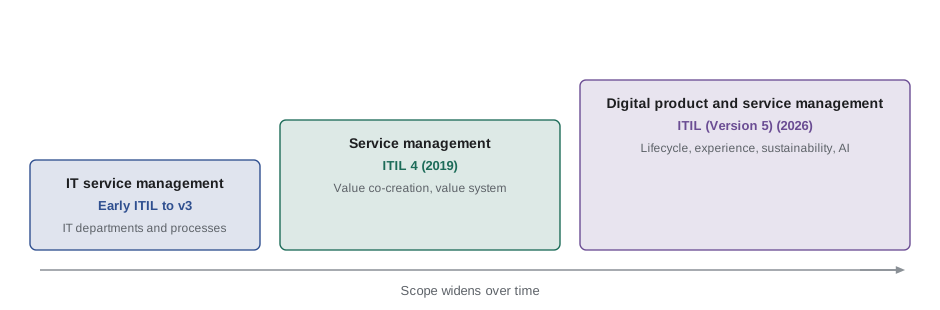
| Edition | Typical framing | Key ideas added |
|---|---|---|
| Early ITIL (1989 onward) | IT service management in government | Process descriptions for service support and delivery |
| ITIL v3 / 2011 | IT service lifecycle | Strategy, design, transition, operation, continual improvement |
| ITIL 4 (2019) | Value co-creation through services | Service value system, value chain, 34 practices, guiding principles |
| ITIL (Version 5) (2026) | Digital product and service management | Product and service lifecycle, experience, sustainability, AI guidance |
For the exam, check which edition your Foundation exam is based on when you book. ITIL 4 Foundation and ITIL (Version 5) Foundation were both available during the transition period, and their syllabuses differ in emphasis. The concepts in this course are written to be compatible with both; where a term is new or more prominent in Version 5, the lesson says so.
Why organizations use a framework
Running services well is hard. Demand changes, technology changes faster, and customers expect services to be available at all hours and pleasant to use. Without shared language, teams talk past each other: an operations team may say a system was "up" while customers could not complete a transaction. A framework gives people a common vocabulary and a set of proven practices to adapt.
- Common language: words such as incident, change, service level and outcome mean the same thing across teams, suppliers and countries.
- Focus on value: the framework keeps attention on what customers achieve rather than on internal activity.
- Proven practices: guidance on dozens of practices, from incident management to relationship management, saves reinventing them.
- Adaptability: ITIL is guidance, not a standard you must follow word for word. Organizations adopt and adapt what helps.
- Career portability: certifications show employers that you share the vocabulary, which is useful in a field with many job changes.
ITIL is not the only body of guidance. ISO/IEC 20000-1 is an international standard for service management systems against which organizations can be certified. COBIT focuses on governance of enterprise information and technology. Lean, agile, DevOps and site reliability engineering all influence how modern services are built and run. ITIL describes how these fit together rather than competing with them, and later courses in this program return to that integration.
Who practices service management?
Service management is not only for people with "service" in their job title. Developers make choices that affect the warranty of a service. Product owners decide which outcomes a service supports. Finance staff weigh costs. Suppliers carry part of the risk. Even the people using a service have a role, because how they use it affects the value created. Typical roles that benefit from the key concepts include:
- Service desk analysts and support engineers, who turn user requests and issues into restored service.
- Service owners and product managers, who decide what is offered and to whom.
- Operations, cloud and platform engineers, who keep services available, secure and able to scale.
- Relationship and account managers, who connect providers with consumers.
- Procurement and vendor managers, who shape the supply relationships services depend on.
- Leaders and governance bodies, who decide where to invest and how to judge success.
A first look at the vocabulary
The rest of this course defines the key terms carefully, because the Foundation exam tests them precisely and because loose usage causes confusion at work. The table below previews them, with the lesson where each is covered in depth.
| Term | Short meaning | Lesson |
|---|---|---|
| Value | Perceived benefits, usefulness and importance of something | 2 |
| Organization, provider, consumer | Who is involved in a service relationship | 3 |
| Product, service, service offering | What is configured, provided and offered | 4 |
| Outcome, output, cost, risk | What the consumer achieves, and at what cost and risk | 5 |
| Utility and warranty | What a service does, and how well it does it | 6 |
| Service relationship | Cooperation between provider and consumer | 7 and 8 |
| Experience | How people feel and what they encounter when using a service | 9 |
Worked problem
Spotting service thinking
An operations manager reports: "Our CRM servers achieved 99.98 % uptime last quarter, so we did a great job." Sales staff, however, complain that quote generation was so slow on Monday mornings that customers gave up. Using service management thinking, what is wrong with the manager's view, and what would a better measure look like?
Show solution
- The manager measures an internal output (server uptime), not the outcome sales staff need (producing quotes quickly for customers).
- A server can be "up" while the service is effectively unusable because of slowness, a faulty integration or poor design.
- Service management asks what the consumer is trying to achieve and how the service supports it.
- A better measure would be, for example, the percentage of quotes produced in under 30 seconds during business hours, alongside user satisfaction.
Answer: The view is provider-centered. Measure the outcome consumers care about, such as quote completion time and success rate, not only component uptime.
Worked problem
Translating a nine into hours
The CRM servers were up 99.98 % of the 2,184 hours in a 91-day quarter. How many hours of downtime does that allow, and why does that still not tell you whether the service supported sales?
Show solution
- Downtime fraction = 1 − 0.9998 = 0.0002.
- Downtime hours = 0.0002 × 2,184 ≈ 0.44 hours, or about 26 minutes.
- That figure covers only full outages of the servers. Slowness, failed integrations and errors that leave the servers running are not counted.
Answer: About 26 minutes of downtime in the quarter. The figure says nothing about slow performance during peak hours, which is what hurt sales.
How this course is organized
Lessons 2 to 6 build the core vocabulary: value and co-creation, the parties involved, what is provided, what the consumer achieves, and how well the service does its job. Lessons 7 to 9 look at relationships, supply chains and experience. Lesson 10 introduces measurement in a light way. Lesson 11 shows service management in public-sector and cloud settings, and lesson 12 brings everything together in a capstone that maps the value proposition of a real-world style service. Each lesson ends with common mistakes, a summary, key terms, practice questions and a short quiz.
Other courses in this program take the ideas further: ITIL-120 covers the guiding principles and governance, ITIL-130 the service value system and value chain, ITIL-140 and ITIL-141 the practices, ITIL-150 creating, delivering and supporting services, and ITIL-160 exam strategy. ITIL-101 covers the certification scheme and exam logistics, so this course does not repeat them.
Common mistakes
MistakeTreating service management as the same thing as the service desk.
InsteadSee it as organization-wide capabilities for enabling value through services.
MistakeSaying the provider "delivers value" on its own.
InsteadDescribe value as co-created by provider and consumer.
MistakeMeasuring success only by component uptime.
InsteadMeasure the outcomes consumers care about as well.
MistakeAssuming ITIL is a standard you must follow exactly.
InsteadTreat ITIL as guidance to adopt and adapt; ISO/IEC 20000-1 is the certifiable standard.
MistakeStudying old ITIL v3 terms for a current Foundation exam.
InsteadCheck which edition your exam uses and study that syllabus.
Summary and key terms
- A service enables a consumer to achieve outcomes while the provider takes on specific costs and risks.
- Service management is a set of specialized organizational capabilities for enabling value for customers in the form of services.
- ITIL has widened from IT service management to digital product and service management.
- ITIL (Version 5) was released in February 2026; the key concepts in this course carry forward from ITIL 4.
- Frameworks provide common language, a value focus and proven practices to adapt.
- Many roles practice service management, not only service desk staff.
- Good measures look at consumer outcomes, not only internal outputs such as uptime.
- Service management
- A set of specialized organizational capabilities for enabling value for customers in the form of services.
- Service
- A means of enabling value co-creation by facilitating outcomes that customers want to achieve, without the customer having to manage specific costs and risks.
- ITSM
- IT service management, the traditional scope of ITIL.
- Digital product and service management
- The broader framing used in ITIL (Version 5).
- ITIL 4
- The 2019 edition that introduced the service value system.
- ITIL (Version 5)
- The edition released in February 2026.
- ISO/IEC 20000-1
- An international standard for service management systems that organizations can be certified against.
- Framework
- A body of guidance that organizations adopt and adapt.
- Capability
- The ability of an organization, person or system to carry out an activity.
- Uptime
- The proportion of time a component is running; not the same as service value.
Practice problems
Work each problem on paper first, then reveal the answer to check.
Give the ITIL definition of service management in your own words.
Show answer
Organizational capabilities, built over time, that enable value for customers through services.
What does a consumer avoid managing when using a service?
Show answer
Specific costs and risks that the provider takes on.
Name one responsibility a consumer keeps when using a service.
Show answer
For example, providing accurate information or following usage rules.
When was ITIL (Version 5) released?
Show answer
February 2026.
Which framing does ITIL (Version 5) use?
Show answer
Digital product and service management.
Which document can an organization be certified against: ITIL or ISO/IEC 20000-1?
Show answer
ISO/IEC 20000-1.
Why is 99.98 % server uptime not proof of a good service?
Show answer
It measures an output; consumers may still fail to achieve outcomes because of slowness or errors.
How much downtime does 99.9 % allow in a 30-day month of 720 hours?
Show answer
0.001 × 720 = 0.72 hours, about 43 minutes.
Name two roles outside the service desk that practice service management.
Show answer
For example product managers and cloud engineers.
Which ITIL course in this program covers the guiding principles?
Show answer
ITIL-120.
Lesson quiz · 5 questions
Score 60% or more to complete this lesson.
Create a free account to save your progress, take quizzes and earn a certificate.