
HSE-406 · Lesson 5 of 12 · 20 min
Prequalifying contractors
Before last August, Harrowgate Foods Inc. chose contractors in much the same way most mid-sized companies do. A maintenance planner knew a few firms, purchasing asked for three quotes and the lowest compliant price usually won. Safety came in at the end, as a request for an insurance certificate and a signed copy of the contractor rules sheet. Coastal Fab and Weld never went through even that, because it was hired by Bayview, not by the plant. When Elena Novak asked Kevin Doucette how many of the twenty-six firms on site last August had ever been asked about their safety program, his answer was four.
Prequalification is the stage where a host checks, before inviting a contractor to bid, that the firm has the safety program, record, competence and documents needed for work at the job's risk level. It is not a guarantee. A firm with a strong record can still have a bad day on a new site. But prequalification removes the firms most likely to have one, and it tells the host what to watch for with the rest.
Prequalify before price
The single most important rule in prequalification is timing. Safety must be assessed before price is known, or at least separately from it. Once a planner has a quote that is twenty percent lower than the others, every question about the cheaper firm's safety record becomes an obstacle to saving money. Harrowgate Foods Inc.'s new rule is simple: only firms already on the approved list for the job's risk level are invited to quote. If the planner wants a new firm, it goes through prequalification first.
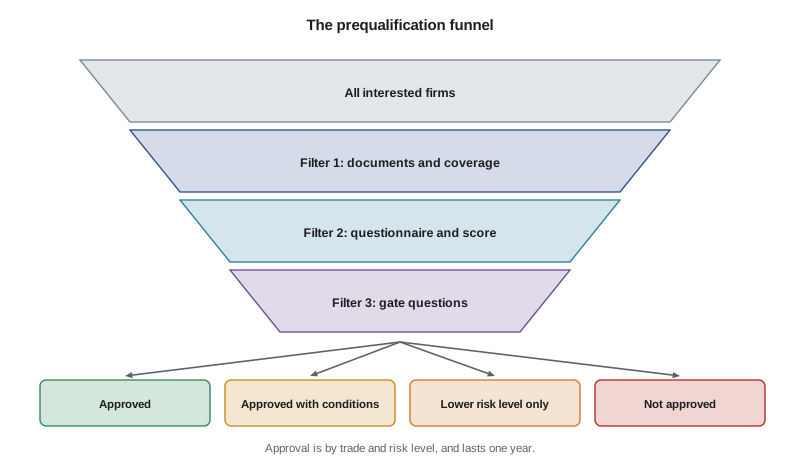
The approved list is organized by trade and by risk level. A firm approved for low-risk work, such as delivering parts or calibrating scales, is not automatically approved for medium- or high-risk work. A roofing contractor approved for high-risk roof work is not approved for confined space entry unless it has shown that capability too. Approval lasts a year, after which the firm must renew with current documents and its performance rating from any work done at the plant.
What to ask for
The information requested increases with the risk level. For low-risk work, Harrowgate Foods Inc. asks only for proof of workers' compensation coverage and liability insurance, a contact name and the firm's agreement to follow site rules. For medium- and high-risk work, it asks for a completed safety questionnaire with supporting documents. The questionnaire has six parts:
- Company information: legal name, ownership, years in business, trades, size, regions served and a safety contact.
- Safety program: the written program, policies for the high-risk activities the firm does, how it trains and supervises workers, how it investigates incidents and how it manages subcontractors. Participation in an audited safety program, such as one recognized under OSHA SHARP or VPP is strong evidence of an audited program.
- Safety record: for the last three years, hours worked, recordable injuries, cases with days away, restricted or transferred work, fatalities, and any OSHA citations, with the firm's experience modification rate (EMR) history and copies of its OSHA 300A summaries.
- Competence: the training and certifications held by workers and supervisors for the trades and high-risk activities the job involves, such as refrigeration technician, electrician, welding, fall protection or confined space.
- Subcontracting: whether the firm uses subcontractors, how it selects and controls them, and its agreement to name them in advance.
- Documents: a certificate of insurance showing workers' compensation and liability coverage, certificates of liability insurance and references from at least two clients for similar work.
an audited safety program, such as one recognized under OSHA SHARP or VPP is useful evidence but not the only kind. OSHA's Safety and Health Achievement Recognition Program, SHARP, recognizes small businesses that have had a comprehensive on-site consultation and run an effective program, and the Voluntary Protection Programs, VPP, recognize worksites with excellent programs. Many contractors have neither, because both are site-based, so Harrowgate Foods Inc. also accepts an audit of the firm's program by a qualified third party or by the company itself.
Reading safety statistics
Safety statistics are the most requested and most misunderstood part of prequalification. They are lagging indicators: they measure harm that has already happened, and for small firms they can be dominated by chance. They are still useful, as long as the host understands what each one measures and treats it as one input among several.
The most common rate is the total recordable incident rate (TRIR), the number of OSHA recordable cases multiplied by 200,000 and divided by the hours worked. The 200,000 represents 100 full-time workers working 40 hours a week for 50 weeks. The DART rate uses the same formula with only cases involving days away from work, restricted work or job transfer, so it focuses on more serious injuries.
The experience modification rate (EMR) compares a firm's actual workers' compensation losses with the losses expected for a firm of its size in its industry, usually over three policy years ending a year before the current one. An EMR of 1.0 is average; below 1.0 means better than expected, and above 1.0 worse. Many owners set a ceiling, such as 1.0 or 1.2, for high-risk work. EMR lags by a year or more and is calculated in a way that makes small firms' numbers swing widely after a single claim.
# Compare three refrigeration contractors bidding on the valve station job
firms = {
    # name: (hours over 3 yrs, recordables, serious cases, experience modifier, audited program)
    "Northline":  (186000, 3, 1, 0.86, True),
    "Polar Mech": (412000, 14, 6, 1.12, True),
    "IceTech":    (38000, 1, 1, 0.95, False),
}
for name, (hrs, rec, dart, emr, audited) in firms.items():
    trir = rec * 200000 / hrs
    dartr = dart * 200000 / hrs
    print(f"{name:<11} recordable rate {trir:4.2f}  serious-case rate {dartr:4.2f}  modifier {emr:.2f}  audited {audited}")

# How much would one more recordable move each firm's rate?
for name, (hrs, rec, *_ ) in firms.items():
    change = 200000 / hrs
print(f"one more recordable adds {change:.2f} to {name}'s rate")Northline recordable rate 3.23 serious-case rate 1.08 modifier 0.86 audited True Polar Mech recordable rate 6.80 serious-case rate 2.91 modifier 1.12 audited True IceTech recordable rate 5.26 serious-case rate 5.26 modifier 0.95 audited False one more recordable adds 1.08 to Northline's rate one more recordable adds 0.49 to Polar Mech's rate one more recordable adds 5.26 to IceTech's rate
The output shows why rates need care. IceTech's rate is based on only 38,000 hours, so one more injury would add more than five points to it. Its single recordable means almost nothing on its own. Polar Mech has the highest rate and the highest modifier, both based on enough hours to be meaningful, which is a real signal worth asking about. Northline looks best on paper, and it is also the firm whose technician opened a valve on a line the plant was working on last year. The numbers did not capture that, because no one was hurt.
Elena's rule for the program is that statistics open conversations; they do not close them. A high rate leads to questions about what happened and what changed. A low rate for a firm with few hours is treated as no information. And a firm's own near misses and incidents on the host's site, recorded in Lesson 11's performance ratings, are given more weight than numbers from elsewhere.
Scoring and decisions
Harrowgate Foods Inc. scores each medium- and high-risk questionnaire out of 100, with points for the safety program, the record, competence, subcontractor management and references. Elena's team does the scoring, not purchasing, and the score is recorded with notes. The thresholds lead to one of four decisions:
- Approved at the requested risk level, for one year.
- Approved with conditions, such as a requirement to provide a site-specific safety plan, to have a supervisor on site at all times or to accept more frequent audits.
- Approved at a lower risk level only, for example for medium-risk work but not high.
- Not approved, with the reasons recorded and the firm told what it would need to change to reapply.
Scoring is not purely mechanical. Some answers are gates: a firm with a fatality or a serious prosecution in the last three years, or one that cannot show training for the high-risk activity it will perform, is not approved for that work whatever its score. Equally, a small firm with a short record and no audit may still be approved with conditions if its owner can show competence and a sound, practical program. Many excellent specialist contractors are small, and a program that excludes every small firm will end up with fewer good choices, not more.
Checking what contractors say
Questionnaires are self-reported. Most contractors answer honestly, but some exaggerate and some simply do not know their own numbers. Harrowgate Foods Inc. checks a sample of answers for every high-risk approval and all answers for any firm with a score close to a threshold:
- OSHA 300A summaries can be compared with the rates reported in the questionnaire.
- OSHA's establishment search can show inspection and citation history.
- EMR letters from the firm's insurer or rating bureau can be requested.
- Certificates of insurance can be confirmed with the issuing agent.
- References are called, not just collected, with specific questions about safety performance on similar work.
- Training certificates for key workers are checked against the issuer's records when possible.
Some companies use third-party prequalification services, which collect contractors' documents, verify some of them and score firms against the host's criteria. They can save time, especially for hosts with hundreds of contractors, and many contractors already maintain a profile with one or more of them. They do not replace the host's judgment. The host still decides the criteria, reviews the high-risk approvals and adds what no outside service can know: how the firm actually performed on the host's own site. Harrowgate Foods Inc. decided that, with fewer than a hundred contractors a year, it would run prequalification itself but accept current documents from such services where a contractor already had them.
Prequalifying subcontractors
Coastal was never prequalified because nobody knew it existed. The new program closes that gap in two ways. First, every high-risk bid must name all subcontractors the bidder intends to use, and each named subcontractor must be prequalified for its part of the work before the contract is awarded. Second, the contract forbids adding unnamed subcontractors without the host's written approval. Lesson 10 covers the management of subcontractors on site.
Jen MacLeod, Bayview's site supervisor, was supportive. Bayview had been caught out by Coastal too: it had subcontracted the steelwork in a hurry when its own welder was injured elsewhere, and had not checked Coastal's program. 'If you had asked us to name them,' she told Elena, 'we would have had to think about it, and we would not have used them.' Coastal's owner was later invited to apply for prequalification and was approved for low-risk work with conditions, after showing a new hot work procedure and fire watch training for its crew.
Worked problem
Prequalifying the duct cleaning contractors
Show solution
- The duct cleaning job, rescoped as high risk in Lesson 4, needed a firm with documented confined space entry capability.
- Four firms applied. One could not provide current workers' compensation documents and was stopped at the first filter. Another had no written confined space program and failed a gate question.
- The remaining two scored 78 and 71 out of 100. The firm scoring 71 had a strong program but a short record; it was approved for medium-risk work only.
- The firm scoring 78 was approved at high risk with two conditions: a site-specific confined space plan reviewed by Elena's team, and a rescue team on standby whenever an entry was under way.
Answer: Prequalification left one firm approved for the high-risk job, with conditions that addressed its specific hazards. Purchasing could still negotiate price, but only with that firm, or by approving another firm first.
Common mistakes
MistakeAssessing safety after price is known.
InsteadPrequalify before inviting quotes, or score safety separately from price.
MistakeTreating a low injury rate from a small firm as proof of safety.
InsteadRecognize that rates based on few hours carry little information.
MistakeApproving a firm for all work because it passed once.
InsteadApprove by trade and risk level, and renew each year.
MistakeRelying on self-reported answers without checking.
InsteadVerify a sample of answers and call references.
MistakePrequalifying only the firms the host hires directly.
InsteadRequire bidders to name subcontractors and prequalify them too.
Summary and key terms
- Prequalification checks a contractor's program, record, competence and documents before it is invited to bid.
- Safety is assessed before price, and the approved list is organized by trade and risk level.
- Questionnaires cover company information, safety program, record, competence, subcontracting and documents.
- TRIR, DART and EMR are useful but lagging, and unreliable for small firms.
- Scores lead to approval, approval with conditions, approval at a lower level or refusal, with gate questions that override scores.
- Answers are verified, third-party services can help but do not replace judgment, and subcontractors are prequalified too.
- Prequalification
- Checking a contractor's ability to work safely before inviting it to bid.
- TRIR
- Recordable injuries normalized to a standard number of hours, usually 200,000.
- EMR
- A measure of a firm's workers' compensation claims experience compared with similar firms.
- Audited program
- Evidence that a contractor's safety program has been audited against a recognized standard.
- Gate question
- A prequalification question whose answer can stop approval whatever the total score.
Practice problems
Work each problem on paper first, then reveal the answer to check.
A firm reports 4 recordables in 250,000 hours. What is its rate per 200,000 hours?
Show answer
4 × 200,000 / 250,000 = 3.2.
Why does IceTech's rate tell the plant very little?
Show answer
It is based on only 38,000 hours, so one injury moves the rate by more than five points.
Name the four possible prequalification decisions.
Show answer
Approved, approved with conditions, approved at a lower risk level, not approved.
Give an example of a gate question.
Show answer
A fatality or serious prosecution in the last three years, or no training for the high-risk activity.
How does the program prevent another unknown subcontractor arriving?
Show answer
Bidders must name and prequalify all subcontractors, and adding unnamed ones needs written approval.
Lesson quiz · 5 questions
Score 60% or more to complete this lesson.
Create a free account to save your progress, take quizzes and earn a certificate.