
HSE-341 · Lesson 9 of 12 · 23 min
Refusals, ID checks, returns and shoplifting without confrontation
Many of the most tense moments in a store come from situations where a worker has to say no or deal with suspected theft: refusing a sale of alcohol, tobacco or cannabis, declining a return, enforcing a limit, or noticing that someone is leaving with goods they have not paid for. These situations are predictable, which means the store can plan for them. This lesson covers how to handle refusals and suspected theft in ways that follow the law and keep workers safe. The core message is simple: no worker should ever risk injury over merchandise.
Age-restricted sales
Selling alcohol, tobacco and vaping products, cannabis (in licensed cannabis stores), lottery tickets and some other products to minors is against the law, and stores and workers can face fines and license suspensions. In Washington the legal age is 21 for alcohol and cannabis, and federal law has set 21 as the minimum age for tobacco and vaping products since 2019. Northfield's policy is to ask for ID from anyone who looks under 30. Refusals are one of the most common triggers of customer aggression, as Riverside's incidents in Lesson 7 showed.
Good practice reduces conflict at the point of sale:
- Post clear signs at the entrance and counter stating the legal age and that ID is required, so the request does not feel personal.
- Ask every customer who looks under the store's threshold, consistently. Customers are less likely to feel singled out if they see others asked too.
- Use neutral language: "I need to see ID for this, it's the law." Avoid jokes or comments about the person's appearance.
- Let the point-of-sale system prompt for ID and record refusals.
- Refuse politely and briefly if there is no valid ID, and offer to hold the rest of the order: "I'm sorry, I can't sell this without ID. I can still ring up the rest for you."
- Refuse alcohol sales to anyone who appears intoxicated, which is also required under liquor laws.
- Do not argue about whether the ID is fake. If unsure, refuse the sale and let the customer leave.
- Have backup nearby during evening shifts, when refusals are most likely to lead to aggression.
If a customer becomes aggressive after a refusal, use the skills from Lesson 8: acknowledge, explain the reason, offer what you can, and disengage if they threaten or become violent. Never complete the sale to make an angry customer go away; it puts the worker and the store at legal risk and teaches the customer that aggression works. Instead, bring in a supervisor, who should back up the refusal.
Returns and refunds
The customer service desk is where many of Northfield's incidents happen, and returns are a major reason. Disputes arise over missing receipts, opened or used items, items past the return period, and suspected return fraud. A clear, well-posted returns policy, applied consistently, prevents many arguments. Workers should be given some flexibility to resolve simple cases and a fast route to a supervisor for anything else. Explaining the reason for a rule ("we can't resell opened food") and offering alternatives (an exchange, store credit, a manufacturer's warranty) usually goes further than repeating the policy.
Suspected return fraud, such as returning stolen goods, should be handled by declining the return politely and recording it, not by accusing the customer or trying to hold them. Loss prevention can investigate later using receipts, video and records.
Limits, bag checks and other rules
Purchase limits during shortages, bag checks at the exit, rules about bringing in outside drinks and similar policies all create friction. Rules that frontline workers must enforce should be clearly posted, explained when possible, applied consistently and supported by supervisors. Many retailers now treat exit bag or receipt checks as voluntary, and workers should never physically stop a customer who declines a check.
Shoplifting: why workers should not intervene
Shoplifting is common and, as Lesson 1 noted, rising in both countries. It is frustrating for staff to watch people take goods. But confronting, chasing or trying to hold a shoplifter is one of the most dangerous things a store worker can do. People caught in the act may panic, fight, pull a weapon or drive off with a worker clinging to a vehicle. Workers have been seriously injured and killed in such incidents. Grant De Patie, whose death led to British Columbia's late-night retail rules, was killed trying to stop a driver who had taken fuel without paying.
For this reason, most large retailers now have policies that frontline workers must not chase, detain, search or physically confront suspected shoplifters, and some have dismissed staff who did so, which itself caused controversy. The intent of these policies is safety: the cost of a stolen item is never worth a worker's injury. Stores that use trained loss prevention or security staff to detain suspects should limit that role to those staff, under strict rules.
What workers can do instead
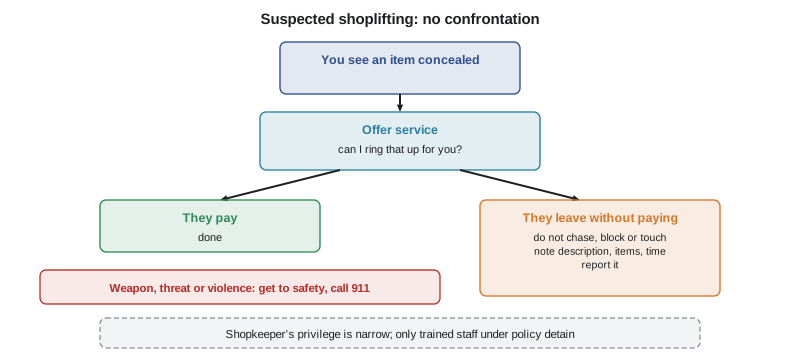
The best response to shoplifting is prevention and good customer service, not confrontation:
- Greet customers and offer help. People who intend to steal often leave when staff are attentive.
- Keep high-theft items in view of staff, in locked cases or behind the counter.
- If you see someone conceal an item, approach with customer service, not accusation: "Can I help you find anything else?" or "I can ring that up for you here." This gives them a chance to pay without losing face.
- If they leave without paying, let them go. Note the time, description, items and direction, and report it to the supervisor or loss prevention.
- Never block a doorway or stand in front of a moving vehicle.
- Call 911 if there is violence, a weapon or a threat to anyone.
The legal position
In the United States, most states have a shopkeeper's privilege that allows a merchant or employee to detain a person suspected of shoplifting for a reasonable time and in a reasonable manner, if they have reasonable grounds, so that police can be called. Washington's version is in RCW 4.24.220, which protects merchants from civil liability for detentions that meet those conditions. The privilege is narrow: it does not allow excessive force, unreasonable searches, long detentions or detentions without good grounds, and mistakes can lead to lawsuits for false imprisonment, assault or malicious prosecution. The existence of the privilege does not mean frontline workers should use it, and Northfield's policy is that they must not.
Group thefts and organized retail crime
Some retailers report more incidents where groups enter together, take large amounts of merchandise and threaten staff who get in the way. These incidents are frightening and can feel like robberies. The same rules apply: do not intervene, get to a safe place, call 911 if there is a threat, and report. Stores that face repeated group thefts should work with police, review layouts and product security, and consider security staff, rather than expecting frontline workers to respond. Locking high-value goods in cases reduces theft but can increase friction when customers have to wait for staff to open them, so it needs enough staff to work well.
Analyzing refusals and incidents
Refusals can be logged by the point-of-sale system or on a simple form. Comparing refusals with incident reports shows which refusals most often lead to aggression and when, so backup can be planned. The program below does that for a month of synthetic Riverside data.
# Refusals and aggression at Riverside Corner Market over one month (synthetic data).
import random
random.seed(19)
kinds = ["alcohol", "tobacco", "lottery", "return"]
hours = list(range(6, 24))
refusals = []
for _ in range(240):
    k = random.choices(kinds, weights=[45, 35, 10, 10])[0]
    h = random.choices(hours, weights=[1,1,1,2,2,2,3,3,3,3,4,5,6,7,8,8,6,4])[0]
    p = 0.03 + (0.06 if h >= 20 else 0) + (0.03 if k == "alcohol" else 0)
    refusals.append((k, h, random.random() < p))
print(f"Refusals: {len(refusals)}, followed by aggression: {sum(a for _, _, a in refusals)}")
for k in kinds:
    sub = [a for kk, _, a in refusals if kk == k]
    print(f"  {k:<8} {len(sub):3d} refusals, {sum(sub):2d} aggressive ({100 * sum(sub) / len(sub):4.1f}%)")
for label, lo, hi in [("06-14", 6, 14), ("14-20", 14, 20), ("20-24", 20, 24)]:
    sub = [a for _, h, a in refusals if lo <= h < hi]
print(f" {label} {len(sub):3d} refusals, {sum(sub):2d} aggressive ({100 * sum(sub) / len(sub):4.1f}%)")Refusals: 240, followed by aggression: 13 alcohol 120 refusals, 7 aggressive ( 5.8%) tobacco 77 refusals, 3 aggressive ( 3.9%) lottery 15 refusals, 0 aggressive ( 0.0%) return 28 refusals, 3 aggressive (10.7%) 06-14 53 refusals, 2 aggressive ( 3.8%) 14-20 103 refusals, 4 aggressive ( 3.9%) 20-24 84 refusals, 7 aggressive ( 8.3%)
The pattern in this synthetic month is the one Riverside's real incidents suggested. Most refusals are for alcohol and tobacco, and the share that lead to aggression roughly doubles after 8 p.m., from about 4% to about 8%. Alcohol refusals account for more aggressive incidents than any other kind. Refused returns have the highest share of all, but the numbers are small (3 of 28), so one more month of data would be needed before reading much into it. The data support a simple rule: after 8 p.m., the worker making a refusal should have backup at the front, and the second worker should not be stocking in the back during the busiest refusal hours.
Self-checkouts and age checks
Self-checkouts add a twist. Age-restricted items trigger an approval request that brings the attendant to the customer, often after the customer has scanned everything and is ready to pay. The customer may already be frustrated by machine errors, and the attendant arrives to refuse the sale. Stores can reduce friction by posting age policies at the self-checkout entrance, having the attendant check ID early when a customer arrives with age-restricted items, keeping the attendant station within easy reach of a supervisor, and making sure attendants are not covering so many machines that they cannot respond calmly. The same rules apply as at a staffed checkout: neutral language, consistent checks, no exceptions under pressure and backup when needed.
For supervisors: back the refusal
When a worker refuses a sale or a return correctly and the customer asks for a manager, support the worker's decision in front of the customer. If you decide to make an exception, such as accepting a return outside policy, make it clear it is your decision and do not suggest the worker was wrong. Never overrule a refusal of an age-restricted sale. Afterwards, thank the worker and check how they are. Workers who are undermined after enforcing a rule learn not to enforce it, or to avoid the situation.
Worked problem
A theft at closing
Ten minutes before closing at Riverside, a customer puts two cases of beer by the door, then walks out carrying them without paying. Jordan, the worker at the counter, starts to follow him to the parking lot to get the license plate. What should Jordan do instead?
Show solution
- Stop. Do not follow the customer outside or approach the vehicle.
- From inside, note what can be seen safely: description, items, time, direction and vehicle if visible through the window.
- Lock the door if it is closing time, and tell the co-worker on shift.
- Report to the manager and to police through the non-emergency line, or 911 if there was a threat or weapon.
- Write an incident report and keep any receipts or video references.
Answer: Jordan should stay inside, observe from a safe place and report. Following a thief into a dark parking lot puts Jordan at risk for two cases of beer.
Common mistakes
MistakeCompleting an age-restricted sale to calm an angry customer.
InsteadKeep the refusal, call a supervisor and use de-escalation skills.
MistakeAsking for ID only from some customers based on how they look.
InsteadApply the age policy consistently to everyone under the threshold.
MistakeChasing or blocking a shoplifter.
InsteadLet them go, observe from a safe place and report.
MistakeAccusing a customer of stealing in front of others.
InsteadOffer customer service, such as offering to ring up the item.
MistakeRelying on the law allowing arrests or detention as permission for staff to intervene.
InsteadFollow store policy; frontline workers should not detain or confront anyone.
Summary and key terms
- Refusals, returns, limits and theft are predictable triggers; plan for them.
- In Washington the legal age for alcohol and cannabis is 21, and 21 for tobacco under federal law; use clear signs, consistent ID checks and neutral language.
- Never complete a refused sale to calm a customer; call a supervisor.
- Clear return policies, explained reasons and alternatives prevent many desk disputes.
- Frontline workers should never chase, detain, search or confront shoplifters.
- The shopkeeper’s privilege (RCW 4.24.220 in Washington) allows limited detentions, but force and mistakes carry legal risk, and store policy should forbid frontline detentions.
- Log refusals and incidents to plan backup at the riskiest times.
- Age-restricted product
- A product that may not be sold below a legal minimum age, such as alcohol, tobacco or cannabis.
- Return fraud
- Returning stolen, used or fake items to obtain refunds dishonestly.
- Arrest or detention by a merchant
- A reasonable detention of a suspected shoplifter for a reasonable time, allowed under a state shopkeeper’s privilege.
- Loss prevention
- Store staff or systems that reduce theft and fraud.
- Organized retail crime
- Theft by groups who steal goods for resale, sometimes using threats.
Practice problems
Work each problem on paper first, then reveal the answer to check.
What is the legal age for alcohol and cannabis in Washington?
Show answer
21; federal law also sets 21 for tobacco and vaping products.
Give three ways to reduce conflict during ID checks.
Show answer
Any three of: clear signs, consistent checks, neutral language, POS prompts, offering to ring up the rest, backup nearby in the evening.
Why should a worker never complete a refused sale to calm an angry customer?
Show answer
It is illegal, creates risk for the worker and store, and teaches that aggression works.
What should a worker say if they see someone conceal an item?
Show answer
Offer service, for example: can I ring that up for you here?
What does the shopkeeper’s privilege allow?
Show answer
A reasonable detention, for a reasonable time and in a reasonable manner, of a person suspected on reasonable grounds of shoplifting.
What legal claims can follow a mistaken or forceful detention?
Show answer
False imprisonment, assault or malicious prosecution.
What should workers do during a group theft?
Show answer
Not intervene, get to safety, call 911 if threatened, and report.
In the refusal data, when was aggression most likely?
Show answer
After 8 p.m., especially after alcohol refusals.
Lesson quiz · 5 questions
Score 60% or more to complete this lesson.
Create a free account to save your progress, take quizzes and earn a certificate.