
HSE-341 · Lesson 8 of 12 · 25 min
De-escalation skills
De-escalation means using words, body language and positioning to help an upset person calm down, while keeping yourself and others safe. It is a skill, not a personality trait, and it can be learned and practiced. In stores it works best early, during the anxiety and early escalation stages from Lesson 7, and it works best when the worker has backup nearby and a clear way to step away. This lesson describes practical de-escalation skills for the counter, the service desk and the sales floor. HSE-108 covers the principles in general terms; here the focus is on what to say and do in common retail situations.
De-escalation is not about winning, giving in to every demand, or putting up with abuse. Sometimes the right answer is still no. The aim is to deliver that answer, or find an alternative, in a way that lowers the temperature, and to recognize quickly when the situation is beyond talking and it is time to disengage.
Start with yourself
The first person to calm is yourself. When someone shouts at us, our bodies react: heart rate rises, breathing quickens, muscles tense, and our thinking narrows. That reaction is normal, but it makes it harder to listen and easier to snap back. A few habits help:
- Take a slow breath before responding. A pause of a second or two feels long but rarely is.
- Remind yourself that the anger is usually about the situation, not about you personally.
- Keep your goal in mind: safety first, then a reasonable outcome.
- Watch for signs that you are getting defensive, sarcastic or louder, and adjust.
- If you feel you are losing your own temper, hand over to a co-worker or supervisor. That is good practice, not failure.
Body language and positioning
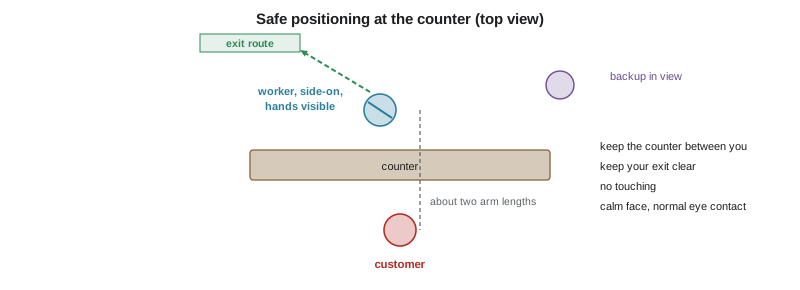
People read body language faster than words, and an upset person is especially alert to signs of hostility or dismissal. Calm, open body language helps, and good positioning keeps you safe if things go wrong.
- Stand slightly side-on rather than squarely facing the person. It looks less confrontational and keeps your body protected.
- Keep your hands visible and relaxed, at waist height or resting on the counter. Avoid crossing your arms, pointing, or putting hands on hips.
- Give space. A distance of 3 to 6 ft (about 1 to 2 m), or at least two arm lengths, is comfortable for most people and gives you time to react. Some people need more space when upset.
- Keep a barrier such as the counter between you where possible, and do not step around it to approach an angry customer.
- Know where your exit is, and do not let the person get between you and it. Avoid being backed into a corner or a small room.
- Do not touch an upset person, even with good intentions; touch is easily misread.
- Keep your face calm and attentive. Make normal eye contact without staring.
What to say
Words matter, but tone, volume and pace often matter more. Speak a little slower and lower than usual, keep sentences short, and use the person's name if you know it. Some techniques that work well in stores:
| Technique | What it sounds like | Why it helps |
|---|---|---|
| Acknowledge the feeling | "I can see you're frustrated. I would be too after waiting that long." | People calm down when they feel heard |
| Listen and paraphrase | "So the price at the shelf was lower than what rang up, and you want it matched." | Shows you understand and checks the facts |
| Apologize for the situation | "I'm sorry this happened." | Expresses regret without admitting fault or arguing |
| Explain the reason | "We have to see ID for every sale like this; we can be fined or lose our license otherwise." | Reasons make rules feel less personal |
| Offer choices | "I can do an exchange today, or the supervisor can review a refund." | Choices give back some control |
| Focus on what you can do | "Here is what I can do for you." | Moves away from what is not possible |
| Set a clear limit | "I want to help, and I need you to stop swearing so we can sort this out." | Names the behavior without attacking the person |
| Bring in someone else | "Let me get my supervisor, who can look at this with you." | A fresh face often resets the conversation |
Phrases to avoid include "calm down" (which usually has the opposite effect), "that's not my problem", "you have to", "I already told you" and "there's nothing I can do". Avoid arguing about facts in the heat of the moment, correcting the customer in front of others, or threatening consequences you cannot or will not carry out.
Setting limits
De-escalation does not mean accepting abuse. When a customer swears at, insults or threatens a worker, it is reasonable to set a limit: name the behavior, say what needs to change, and say what will happen if it does not. For example: "I want to help you, but I won't be spoken to like that. If the swearing continues, I'll need to end this conversation and ask my supervisor to take over." Then follow through calmly. Limits work best when the store's policy supports them and workers know they will be backed up. Store signs that state abuse of staff is not tolerated help set expectations.
Backup and the tag team
One of the most effective de-escalation tools in a store is another person. A supervisor or co-worker who steps in can bring authority, a fresh start and a witness. Many stores use a simple code word or phrase over the radio or intercom, such as a request for a particular manager by a name nobody actually has, to summon help without alarming the customer. The person who responds should approach calmly, introduce themselves, and take over the conversation if appropriate, while the first worker steps back. Backup should not crowd the customer or create a show of force, which can escalate things. Two calm people are usually enough.
When to disengage
De-escalation has limits. Stop trying to resolve the issue and focus on safety when:
- the person makes a threat, mentions a weapon or shows one;
- the person throws items, damages property or makes physical contact;
- the person blocks your exit or follows you;
- you feel unsafe, even if you cannot say exactly why;
- the person appears to be in a mental health or drug-related crisis and is not responding to calm talk.
Disengaging means saying something short and neutral if you can ("I'm going to get help with this"), stepping back to a safe place, alerting co-workers, and calling security or 911 if there is a risk to anyone. It does not mean leaving the person alone with other workers or customers in danger. A worker who steps away from an abusive customer is following good practice, and store policy should say so.
Calling for outside help
Call 911 when someone is hurt, a weapon is shown or mentioned, a person is violent or threatening violence, or a person appears to be at risk of harming themselves or others. For a person in a mental health crisis who is not violent, some communities have crisis lines or mobile crisis teams that can respond, and some police services pair officers with mental health workers. In Canada and the United States, 988 is now a national suicide and crisis line that can be called or texted. Stores should know the local options and include them in their procedures.
Choosing a response
A simple decision path helps new workers remember the order of priorities: safety first, then calm, then resolve. The program below turns that into a small decision tree and runs it on a few invented situations. Real situations are messier, but the order of the questions is the key point.
# A simple de-escalation decision path (teaching aid; situations are invented).
def respond(s):
    if s.get("weapon") or s.get("violence") or s.get("someone hurt"):
        return "Get to safety, call 911, warn others. Do not engage."
    if s.get("threat") or s.get("blocking exit") or s.get("following"):
        return "Disengage: short neutral words, step back behind the counter, call backup or 911."
    if s.get("abusive language"):
        if s.get("limit already set"):
            return "Follow through: end the conversation, hand over to supervisor, call security if needed."
        return "Set a clear limit, offer to help if it stops, call backup to stand by."
    if s.get("in crisis") and not s.get("responding to calm talk"):
        return "Give space, keep others away, call crisis line or 911 if anyone is at risk."
    if s.get("frustrated"):
        return "Acknowledge, listen, explain, offer choices; bring in a supervisor if stuck."
    return "Serve as normal."
cases = {
    "Long line, customer annoyed":           {"frustrated": True},
    "Refused return, swearing (first time)": {"frustrated": True, "abusive language": True},
    "Swearing continues after limit":        {"abusive language": True, "limit already set": True},
    "Says he will wait outside":             {"threat": True},
    "Confused, shouting at no one":          {"in crisis": True, "responding to calm talk": False},
    "Throws a bottle at the counter":        {"violence": True},
}
for name, s in cases.items():
print(f"{name:<40} -> {respond(s)}")Long line, customer annoyed -> Acknowledge, listen, explain, offer choices; bring in a supervisor if stuck. Refused return, swearing (first time) -> Set a clear limit, offer to help if it stops, call backup to stand by. Swearing continues after limit -> Follow through: end the conversation, hand over to supervisor, call security if needed. Says he will wait outside -> Disengage: short neutral words, step back behind the counter, call backup or 911. Confused, shouting at no one -> Give space, keep others away, call crisis line or 911 if anyone is at risk. Throws a bottle at the counter -> Get to safety, call 911, warn others. Do not engage.
The order matters. A customer who swears and makes a threat is handled as a threat, not as a language problem. A customer in crisis who is calming with quiet talk can be supported; one who is not responding needs space and outside help. The tree also shows the follow-through on limits: setting a limit only works if the worker and the store act on it.
After the interaction
Even a successful de-escalation can leave a worker shaken. A short break, a check-in from a supervisor and a chance to talk it over help. The incident should be reported, even if nothing physical happened, so the store can see patterns. If the customer was banned or is likely to return, affected workers should be briefed on what to do. Lesson 11 covers support after more serious incidents.
Training
De-escalation skills improve with practice. Good training uses realistic store scenarios, short role-plays in a supportive setting, and discussion of what worked in real incidents. Several commercial programs teach verbal de-escalation, and many regulators and retail associations publish free materials. Whatever program is used, training should match the store's procedures, include when to disengage and how to call for help, and be refreshed regularly. Training is one control among many; it does not replace staffing, design and policy.
For supervisors: be the backup you would want
When a worker signals for help, go promptly and calmly. Introduce yourself to the customer, listen, and take over if that helps. Do not undermine the worker in front of the customer by overruling a correct decision; if a policy exception is appropriate, explain it as your decision. Afterwards, check on the worker, thank them for how they handled it and make sure the incident is reported. Workers who know their supervisor will back them up handle difficult customers more calmly.
Worked problem
A self-checkout dispute
At Northfield's self-checkouts, the attendant, Omar, sees that a customer's bag contains an item that was not scanned. When Omar mentions it, the customer says loudly that Omar is calling him a thief, and other customers turn to look. How should Omar de-escalate?
Show solution
- Stay calm and lower his voice; keep a comfortable distance and his hands visible.
- Avoid accusation: 'I'm not saying that at all. These machines miss items often. Let's check it together.'
- Offer a face-saving option: 'I can scan it for you here, or if you'd prefer not to buy it, that's fine too.'
- If the customer keeps escalating, call the front-end supervisor using the store's code phrase.
- If the customer leaves with the item, let him go. Do not block or follow him; note what happened and report it (Lesson 9).
Answer: Neutral language, a face-saving option and backup if needed give the best chance of a calm outcome. Omar should never block or chase the customer.
Common mistakes
MistakeTelling an upset customer to calm down.
InsteadAcknowledge the feeling, listen and speak calmly and slowly.
MistakeStepping around the counter to talk face to face with an angry customer.
InsteadKeep the counter between you, stand side-on and keep your exit clear.
MistakePutting up with continued abuse to keep the customer happy.
InsteadSet a clear limit and follow through, with supervisor backup.
MistakeSending several staff to surround a customer.
InsteadUse one or two calm people; a show of force can escalate.
MistakeContinuing to negotiate after a threat.
InsteadDisengage, get to safety and call for help.
Summary and key terms
- De-escalation uses words, body language and positioning to calm an upset person while staying safe.
- Calm yourself first; hand over if you are losing your temper.
- Stand side-on, keep hands visible, give 3 to 6 ft (about 1 to 2 m) of space, keep a barrier and keep your exit clear.
- Acknowledge, listen, explain, offer choices and focus on what you can do; avoid phrases like calm down.
- Set clear limits on abuse and follow through with supervisor backup.
- Use a code word to call calm backup; disengage at threats, weapons, violence or blocking.
- Call 911 for danger; know local crisis options such as 988.
- De-escalation
- Using communication and positioning to reduce a person’s agitation and the risk of violence.
- Side-on stance
- Standing at an angle to a person rather than squarely facing them.
- Paraphrasing
- Repeating back what someone said in your own words to show understanding.
- Limit setting
- Naming unacceptable behavior, saying what needs to change and what will happen if it does not.
- Code word
- A phrase used over the radio or intercom to summon help without alarming the customer.
- Disengage
- Stop trying to resolve an issue and move to safety when a situation is beyond talking.
Practice problems
Work each problem on paper first, then reveal the answer to check.
What is the first person to calm in a difficult interaction?
Show answer
Yourself.
Give three features of safe body language and positioning.
Show answer
Any three of: side-on stance, visible relaxed hands, 3 to 6 ft (about 1 to 2 m) of space, counter as barrier, exit clear, no touching, calm face.
Why should workers avoid saying calm down?
Show answer
It usually makes people angrier.
Give an example of acknowledging a customer’s feeling.
Show answer
For example: I can see you’re frustrated; I would be too after waiting that long.
What are the three parts of setting a limit?
Show answer
Name the behavior, say what needs to change and say what will happen if it does not.
Why use a code word to call backup?
Show answer
It summons help without alarming the customer.
List three situations where a worker should disengage.
Show answer
Any three of: threat, weapon, violence or contact, blocking or following, feeling unsafe, crisis not responding to calm talk.
What national crisis line now operates in both Canada and the United States?
Show answer
988, by call or text.
Lesson quiz · 5 questions
Score 60% or more to complete this lesson.
Create a free account to save your progress, take quizzes and earn a certificate.