
HSE-320 · Lesson 7 of 12 · 29 min
Electrical rooms and power distribution awareness
Electricity is the reason a data center exists and its most serious hazard. A large hall can draw tens of megawatts, delivered through switchgear, transformers, uninterruptible power supplies, busway and cables that are energized every hour of every year. Most people who work in a data center will never open an electrical panel, but almost all of them will work near energized equipment, plug and unplug servers, walk past electrical rooms and stand within reach of an emergency power off button. This lesson gives you the awareness to do that safely. It is not training to work on electrical equipment.
If your job involves electrical work, you need more than this lesson. HSE-214, Electrical Safety Awareness, covers how electricity injures people. HSE-224, Working On or Near Energized Electrical Systems, covers approach boundaries, arc flash risk assessment, energized work permits and protective equipment in general. HSE-321, Electrical Safety in Critical Facilities, applies those rules to the UPS systems, switchgear and busway of data centers. DCE-310 and DCE-340 explain the design of the power systems themselves.
The power chain
Power reaches a server through a chain of equipment. The figure below shows a simplified version. Real facilities have two or more independent paths, usually called A and B, so that any one piece of equipment can be maintained or can fail without dropping the load.
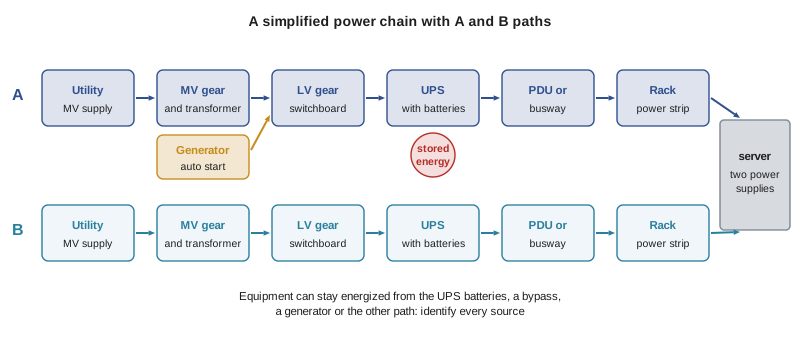
Starting from the utility, the chain usually runs as follows. A medium-voltage service, often several thousand to tens of thousands of volts, enters the site at medium-voltage switchgear. Transformers step it down to low voltage, typically 600 V or 347/600 V in Canada and 480 V or 277/480 V in the United States, feeding low-voltage switchgear or switchboards. Standby generators, usually diesel, connect through automatic transfer switches or paralleling switchgear so that they can pick up the load if the utility fails. Uninterruptible power supplies (UPS) sit between the switchgear and the IT load; they convert power to direct current, keep batteries charged and convert it back to alternating current, so that the load keeps running through the seconds it takes generators to start. From the UPS, power flows to power distribution units (PDUs), remote power panels or overhead busway with plug-in tap-off boxes in the data hall, then through rack power strips, often also called rack PDUs, to the servers. Most servers have two power supplies, one fed from the A path and one from the B path.
Some newer AI facilities distribute direct current at higher voltages closer to the rack, and vendors have announced designs that carry much higher DC voltages to the rack itself. These architectures are still emerging as of 2026. They do not change the basic message of this lesson, but they do mean that the equipment labels and procedures in a new hall may differ from what you are used to.
Why data center power is different
Several features of data center power systems make them more hazardous to work around than the electrical system of an ordinary building.
Energy is high everywhere. Large transformers and short cable runs mean high available fault current, which drives arc flash energy. Busway and PDUs in the hall carry hundreds of amperes, and a fault at a tap-off box or a dropped tool across busbars can release a serious arc flash right in the white space.
Equipment stays energized when you might expect it to be dead. The whole point of a UPS is to keep the load running when the utility supply is lost, so switching off an upstream breaker or even losing the utility does not de-energize the equipment downstream. UPS units contain capacitors and batteries that store energy after they are switched off. Batteries are always energized; HSE-322 covers battery systems.
Equipment can be fed from more than one direction. A PDU may be fed from the UPS output, from a static bypass and from a maintenance bypass. A generator may start automatically during a utility outage or a scheduled test. A server's second power supply keeps it running when the first cord is unplugged. Electrical work therefore requires identifying every source, not just the obvious one.
Systems are operated remotely and automatically. Building and electrical power monitoring systems can open and close breakers, transfer loads and start generators without anyone in the room. A transfer can happen during a utility disturbance at any time.
Electrical rooms
Electrical rooms, UPS rooms and switchgear rooms are restricted spaces. Only authorized people should enter, and only for authorized work. Inside, energized equipment is normally enclosed, and with doors and covers closed and properly maintained, the risk to someone walking through is low. The risk rises sharply when covers are removed, doors are opened, equipment is operated or work is done on or near exposed energized parts.
Codes require clear working space in front of electrical equipment, typically at least 3 ft (1 m) deep and more for some higher voltages, so that people can work and escape safely; in the United States, section 110.26 of the National Electrical Code is the usual reference, and the Canadian Electrical Code has corresponding rules. Never store anything in an electrical room or in the working space in front of panels, switchgear or PDUs, even temporarily. Boxes, carts and ladders left in front of electrical equipment slow escape in an emergency and get in the way of the people who need to operate it.
Arc flash labels and approach boundaries
Under CSA Z462 and NFPA 70E, electrical equipment that is likely to be examined, adjusted, serviced or maintained while energized must be labeled with information about its hazards. A typical arc flash label shows the nominal voltage, the arc flash boundary, and either the incident energy at a working distance or the protective equipment category, along with the shock approach boundaries. Labels are prepared by engineers from a study of the electrical system.
| Boundary | What it is | What it means for an unqualified person |
|---|---|---|
| Arc flash boundary | The distance at which incident energy from an arc flash would cause a second-degree burn to bare skin | Do not cross it while equipment is open or being operated unless authorized, protected and escorted |
| Limited approach boundary | A shock protection boundary around exposed energized parts | Do not cross it unless continuously escorted by a qualified person and informed of the hazards |
| Restricted approach boundary | A closer shock boundary where the risk of contact is high | Never cross it; only qualified persons with protection and a plan may do so |
The boundaries matter mainly when equipment is open. If you see a panel with its cover off, a PDU with its door open, a busway tap-off box being installed or electricians in arc-rated clothing working on switchgear, stay back and keep your distance outside the barriers they have set up. If there are no barriers and you are unsure where the boundary is, stay well away and ask.
Qualified and unqualified persons
Both standards distinguish between qualified persons, who have the knowledge, skills and training to recognize and avoid the electrical hazards of specific equipment and tasks, and everyone else. Being a licensed electrician does not automatically make someone qualified for every task; qualification is task- and equipment-specific and is decided by the employer under its electrical safety program. In a data center, many tasks that look simple, such as resetting a breaker on a rack power strip, replacing a power supply, connecting a tap-off box to busway or operating a UPS bypass, may be restricted to qualified persons. Follow your site's rules about who may do what.
Worked problem
The second cord
A server technician is asked to replace a faulty rack power strip on the A side of a rack. The work order says the B side will keep the servers running. As she prepares to unplug the A cords, she notices that the B power strip's display is dark. What should she do?
Show solution
- Stop. A dark display may mean the B strip has no power, in which case unplugging the A cords would shut down the servers.
- Check with operations whether the B path is in maintenance or has failed, and whether the B strip is actually energized.
- Do not proceed until the change owner confirms that the B side is carrying the load and the work can continue under the approved procedure.
- Report the dark display as an issue, even if it turns out to be only a failed display.
Answer: She should stop and confirm the state of the B side before unplugging anything. A procedure that assumes the redundant path is healthy must be checked against the real state of the system before each critical step.
Emergency power off
Many data halls have emergency power off (EPO) buttons near exits. Pressing one disconnects power to the IT equipment in the area, and in some designs also shuts down cooling and closes dampers. EPOs exist so that firefighters and staff can remove power quickly in an emergency such as an electrical fire, a person in contact with energized equipment or a major flood. Their history is tied to NFPA 75 and to NEC Article 645, which have long dealt with disconnecting means for IT equipment rooms; requirements have changed over editions, and some modern facilities have no EPO or have redesigned it.
Accidental EPO activation is a well-known cause of outages: someone leans on the button, mistakes it for a door release, or bumps it with a cart. Most EPOs are now protected by hinged covers and clearly labeled. Know where the EPO buttons are in your work area, never block them, never use them as a door release, and press one only in a real emergency as described in the site's emergency procedure. If you activate one by accident, tell operations at once; do not try to restore power yourself.
Rules for everyone
Whatever your role, a few rules apply to everyone who works near data center power systems:
- Do not open, remove covers from or operate electrical equipment unless you are authorized and qualified for that task.
- Do not plug or unplug equipment from rack power strips except as approved in your work order; adding load can overload a strip or its upstream breaker, and removing a cord can shut down a server if the other path is not healthy.
- Never use rack power strips for power tools, vacuums or heaters; use the convenience receptacles provided, protected by ground fault circuit interrupters where required.
- Keep the working space in front of electrical equipment clear at all times.
- Report damaged cords, scorched outlets, buzzing, burning smells, unusual heat or water near electrical equipment immediately.
- Stay outside barriers around energized work, and outside the arc flash boundary of open equipment.
- Treat every conductor and terminal as energized until a qualified person has proved otherwise.
Establishing an electrically safe work condition
When electrical equipment must be worked on, the preferred approach under CSA Z462, NFPA 70E and OSHA Subpart S is to de-energize it and establish an electrically safe work condition. In outline, a qualified person identifies every source of supply from up-to-date drawings, disconnects each source, verifies a visible break where possible, applies locks and tags under the lockout program, tests for absence of voltage with a properly rated tester verified before and after use, and applies temporary protective grounding where there is a possibility of induced voltage or stored energy. Only then is the equipment safe to work on. In a data center this often depends on transferring the load to another path first, which is why electrical isolation is almost always part of a planned change with a method of procedure, as Lesson 9 explains. HSE-210 covers lockout, and HSE-224 and HSE-321 cover the electrically safe work condition in detail.
Energized work is permitted only in limited circumstances, such as when de-energizing would create a greater hazard or is infeasible because of equipment design or operational limitations, and it requires a justified energized electrical work permit approved under the electrical safety program. The desire to avoid inconvenience or reduced redundancy is not, on its own, a valid justification. Testing and troubleshooting that require equipment to be energized are handled under specific rules in the standards.
# Trace every energy source that can feed a load, walking a simple supply graph
feeds = {
    "Rack strip A": ["PDU A"],
    "PDU A": ["UPS A output", "UPS A maintenance bypass"],
    "UPS A output": ["UPS A rectifier", "UPS A batteries"],
    "UPS A rectifier": ["LV switchgear A"],
    "UPS A maintenance bypass": ["LV switchgear A"],
    "LV switchgear A": ["Transformer A", "Generator 1"],
    "Transformer A": ["Utility MV"],
}
sources = {"Utility MV", "Generator 1", "UPS A batteries"}

def trace(node, seen=None):
    seen = set() if seen is None else seen
    for upstream in feeds.get(node, []):
        if upstream not in seen:
            seen.add(upstream)
            trace(upstream, seen)
    return seen

found = trace("PDU A")
print("Everything upstream of PDU A:", sorted(found))
print("Energy sources to isolate:", sorted(found & sources))
print("Paths into PDU A:", feeds["PDU A"])Everything upstream of PDU A: ['Generator 1', 'LV switchgear A', 'Transformer A', 'UPS A batteries', 'UPS A maintenance bypass', 'UPS A output', 'UPS A rectifier', 'Utility MV'] Energy sources to isolate: ['Generator 1', 'UPS A batteries', 'Utility MV'] Paths into PDU A: ['UPS A output', 'UPS A maintenance bypass']
Even this simplified graph shows three separate energy sources and two paths into a single PDU. Real one-line diagrams are far more complex, which is why isolation is planned by qualified people using current drawings, and why the second cord on a server, a bypass breaker or an automatic generator start can catch out someone who assumed that switching off one breaker made the equipment safe.
Common mistakes
MistakeAssuming equipment is dead because the utility supply or an upstream breaker is off.
InsteadRemember that UPS systems, batteries, bypasses, generators and the B path can keep equipment energized.
MistakeLeaving a cart or boxes in front of a PDU or switchboard for a few minutes.
InsteadKeep working space in front of electrical equipment clear at all times.
MistakePlugging a vacuum or power tool into a spare rack power strip outlet.
InsteadUse the designated convenience receptacles.
MistakeUnplugging the A cords because the work order says the B side will carry the load.
InsteadConfirm the actual state of the B side before each critical step.
MistakeTreating a license as qualification for every electrical task on site.
InsteadFollow the site's electrical safety program, which decides qualification task by task.
Summary and key terms
- Power reaches servers through switchgear, transformers, UPS systems, PDUs or busway and rack power strips, usually on redundant A and B paths.
- Data center power has high fault energy, stored energy in UPS systems and batteries, multiple sources and automatic operation.
- Electrical rooms are restricted; keep working space in front of electrical equipment clear.
- Arc flash labels and approach boundaries under CSA Z462 and NFPA 70E tell you how close you may come to open equipment.
- Qualification is task-specific and is decided under the electrical safety program.
- EPO buttons are for real emergencies only; protect them from accidental activation.
- De-energizing and establishing an electrically safe work condition is the preferred approach; energized work needs a justified permit.
- UPS
- Uninterruptible power supply: equipment that keeps the load running through supply interruptions using stored energy.
- PDU
- Power distribution unit: equipment that distributes power to racks, often with a transformer and panelboards.
- Busway
- An enclosed assembly of busbars with plug-in points, often run overhead in data halls.
- Rack power strip
- A power strip mounted in a rack that feeds the servers, also called a rack PDU.
- A and B paths
- Two independent power paths feeding dual-corded equipment.
- Arc flash boundary
- The distance at which an arc flash could cause a second-degree burn to bare skin.
- Limited approach boundary
- A shock boundary that unqualified persons may cross only with continuous escort by a qualified person.
- Qualified person
- A person with the skills and training to recognize and avoid the electrical hazards of specific equipment and tasks.
- Emergency power off
- A control that disconnects power to equipment in an area in an emergency.
- Electrically safe work condition
- A state in which equipment has been disconnected, locked out, tested and grounded as needed.
Practice problems
Work each problem on paper first, then reveal the answer to check.
List the main stages of the power chain from utility to server.
Show answer
Utility supply, MV switchgear, transformer, LV switchgear, UPS, PDU or busway, rack power strip, server.
Why might equipment remain energized after an upstream breaker opens?
Show answer
The UPS, batteries, a bypass, a generator or the B path may still feed it.
What is the purpose of a UPS?
Show answer
To keep the load running through supply interruptions until generators start or power returns.
How deep is the typical minimum working space in front of electrical equipment?
Show answer
At least 3 ft (about 1 m), more for some higher voltages.
Which boundary may an unqualified person cross only with continuous escort?
Show answer
The limited approach boundary.
Which boundary must an unqualified person never cross?
Show answer
The restricted approach boundary.
Who decides whether a worker is qualified for a task?
Show answer
The employer, under its electrical safety program.
What should you do if you press an EPO by accident?
Show answer
Tell operations at once and do not try to restore power yourself.
Where should power tools be plugged in?
Show answer
Into designated convenience receptacles, not rack power strips.
Name the main steps in establishing an electrically safe work condition.
Show answer
Identify sources, disconnect, verify a visible break, lock and tag, test for absence of voltage, ground if needed.
Lesson quiz · 5 questions
Score 60% or more to complete this lesson.
Create a free account to save your progress, take quizzes and earn a certificate.