
HSE-320 · Lesson 4 of 12 · 26 min
Data hall hazards I: raised floors, tiles and floor loading
Many data halls stand on a raised access floor: a grid of removable panels, usually called tiles, supported on adjustable pedestals above the concrete slab. The space underneath, the underfloor plenum, may carry cool supply air, power cables, network cabling, chilled water piping, condensate drains, leak detection cables and fire detection. Raised floors make it easy to change the layout of a hall and to reach services, which is why they became standard. They also create hazards that people who work elsewhere rarely meet: holes in the floor that open and close throughout the day, panels that can be overloaded or damaged, and a hidden space full of energized cables and water pipes.
Newer halls, especially those built for AI equipment, are often built slab on grade, with racks standing directly on the concrete and power, cabling and cooling running overhead. You will still meet raised floors in most existing facilities, and many of the floor loading lessons apply to slabs too, because the racks themselves are getting much heavier. This lesson covers how raised floors are built, the hazards of lifting and working around tiles, and how to check that the floor can carry the equipment you plan to put on it or move across it. Structural design of floors and slabs is covered in DCE-430.
How a raised floor is built
A raised floor is built from four main parts. Pedestals are steel posts with adjustable heads, glued or bolted to the slab on a regular grid. Stringers, where used, are horizontal bars that connect the pedestal heads and add lateral stability. Panels or tiles, typically 24 in by 24 in, rest on the pedestal heads and stringers; they are usually steel shells filled with cement or made of cast aluminum, covered with a high-pressure laminate or vinyl finish. Finished floor heights range from about 12 in in older computer rooms to 36 in or more in halls that use the plenum for air supply.
Not all tiles are the same. Solid tiles carry the highest loads. Perforated tiles and grates let cool air up from the plenum into the cold aisles; they usually have lower load ratings than solid tiles of the same series, and their open area varies widely. Cut-out tiles have openings for cables, normally fitted with brush grommets to limit air leakage and protect cables from sharp edges. A hall may contain tiles of several series with different ratings that look almost identical from above.
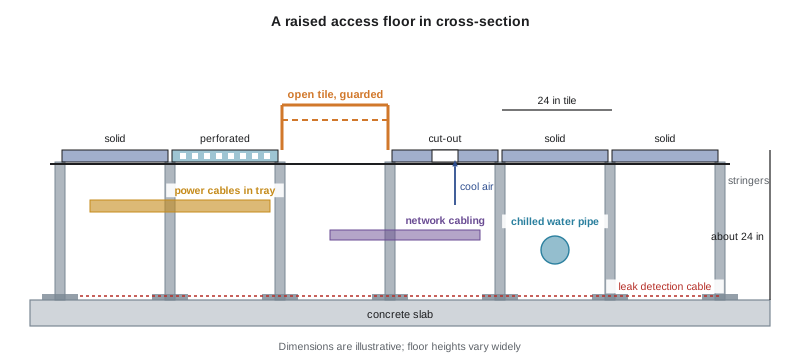
Open tiles and the underfloor void
An open tile leaves a hole as wide as a step and, depending on the floor height, anywhere from 12 in to more than 3 ft deep. Stepping into one can cause a fractured ankle or leg, a fall against a rack, or a head injury. Because tiles are lifted and replaced throughout the day for cable work, inspections and cleaning, the hazard keeps moving. The people most at risk are often not the ones who lifted the tile, but colleagues walking backward while pulling a cable, someone pushing a cart who cannot see the floor ahead, or a visitor who does not expect holes in an office-like floor.
Good practice for open tiles is simple and should be in every site's rules:
- Lift tiles only when the work requires it and only with approval, because tile removal is often part of an approved change.
- Guard every opening as soon as the tile is lifted, using a barrier designed for the purpose, cones and tape, or a person standing by. Never leave an open tile unattended without a guard.
- Lift as few tiles as possible. Removing many adjacent tiles can reduce the lateral stability of the floor, especially in stringerless systems; follow the manufacturer's guidance and the site's limits.
- Use a proper tile lifter, usually a suction cup tool, and check it before use. Lift with your legs and keep your fingers clear of the gap when lowering a tile.
- Replace tiles in the same position and orientation, with the same type. A perforated tile placed where a solid one belongs changes the airflow; a lower-rated tile placed in a rack path may fail under load.
- Do not stand on the edge of an opening or reach deep into the plenum without checking what is there.
The plenum itself carries hazards. Power cables, often flexible whips feeding rack power distribution units, run under many raised floors, along with receptacles and junction boxes. Chilled water and condensate pipes may be present, and a leak can put water on energized connections. Fire detection and sometimes clean agent nozzles may be installed below the floor. Sharp edges on cable trays and cut tiles can cause cuts. Older floors may have tiles or pedestals with electroplated zinc surfaces that shed tiny metallic filaments called zinc whiskers, which can be blown into equipment and cause short circuits; operators with older floors manage this with inspection and cleaning.
A deep underfloor plenum is usually not a confined space, because it is open above when tiles are lifted and people rarely enter it fully. However, a very deep void, a closed plenum under a hall where clean agent can collect, or a cable vault reached through the floor may meet the definition of a confined space in your jurisdiction. If work requires entering the void with your whole body, treat it as a possible confined space and check with your supervisor; HSE-211, Confined Space Awareness, explains how to recognize one.
Floor load ratings
Raised floor tiles have published load ratings, usually tested with methods published by the Ceilings and Interior Systems Construction Association (CISCA) or similar procedures. The ratings describe several different kinds of load, and you need to know which one applies to your situation.
| Rating | What it means | When it matters |
|---|---|---|
| Concentrated load | A load applied on a small area, such as a 1 in (25 mm) square, at the weakest point of the tile without excessive deflection | Rack feet, leveling feet, ladder feet, lift outriggers |
| Uniform load | A load spread evenly over the tile area, expressed per unit area | Racks and equipment that spread their weight over a base |
| Rolling load | A wheeled load passing over the tile a given number of times without permanent damage | Moving racks on casters, pallet jacks, carts and lifts |
| Impact load | A load dropped onto the tile from a height | Dropping equipment or tools |
| Ultimate load | The load at which the tile fails; the concentrated rating is set well below it | A safety margin, never a working value |
The numbers vary a great deal with the tile series. As an illustration only, a common standard-duty solid tile might be rated for a concentrated load of about 1,000 lbf, and heavy-duty series for 1,500 to 2,000 lbf or more, with rolling ratings lower than the concentrated rating, especially for many passes. Perforated tiles in the same series are often rated lower. Always use the manufacturer's data for the tiles actually installed, and the site's floor plan, which should identify heavy-duty zones and rack paths.
Weight and force are related by gravity, and US floor data usually gives loads in pounds-force (lbf) and pounds per square foot (lb/ft²). A rack's weight is shared among its feet or casters, but rarely equally; a rack with heavy equipment at one side or a rack being tilted puts much more on some feet than others. For comparison with metric data, 1 lbf is about 4.45 N, and 1 lb/ft² is about 0.048 kN/m², so 100 lb/ft² is about 4.8 kN/m².
Worked problem
Can the tile take the rack?
A liquid-cooled AI rack weighs 3,100 lb fully loaded and stands on four leveling feet. The hall's solid tiles are rated for a concentrated load of 1,500 lbf and the perforated tiles for 1,000 lbf. Can the rack stand on either tile type, allowing for uneven load sharing?
Show solution
- The weight is already a force: 3,100 lb exerts about 3,100 lbf.
- Share equally among four feet: 3,100 ÷ 4 ≈ 775 lbf per foot.
- Allow for uneven sharing; a common planning assumption is that one foot may carry up to about 1.5 times its equal share, giving about 1,160 lbf (illustrative factor).
- Compare: 1,160 lbf is below the 1,500 lbf solid tile rating but above the 1,000 lbf perforated tile rating.
- Check the rolling load separately, because moving the rack on casters may exceed the rolling rating even if the static load is acceptable.
Answer: The rack's feet may stand on solid tiles but not on perforated tiles, and the move needs its own rolling load check, with load-spreading plates if required. The facility's engineer or floor manufacturer should confirm the plan.
G = 9.81            # N per kg
KN_TO_LBF = 224.81  # lbf per kN

def foot_load_kn(mass_kg, feet=4, uneven=1.5):
    """Static load on the worst foot, kN (illustrative uneven factor)."""
    return mass_kg * G / 1000 / feet * uneven

tiles = {"solid heavy-duty": 6.7, "solid standard": 4.5, "perforated": 4.5}
for mass in (600, 1000, 1400, 1800):
    load = foot_load_kn(mass)
    ok = [name for name, rating in tiles.items() if load <= rating]
    print(f"{mass:5d} kg rack: worst foot {load:4.1f} kN ({load * KN_TO_LBF:5.0f} lbf); "
          f"tiles OK: {ok or 'none - engineer review'}")

# Uniform load over the rack footprint, 0.6 m x 1.2 m
area_m2 = 0.6 * 1.2
for mass in (1000, 1400):
    q = mass * G / 1000 / area_m2
print(f"{mass} kg over footprint: {q:.1f} kN/m2 ({q * 20.885:.0f} lb/ft2)")600 kg rack: worst foot 2.2 kN ( 496 lbf); tiles OK: ['solid heavy-duty', 'solid standard', 'perforated'] 1000 kg rack: worst foot 3.7 kN ( 827 lbf); tiles OK: ['solid heavy-duty', 'solid standard', 'perforated'] 1400 kg rack: worst foot 5.2 kN ( 1158 lbf); tiles OK: ['solid heavy-duty'] 1800 kg rack: worst foot 6.6 kN ( 1489 lbf); tiles OK: ['solid heavy-duty'] 1000 kg over footprint: 13.6 kN/m2 (285 lb/ft2) 1400 kg over footprint: 19.1 kN/m2 (398 lb/ft2)
The uniform load figures show why AI racks are a challenge. A heavy rack over a small footprint can exceed the uniform rating of older floors even if each foot sits on a strong tile, which is one reason new AI halls often put racks on the slab.
Moving loads across the floor
Rolling loads cause much of the damage to raised floors. Moving a heavy rack, a pallet jack or a scissor lift across tiles can crack tile cores, bend edges, dislodge pedestals or leave a tile rocking. A damaged tile can later collapse under someone's foot or a rack. Before moving anything heavy across a raised floor:
- Check the route on the floor plan, including tile types, heavy-duty paths and any perforated tiles or cut-outs along the way.
- Lay load-spreading plates, such as plywood, hardboard or purpose-made steel or aluminum plates, where the rolling rating could be exceeded, and over perforated tiles that must be crossed.
- Avoid stopping or turning sharply on a single tile, which concentrates load.
- Never move heavy loads across a section with open tiles or recently disturbed pedestals.
- After the move, inspect the route for cracked, rocking or uneven tiles and report damage at once.
Lesson 8 covers the rest of a rack move: the ramp from the loading dock, tipping hazards, crews and communication. Lifts and ladders on raised floors also concentrate load at their wheels, outriggers and feet; scissor lifts in particular may need load-spreading plates or may be prohibited on some floor areas. HSE-212 and HSE-220 cover working at height and aerial work platforms.
Common mistakes
MistakeLeaving an open tile unguarded for a moment while fetching a tool.
InsteadGuard the opening or replace the tile before walking away.
MistakeReplacing a solid tile with whichever tile is closest.
InsteadReplace each tile in the same position with the same type and rating.
MistakeStanding a heavy rack on perforated tiles because they look the same as solid ones.
InsteadCheck the tile type and rating under every foot.
MistakeChecking only the static load before moving a rack.
InsteadCheck the rolling load along the whole route and use load-spreading plates where needed.
MistakeReaching into the plenum without looking.
InsteadCheck for power cables, pipes, sharp edges and detection devices first.
Summary and key terms
- Raised floors are built from pedestals, stringers and removable tiles over a plenum that carries air, cables and pipes.
- Open tiles create moving fall hazards; guard every opening and replace tiles promptly with the right type.
- Lifting many adjacent tiles can reduce floor stability; follow manufacturer and site limits.
- The plenum may contain power cables, water pipes, detection devices, sharp edges and sometimes zinc whiskers.
- Tiles have concentrated, uniform, rolling, impact and ultimate ratings; perforated tiles are often rated lower.
- Check the worst-case foot load and the rolling load against the actual tiles, allowing for uneven sharing.
- Heavy AI racks often exceed older floor ratings, so many new halls put racks on the slab.
- Raised access floor
- A floor of removable panels on pedestals above the structural slab.
- Plenum
- The space under a raised floor or above a ceiling used for air distribution and services.
- Pedestal
- An adjustable post that supports raised floor panels.
- Stringer
- A horizontal member joining pedestal heads to add stability.
- Perforated tile
- A floor tile with openings that let cool air into the cold aisle.
- Concentrated load
- A load applied over a small area of a tile.
- Rolling load
- A wheeled load moving across a tile.
- Uniform load
- A load spread evenly over an area.
- Load-spreading plate
- A sheet laid on the floor to distribute a heavy or rolling load.
- Zinc whiskers
- Tiny metal filaments that can grow on zinc-plated surfaces and short-circuit equipment.
- Slab on grade
- A concrete floor placed directly on the ground, used in many new halls instead of a raised floor.
Practice problems
Work each problem on paper first, then reveal the answer to check.
What is a typical raised floor tile size in the United States?
Show answer
24 in by 24 in.
Why are perforated tiles a concern for heavy loads?
Show answer
They are often rated lower than solid tiles of the same series.
A rack weighs 2,600 lb. What is the equal share per foot on four feet?
Show answer
About 650 lbf per foot.
With an uneven sharing factor of 1.5, what is the worst-case foot load for that rack?
Show answer
About 975 lbf.
Roughly how many kN/m² is 250 lb/ft²?
Show answer
About 12 kN/m².
Name three things that may be found in the plenum.
Show answer
Any three of power cables, network cabling, chilled water or condensate pipes, leak detection, fire detection, clean agent nozzles.
Why should you not remove many adjacent tiles?
Show answer
It can reduce the lateral stability of the floor.
Which load rating matters most when moving a rack on casters?
Show answer
The rolling load rating.
What should you do after moving a heavy load across a raised floor?
Show answer
Inspect the route for cracked, rocking or uneven tiles and report damage.
When might an underfloor void be treated as a confined space?
Show answer
When work requires full-body entry into a deep or enclosed void, or agent may collect there.
Lesson quiz · 5 questions
Score 60% or more to complete this lesson.
Create a free account to save your progress, take quizzes and earn a certificate.