
HSE-320 · Lesson 3 of 12 · 26 min
Site rules, access control and escorts
Your first experience of a data center is usually its security. Before you see a single rack you may pass a fence, a vehicle barrier, a guard house, a lobby where your identification is checked against an approved visitor list, and a mantrap that lets only one person through at a time. Inside, every door may need a badge, a PIN or a fingerprint. Cameras watch the corridors, and the security operations center logs every swipe. To someone from a construction site or a factory this can feel excessive. It is not just about protecting customer data. Many of the access rules are also safety rules, and understanding why they exist makes them easier to follow.
This lesson explains how access control is layered, what the common site rules are and why they matter, how escorts work, and what your responsibilities are as a visitor, contractor or employee. Physical security design, including the engineering of barriers, readers and camera systems, is covered in DCE-440; here the focus is on what you will be asked to do and why.
Layers of access control
Data centers use defense in depth: several layers of protection, each of which must be passed to reach the most critical spaces. If one layer fails, the next still stands. A typical arrangement has five or six layers, shown in the figure below, though the details vary by operator and by the security level a customer requires.
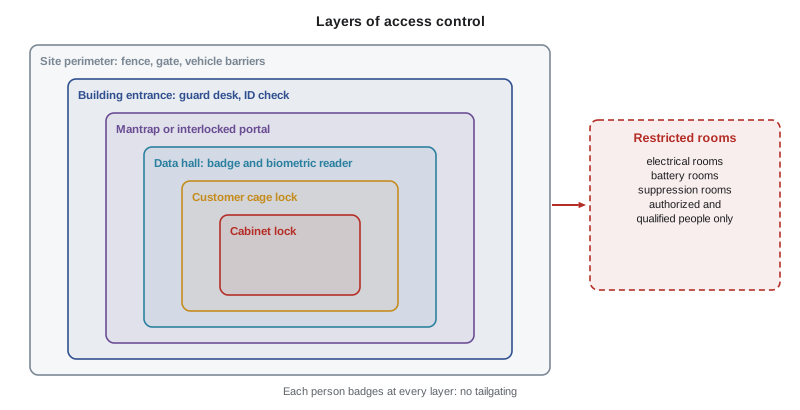
The site perimeter usually has a fence, a controlled gate and sometimes crash-rated barriers against vehicle attack. Deliveries are checked at the gate or at the loading dock. The building entrance has a guard desk or reception where identification is checked against an approved access list; visitors without an approved request are turned away, however important they are. A mantrap or interlocked portal is a small vestibule with two doors that cannot both be open at once, often with a weight sensor or camera to detect a second person. It prevents tailgating, where an unauthorized person follows an authorized one through a door.
Inside, the corridors lead to data halls, which have their own readers, sometimes with biometrics such as fingerprint, palm or iris scanning. In colocation facilities each customer's equipment may be in a locked cage or suite, and individual cabinets may have keys or electronic locks. Gray space rooms such as electrical rooms, battery rooms and fire suppression rooms are restricted to people who are authorized and, for electrical spaces, qualified for the work they will do there.
Why access rules are also safety rules
It is easy to see access control as purely about protecting equipment and data. Several of its effects are just as important for safety.
Knowing who is in the building is essential in an emergency. If the fire alarm sounds, the people coordinating the evacuation need to know who is inside and where, so that they can account for everyone at the assembly point and tell firefighters whether anyone is missing. Badge records, sign-in sheets and escort logs are how that headcount is done. A person who tailgated, or who left without badging out, can send rescuers looking for someone who is not there, or leave someone unaccounted for who is.
Some spaces have hazards that only certain people should face. Electrical rooms contain switchgear where arc flash and shock hazards exist; only qualified persons, or people escorted by qualified persons, should enter. Battery rooms may contain corrosive electrolyte, flammable gases or lithium-ion cells. Rooms protected by clean agent fire suppression systems may discharge without much warning, and some agents, or the oxygen reduction caused by inert gases, are hazardous at the concentrations used; HSE-323 covers that in detail. Controlling access to these rooms is a direct safety control.
Access control also enforces change control. If only authorized people can reach a piece of equipment, it is much harder for someone to make an unplanned change, such as unplugging a cable, opening a breaker or adjusting a cooling setpoint, that could cause an outage or create a hazard for someone else working downstream.
Escorts
Most data centers require visitors and many contractors to be escorted. An escort is an authorized person who accompanies someone without unescorted access, keeps them within sight, makes sure they go only where their work requires and follows them out. Escorts are not just guides; they are responsible for what their visitors do.
| Rule | Typical requirement | Why it matters |
|---|---|---|
| Escort ratio | One escort for a small number of visitors, often no more than three to five; set by the site | An escort cannot watch a large group in a data hall |
| Line of sight | Visitors stay where the escort can see them at all times | Prevents wandering into restricted rooms or touching equipment |
| Badge use | Every person badges individually at every reader; no tailgating or holding doors | Keeps the headcount accurate and the access log reliable |
| Restricted rooms | Visitors enter electrical, battery and suppression rooms only when the work requires it and the escort is authorized | These rooms have serious hazards |
| Hand-off | An escort hands visitors to another authorized escort before leaving, never leaving them alone | There is never a gap in supervision |
| Departure | Escort accompanies visitors out and confirms they have badged out and returned temporary badges | Keeps the headcount and badge inventory correct |
Worked problem
Tailgating at the mantrap
A contractor arrives late for a maintenance window. As he approaches the mantrap, a facility technician he knows is going through. The technician holds the inner door and says, 'Come on through, I know you're on the list.' What should both of them do?
Show solution
- The contractor should decline and wait to badge through himself. Being on the list does not mean his badge is active for today or for this area.
- The technician should let the door close. Holding the door defeats the mantrap and breaks the headcount.
- If the contractor's badge does not work, he should contact security, who can confirm his approval and fix the badge.
- If anyone sees tailgating, they should report it to security, even if the person is known to them.
Answer: Both should follow the rule: each person badges individually. Courtesy is not a reason to defeat access control, because the access log is also the emergency headcount.
Common site rules
Every data center has a set of site rules, usually given in an orientation and posted at the entrance and in data halls. They vary, but most include rules in the following areas. Each has a safety reason as well as an operational one.
- No food or drink in the data halls or electrical rooms. Spills can damage equipment and create electrical hazards, and food attracts pests.
- No cardboard, wooden pallets or packaging in the data hall. Equipment is unpacked in a staging room. Packaging adds fire load, sheds dust that can trigger very sensitive smoke detectors, and creates trip hazards; NFPA 75 limits combustible materials in IT equipment areas.
- No photography without permission. Photographs can reveal security details and customer information.
- Personal protective equipment as required by the area and task, such as safety footwear in the loading dock, hearing protection in plant rooms and arc-rated clothing for electrical work.
- No hot work, such as welding, cutting or brazing, without a hot work permit, because of fire risk and the chance of setting off detection or suppression systems.
- No ladders, lifts or tools brought into a hall without approval, and no work above equipment without controls for falling objects.
- No touching equipment outside the scope of your approved work, even to tidy a cable or close a cabinet door.
- Report every incident, near miss and hazard, however small.
Many sites add rules about lone work. Some spaces, such as electrical rooms or generator enclosures, may require two people for certain tasks. Others allow lone work only with a check-in system, where the security operations center or a colleague contacts the worker at fixed intervals and escalates if there is no reply.
Getting in: the access request
Unescorted access to a data center is normally granted only after a formal request. For a contractor, that usually means the hiring party submits an access request listing the people, dates, areas and the approved change or work order. Security checks identification and may require a background check, especially for unescorted access. The person completes site orientation and any required training, signs an acknowledgment of the site rules and receives a badge that works only in the approved areas and times.
This process takes time, which is one reason last-minute work in data centers is difficult. A crew member who was not on the access request may be turned away at the gate even if the rest of the crew is inside. Good planning, covered in Lesson 9, includes making sure access requests are submitted early.
import random

# Reconcile badge-in and badge-out events to build an emergency headcount
random.seed(33)
people = ["Ava (tech)", "Ben (vendor)", "Chen (vendor)", "Dara (cleaner)", "Eli (visitor)"]
events = []
for p in people:
    t_in = random.randint(7 * 60, 9 * 60)          # minutes after midnight
    events.append((t_in, p, "IN"))
    if random.random() < 0.6:
        events.append((t_in + random.randint(60, 240), p, "OUT"))
events.sort()
inside = set()
for t, p, kind in events:
    if kind == "IN":
        inside.add(p)
    else:
        inside.discard(p)
    print(f"{t // 60:02d}:{t % 60:02d} {kind:3s} {p}")
print("Badge records say still inside:", sorted(inside))07:23 IN Eli (visitor) 08:01 IN Chen (vendor) 08:13 IN Ava (tech) 08:44 IN Ben (vendor) 08:54 IN Dara (cleaner) 10:12 OUT Ava (tech) 12:09 OUT Dara (cleaner) Badge records say still inside: ['Ben (vendor)', 'Chen (vendor)', 'Eli (visitor)']
A headcount built from badge data is only as good as the badging. If one of the people shown as inside actually tailgated out behind a colleague, emergency coordinators would search for someone who had already left. If someone tailgated in, they would not appear at all.
Egress always comes first
Security wants to keep people out; safety requires that people can always get out. Building and fire codes require that exits remain usable, and they allow security hardware such as delayed-egress locks and interlocked portals only under conditions set by the code, such as automatic release on fire alarm or power failure. Never prop open, block or bypass an exit door, and report any exit that is locked, obstructed or does not open freely. In an evacuation, follow the exit signs and the instructions of wardens; do not stop to badge out unless the site's emergency procedure tells you to use a specific reader at the assembly point.
Common mistakes
MistakeHolding a door or the mantrap for a colleague you know.
InsteadLet each person badge individually; the access log is also the emergency headcount.
MistakeLeaving visitors alone in a data hall while you take a phone call.
InsteadHand them to another authorized escort or take them with you.
MistakeBringing equipment into the data hall in its cardboard box to save time.
InsteadUnpack in the staging room and keep packaging out of the hall.
MistakeEntering an electrical room because the door was open.
InsteadEnter only if you are authorized and qualified for the work, or properly escorted.
MistakePropping open an exit or a security door for ventilation or convenience.
InsteadKeep exits clear and doors closed, and report faulty hardware.
Summary and key terms
- Data centers use layers of access control, from the site perimeter to individual cabinets.
- Access rules also protect safety: they keep an accurate headcount, keep people out of hazardous rooms and enforce change control.
- Escorts keep visitors in sight, limit them to approved areas, hand them off properly and see them out.
- Every person badges individually; tailgating and holding doors defeat both security and the headcount.
- Common site rules restrict food, packaging, photography, hot work, ladders and tools, and require reporting of incidents.
- Access requests take time, so plan them early.
- Exits must always remain usable, and security hardware must release as the code requires.
- Defense in depth
- Using several layers of protection so that the failure of one does not expose the asset.
- Mantrap
- A small vestibule with two interlocked doors that lets one person through at a time.
- Tailgating
- Following an authorized person through a controlled door without using your own credential.
- Escort
- An authorized person who accompanies and is responsible for a visitor without unescorted access.
- Access request
- A formal request listing the people, dates, areas and work for which access is needed.
- Biometric reader
- A device that identifies people by a physical feature such as a fingerprint or iris.
- Security operations center
- The room where security staff monitor cameras, alarms and access events.
- Delayed-egress lock
- An exit lock that releases after a short delay, permitted only under conditions set by the code.
- Lone work
- Work done by a person who cannot be seen or heard by others.
Practice problems
Work each problem on paper first, then reveal the answer to check.
Name four layers of access control in a typical data center.
Show answer
Any four of: perimeter, building entrance, mantrap, data hall, cage, cabinet; also restricted gray space rooms.
How does tailgating affect emergency response?
Show answer
It makes the headcount wrong, so rescuers may search for someone who left or miss someone inside.
Why are cardboard and packaging kept out of the data hall?
Show answer
They add fire load, shed dust that can trigger detectors and create trip hazards.
What should an escort do before leaving visitors?
Show answer
Hand them to another authorized escort; never leave them alone.
Why is access to electrical rooms restricted?
Show answer
They contain shock and arc flash hazards; only authorized, qualified or escorted people should enter.
How does access control support change control?
Show answer
It limits who can reach equipment, making unplanned changes less likely.
What is a mantrap designed to prevent?
Show answer
Tailgating, by letting only one person through at a time.
What should you do if your badge does not work?
Show answer
Contact security; do not follow someone else through.
When may delayed-egress locks be used?
Show answer
Only under conditions set by the building and fire codes, such as release on fire alarm.
What is a lone work check-in system?
Show answer
A system where someone contacts a lone worker at set intervals and escalates if there is no reply.
Lesson quiz · 5 questions
Score 60% or more to complete this lesson.
Create a free account to save your progress, take quizzes and earn a certificate.