
HSE-107 · Lesson 9 of 12 · 27 min
Handling people: patient and client handling awareness
Health care and personal support workers have some of the highest rates of musculoskeletal injury of any occupation. Nurses, personal support workers, nursing assistants, care aides, porters, paramedics, home care workers and staff in long-term care homes, hospitals and group homes regularly help people move: transferring them between bed and chair, repositioning them in bed, helping them stand, walk, bathe and use the toilet, and responding when they fall. People are not boxes. They are heavy, unevenly shaped, have no handles, may move unexpectedly, may be in pain or confused, and must be handled with dignity. This lesson introduces the risks of handling people and the principles of safe patient handling at an awareness level. It does not train you to perform transfers; workers who handle people need hands-on training in the specific equipment and procedures used where they work.
Why handling people is different
The lifting tools in Lesson 6 do not apply to handling people. The NIOSH lifting equation assumes a stable load held close to the body, while people shift their weight, may resist or collapse, and are often handled at a distance across a bed or in a cramped bathroom. Biomechanical studies have shown that manually lifting or transferring most adults exceeds safe limits for compressive force on the spine, even with good technique and two workers. Based on such research, NIOSH proposed in 2007 that the maximum weight a worker should lift during patient handling, under ideal conditions, is about 16 kg (35 lb). When a task requires lifting more than this, or lifting under less than ideal conditions, assistive devices should be used.
Many common tasks exceed this limit. An adult leg is roughly 16 percent of body weight, so holding up the leg of a 100 kg (220 lb) person for wound care already reaches the limit, before any reach or awkward posture is considered. Lifting a person from the floor, carrying them, or pulling them up in bed by the arms or under the armpits puts both workers and patients at risk of injury.
Worked problem
Is it safe to lift a patient's leg by hand?
A nurse must hold a patient's leg raised for 5 minutes during dressing changes. The patient weighs 240 lb. Each leg is about 16 percent of body weight. NIOSH proposes a maximum of about 35 lb for patient handling under ideal conditions, with lower values for long holds and extended reach. Should the nurse hold the leg manually?
Show solution
- Leg weight: \( 0.16 \times 240 \approx 38 \) lb.
- This exceeds the 35 lb limit even under ideal conditions.
- The leg will be held for 5 minutes, often with the nurse bent over the bed at a reach, so the true acceptable weight is lower still.
- Use a limb-holding sling on a ceiling or floor lift, raise the bed to the nurse's hip height, and work close to the patient.
Answer: No; the leg alone exceeds the recommended limit. Use a limb sling and lift, and set the bed at a good working height.
Patients face risks too
Manual handling also harms patients. Lifting under the armpits can dislocate shoulders and tear skin; dragging people up in bed causes friction and shear injuries to fragile skin and contributes to pressure injuries; and manual transfers can lead to falls. Patients often feel safer, more comfortable and more dignified when appropriate equipment is used by trained staff. Safe patient handling programs aim to protect workers and patients together, while encouraging patients to use their own abilities to keep or regain mobility.
Safe patient handling and mobility programs
Safe patient handling and mobility (SPHM) programs replace routine manual lifting with assessment, equipment and training. Programs described as minimal lift or no manual lift aim to eliminate manual lifting of all or most of a person's weight, except in emergencies. Key elements include:
- Leadership commitment, a written policy and an interdisciplinary team including front-line staff.
- Assessment of each patient or client's mobility on admission and whenever their condition changes, with the result recorded in the care plan so all staff know how to move them.
- Enough suitable equipment, located where it is needed, maintained and ready to use.
- Training for all staff in assessment and equipment use, with competency checks and refreshers, and peer leaders or coaches on each unit.
- Facility design that allows equipment to be used: space around beds, ceiling track installation, accessible bathrooms and storage.
- Injury and incident reporting, data review and continuous improvement.
Studies of SPHM programs in hospitals and long-term care homes have reported substantial reductions in staff injuries, lost days and compensation costs, with improvements in patient outcomes such as fewer falls and pressure injuries.
In the US, about a dozen states, including California, Washington, New York, Illinois, Minnesota and Texas, have safe patient handling laws that require hospitals or other health care facilities to have programs, equipment and training. The American Nurses Association published interprofessional national standards for safe patient handling and mobility, and the Department of Veterans Affairs runs a large SPHM program across its hospitals. OSHA's ergonomics guidelines for nursing homes recommend minimizing manual lifting, and OSHA has cited health care employers under the General Duty Clause for patient handling hazards.
Assessing a person's mobility
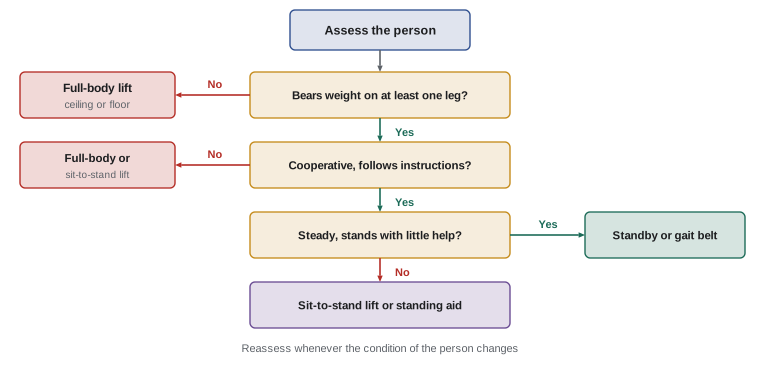
Before moving a person, staff need to know how much help they need. Many facilities use standardized mobility assessment tools that ask a few questions in sequence:
- Can the person bear weight through at least one leg?
- Can they sit upright with or without support, and use their arms?
- Can they understand and follow instructions and cooperate?
- Are there other factors: weight and body shape (bariatric care), pain, fractures, attached medical devices such as lines and drains, skin condition, behavior, or a history of falls?
The answers point to the right method and equipment, from standby supervision for independent people, to a gait belt or standing aid for those who can bear weight and cooperate, to a sit-to-stand lift, to a full-body mechanical lift for those who cannot bear weight. The assessment must be repeated when the person's condition changes, for example after surgery, during illness or at the end of the day when fatigue sets in.
Equipment for handling people
| Equipment | Used for | Notes |
|---|---|---|
| Ceiling lift (overhead track) | Full-body lifts, transfers, repositioning, walking support | Always available, takes little floor space, lowest force for staff |
| Floor-based full-body lift | Transfers for people who cannot bear weight | Needs floor space and pushing; check slings and capacity |
| Sit-to-stand lift | People who can bear some weight and follow instructions | Supports standing for toileting and transfers |
| Friction-reducing devices (slide sheets) | Repositioning in bed, lateral transfers | Greatly reduce pulling force; remove after use to prevent sliding |
| Air-assisted lateral transfer device | Moving people between bed and stretcher | Cushion of air reduces force substantially |
| Gait or transfer belt | Guiding people who can mostly support themselves | Not for lifting dependent people |
| Powered and height-adjustable beds and stretchers | Setting work at hip height, repositioning, transport | Use bed height and features every time |
| Bariatric equipment | People of high body weight | Check rated capacity of lifts, slings, beds, chairs and toilets |
Slings must match the lift, the task and the person's size and condition, and they must be inspected before each use for wear, tears and damaged stitching. Lifts must be inspected and maintained according to the manufacturer's instructions and the facility's program. Staff must know the rated capacity of every device and never exceed it.
Repositioning and friction
Repositioning a person up in bed or turning them is one of the most frequent and most hazardous handling tasks, because it involves pulling a heavy load sideways at a reach. The force needed is mainly the force to overcome friction between the person and the mattress. Friction-reducing devices cut this force dramatically.
Worked problem
How much does a slide sheet help?
Two care aides must move a 200 lb resident (about 91 kg) up the bed. The friction coefficient between the resident's clothing and a cotton sheet is about 0.5. With a low-friction slide sheet, it is about 0.1. Estimate the total pulling force needed in each case and the force per worker. Use \( g = 9.81 \) m/s².
Show solution
- Without a slide sheet: \( 0.5 \times 91 \times 9.81 \approx 446 \) N (about 100 lbf) in total, about 223 N (50 lbf) per worker, pulling sideways at a reach.
- With a slide sheet: \( 0.1 \times 91 \times 9.81 \approx 89 \) N (about 20 lbf) in total, about 45 N (10 lbf) per worker.
- The slide sheet reduces the force by about 80 percent.
- Raise the bed to hip height, lower the head of the bed flat if the resident's condition allows, and have the resident help by bending knees and pushing if they can.
Answer: The slide sheet cuts the force from about 220 N to about 45 N per worker, an 80 percent reduction.
Falls and emergencies
Workers instinctively try to catch a person who is falling, but catching or holding a falling adult can generate forces far beyond what the body can withstand and often injures both people. Training should teach workers not to catch a falling person. Instead, if a person begins to fall while being supported, the worker can guide them gently to the floor while protecting their head, keeping their own back straight and bending their knees. Once the person is on the floor, staff should check for injuries, call for help, and use a mechanical lift or a floor recovery device to raise them, not lift them manually. Emergency evacuation of people who cannot walk requires planned methods and equipment, such as evacuation sleds or chairs, and practice.
Home and community care
Home care and community support workers face particular challenges: small bathrooms and bedrooms, beds at fixed low heights, stairs, clutter, pets, no co-workers to help, and limited equipment. Clients may decline equipment, and family members may expect workers to lift as they always have. Employers should assess each home before service starts and when conditions change, provide or arrange equipment such as portable lifts, transfer boards, bed raisers and grab bars, schedule two workers when a task needs them, and give workers the right to stop a task that is unsafe and report it. Care plans should state how each client is to be moved.
Organizational factors in health care
In health care, staffing levels, workload and organizational culture strongly influence handling injuries. When units are short staffed, workers skip equipment because it takes longer to fetch, or lift alone when two people are needed. Equipment stored far away or unavailable when needed will not be used. Emergencies and patient behavior create pressure to act quickly. Effective programs address these factors: they make equipment easy to access, include equipment time in workload planning, support staff who take the time to use it, and investigate injuries to understand why safe methods were not used.
Common mistakes
MistakeLifting a dependent adult manually with good technique.
InsteadUse a mechanical lift; manual lifting of most adults exceeds safe limits.
MistakeUsing a gait belt to lift a person who cannot bear weight.
InsteadGait belts guide; use a full-body or sit-to-stand lift as assessed.
MistakePulling a person up in bed without a slide sheet.
InsteadUse friction-reducing devices and raise the bed to hip height.
MistakeTrying to catch a falling person.
InsteadGuide them to the floor, protect the head and use a lift to raise them.
MistakeAssessing mobility only on admission.
InsteadReassess whenever the person's condition changes.
Summary and key terms
- Handling people is among the highest-risk manual tasks; the NIOSH lifting equation does not apply.
- NIOSH proposes a limit of about 35 lb for lifting during patient handling under ideal conditions.
- Safe patient handling programs combine policy, assessment, equipment, training and design.
- Assess each person's weight bearing, cooperation and other factors, and reassess when things change.
- Ceiling lifts, floor lifts, sit-to-stand lifts and slide sheets greatly reduce forces.
- Do not catch falling people; guide them down and raise them with a lift.
- Staffing, equipment access and culture determine whether safe methods are used.
- Safe patient handling and mobility (SPHM)
- Program to replace manual lifting with assessment and equipment.
- Minimal lift policy
- Policy to avoid manual lifting of a person's weight except in emergencies.
- Mobility assessment
- Evaluation of how much help a person needs to move.
- Ceiling lift
- Lift running on an overhead track.
- Sit-to-stand lift
- Device helping people who can bear some weight to stand.
- Slide sheet
- Low-friction sheet used to reposition people.
- Gait belt
- Belt around a person's waist used to guide them while walking.
- Bariatric
- Relating to the care of people of high body weight.
- Sling
- Fabric support attached to a lift to hold a person.
- Lateral transfer
- Moving a person sideways between surfaces, such as bed to stretcher.
Practice problems
Work each problem on paper first, then reveal the answer to check.
Why does the NIOSH lifting equation not apply to people?
Show answer
People are unstable, unevenly shaped loads that may move unexpectedly.
What maximum weight does NIOSH propose for patient handling lifts under ideal conditions?
Show answer
About 35 lb.
About how much does one leg of a 180 lb person weigh?
Show answer
About 29 lb (16 percent).
Name four elements of an SPHM program.
Show answer
Policy, mobility assessment, equipment, training, facility design, data review.
What is the first question in many mobility assessments?
Show answer
Can the person bear weight on at least one leg?
Which device suits a person who cannot bear weight?
Show answer
A full-body mechanical lift, ceiling or floor-based.
How much can a slide sheet reduce repositioning force?
Show answer
By roughly 80 percent in the example.
What should a worker do if a person starts to fall?
Show answer
Guide them to the floor, protecting the head, rather than catching them.
Name two challenges in home care.
Show answer
Small spaces, low beds, no co-workers, limited equipment, clients declining equipment.
How can staffing affect handling injuries?
Show answer
Short staffing leads workers to skip equipment or lift alone.
Lesson quiz · 5 questions
Score 60% or more to complete this lesson.
Create a free account to save your progress, take quizzes and earn a certificate.