
HSE-107 · Lesson 8 of 12 · 32 min
Pushing, pulling, carrying and mechanical aids
Lifting gets most of the attention, but a great deal of manual handling involves pushing, pulling and carrying. Workers push carts, cages, hospital beds and food trolleys, pull pallet jacks and hose lines, and carry boxes, tools and buckets over long distances. These tasks can strain the back, shoulders and arms, and they add slip, trip and collision hazards. Mechanical aids reduce or remove manual effort, but only if they are well chosen, well maintained and actually used. This lesson explains how to assess and reduce the forces in pushing, pulling and carrying, and how to choose and introduce mechanical aids.
Pushing or pulling?
In most situations, pushing is better than pulling. When pushing, the worker faces the direction of travel and can see where they are going, the body leans into the load using body weight, and both hands are usually in a balanced position. Pulling often means walking backward or twisting to look over a shoulder, with the arms stretched behind and the shoulders and lower back under strain. Pulling may be acceptable for short distances or where pushing is impossible, such as with a manual pallet jack moving forward with the handle in front, which is actually a form of pulling while walking forward. Where possible, design equipment and routes so that loads can be pushed.
Initial and sustained force
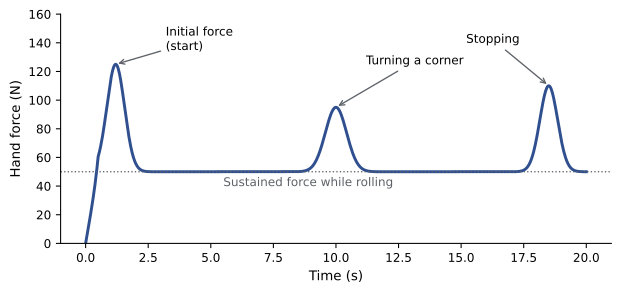
Two forces matter when moving a wheeled load. The initial force is the peak force needed to overcome inertia and start the load moving, or to stop it, turn it or move it over an obstacle. The sustained force is the smaller force needed to keep the load moving at a steady speed. Initial forces are typically two to three times sustained forces, and they are most likely to cause sudden strains. Both can be measured with a push-pull force gauge placed between the hands and the handle.
On a level floor, the sustained force needed to roll a load depends on its mass and on the rolling resistance of the wheels and floor:
The coefficient of rolling resistance \( \mu_r \) is small for large, hard wheels on smooth, hard floors, roughly 0.01 to 0.02, and much larger for small or soft wheels, carpet, gravel, worn bearings or wheels clogged with debris, sometimes 0.05 or more. On a slope, the component of the load's weight along the slope adds to the force, often far more than rolling resistance does.
Worked problem
Is this cart too hard to push?
A laundry cart loaded to 250 kg rolls on medium casters on a smooth vinyl floor with a rolling resistance coefficient of about 0.02. Measurements show the initial force to start it is about 2.5 times the sustained force. UK HSE screening guidance suggests that, for most workers, initial forces up to about 150 N (women) to 200 N (men) and sustained forces up to about 70 N (women) to 100 N (men) are low risk when pushing with hands between knuckle and shoulder height. How does the cart compare? Use \( g = 9.81 \) m/s².
Show solution
- Sustained force: \( 0.02 \times 250 \times 9.81 \approx 49 \) N.
- Initial force: \( 2.5 \times 49 \approx 123 \) N.
- Both forces are below the screening values for both women and men on a level floor.
- But if the casters wear and rolling resistance doubles to 0.04, the sustained force becomes about 98 N and the initial force about 245 N, above the screening values. Caster maintenance matters.
Answer: With good casters, about 49 N sustained and 123 N initial, which is acceptable; with worn casters, the forces roughly double and exceed the screening values.
Worked problem
Pushing up a ramp
The same 250 kg cart must be pushed up a ramp with a slope of 1 in 12 (an angle of about 4.8 degrees, \( \sin\theta \approx 0.083 \)). Estimate the sustained force on the ramp with good casters.
Show solution
- Slope force: \( 250 \times 9.81 \times 0.083 \approx 204 \) N.
- Rolling force: about 49 N (from the previous example).
- Total sustained force: \( 204 + 49 \approx 253 \) N, more than twice the screening value for sustained force for men and over three times that for women.
- Controls: avoid the ramp by rerouting through a level path or lift, reduce the load per trip, use a powered cart or tug, or have two workers on a short ramp with a planned method. Controlling the load on the way down is equally important.
Answer: About 250 N, far above screening values; the slope, not the rolling resistance, dominates. Use a level route, smaller loads or powered help.
Reducing push and pull forces
Push and pull forces can be reduced at every stage of design and maintenance:
- Reduce the load per trip, or the weight of the cart itself.
- Choose larger-diameter wheels and casters, with tread materials suited to the floor: harder treads such as polyurethane roll more easily on smooth floors, while softer treads absorb shocks on rough floors.
- Choose wheel bearings that roll freely, and maintain them: clean debris, lubricate and replace worn or flat-spotted wheels on a schedule.
- Place swivel casters at the handle end for steering, or use carts with central fixed wheels for straight-line movement.
- Keep floors smooth, level, clean and free of gaps, thresholds and cables; repair potholes and uneven joints. Avoid carpets on routes used by carts.
- Avoid ramps and slopes where possible, and make unavoidable ramps as gentle as practical.
- Provide handles at a height between hip and elbow (roughly 90 to 115 cm, or 35 to 45 in, for most adults), or vertical handles that allow each worker to choose a comfortable height.
- Use powered carts, tugs, powered pallet jacks and motorized beds for heavy loads, long distances, slopes and frequent moves.
- Provide enough space to maneuver, and plan routes to avoid tight turns, doors that must be held open and crowded areas.
For more detailed assessment, measured forces can be compared with the Liberty Mutual tables, which give maximum acceptable initial and sustained forces for given percentages of male and female workers, based on handle height, distance and frequency. ISO 11228-2 offers a similar method.
Carrying
Carrying combines holding a load, which loads the back, shoulders and arms statically, with walking, which adds balance demands and trip hazards. Risk increases with the weight of the load, the distance carried, the frequency, and the posture: loads carried far from the body, on one side, above shoulder height, or blocking the view are particularly hazardous. One-handed carrying, such as carrying a bucket or toolbox, loads the spine asymmetrically and bends the trunk to the side.
- Carry loads close to the body, between knuckle and shoulder height, with the arms close to the trunk.
- Split loads between both hands, such as two half-full buckets instead of one full one, or use a two-handed container.
- Keep carrying distances short; as a guide, consider carts or other aids whenever loads are carried more than about 10 m (33 ft) or carried repeatedly.
- Make sure the carrier can see over or around the load and that the route is clear, well lit and free of stairs where possible.
- Use shoulder straps, carrying frames, panel carriers and harnesses to improve grip and distribute load.
Worked problem
Carrying by hand or using a cart
A stock worker must move 150 boxes of 10 kg each from a receiving area to a storeroom 25 m away each shift. Carrying one box at a time, each round trip takes about 45 seconds. Using a cart that holds 15 boxes, each round trip takes about 4 minutes including loading and unloading. Compare the total distance walked carrying loads and the total time for each method.
Show solution
- By hand: 150 trips. Loaded distance: \( 150 \times 25 = 3\,750 \) m, plus the same unloaded. Time: \( 150 \times 45 = 6\,750 \) s, about 1 hour 53 minutes.
- By cart: \( 150 \div 15 = 10 \) trips. Loaded distance pushing the cart: \( 10 \times 25 = 250 \) m. Time: \( 10 \times 4 = 40 \) minutes.
- Each box is still lifted twice (onto and off the cart), so arrange the cart shelves between knuckle and shoulder height to keep those lifts low risk.
- The cart cuts carrying distance by over 90 percent and saves more than an hour per shift.
Answer: The cart reduces loaded walking from 3,750 m of carrying to 250 m of pushing and saves about 73 minutes per shift.
Mechanical aids
Mechanical aids range from simple tools to automated systems. Choosing the right aid starts with understanding the task: what is moved, how often, how far, between which heights, in what space and by whom.
| Aid | Best for | Points to check |
|---|---|---|
| Hand truck (dolly) | Moving boxes, appliances and kegs short distances | Wheel size for the floor, stair-climbing models for steps, load securing |
| Platform cart and shelf cart | Moving many items at once | Shelf heights between knuckle and shoulder, casters, handle height |
| Manual and powered pallet jack | Moving pallets on level floors | Powered models for heavy loads and long distances, training, pedestrian safety |
| Scissor lift table and pallet positioner | Keeping work at a good height as pallets are built or unloaded | Toe guards, capacity, automatic leveling, turntables |
| Vacuum lifter and balancer | Repetitive lifting of boxes, sacks and panels | Fast enough for the work rate, easy controls, suitable for the load surface |
| Overhead hoist and jib crane | Heavy or awkward loads in a fixed area | Rated capacity, rigging, training, inspection |
| Conveyor and gravity roller | Moving items between fixed points | Height matched to work, guarding of pinch points, reach distance |
| Drum and cylinder handlers | Moving drums and gas cylinders | Purpose-designed equipment; never roll cylinders by hand over distances |
| Powered tug, motorized cart and automated vehicles | Heavy loads, long routes, slopes | Traffic management, speed limits, training, battery charging |
Worked problem
Force at the handle of a hand truck
A worker tilts a hand truck loaded with 100 kg of boxes. When tilted, the center of mass of the load is 20 cm horizontally behind the wheel axle, and the worker holds the handle 110 cm horizontally from the axle. Estimate the vertical force the worker must apply to hold the load balanced. What if poor stacking moves the center of mass to 40 cm from the axle?
Show solution
- Moment of the load about the axle: \( 100 \times 9.81 \times 0.20 \approx 196 \) N·m.
- Handle force: \( 196 \div 1.10 \approx 178 \) N, about the weight of 18 kg.
- With the center of mass at 40 cm: moment \( 100 \times 9.81 \times 0.40 \approx 392 \) N·m; handle force \( 392 \div 1.10 \approx 357 \) N, about the weight of 36 kg.
- Stack heavy items at the bottom and against the frame, and tilt to the balance point where the load is nearly over the axle.
Answer: About 178 N with good stacking, rising to about 357 N if the load is stacked badly: correct loading halves the effort.
Making mechanical aids work
Many workplaces buy mechanical aids that then sit unused in a corner. Workers do not use aids that are slow, hard to find, awkward to use, poorly maintained or unsuitable for the task, especially under time pressure. To make aids work:
- Involve workers in choosing and trialling equipment before buying it.
- Make sure the aid fits the task, the loads, the space and the pace of work. An aid that doubles the time of each lift will not be used when quotas are tight.
- Keep aids where they are needed, with clear storage and charging locations.
- Train workers and supervisors in using the aid and in recognizing when it should be used.
- Maintain aids on a schedule and make it easy to report and repair faults.
- Adjust production standards and quotas to allow time to use the aid.
- Check that the aid does not introduce new hazards, such as pinch points, collisions with pedestrians, tipping or electrical hazards.
Pushing and pulling special loads
Some loads need special care. Hospital beds, stretchers and loaded wheelchairs combine high mass with the need for careful control; many health care facilities now use powered bed movers. Tall cages and roll containers can tip over if pushed from the bottom, turned too quickly or pushed over thresholds; push them from the side at handle height and keep heavy items low. Manual pallet jacks should be used only for loads and distances within their design, with powered jacks for heavy loads, long distances or slopes. Hose lines, cables and ropes should be pulled with the body facing the direction of travel when possible and with good footing.
Common mistakes
MistakePulling a heavy cart while walking backward.
InsteadPush the cart facing the direction of travel, with hands between hip and elbow height.
MistakeIgnoring worn or clogged casters.
InsteadMaintain wheels and bearings; worn casters can double push forces.
MistakePushing heavy loads up ramps by hand.
InsteadUse level routes, smaller loads or powered aids; slopes add large forces.
MistakeCarrying loads long distances by hand.
InsteadUse carts or other aids for loads carried more than about 10 m or repeatedly.
MistakeBuying aids without asking workers.
InsteadTrial aids with workers and allow time in production standards to use them.
Summary and key terms
- Pushing is usually better than pulling; workers face the direction of travel and use body weight.
- Initial forces are typically two to three times sustained forces.
- Rolling force = μr × m × g; slope force = m × g × sin θ, which can be far larger.
- Good wheels, maintenance, smooth floors and correct handle height reduce forces.
- Carry loads close, in both hands, over short distances, with a clear view and route.
- Choose mechanical aids that fit the task, space, loads and pace.
- Involve workers, train them, maintain aids and allow time to use them.
- Initial force
- Peak force to start, stop or turn a load.
- Sustained force
- Force to keep a load moving steadily.
- Rolling resistance
- Resistance of wheels rolling on a floor.
- Push-pull force gauge
- Instrument that measures hand force on a handle.
- Caster
- Wheel mounted in a frame, either swivel or fixed.
- Hand truck
- Two-wheeled lever device for moving stacked loads.
- Pallet positioner
- Device that keeps the working layer of a pallet at a good height.
- Vacuum lifter
- Device that uses suction to lift loads.
- Balancer
- Device that counterbalances the weight of a load or tool.
- Powered tug
- Motorized unit that pulls or pushes carts.
Practice problems
Work each problem on paper first, then reveal the answer to check.
Why is pushing usually better than pulling?
Show answer
The worker faces the direction of travel, sees ahead and uses body weight with better posture.
What is the difference between initial and sustained force?
Show answer
Initial force starts, stops or turns the load; sustained force keeps it moving.
A 200 kg cart has μr = 0.015. What sustained force is needed on a level floor?
Show answer
About 29 N.
What slope force acts on a 200 kg cart on a slope with sin θ = 0.05?
Show answer
About 98 N.
Name three ways to reduce push forces.
Show answer
Lighter loads, larger and maintained wheels, smooth floors, no ramps, powered aids.
At about what height should cart handles be?
Show answer
Between hip and elbow height, roughly 90 to 115 cm (35 to 45 in).
When should a cart be considered instead of carrying?
Show answer
When loads are carried more than about 10 m or repeatedly.
Why is one-handed carrying risky?
Show answer
It loads the spine asymmetrically and bends the trunk to the side.
How do you reduce the handle force on a hand truck?
Show answer
Stack heavy items low and against the frame so the load is near the axle.
Give two reasons mechanical aids go unused.
Show answer
They are slow, hard to find, poorly maintained, unsuitable or not allowed for in quotas.
Lesson quiz · 5 questions
Score 60% or more to complete this lesson.
Create a free account to save your progress, take quizzes and earn a certificate.