
HSE-107 · Lesson 12 of 12 · 32 min
Ergonomics programs, return to work and capstone
Fixing one workstation at a time helps the people who use it, but lasting results come from a systematic program that finds and fixes ergonomic hazards across the whole organization, catches problems early, helps injured workers recover and return, and keeps improving. This final lesson describes the elements of an effective ergonomics program, the role of worker participation, early reporting and return to work, and how to evaluate results. It ends with a capstone exercise that brings together the tools from the whole course.
Elements of an ergonomics program
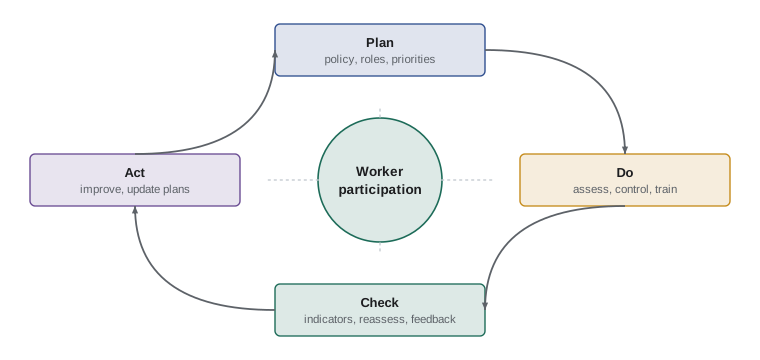
Guidance from OSHA, NIOSH, Canadian regulators and standards such as CSA Z1004 describes broadly similar program elements, which fit naturally into a plan-do-check-act management system such as ISO 45001:
- Management leadership and commitment: a written policy, clear responsibilities, resources and time, and visible support from senior leaders.
- Worker participation: involving workers, joint committees and representatives in identifying problems, developing solutions and evaluating results.
- Training: for workers, supervisors, engineers, purchasers and the people who do assessments, matched to their roles.
- Hazard identification and assessment: screening and detailed assessment of jobs using the tools in Lessons 5 and 6, prioritized by risk.
- Hazard control: implementing controls using the hierarchy of controls, with interim measures while permanent solutions are developed.
- Early reporting and medical management: encouraging prompt reporting of symptoms and providing timely, appropriate care.
- Return to work and accommodation: helping injured workers stay at work or return safely, with suitable modified duties.
- Design and procurement: building ergonomics into new facilities, equipment, tools, products and processes before they are introduced.
- Evaluation and continuous improvement: tracking leading and lagging indicators, reviewing the program at least annually and acting on the findings.
Participatory ergonomics
Participatory ergonomics means involving workers directly in identifying ergonomic problems and developing and testing solutions. Workers know the details of their jobs, the variations, the workarounds and the practical limits better than anyone, and solutions they help design are more likely to work and to be used. A typical approach forms a small ergonomics team for a department, including front-line workers, a supervisor, a maintenance or engineering representative and a person trained in assessment. The team reviews injury and discomfort data, observes and assesses jobs, brainstorms solutions, tries low-cost changes quickly, evaluates them with the workers affected and shares successes. Research on participatory programs has found improvements in discomfort, injury rates and productivity, especially when management supports the team with time and resources.
Early reporting and medical management
Early reporting is one of the most cost-effective parts of an ergonomics program. Workers who report symptoms early can often be helped with simple job adjustments, before a minor problem becomes a lost-time injury. Employers should make reporting easy and safe: explain what symptoms to report, provide several ways to report, respond promptly, never discipline or discourage reporting, and avoid incentive programs that reward low injury numbers in ways that suppress reports. Each report should trigger a review of the job, not just treatment of the person.
Medical management means connecting workers with appropriate health care providers, sharing information about job demands so that providers can recommend suitable activity, and following up. Health care providers should know what the job involves, which modified duties are available and how to communicate restrictions. Workers have rights to privacy for their medical information; employers need to know functional abilities and restrictions, not diagnoses.
Return to work and accommodation
After an MSD, staying active and returning to suitable work as soon as it is safe generally supports recovery. Long absences make return harder and increase the risk of long-term disability. A good return-to-work process involves early contact with the injured worker, identification of suitable modified or alternative work that respects medical restrictions, a written plan with gradual increases in duties and hours, regular review, and attention to the job hazards that caused the injury so that the worker does not return to the same risk.
In the US, return-to-work duties come from several laws. The Americans with Disabilities Act (ADA) requires employers with 15 or more employees to provide reasonable accommodation to qualified employees with disabilities, which can include some work-related MSDs, unless it would cause undue hardship. The Family and Medical Leave Act (FMLA) gives eligible employees of covered employers (generally those with 50 or more employees) up to 12 weeks of job-protected leave for a serious health condition. State workers' compensation laws govern benefits and, in some states, return-to-work programs and incentives. Transitional or light-duty programs should be designed so that they do not expose workers to the same hazards.
Building ergonomics into design and purchasing
The cheapest time to fix an ergonomic problem is before it exists. Once a building is built, a production line installed or a fleet of carts bought, changes are expensive and slow. Organizations can build ergonomics into:
- Facility design: dock levelers, conveyors, adequate space around equipment, ceiling lifts in patient rooms, storage at good heights.
- Equipment and tool purchasing: ergonomic criteria in specifications, worker trials before purchase, suppliers' data on forces and vibration.
- Product and packaging design: smaller and lighter cases, hand-hold cut-outs, parts that are easy to assemble with fewer fasteners.
- Process changes: an ergonomic review in the management of change process, so new tasks are assessed before they start.
- Contracts with suppliers: case weights, pallet heights and packaging features that reduce handling risk downstream.
Evaluating the program
Evaluate both whether the program is being carried out and whether it is working. Leading indicators include the number and percentage of jobs assessed, high-risk jobs with controls completed, average time from symptom report to job review, training completed, worker suggestions implemented and discomfort survey results. Lagging indicators include MSD rates, lost-time MSD rates, days lost, claim costs and premiums. Compare results over several years, by department and against industry averages, and look for unintended effects, such as an apparent fall in injuries caused by discouraged reporting. Report results to workers, committees and management, and use them to set priorities for the next year.
Worked problem
Evaluating results after two years
A warehouse introduced an ergonomics program two years ago. Before: 1,050,000 hours a year, 24 MSDs, 13 lost-time MSDs, 610 days lost. Year 2: 1,120,000 hours, 15 MSDs, 6 lost-time MSDs, 230 days lost, while early symptom reports rose from 5 to 41 a year. Calculate the MSD rate, lost-time MSD rate and severity rate before and after, and interpret the change in early reports.
Show solution
- MSD rate before: \( 24 \times 200\,000 \div 1\,050\,000 \approx 4.57 \); after: \( 15 \times 200\,000 \div 1\,120\,000 \approx 2.68 \).
- Lost-time MSD rate before: \( 13 \times 200\,000 \div 1\,050\,000 \approx 2.48 \); after: \( 6 \times 200\,000 \div 1\,120\,000 \approx 1.07 \).
- Severity before: \( 610 \times 200\,000 \div 1\,050\,000 \approx 116 \) days per 100 workers; after: \( 230 \times 200\,000 \div 1\,120\,000 \approx 41 \).
- Early reports rose eightfold while recorded MSDs and their severity fell, suggesting that problems are being caught and fixed before they become injuries, not that reporting is being suppressed.
Answer: The MSD rate fell about 41 percent (4.6 to 2.7), the lost-time rate about 57 percent (2.5 to 1.1) and the severity rate about 65 percent (116 to 41 days), while early reports rose: strong evidence that the program is working.
Capstone: assessing and redesigning a job
The capstone brings the course together. Read the scenario, then work through the steps as you would in a real workplace.
Scenario: a grocery store's receiving dock. Two workers unload deliveries from the floor of a trailer onto carts. A typical case weighs 33 lb and has no handles. The worker reaches into the trailer to pick up each case at a hand height of 4 in and a horizontal distance of 18 in, turns about 45 degrees and places it on a cart shelf 24 in high, about 3 times a minute for 2 hours per delivery, followed by lighter work. Loaded carts weigh up to 700 lb (about 320 kg) and are pushed 100 ft into the store, including a short ramp with a slope of about 1 in 20. The two workers have had three back strains and one shoulder injury in the past two years, with total direct claim costs of $96,000.
Worked problem
Step 1: the lifting task
Calculate the RWL and LI for picking up a case at the origin. Use FM = 0.79 (3 lifts per minute, 1 to 2 hours) and CM = 0.90 (poor coupling).
Show solution
- HM = 10 ÷ 18 = 0.556. VM = 1 − 0.0075 × |4 − 30| = 0.805. DM = 0.82 + 1.8 ÷ 20 = 0.910. AM = 1 − 0.0032 × 45 = 0.856.
- RWL = \( 51 \times 0.556 \times 0.805 \times 0.910 \times 0.856 \times 0.79 \times 0.90 \approx 12.6 \) lb.
- LI = \( 33 \div 12.6 \approx 2.6 \).
- The largest losses are the horizontal reach (0.556), the low origin (0.805), the frequency (0.79) and the twist (0.856).
Answer: An LI of about 2.6: increased risk for many workers. The task needs redesign.
Worked problem
Step 2: redesign and recalculate
The store works with its distributor to have cases delivered on pallets unloaded by a powered pallet jack, and installs a gravity roller conveyor at knuckle height beside the cart so workers slide cases from the conveyor straight onto cart shelves set at 75 to 100 cm (30 to 40 in). The worker now faces the conveyor and cart without twisting, and the horizontal distance is 30 cm (12 in). The distributor agrees to supply cases with hand-hold cut-outs, giving fair coupling, which at V of 75 cm (30 in) or more gives CM = 1.00. Recalculate, keeping FM = 0.79.
Show solution
- HM = 10 ÷ 12 = 0.833. VM = 1.00 at 30 in. DM = 1.00 for travel of 10 in or less. AM = 1.00. CM = 1.00.
- RWL = \( 51 \times 0.833 \times 0.79 \approx 33.6 \) lb.
- LI = \( 33 \div 33.6 \approx 0.98 \).
- Without the hand-hold cut-outs (CM = 0.90), the LI would be about 1.1, so the packaging change matters.
Answer: The LI falls from about 2.6 to just under 1.0. The case weight is unchanged; the gains come from height, reach, twisting and handles.
Worked problem
Step 3: the push task and the business case
For the 320 kg cart, rolling resistance is about 0.02 on the store floor and the ramp has \( \sin\theta \approx 0.05 \). Estimate the sustained push force on the level and on the ramp. Then estimate the payback if the conveyor, pallet jack and a powered cart tug together cost $27,000, indirect costs are 1.5 times direct costs, and the changes are expected to prevent 75 percent of the injuries seen in the past two years.
Show solution
- Level: \( 0.02 \times 320 \times 9.81 \approx 63 \) N, acceptable for most workers; initial force at about 2.5 times is about 157 N, at the upper end of screening values.
- Ramp: slope force \( 320 \times 9.81 \times 0.05 \approx 157 \) N, plus 63 N rolling, about 220 N sustained, far above screening values. The powered tug is needed for the ramp, or a level route.
- Past injury cost: \( 96\,000 + 1.5 \times 96\,000 = 240\,000 \) dollars over two years, or \( 120\,000 \) dollars a year.
- Expected annual saving: \( 0.75 \times 120\,000 = 90\,000 \) dollars. Payback: \( 27\,000 \div 90\,000 = 0.3 \) years, about 3.6 months.
Answer: The ramp push of about 220 N needs a powered tug or a level route. The whole package pays for itself in under four months, before counting faster unloading.
Step 4 is to finish the job as part of the program: involve the two receiving workers in trialling the conveyor and cart heights; train them and their supervisor on the new method and the tug; set interim controls until the equipment arrives, such as two-person handling of the heaviest cases, limiting each person's unloading time and avoiding the ramp with heavy carts; record the assessment and plan with owners and dates; and reassess the task after a month using the same tools, with a short discomfort survey. Finally, share the result with other stores and add case weight and handle requirements to purchasing contracts so that the improvement spreads.
Course wrap-up
This course has given you an awareness of how musculoskeletal disorders develop, how common and costly they are, what the law requires, how to assess risk, and how to reduce it through better design, handling methods, mechanical aids, tool selection, vibration control, workstation set-up and an organized program. The most important ideas are simple: fit the task to the worker; keep loads close, at good heights and light enough; reduce force, repetition and awkward postures; allow recovery; involve the workers who do the job; and act early on reports of discomfort. For complex jobs, workers with symptoms, and the design of major changes, seek help from a qualified ergonomist or health professional, and follow the specific requirements of your jurisdiction and workplace.
Common mistakes
MistakeRunning ergonomics as a series of one-off fixes.
InsteadBuild a program with leadership, participation, assessment, control, reporting and evaluation.
MistakeDesigning solutions without the workers who do the job.
InsteadUse participatory ergonomics and trial solutions with workers.
MistakeRewarding low injury counts in ways that suppress reporting.
InsteadEncourage early reporting and reward prevention activity.
MistakeReturning injured workers to the same hazard.
InsteadProvide suitable modified work and fix the job hazards that caused the injury.
MistakeWaiting until equipment is installed to think about ergonomics.
InsteadBuild ergonomic criteria into design, purchasing and management of change.
Summary and key terms
- An effective program combines leadership, participation, training, assessment, control, reporting, return to work, design and evaluation.
- Participatory ergonomics uses workers' knowledge to find practical, accepted solutions.
- Early reporting lets simple changes prevent lost-time injuries.
- Return to work is supported by workers' compensation, the ADA and the FMLA.
- Design and purchasing decisions prevent problems most cheaply.
- Evaluate with leading and lagging indicators and watch for suppressed reporting.
- Redesign that improves height, reach, twisting and handles can cut an LI from 2.6 to under 1.0.
- Ergonomics program
- Organized system for finding and controlling ergonomic hazards.
- Plan-do-check-act
- Continuous improvement cycle used in management systems.
- Participatory ergonomics
- Workers directly involved in solving ergonomic problems.
- Early reporting
- Prompt reporting of symptoms before injury develops.
- Medical management
- Coordinating appropriate care and information about job demands.
- Modified duties
- Temporary changes to work that respect medical restrictions.
- Duty to accommodate
- Legal duty to adjust work for people with disabilities.
- Undue hardship
- The limit of the duty to accommodate.
- Prevention through design
- Eliminating hazards at the design stage.
- Management of change
- Process for reviewing hazards before changes are made.
Practice problems
Work each problem on paper first, then reveal the answer to check.
Name five elements of an ergonomics program.
Show answer
Leadership, participation, training, assessment, control, early reporting, return to work, design, evaluation.
What is participatory ergonomics?
Show answer
Involving workers directly in identifying and solving ergonomic problems.
Why is early reporting valuable?
Show answer
Simple job changes can prevent minor symptoms becoming lost-time injuries.
What should an employer know about an injured worker's condition?
Show answer
Functional abilities and restrictions, not the diagnosis.
Which US law requires reasonable accommodation for disabilities?
Show answer
The Americans with Disabilities Act.
Give two ways to build ergonomics into purchasing.
Show answer
Ergonomic specifications, worker trials, supplier force and vibration data, case weight requirements.
A site had 20 MSDs in 1,000,000 hours, then 10 in 1,000,000 hours. What were the rates?
Show answer
4.0 and 2.0 per 100 full-time workers.
Why might rising early reports be a good sign?
Show answer
They show workers trust the system and problems are caught early.
In the capstone, which changes lowered the LI most?
Show answer
Raising the origin, reducing reach, removing the twist and adding handles.
What interim controls could be used before new equipment arrives?
Show answer
Two-person handling of heavy cases, limiting unloading time, avoiding the ramp with heavy carts.
Lesson quiz · 5 questions
Score 60% or more to complete this lesson.
Create a free account to save your progress, take quizzes and earn a certificate.