
GCP-191 · Lesson 9 of 12 · 22 min
Practice strategy and timing
▶ Video coming soon A video version of this lesson is on the way.
Jules has already sat one timed practice session, a set of forty original questions Ravi wrote in November, and the result shows a pattern Ravi has seen many times. Jules knew most of the material but spent almost eight minutes on one long question about agents and tools, then rushed the last ten and missed three easy ones. "Practice is not just about what you know," Ravi says. "It is about how you spend the ninety minutes." The plan for the spring is two full timed sessions, one in late March and one about a week before the April exam, each of fifty-five questions in ninety minutes, in a closed room with the phone left outside. This lesson covers how to practice effectively and how to manage time on the real exam. The sessions it describes are plans, still ahead as this course is written.
Practice the way you will be tested
Practice works best when it matches the real conditions. That means timed sessions of the same length as the exam, with no notes, no phone and no breaks, and with questions in the same style: business scenarios, multiple choice, mixed across all four sections. Untimed study with notes open is useful early on for learning, but it does not prepare you for the clock or for switching quickly between topics. Once you have finished the section reviews, at least two full timed sessions before the exam are a good minimum.
Use legitimate practice material. Google's certification page links to its exam guide and to a learning path on Google Skills, and Google provides sample questions for many of its exams; check what the Generative AI Leader page offers when you prepare. This course and the three before it provide original questions in every lesson. Avoid exam dumps, which are collections of questions claimed to come from the real exam. Using them breaks Google's exam terms, can lead to a revoked certification, and teaches you nothing you can use at work. Many of them are also simply wrong, and in a fast-moving field like generative AI, many are out of date as well.
Mixed practice beats blocked practice
When you first learn a topic, it is natural to practice it in a block: ten questions on prompting, then ten on contact center tools. On the exam, topics arrive mixed, and part of the skill is recognizing which section a question belongs to. Research on learning calls the mixed approach interleaving, and it tends to produce better long-term results even though it feels harder. After the section reviews, Ravi plans to give Jules only mixed sets, so that each question starts with the step of deciding whether it is about fundamentals, offerings, output or strategy.
Spacing helps too. Reviewing a topic again after a few days, then after a week, makes it stick far better than reviewing it many times in one evening. Retrieval practice, which means trying to recall an answer before checking it, beats rereading. Flash cards, practice questions and explaining an idea aloud to someone else are all forms of retrieval. Jules has started explaining one offering a day to Owen over lunch; Owen asks the awkward follow-up questions, which turns out to be the most useful part.
Time on the real exam
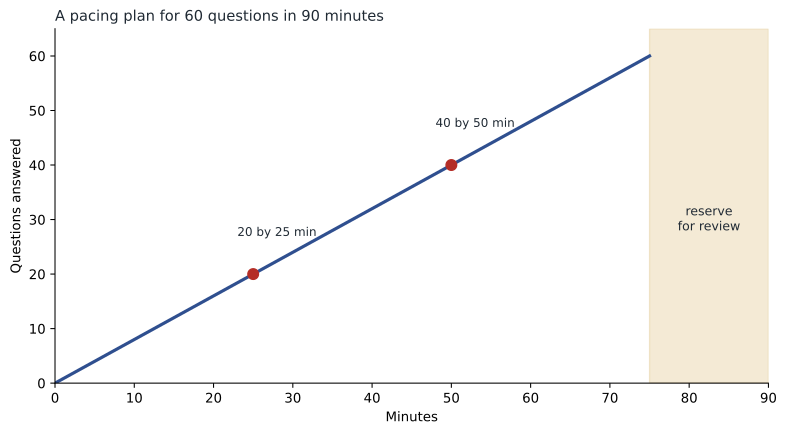
Google's page lists 90 minutes for 50 to 60 questions. If you plan for the larger number, you have 90 seconds per question on average, and some questions will take far less. A simple plan is to aim for an average of about 75 seconds per question on the first pass, which leaves a reserve of around 15 minutes at the end for review. Set checkpoints so you know whether you are on track without doing arithmetic under pressure. If the exam shows 60 questions, aim to have finished about 20 by the 25-minute mark and about 40 by the 50-minute mark.
# Checkpoints for a 90-minute exam at a planned 75 seconds per question
total_minutes = 90
for n in (50, 55, 60):
    plan = 75
    checkpoints = [(q, round(q * plan / 60)) for q in (n // 3, 2 * n // 3, n)]
    reserve = total_minutes - round(n * plan / 60)
print(n, "questions:", checkpoints, "reserve", reserve, "minutes")50 questions: [(16, 20), (33, 41), (50, 62)] reserve 28 minutes 55 questions: [(18, 22), (36, 45), (55, 69)] reserve 21 minutes 60 questions: [(20, 25), (40, 50), (60, 75)] reserve 15 minutes
What this code does
For each possible exam length, the program plans 75 seconds per question and works out where the candidate should be after one third, two thirds and all of the questions. It also shows how many minutes would be left over for review. With 60 questions the reserve is 15 minutes, and with 50 it is 28.
Generative AI Leader questions vary more in length than many foundational exams. A question about which model family makes video may take twenty seconds; a scenario about an agent, its tools and its permissions may take two minutes to read carefully. Short questions bank time for long ones, which is why an average works better than a fixed time per question. The most important timing rule is to cap the time on any one question. If a question is still unclear after about two minutes, choose your best answer, mark it for review if the exam lets you, and move on. One stubborn question is worth the same as one easy question at the end, and running out of time loses several easy marks.
Answer every question
Unanswered questions cannot score, and we know of no published penalty for a wrong answer on Google's exams, so make sure every question has an answer before time runs out. If you are running short, go through the remaining questions quickly, apply the reading routine from lesson 3 in its fastest form, and choose the best option. If a question asks you to choose more than one answer, choose exactly the number asked.
When to change an answer
Many candidates change correct answers to wrong ones during review. Studies of test takers suggest that changed answers more often go from wrong to right than from right to wrong, but only when there is a reason for the change. The rule Ravi gives Jules is simple: change an answer only if you can name the specific fact or constraint you missed the first time. A vague feeling that another option seems better is not a reason. During review, reread the ask and the constraints of each marked question before looking at your answer again.
| Situation | What to do |
|---|---|
| Question unclear after about two minutes | Choose the best answer, mark it if you can and move on |
| Behind at a checkpoint | Speed up by trusting the reading routine; skip deep rereading |
| Ahead at a checkpoint | Keep the pace; spend the extra time in final review |
| A long agent or tools scenario | Read the ask first, then the constraints, then the options |
| Two options seem equally good | Choose the simpler option that fully meets the need |
| Reviewing a marked question | Change it only if you can name what you missed |
Reviewing a practice session
The most valuable part of a practice session happens afterwards. For every question you got wrong, and every question you got right by guessing, write down which section it belonged to and why you missed it. Lesson 10 turns this into a simple heat map with four reasons: you did not know it, you mixed up two similar things, you misread the question, or you ran out of time. Each reason has a different fix, so the record tells you what to study next. A score alone tells you very little; a score with reasons tells you exactly where to spend the next week.
Review your right answers too. If you chose the correct option for the wrong reason, the next question on the same topic may catch you. Jules plans to mark every answer in practice with a confidence level, sure, fairly sure or guessing, and to review every guess, even the lucky ones.
Practicing for an online exam
Because Jules will sit the exam online, Ravi suggests making at least one full practice session as close to the online conditions as possible: the same desk, the same computer, a cleared workspace, no breaks, a webcam on, and silent reading. It feels like overkill until exam day, when the environment is one less new thing to deal with. If you will sit at a testing center instead, practice at least once away from home, in a library or a quiet meeting room, so that an unfamiliar room does not throw you.
Writing your own questions
One of the most effective practice methods is writing questions yourself. To write a good multiple choice question, you have to know the right answer, the reason it is right, and the three most tempting wrong answers and why each is wrong. That is exactly the understanding the exam tests. Ravi asks Jules to write two questions after each review session, one easy and one hard, with a short explanation for every option. Jules's best question so far asks which offering helps human agents during live calls, with Conversational Agents, Conversational Insights and Agent Search as the distractors. Jules now never confuses the three.
Writing questions also shows you how exam writers think. Distractors are rarely nonsense; they are true statements that answer a different question, offerings for a different audience, or techniques that fix a different problem. Once you have built a few distractors yourself, you start to see them coming.
How much practice is enough
There is no fixed number of practice questions that guarantees a pass, but there is a useful sign of readiness: consistent, comfortable results on fresh, mixed, timed sets, with most misses explained by reasons you have already fixed. One good score can be luck; three in a row on different sets is evidence. If your results are rising but not yet consistent, keep practicing. If they have leveled off, return to the heat map in lesson 10, because the remaining gaps probably need a different fix rather than more of the same practice.
Looking after yourself
Practice is more effective when you are rested. Short, regular sessions beat long ones squeezed in after a tiring day, and sleep plays an important part in consolidating what you learn. Jules plans most sessions for the early morning, before the shop's busy hours, and keeps evenings free for anything except studying at least twice a week. That rhythm is not a luxury; it is part of the plan.
Worked problem
Building a pacing plan
Jules's April exam shows 55 questions. Using 75 seconds per question on the first pass, when should Jules expect to reach question 18, question 36 and the end, and how much reserve will be left?
Show solution
- 18 questions at 75 seconds is 1,350 seconds, which is 22.5 minutes, so about 23 minutes.
- 36 questions at 75 seconds is 2,700 seconds, which is 45 minutes.
- 55 questions at 75 seconds is 4,125 seconds, which is about 69 minutes.
- 90 minutes minus 69 minutes leaves about 21 minutes of reserve.
Answer: Checkpoints at about 23 and 45 minutes, finishing the first pass at about 69 minutes with about 21 minutes for review.
Ravi books the meeting room for both planned sessions and writes the checkpoints on a sticky note for Jules's study log. They will not be on the screen during the real exam, of course; the point is to learn them well enough that they are not needed.
Common mistakes
MistakePracticing only untimed, with notes open.
InsteadAfter the reviews, practice timed, closed-book and mixed.
MistakeUsing exam dumps.
InsteadUse the official guide, learning path, any official samples and original questions.
MistakeSpending many minutes on one hard question.
InsteadCap each question at about two minutes, mark it and move on.
MistakeLeaving questions blank.
InsteadAnswer every question; we know of no published penalty for wrong answers.
MistakeChanging answers on a hunch.
InsteadChange only when you can name the fact or constraint you missed.
Summary and key terms
- Practice under exam conditions: timed, closed-book, mixed across the four sections.
- Use legitimate material; exam dumps break the rules and are often wrong or out of date.
- Mixed, spaced retrieval practice works better than blocked rereading.
- Plan about 75 seconds per question with checkpoints and a reserve of around 15 minutes.
- Cap time on any one question, answer every question, and change answers only for a reason.
- Review every miss and every guess, with the reason, after each practice session.
- Interleaving
- Mixing topics within a practice session rather than studying one at a time.
- Spacing
- Reviewing material again after gaps of days or weeks.
- Retrieval practice
- Recalling an answer from memory before checking it.
- Checkpoint
- A planned point in the exam at which you check your progress.
- Exam dump
- A collection of questions claimed to be from a real exam; using one breaks the rules.
- Confidence mark
- A note of how sure you were of a practice answer.
Practice problems
Work each problem on paper first, then reveal the answer to check.
How many full timed practice sessions are a good minimum?
Show answer
At least two.
What average time per question leaves about 15 minutes of reserve for 60 questions?
Show answer
About 75 seconds.
What should you do with a question still unclear after about two minutes?
Show answer
Choose the best answer, mark it if possible and move on.
Why avoid exam dumps?
Show answer
They break the exam terms, can lead to revocation and are often wrong or out of date.
What is interleaving?
Show answer
Mixing topics within a practice session.
When should you change an answer in review?
Show answer
Only when you can name the fact or constraint you missed.
Why review correct guesses?
Show answer
Because a right answer for the wrong reason may fail next time.
Lesson quiz · 5 questions
Score 60% or more to complete this lesson.
Create a free account to save your progress, take quizzes and earn a certificate.