
GCP-191 · Lesson 12 of 12 · 22 min
After the exam: results, renewal and next steps
▶ Video coming soon A video version of this lesson is on the way.
The last session of the course is about the part most candidates do not plan for: what happens after the exam ends. Ravi asks Jules to plan it now, before the exam, for a simple reason. "When you pass, you will want to celebrate, not think," he says, "and if you don't pass, you will want a plan you made with a clear head." This lesson covers what you see at the end of the exam, how official results and badges arrive, how to act on a pass or a fail, how the certification stays current, and where it can lead. As before, Jules's exam and everything after it are still ahead as this course is written, so this lesson describes plans, and results are never assumed.
What you see at the end
When you submit the exam, the screen typically shows a provisional pass or fail result. It is provisional because results go through checks before they are confirmed. Do not photograph it; for online exams, photographing the result is a listed violation that can invalidate the exam. The official result, the certificate and a digital badge then arrive through your certification account and by email. Candidates commonly report that this takes several days, but check Google's help pages for the current process rather than relying on any fixed number. If you hear nothing after a reasonable time, check your account and spam folder before contacting support.
Google does not publish a passing score, and the result you receive is a pass or fail rather than a mark you can compare with others. That is worth knowing in advance, so that you are not looking for a number that will not appear.
Sharing a pass
A digital badge is a small image with verified information behind it: who earned it, what it means and when it expires. You can add it to a professional profile, an email signature or a résumé, and anyone who clicks it can check that it is real. Many employers now ask for badges rather than paper certificates. For a Generative AI Leader certification, sharing a pass also says something about your role: that you can lead conversations about generative AI with both business and technical colleagues.
Jules has already agreed with Ravi how a pass would be shared at Birchline: a short note to the leadership team, the badge on Jules's profile, and, more usefully, a lunch-and-learn session for the store managers on what generative AI can and cannot do for them. Ravi argues that teaching the material to others is the best way to keep it, and that the session matters more than the badge.
Acting on a fail
A fail is information, not a verdict. Most candidates who fail a foundational exam pass on a later attempt, especially if they plan the retake from evidence rather than from disappointment. For foundational exams, the retake policy we checked in November 2026 allowed up to 10 attempts in a year, with at least 14 days after each failed attempt, and every attempt is paid for. The score report usually shows how you performed by section, even though it gives no overall mark. Use that, together with your memory of which questions felt hard, to redraw the heat map from lesson 10.
A good retake plan has three parts. First, write down within a day what the exam felt like: which sections felt weak, which kinds of question surprised you and whether time was a problem. Second, rebuild the heat map and spend two weeks on the darkest cells, using the fixes from lesson 10. Third, sit a fresh timed practice set before booking again, and book only when it is consistently comfortable. Do not simply book the earliest retake date and hope; the 14-day wait is a minimum, not a target.
| After a pass | After a fail |
|---|---|
| Wait for the official result and badge before announcing | Write down what the exam felt like within a day |
| Share the badge and tell your manager | Use the section feedback to rebuild the heat map |
| Teach what you learned to colleagues | Spend at least two weeks on the darkest cells |
| Note the expiry date and renewal window | Sit a fresh timed practice set before rebooking |
| Choose a next step that fits your role | Book again only when practice is consistently comfortable |
Keeping the certification current
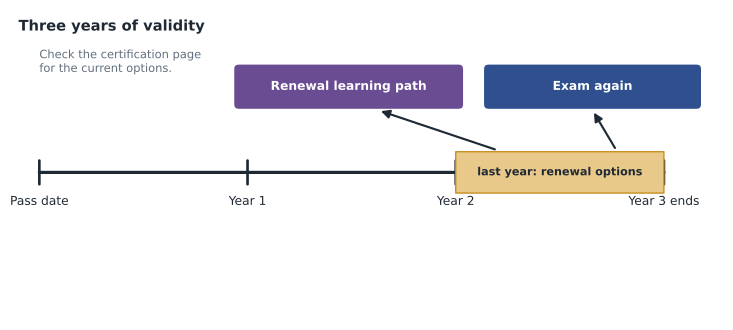
A pass is valid for three years. When we checked Google's certification page in November 2026, it described a way to renew through Google Skills: completing the designated courses or skill badges in a renewal learning path within the last year of the certification's active period. The page described the renewal as extending validity for a period of one year, and asked candidates to link their CM Connect and Google Skills accounts using the same email address. The page also mentioned a renewal exam option without giving its details, and you can always sit the standard exam again. Renewal rules change, so check the certification page and the renewal help page in your final year rather than relying on this summary.
# When does a pass expire, and when does the final year begin?
import datetime
passed = datetime.date(2027, 4, 14)          # example date only
expires = passed.replace(year=passed.year + 3)
final_year_starts = passed.replace(year=passed.year + 2)
print("Example pass:", passed.isoformat())
print("Expires:", expires.isoformat())
print("Final year for renewal begins:", final_year_starts.isoformat())Example pass: 2027-04-14 Expires: 2030-04-14 Final year for renewal begins: 2029-04-14
What this code does
From an example pass date, the program adds three years to find when the certification expires and two years to find when the final year, the renewal window, begins. It prints all three dates. The example shows the renewal window opening in April 2029.
Generative AI changes faster than almost any other area of cloud technology, and that makes keeping current more than an administrative task. The offerings, model families and best practices you studied for this exam will look different within a year. A short routine helps: read Google Cloud's release notes or AI blog once a month, try one new feature a quarter in a sandbox or in a tool you already use, and update your pair cards when something is renamed. By the time renewal comes, the learning path will feel like a review rather than a new course.
Where the certification can lead
Generative AI Leader is a foundational certification, so it is a starting point rather than an end. Which direction to take depends on your role. For business leaders like Jules, the most valuable next step is often applying the knowledge at work: leading a well-measured pilot, writing a responsible AI checklist for the team, or helping colleagues choose between prebuilt tools and custom builds. For people who want broader cloud knowledge, Cloud Digital Leader covers the rest of Google Cloud at the same level. For technical people, associate and professional certifications go deeper, including in cloud engineering, machine learning engineering and building agentic systems; check Google's current certification list, which changes as new roles appear.
Jules's own plan, agreed with Ravi, is modest and practical: sit Cloud Digital Leader in January and Generative AI Leader in April, then spend the rest of 2027 turning the shopping assistant pilot into a measured, well-governed service, and helping two other teams find their first good use case. Owen, meanwhile, is aiming at Associate Cloud Engineer. Ravi is not sure he will ever sit another exam himself, but he has promised to write the questions.
Turning the certification into value at work
The real return on the certification comes from using what you learned. A few concrete ideas follow from the exam's own sections. From the fundamentals, you can explain to colleagues what generative AI can and cannot do, which often prevents unrealistic projects. From the offerings section, you can steer teams toward prebuilt tools for common needs and save custom builds for distinctive ones. From the output section, you can insist on grounding for factual tasks, evaluation sets for every assistant and human review where stakes are high. From the strategy section, you can make sure every project has a business problem, a baseline, success measures, a security review and a named owner.
Jules has turned those ideas into a one-page checklist for any new AI project at Birchline, with five questions: what problem, for whom, how will we know it worked, what could go wrong, and who owns it. Teresa has added a sixth: what data does it touch. The checklist will be the subject of the lunch-and-learn session after the exam.
Helping others prepare
If colleagues plan to sit the same exam, sharing your preparation method is more useful than sharing your notes. Show them how to build the objective checklist, the heat map and the pair cards, and lend them the original practice questions you wrote. Do not share anything about the content of the real exam: the candidate agreement forbids disclosing exam questions, and breaking it can cost you the certification. Talking about which sections felt harder or how you managed time is fine; describing specific questions is not.
If your role changes
Certifications follow you when you change jobs, but their value depends on what you do with them. If you move into a more technical role, the concepts from this program are a foundation for associate and professional study. If you move into a role with more people to lead, the strategy and responsible AI material becomes the most useful part. Either way, keep the badge current, keep your pair cards up to date with product changes, and keep asking the five checklist questions of every AI idea that crosses your desk.
Finally, look back. Keep the study log, the heat maps and the pair cards. They are a record of how you learned something difficult in a few months, and they will be useful the next time you prepare for an exam, a certification renewal or simply a new project. Many people find that the method they built for one exam carries over to every one after it.
Worked problem
Planning a retake from evidence
A colleague receives a fail on a foundational exam on May 6. The section feedback shows strong results in fundamentals and business strategy and weaker results in offerings and improving output. She wants to book the earliest possible retake. What is a better plan?
Show solution
- The earliest retake is May 20, after the 14-day minimum wait, but the date should follow readiness, not the rule.
- Within a day, she writes down what felt hard, such as offering names and sampling settings.
- She rebuilds the heat map and spends two weeks on the offering pair cards and the output techniques and settings, with short mixed review of the strong sections.
- She sits a fresh timed practice set, and books the retake only when it is consistently comfortable, perhaps early June.
Answer: Plan from evidence: rebuild the heat map, close the gaps, practice again, then book. The 14-day wait is a minimum, not a target.
Ravi ends the course where he began, at the whiteboard with the four phrases on it. He adds a fifth beneath them: "keep learning". "The exam measures where you are in April," he says. "The field will have moved by May. The habit of keeping up is the thing worth having." Jules takes a photo of the whiteboard. It becomes the last page of the study log, and the first page of whatever comes next.
Common mistakes
MistakePhotographing the provisional result.
InsteadDo not; it is a listed violation for online exams.
MistakeAnnouncing a pass before the official confirmation.
InsteadWait for the official result and badge.
MistakeBooking the earliest retake date out of frustration.
InsteadPlan from evidence and book when practice is consistently comfortable.
MistakeForgetting the expiry date.
InsteadNote the date and check renewal options in the final year.
MistakeTreating the certification as the finish line.
InsteadKeep current and apply the knowledge at work.
Summary and key terms
- The end-of-exam result is provisional; the official result, certificate and badge follow later.
- Google does not publish a passing score; you receive a pass or fail with section feedback.
- Share a pass with the badge, and teach what you learned to keep it.
- After a fail, write down what was hard, rebuild the heat map, close gaps and practice before rebooking.
- A pass is valid for three years; in November 2026 the page described renewal through a learning path in the final year.
- Keep current with release notes and practice, and choose a next step that fits your role.
- Provisional result
- The pass or fail shown at the end of the exam, before checks confirm it.
- Digital badge
- A verifiable online image that shows a certification and its details.
- Renewal learning path
- Designated courses or skill badges that renew a certification.
- Validity period
- How long a certification remains active.
- Retake plan
- A plan for a later attempt built from evidence about the first.
- Release notes
- Published notes on changes and new features in a product.
Practice problems
Work each problem on paper first, then reveal the answer to check.
Why is the end-of-exam result called provisional?
Show answer
Because it goes through checks before it is confirmed.
Does Google publish a passing score?
Show answer
No.
How long is a Generative AI Leader pass valid?
Show answer
Three years.
How did the page in November 2026 describe renewal through Google Skills?
Show answer
Completing a renewal learning path within the last year of the certification's active period.
What is the minimum wait after a failed foundational exam?
Show answer
14 days.
What three parts make a good retake plan?
Show answer
Write down what was hard, close the gaps from a rebuilt heat map, and practice again before rebooking.
Why does keeping current matter especially for this certification?
Show answer
Because generative AI offerings and practices change very quickly.
Lesson quiz · 5 questions
Score 60% or more to complete this lesson.
Create a free account to save your progress, take quizzes and earn a certificate.