
GCP-110 · Lesson 12 of 12 · 18 min
Case study: choosing a generative AI approach
▶ Video coming soon A video version of this lesson is on the way.
By late January 2027 Jules has a decision to make. The steering committee has approved budget for one more generative AI project in the spring, and three proposals compete for it. The help desk wants an assistant that drafts replies to customer emails. The buying team wants a tool that compares supplier specification sheets. And the stores want a voice assistant on tablets that answers staff questions while they work the floor. Jules must recommend one, with an approach, a model choice, an evaluation plan and the controls it needs. This capstone lesson walks through his reasoning, pulling together every lesson in the course into a method that also works for scenario questions on the exam.
A method for choosing an approach
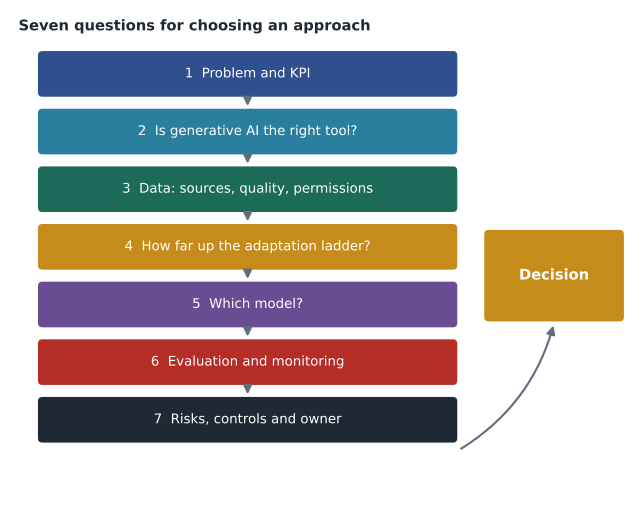
Ravi suggests a sequence of seven questions. Each one draws on earlier lessons, and together they turn a vague idea into a design.
- 1. What is the business problem and how will we measure success? Name the outcome and the KPI before naming any technology (lesson 9).
- 2. Is generative AI the right tool? Does the task need new content, work with unstructured data, or benefit from flexible language understanding? Would rules, search or a predictive model do better (lesson 1)?
- 3. What data does it need, and is that data good enough? Identify first-party, third-party and world data, and check quality, permissions and privacy (lessons 6 and 10).
- 4. How far up the adaptation ladder must we climb? Start with prompting; add grounding for facts, tools for live data and actions, and tuning only for behavior that prompts cannot achieve (lessons 5 to 8).
- 5. Which model fits? Choose by modality, measured quality, context, latency, cost, customization and governance (lessons 2 to 4).
- 6. How will we evaluate and monitor it? Build the evaluation set, set launch criteria and plan monitoring (lesson 9).
- 7. What could go wrong, and what controls are needed? Map limitations and risks to practices, decide the level of human involvement and assign an owner (lessons 10 and 11).
Proposal 1: drafting replies to customer emails
Problem and KPI. The help desk receives about 20,000 emails a month. Agents spend most of their time on routine questions about orders, returns and products. The goal is to cut the average handling time per email while keeping customer satisfaction at least as high. KPIs: handling time, satisfaction scores on replies, and the share of drafts sent with little editing.
Is generative AI right? Yes. Replies are new text, emails are unstructured, and wording varies endlessly, which rules cannot handle well. A predictive classifier already sorts emails into queues; the drafting adds the generative part.
Data. First-party: the policy documents, product catalog and order status system. Past emails and approved replies are valuable for examples and evaluation but contain personal information, so they must be redacted before use. Data quality work already done for the policy assistant helps.
Adaptation. Prompting with Birchline's tone rules and a few example replies; grounding in the policy documents through retrieval; a read-only order-status function so drafts can include real delivery dates. No tuning at first. Crucially, the system drafts and an agent sends: a human in the loop for every reply.
Model. A capable mid-sized model is a reasonable starting point, tested against a larger one on the evaluation set. Latency matters less than for live chat, because agents review drafts in a queue.
Evaluation. 300 past emails with redacted personal details and the replies agents actually sent; automated checks that cited policies exist and order details match the order system; a model judge for groundedness and tone, calibrated against ratings from senior agents.
Risks and controls. Hallucinated policies (grounding, citations, review); privacy (redaction, access controls on order data); automation bias (watch the edit rate and the share of drafts sent unchanged); prompt injection in incoming emails (screening, and drafts can only be sent by a person).
Proposal 2: comparing supplier specification sheets
Problem and KPI. Buyers compare specification sheets from competing suppliers, often scanned PDFs with tables in different layouts. Comparing three suppliers for a new tent takes a buyer most of a day. KPI: time to produce a comparison, and the accuracy of extracted fields checked against the source sheets.
Is generative AI right? Partly. Extracting fields from messy documents in many layouts is a strong multimodal task (lesson 3). The comparison itself, which supplier offers better value, is a business judgment that stays with the buyer.
Data. Third-party supplier documents, used within the supplier agreements. Volume is modest: perhaps a few hundred sheets a season.
Adaptation. A multimodal model with a structured output schema for the fields buyers need: fabric, weight, dimensions, warranty, certifications and price breaks. Low temperature. Validation in code for units and ranges, and a side-by-side table that shows each value with a link to its place in the source document. No agent or tuning needed.
Model. A capable multimodal model, because document understanding quality matters more than cost at this volume.
Evaluation. 50 sheets with fields extracted by hand; field-level accuracy per supplier format; special attention to units, which are a known source of error.
Risks and controls. Misread values (validation, source links, buyer review); confidentiality of supplier pricing (access limited to the buying team). Low risk overall, because a buyer checks every comparison.
Proposal 3: a voice assistant for store staff
Problem and KPI. Store associates often need answers while helping a customer: a policy detail, a product comparison, whether another store has stock. A hands-free voice assistant on tablets could answer in seconds. KPIs: questions answered without calling the help desk, time to answer, and associate satisfaction.
Is generative AI right? Yes for understanding spoken questions and answering from policies and product data. But the environment is hard: noisy stores, varied accents, and the need for very fast answers.
Data. First-party policies and catalog, already prepared for the policy assistant, plus live inventory through a function call. Voice recordings may capture customers nearby, which raises privacy questions under the applicable state privacy laws.
Adaptation. Speech recognition, retrieval over policies, a read-only stock function, and short spoken answers. Possibly a small, fast model for latency, or a small open model on the tablet for the stores with poor internet (lesson 3), with harder questions sent to a larger model in the cloud.
Model. Latency is the deciding factor, which favors smaller models and careful testing in real stores.
Evaluation. Recordings of staff questions made in a test store with background noise; speech recognition accuracy by accent and noise level; answer groundedness and speed.
Risks and controls. Misheard questions in noisy stores (confirmation for anything consequential); bias in speech recognition across accents (testing across the staff population); privacy of recorded customers (on-device processing where possible, no retention of audio, clear notices to staff). Higher complexity and more unknowns.
Comparing the proposals
Jules scores the three proposals on value, feasibility, risk and readiness of the data, using a simple weighted model the steering committee can see and question.
weights = {"value": 0.35, "feasibility": 0.25, "low_risk": 0.20, "data_ready": 0.20}
# Scores from 1 (poor) to 5 (strong), agreed in a workshop with each team.
proposals = {
    "email reply drafts":      {"value": 5, "feasibility": 4, "low_risk": 3, "data_ready": 4},
    "spec sheet comparison":   {"value": 3, "feasibility": 5, "low_risk": 5, "data_ready": 3},
    "store voice assistant":   {"value": 4, "feasibility": 2, "low_risk": 2, "data_ready": 3},
}
ranked = sorted(proposals, key=lambda p: sum(weights[k] * proposals[p][k] for k in weights), reverse=True)
for p in ranked:
    score = sum(weights[k] * proposals[p][k] for k in weights)
print(f"{score:.2f} {p}")4.15 email reply drafts 3.90 spec sheet comparison 2.90 store voice assistant
What this code does
Three AI proposals are scored from 1 to 5 on value, feasibility, low risk and data readiness, and each score is multiplied by an agreed weight and added up. Email reply drafts come first at 4.15, ahead of spec sheet comparison at 3.90 and the store voice assistant at 2.90. The weights make value count most, but low feasibility and high risk pull the voice assistant down.
| Proposal | Main technique | Human involvement | Biggest risk | Readiness |
|---|---|---|---|---|
| Email reply drafts | Prompting, RAG and a read-only function | An agent sends every reply | Automation bias and privacy | High: reuses policy grounding |
| Spec sheet comparison | Multimodal extraction with a schema | A buyer checks each comparison | Misread values | High, smaller benefit |
| Store voice assistant | Speech, RAG, function call, small models | Confirmation for actions | Noise, accents and recorded customers | Lower: needs field testing |
The scores are only as good as the judgments behind them, and Jules says so in his recommendation. But the structure makes the reasoning visible. The email drafting assistant offers the largest value, reuses the grounding work already done, keeps a person in control of every reply and has clear KPIs. The specification comparison is low risk and easy, so Jules proposes it as a small side project for the buying team using the same platform. The voice assistant is promising but needs a field trial in two stores before any commitment.
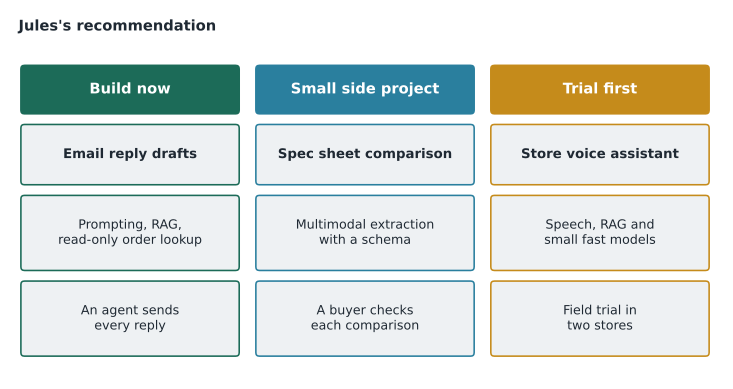
The recommendation
Jules's final recommendation fits on one page, the format the board liked in January.
- Build: the email reply drafting assistant, launching to one help desk team in spring 2027 and expanding if KPIs are met.
- Approach: prompting with tone rules and examples, grounding in policy documents, a read-only order-status function, human approval of every reply. No tuning in the first release.
- Model: a mid-sized model chosen by evaluation against a larger one; revisit a tuned small model if volume grows.
- Evaluation: 300 redacted past emails, automated checks, a calibrated model judge and senior-agent ratings; launch only if groundedness and edit-rate targets are met.
- Controls: redaction and access control, screening for prompt injection, monitoring of the share of drafts sent unchanged, and Jules as business owner with Teresa approving privacy and security.
- Also: the specification comparison as a small project for buyers; a two-store field trial of the voice assistant before any further investment.
Ravi reads it and has only one comment: "You did not mention a single model by name until step five." Jules takes that as the compliment it is. The model is one decision among seven, and rarely the most important one.
Applying the method on the exam
Scenario questions on the Generative AI Leader exam often describe an organization, a goal and some constraints, then ask for the best approach, product or next step. The same method helps. Identify the business goal first. Look for words that point to a technique: "current" or "our own documents" suggests grounding; "consistent style" suggests tuning after prompting; "take action" or "look up live data" suggests agents and tools; "images" or "documents" suggests multimodal models. Watch for constraints such as data residency, limited budget, low latency or regulatory scrutiny. Prefer the simplest approach that meets the need, keep people in the loop where stakes are high, and remember that responsible AI is part of every correct answer, not an optional extra. GCP-191 practices these patterns in depth.
Common mistakes
MistakeChoosing the model first.
InsteadStart from the business problem and KPI; the model is one decision among seven.
MistakePicking the most ambitious project.
InsteadWeigh value against feasibility, risk and data readiness; trial uncertain ideas first.
MistakeHiding the reasoning behind a recommendation.
InsteadShow scores, assumptions and risks so others can question them.
MistakeLeaving controls until after launch.
InsteadDesign evaluation, human involvement and ownership before building.
Checking the recommendation
Before sending the recommendation, Jules asks Teresa and Dana to try to break it. Teresa asks what happens if a customer's email contains another customer's order number; the order-status function must check that the order belongs to the sender. Dana asks what the assistant will cost if volume doubles at the holidays; Ravi's estimate shows it stays well within budget with the mid-sized model. Both answers go into the recommendation, which is stronger for having been challenged.
Worked problem
A scenario in exam style
A regional bank wants staff to answer customer questions about its current fee schedule, which changes quarterly, in a consistent, plain-language style. Customer data must stay in the country. What approach fits best?
Show solution
- Business goal: accurate, consistent answers for staff, measured by accuracy and time saved.
- Current, changing facts point to grounding in the fee schedule through retrieval, not tuning.
- Consistent style can start with prompting and examples; tuning only if that falls short.
- Data residency points to choosing a region in the country for processing and storage.
- Staff review answers before sharing them with customers, and answers cite the fee schedule.
Answer: A grounded assistant using retrieval over the current fee schedule, prompted for style, deployed in an in-country region, with citations and staff review.
Summary and key terms
- Choosing a generative AI approach follows seven questions: define the problem and KPI; check that generative AI fits; assess the data; decide how far to adapt; select a model; plan evaluation and monitoring; and map risks to controls with an owner.
- Applied to Birchline's three proposals, email reply drafting offered the most value with reusable grounding and a person sending every reply; specification extraction was easy and low risk; the store voice assistant needed a field trial.
- A transparent scoring model made the trade-offs visible.
- The same method answers exam scenarios: start from the goal, read the clues that point to grounding, tuning, agents or multimodal models, respect constraints, prefer the simplest approach and include responsible AI.
- KPI
- A measurable indicator that shows whether a project meets its business goal.
- Adaptation ladder
- The sequence from prompting to grounding, tools and tuning, climbed only as needed.
- Field trial
- A limited test in real conditions before full rollout.
- Launch criteria
- Evaluation targets a system must meet before release.
- Business owner
- The person accountable for an AI system's use and outcomes.
- Weighted scoring
- Comparing options by scoring criteria and combining them with agreed weights.
Practice problems
Work each problem on paper first, then reveal the answer to check.
In the method, what comes before choosing a model?
Show answer
Defining the problem and KPI, checking that generative AI fits, assessing the data and deciding how far to adapt.
A scenario mentions answers from "our own current documents". Which technique does that suggest?
Show answer
Grounding, typically retrieval-augmented generation.
Why did Jules recommend a field trial for the voice assistant?
Show answer
It had high uncertainty from noise, accents, latency and privacy, so it needed real-world testing first.
Lesson quiz · 5 questions
Score 60% or more to complete this lesson.
Create a free account to save your progress, take quizzes and earn a certificate.