
GCP-110 · Lesson 11 of 12 · 18 min
Responsible AI principles and governance
▶ Video coming soon A video version of this lesson is on the way.
In January Birchline's board asks a simple question at its quarterly meeting: "How do we know our AI is being used responsibly?" Dana forwards it to Jules with a note: "I need an answer in one page, and I need it to be true." Writing that page forces Jules to bring together everything he has learned about limitations into a set of principles, practices and responsibilities. This lesson covers responsible AI: what it means, the principles most organizations adopt, Google's own frameworks, privacy and security practices, and the governance that turns principles into daily habits.
What responsible AI means
Responsible AI is the practice of designing, building, deploying and using AI systems in ways that are beneficial, fair, safe, transparent, accountable and respectful of privacy and human rights. It is not a separate project bolted on at the end. It runs through every stage of the lifecycle from lesson 1: which problems to tackle, what data to use, how to evaluate, how to deploy, and how to monitor and respond when things go wrong.
Responsibility matters for practical as well as ethical reasons. Irresponsible AI creates legal risk, damages customer trust, harms people and can force expensive withdrawals of products. Responsible AI, done well, is what lets an organization use AI with confidence and at scale. Jules opens his page to the board with that sentence.
Common principles
Organizations, governments and standards bodies have published many sets of AI principles. They differ in wording but share a core that the exam expects leaders to recognize.
| Principle | What it asks | Birchline practice |
|---|---|---|
| Fairness | Avoid unjust differences in outcomes across groups | Test the assistant in English and French and with varied phrasing; no AI screening of job applicants |
| Safety | Prevent harm, including harmful or dangerous content | Safety settings at default or stricter; screening of prompts and responses |
| Privacy | Protect personal information and respect consent | Remove personal details from logs used for evaluation; no customer data in tuning without review |
| Transparency | Be open about when and how AI is used | The assistant says it is an AI and offers a person; generated images are labeled |
| Explainability | Make outputs and decisions understandable | Policy answers cite their sources |
| Accountability | Keep people responsible for outcomes | Every AI system has a named business owner |
| Reliability | Perform consistently and as intended | Evaluation sets, launch criteria and monitoring |
| Security | Protect systems and data from attack and misuse | Least privilege for agents; logging; input screening |
Google's approach
Google published its AI Principles in 2018 and has updated them since, most recently in 2025. They commit Google to pursuing AI that is beneficial, to developing and deploying it responsibly with human oversight, due diligence and feedback, and to safety, security and privacy throughout. Google Cloud applies these principles to its products and offers tools and documentation to help customers use AI responsibly, but, as with security under the shared responsibility model, each customer remains responsible for how it uses AI in its own business.
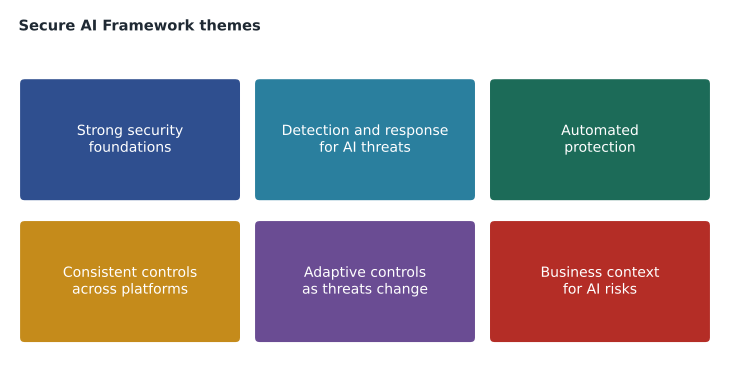
For security specifically, Google created the Secure AI Framework (SAIF), a conceptual framework for securing AI systems. SAIF extends familiar security practices to AI: build on strong security foundations, extend detection and response to AI threats, automate defenses, harmonize controls across platforms, adapt controls as threats evolve, and understand AI risks in the context of the surrounding business processes. The exam guide asks leaders to recognize SAIF and the Google Cloud security tools that support it, such as secure-by-design infrastructure, Identity and Access Management, Security Command Center and workload monitoring. GCP-112 covers these in more depth.
Privacy in practice
Generative AI touches personal information in prompts, grounding data, logs, tuning datasets and outputs. Responsible use applies privacy principles at each point: collect and use only what is needed, protect it, limit who can see it, keep it only as long as necessary, and be clear with people about how it is used.
Two techniques named in the exam guide help when personal data must be used for analysis or evaluation. Anonymization removes or alters identifying information so that individuals can no longer be identified, even by combining the data with other sources; done properly, the data is no longer personal information. Pseudonymization replaces identifiers such as names and email addresses with consistent codes, so records can still be linked and analyzed, but the codes can be traced back to people by whoever holds the key. Pseudonymized data is still personal information and must be protected accordingly.
import hashlib, re
SECRET = "keep-this-key-in-a-secret-manager"   # illustrative; never hard-code real keys

def pseudonymize(email):
    digest = hashlib.sha256((SECRET + email.lower()).encode()).hexdigest()
    return "cust_" + digest[:10]

def redact(text):
    text = re.sub(r"[A-Za-z0-9._+-]+@[A-Za-z0-9.-]+", "[email]", text)
    return re.sub(r"[0-9]{3}[- ][0-9]{3}[- ][0-9]{4}", "[phone]", text)

log = "Customer ana.r@example.com called from 555-201-3344 about a torn tent fly."
print(pseudonymize("ana.r@example.com"), "|", redact(log))
print("same customer, same code:", pseudonymize("Ana.R@example.com"))cust_686f0653f5 | Customer [email] called from [phone] about a torn tent fly. same customer, same code: cust_686f0653f5
What this code does
Two privacy steps are shown. Pseudonymization turns a customer's email address into a stable code using a secret and a hash, so the same customer always gets the same code without the address being stored. Redaction replaces email addresses and phone numbers in a log with placeholders before the text is used.
The pseudonymized code lets Ravi's team count how many times one customer contacted the help desk without seeing who it was, while the redacted log removes the email and phone number before the conversation is added to an evaluation set. Simple pattern-based redaction misses things, so Birchline also uses Google Cloud's Sensitive Data Protection service to find and mask personal information more thoroughly.
Privacy obligations depend on where an organization operates. In the United States, Birchline follows the state privacy laws that apply to its customers, several of which give consumers rights over automated decision-making and profiling, along with sector rules such as those for card payment data. Teresa reviews every AI project for privacy before launch.
Transparency, explainability and accountability
Transparency means being open about AI use. Customers should know when they are talking to an AI assistant, and generated content should not be passed off as human-made or as real when it is not. Google's SynthID watermarking (lesson 3) supports this for generated media. Internally, transparency means documenting what each AI system does, what data it uses and what its known limitations are, often in a short model card or system card.
Explainability means people can understand why a system produced an output. Deep learning models are hard to explain internally, but systems can still be designed to be understandable: grounded answers that cite their sources, agents that log each tool call and reason, and classifications that come with a short justification. For decisions that affect people, explanations are often a legal as well as an ethical requirement.
Accountability means people, not systems, answer for outcomes. Every AI system needs a named business owner who decides how it is used, accepts its risks and responds when it fails. Birchline's draft policy assigns Jules as owner of the shopping assistant and the description writer, Ravi as owner of the review summarizer and its data, and Teresa as the approver for security and privacy.
Governance: turning principles into practice
Principles on a page do nothing by themselves. AI governance is the set of structures, policies and processes that make sure AI is used according to the principles. The exam expects leaders to recognize its common elements.
- An AI policy stating what uses are allowed, which need review and which are prohibited.
- An inventory of AI systems in use, including third-party tools staff use, with owners.
- Risk classification that sorts uses by potential impact, so high-risk uses get more review (as in lesson 10's table).
- A review process, often a cross-functional committee with business, data, security, privacy and legal members, that approves higher-risk uses before launch.
- Standards for data, evaluation and monitoring that every project must meet.
- Incident handling for when AI causes harm or errs publicly: report, investigate, fix, learn.
- Training so staff understand both the capabilities and the limits of the tools they use.
Organizations often align their governance with published frameworks such as the NIST AI Risk Management Framework and the international standard ISO/IEC 42001 for AI management systems, which provide structure for identifying, measuring and managing AI risks.
The regulatory landscape
AI regulation is changing quickly and differs by country, so leaders must track it with their legal teams rather than rely on any course for current details. In the United States there is no single comprehensive federal AI law. A December 2025 executive order set out to challenge state AI laws seen as conflicting with a national framework, while states continue to act; Colorado, for example, replaced its earlier AI law with a narrower one that takes effect on January 1, 2027. Existing laws on consumer protection, discrimination and privacy still apply to AI use. Organizations that serve customers in Europe must also consider the EU AI Act, whose obligations for high-risk systems are being phased in over several years.
Jules's page to the board ends with three commitments: every AI system has an owner and is in the inventory; every higher-risk use is reviewed before launch; and every customer-facing system is evaluated before launch and monitored after it. The board approves the page and asks for a progress report each quarter.
Common mistakes
MistakeTreating responsible AI as a final checklist.
InsteadBuild it into every lifecycle stage, from choosing the problem to monitoring.
MistakeAssuming the provider's principles cover the customer's use.
InsteadProviders supply tools and safeguards; each organization is responsible for how it uses AI.
MistakeTreating pseudonymized data as anonymous.
InsteadPseudonymized data can be re-linked by the key holder and is still personal information.
MistakeWriting principles without governance.
InsteadPolicies, inventories, risk tiers, reviews and incident handling make principles real.
MistakeRelying on a course for current regulation.
InsteadAI law changes quickly; track it with legal advisers.
Responsible AI across the lifecycle
Ravi maps responsible AI practices onto the lifecycle from lesson 1 so that each team knows what to do at each stage.
| Lifecycle stage | Responsible AI questions |
|---|---|
| Choosing the problem | Should AI be used here at all? Who could be affected, and how? |
| Data | Is the data lawfully obtained, accurate and representative? Is personal information minimized? |
| Model and adaptation | Does the model's license and data handling fit? Could tuning data introduce bias? |
| Evaluation | Are fairness, safety and privacy tested alongside quality? |
| Deployment | Do people know they are dealing with AI? Are controls and handoffs in place? |
| Monitoring | Are incidents reported and fixed? Are new risks being watched for? |
Asking these questions early is far cheaper than answering them after launch. A project that discovers a fairness problem in evaluation can fix its data; one that discovers it from a customer complaint must also repair trust.
Staff use of public AI tools
Governance also covers AI that staff use on their own initiative. Within weeks of Birchline's first announcement, Teresa found staff pasting supplier contracts into free public chatbots to summarize them. The draft policy now lists approved tools, such as Gemini in Birchline's Google Workspace accounts, where enterprise data protections apply, and forbids putting confidential or customer information into unapproved services. Training explains why, rather than only what, because staff who understand the risk make better decisions in situations no policy anticipated.
Worked problem
A one-page responsible AI summary for the board
Dana needs a truthful one-page answer to "How do we know our AI is used responsibly?" What should it contain?
Show solution
- Principles: the eight Birchline follows, each with one concrete practice.
- Inventory and owners: the three live AI systems, their owners and their risk levels.
- Review: higher-risk uses approved by a committee of business, data, security, privacy and legal staff.
- Evidence: evaluation results at launch, monitoring KPIs and any incidents, reported quarterly.
- Privacy and security: redaction and pseudonymization for logs, least privilege for agents, alignment with SAIF.
Answer: A page that pairs principles with owners, reviews, evidence and controls, and commits to quarterly reporting.
Summary and key terms
- Responsible AI means designing, building, deploying and using AI that is beneficial, fair, safe, transparent, accountable and respectful of privacy, throughout the lifecycle.
- Common principles include fairness, safety, privacy, transparency, explainability, accountability, reliability and security.
- Google publishes AI Principles and the Secure AI Framework, but customers remain responsible for their own use.
- Anonymization removes identifiability, while pseudonymization replaces identifiers with codes and remains personal data.
- Transparency, explanations such as citations, and named owners make systems trustworthy.
- Governance turns principles into practice through policy, inventory, risk classification, review, standards, incident handling and training, often aligned with NIST and ISO/IEC frameworks.
- Regulation is changing and differs by country.
- Responsible AI
- Developing and using AI in ways that are beneficial, fair, safe, transparent, accountable and private.
- Secure AI Framework (SAIF)
- Google's conceptual framework for securing AI systems.
- Anonymization
- Removing identifying information so individuals cannot be identified.
- Pseudonymization
- Replacing identifiers with codes that can be re-linked by a key holder.
- Transparency
- Openness about when and how AI is used.
- Explainability
- Making outputs and decisions understandable to people.
- Accountability
- People remaining responsible for AI outcomes.
- AI governance
- The structures, policies and processes that ensure responsible AI use.
- Model card
- A short document describing a model or system, its uses and its limitations.
Practice problems
Work each problem on paper first, then reveal the answer to check.
Is pseudonymized data still personal information?
Show answer
Yes; whoever holds the key can re-link it, so it must be protected.
Name three elements of AI governance.
Show answer
For example, an AI policy, an inventory with owners, risk classification, a review process and incident handling.
What does SAIF stand for, and what is it for?
Show answer
The Secure AI Framework, Google's framework for securing AI systems.
Lesson quiz · 5 questions
Score 60% or more to complete this lesson.
Create a free account to save your progress, take quizzes and earn a certificate.