
FILM-420 · Lesson 8 of 12 · 25 min
Defamation, filming in public and recording
Documentaries, journalism, true-crime podcasts, docudramas and even fiction can harm real people's reputations, and the act of gathering material can break laws on trespass, recording and voyeurism. This lesson covers defamation, which protects reputation; the rules on filming and photographing in public and on private property; and the rules on recording conversations and using hidden cameras. These are areas where good editorial practice and good legal practice overlap: accuracy, fairness, documentation and care.
This lesson is not a substitute for a pre-publication legal review. Films and podcasts that make serious allegations about identifiable people should be reviewed by a media lawyer before release, and most broadcasters and insurers require it.
What defamation is
Defamation is the publication of a statement that tends to lower a person's reputation in the eyes of reasonable members of the community. Written or recorded statements are traditionally called libel and spoken ones slander; films, broadcasts and online content are generally treated like libel. The statement can be made by words, images, captions, music cues, editing or the juxtaposition of shots. A shot of an innocent shopkeeper placed in a sequence about fraud can defame him even if no one says his name.
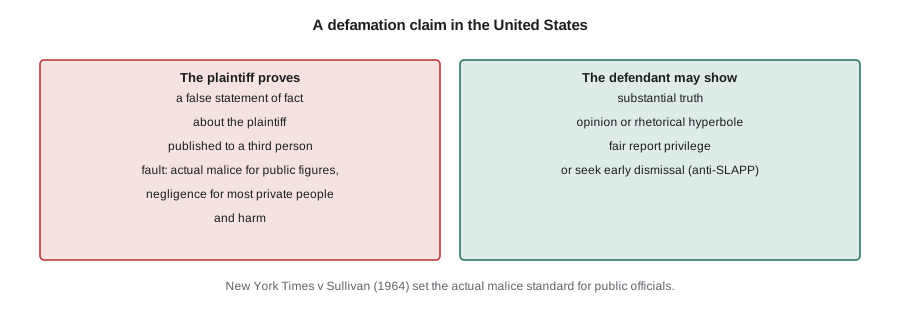
In the United States, defamation is governed by state law within limits set by the First Amendment. A plaintiff must generally prove a false statement of fact about them, published to a third party, with the required degree of fault, causing harm. Truth is not merely a defense: the plaintiff bears the burden of proving falsity in cases involving matters of public concern.
The level of fault depends on the plaintiff. Under New York Times v Sullivan (1964), public officials, and later public figures, must prove actual malice, which means the defendant knew the statement was false or acted with reckless disregard for whether it was true. Private individuals must usually prove at least negligence (Gertz v Robert Welch, 1974). Opinions that cannot be proved true or false are protected, but statements framed as opinion that imply false facts are not.
Defenses
Truth and substantial truth. Because the plaintiff must usually prove falsity, a defendant who can show substantial truth defeats the claim. Minor inaccuracies do not matter if the gist of the statement is true.
Opinion and rhetorical hyperbole. Statements that cannot reasonably be understood as stating actual facts, such as insults, parody and obvious exaggeration, are protected. In Hustler Magazine v Falwell (1988), the Supreme Court held that a public figure could not recover for a parody that no reasonable reader would take as fact.
Fair report privilege. Most states protect fair and accurate reports of official proceedings and public records, such as court filings and police statements, even if the underlying allegations turn out to be false.
Anti-SLAPP laws. About three dozen states have anti-SLAPP laws, which let defendants seek early dismissal of claims arising from speech on public issues and often award attorney's fees if they win. California's law, section 425.16 of the Code of Civil Procedure, is among the strongest, and several states have adopted the Uniform Public Expression Protection Act. Federal courts disagree about whether state anti-SLAPP procedures apply in federal cases.
Defamation risks in documentary and drama
Most defamation claims against filmmakers come from a predictable set of situations: allegations of crime or misconduct, unflattering portrayals of identifiable private people, editing that changes meaning, and fictional characters who resemble real people.
- Allegations: verify every factual claim with reliable, documented sources, give the subject a fair chance to respond, and report the response accurately.
- Editing and juxtaposition: check that the order of shots, the music and the narration do not imply things that are not true, especially about bystanders and archive subjects.
- Captions and titles: a neutral image becomes defamatory with the wrong caption. Review all on-screen text and promotional material, including trailers and thumbnails.
- Docudrama and dramatization: invented dialogue and composite characters can imply facts. Use disclaimers, but do not rely on them alone; a disclaimer does not cure a portrayal that a viewer would take as fact.
- Fiction: a fictional character who closely matches a real person in name, job and location can be read as referring to that person. Script clearance (Lesson 6) catches many of these.
Worked problem
Reviewing a true-crime episode before release
A podcast episode about an unsolved theft names a former employee as a person who "had motive and opportunity" and plays a clip of a neighbor saying "everyone knew it was him". The employee was never charged. What should the producers check?
Show solution
- Meaning: would an ordinary listener understand the episode to say the employee committed the theft or is reasonably suspected of it? The neighbor's clip strengthens that meaning.
- Truth and sources: what evidence supports motive, opportunity and suspicion? Rumor from a neighbor is not evidence of guilt.
- Response: was the employee asked for comment, and is his response included fairly?
- Defenses: in the United States, the employee is likely a private figure, so he must prove falsity and negligence; careless reliance on rumor could meet that standard.
Answer: The producers should cut or rewrite the neighbor's clip, describe the facts precisely without implying guilt, include the employee's response and have the episode reviewed by a lawyer before release.
Filming and photographing in public
Filming in public places is generally lawful in both countries, subject to the rights discussed in Lesson 7 and to rules on permits, safety and public order. Practical limits come from permits, property boundaries and the behavior of the crew rather than from a general ban.
- Permits: many cities require film permits for crews that use equipment, block sidewalks or roads, or film in parks; casual photography and small documentary crews often do not need them, but rules vary.
- Property: sidewalks and streets are public, but malls, transit systems, stadiums, campuses and private lots are private or controlled property, where the owner can set conditions or refuse permission.
- Police and public officials: recording police officers performing their duties in public is generally lawful, but crews must not obstruct them.
- Drones: flying a drone for filming is regulated by aviation authorities, with rules on licensing, altitude, distance from people and restricted airspace; PHOT-350 and ROB-450 cover those rules.
In the United States, several federal appeals courts have recognized a First Amendment right to record police officers performing their duties in public, beginning with Glik v Cunniffe (2011). Trespass is governed by state law. Newsgathering does not give journalists a right to trespass, and hidden-camera investigations on private property have led to liability for trespass or breach of duty even when the reporting was true.
Recording conversations
Recording laws differ sharply between the two countries and among American states, and the consequences of breaking them can be criminal.
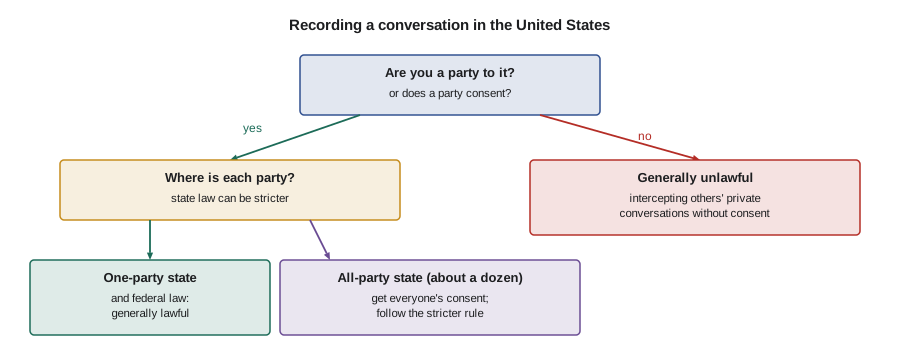
In the United States, the federal Wiretap Act allows recording when one party consents, unless the recording is made for a criminal or tortious purpose. But about a dozen states, including California, Florida, Illinois, Maryland, Massachusetts, Montana, New Hampshire, Pennsylvania and Washington, require the consent of all parties to record certain private conversations. When a call crosses state lines, producers usually follow the stricter rule.
Hidden cameras and voyeurism
Hidden cameras can expose wrongdoing, but they also carry the highest legal and ethical risk. Voyeurism laws prohibit secretly observing or recording people in places where they reasonably expect privacy, such as bathrooms, changing rooms and bedrooms, or recording intimate images, regardless of purpose. Using hidden cameras in other settings may still raise privacy, trespass, recording and broadcasting code issues.
Federal law prohibits capturing images of a person's private areas without consent in circumstances where they have a reasonable expectation of privacy on federal property, and every state has voyeurism or unlawful surveillance laws. Many states also restrict hidden cameras in homes and businesses. The federal TAKE IT DOWN Act, enforced by the Federal Trade Commission from May 2026, requires platforms to remove non-consensual intimate images, including AI-generated ones.
Before using a hidden camera or covert recording, a responsible production asks whether there is a strong public interest that cannot be served any other way, whether the method is lawful where it will be used, whether the broadcaster's standards allow it, and how identifiable bystanders will be protected. Legal review is essential.
Fact-checking and legal review
Documentary teams that make allegations about real people build a verification file as they go. It records each factual claim in the script, the source supporting it, how the source was checked and any response from the people concerned. When the lawyer reviews the fine cut, the file lets the team answer questions quickly, and if a claim arrives later, it shows the care the producers took, which matters for defenses such as responsible communication in Canada and for proving the absence of fault in the United States.
- Primary documents first: court records, inspection reports, official statistics and contemporaneous records are stronger than recollections.
- Multiple independent sources for serious allegations, with notes on each source's basis of knowledge and possible motives.
- Right of reply: a written request for comment with enough detail and time to respond, and a fair summary of the response in the film.
- Script and caption review: check narration, lower thirds, titles, thumbnails and trailers, not only interviews.
- Archive and B-roll review: confirm that people shown in illustrative footage are not wrongly linked to the story.
American networks and streaming services apply their own standards and practices, and public media outlets follow editorial standards on accuracy, fairness and transparency. These internal standards are often stricter than the law and form part of the delivery requirements.
Dramatized scenes and reconstructions
Many documentaries use reconstructions, actors or re-enactments to show events that were not filmed. These scenes carry particular risks, because viewers may take invented details as fact. Label reconstructions clearly on screen, base dialogue on documented sources wherever possible, avoid inventing conduct that would harm a real person's reputation, and keep the research that supports each scene. When a scene compresses time or combines characters, say so in the film or its notes. The same care applies to podcasts that use voice actors to read real documents or messages, where a listener may not realize the voice is not the real person's.
Common mistakes
MistakeAssuming that a disclaimer makes a docudrama safe
InsteadCheck every portrayal of real people for implied facts; disclaimers help but do not cure.
MistakeThinking defamation requires naming someone
InsteadImages, captions and editing can identify and defame a person without naming them.
MistakeRelying on a neighbor's rumor as evidence
InsteadVerify allegations with reliable sources and seek the subject's response.
MistakeRecording a phone call without checking the consent rule
InsteadCheck the law where each party is, and follow the stricter rule.
MistakeUsing hidden cameras without legal review
InsteadAssess public interest, legality and broadcaster standards before covert recording.
Summary and key terms
- Defamation protects reputation against statements, images and editing that lower it.
- Canadian law presumes falsity and damage once the plaintiff proves the basic elements.
- American law requires plaintiffs to prove falsity and fault, with actual malice for public figures.
- Defenses include truth, fair comment or opinion, privilege and responsible communication, and anti-SLAPP laws allow early dismissal.
- Filming in public is generally lawful, subject to permits, property and the rights of people filmed.
- Canada and many American states allow one-party consent to recording, but about a dozen states require all parties.
- Voyeurism laws prohibit secret recording in private settings, and hidden cameras need legal review.
- Defamation
- A statement that tends to lower a person's reputation in the eyes of reasonable people.
- Libel
- Defamation in written, recorded or broadcast form.
- Justification
- The defense that a defamatory statement is substantially true.
- Fair comment
- A defense protecting honest opinion on matters of public interest based on true facts.
- Responsible communication
- A Canadian defense for diligent reporting on matters of public interest.
- Actual malice
- In American law, knowledge of falsity or reckless disregard for the truth.
- Anti-SLAPP law
- A law allowing early dismissal of lawsuits that target expression on public issues.
- One-party consent
- A rule allowing a party to a conversation to record it without the others' consent.
- All-party consent
- A rule requiring everyone in a private conversation to consent to recording.
- Voyeurism
- Secretly observing or recording a person in circumstances where they expect privacy.
Practice problems
Work each problem on paper first, then reveal the answer to check.
Can editing alone defame someone?
Show answer
Yes, juxtaposition, captions and music can create a defamatory meaning.
In Canada, who must prove that a defamatory statement is true?
Show answer
The defendant, as a defense of justification.
What must an American public figure prove to win a defamation case?
Show answer
Actual malice, among other elements.
Name two factors courts consider in the responsible communication defense.
Show answer
For example, the seriousness of the allegation and whether the plaintiff's side was sought.
What does an anti-SLAPP law allow a defendant to do?
Show answer
Seek early dismissal of a claim arising from expression on a public issue.
Can a person who takes part in a phone call in Canada record it without telling the others?
Show answer
Generally yes, under the one-party consent rule.
What should a producer do when recording a call with someone in an all-party consent state?
Show answer
Get everyone's consent or follow the stricter rule.
Is recording police officers in public generally lawful?
Show answer
Generally yes, provided the crew does not obstruct them.
Why are hidden cameras in changing rooms always prohibited?
Show answer
Voyeurism laws prohibit secret recording where people expect privacy.
Do disclaimers protect a docudrama from defamation claims?
Show answer
Not fully; the portrayal itself must not imply false facts.
Lesson quiz · 5 questions
Score 60% or more to complete this lesson.
Create a free account to save your progress, take quizzes and earn a certificate.